


The tokenization of real-world assets (RWAs) is no longer a futuristic concept discussed only within blockchain circles. In 2026, it has become one of the fastest-growing segments of digital finance, attracting interest from asset managers, real estate firms, private credit funds, commodity traders, and financial institutions worldwide.̱̱
As investors increasingly seek access to alternative assets and businesses look for new ways to unlock liquidity, tokenization is emerging as a practical solution. By converting ownership rights into blockchain-based tokens, companies can create investment opportunities that are more accessible, transparent, and efficient than traditional models.
However, Launch RWA Tokenization Platform 2026 involves far more than creating a token and deploying a smart contract. It requires careful planning across legal, operational, compliance, and technological domains. The most successful platforms are those that combine regulatory readiness with seamless investor experiences and robust infrastructure.
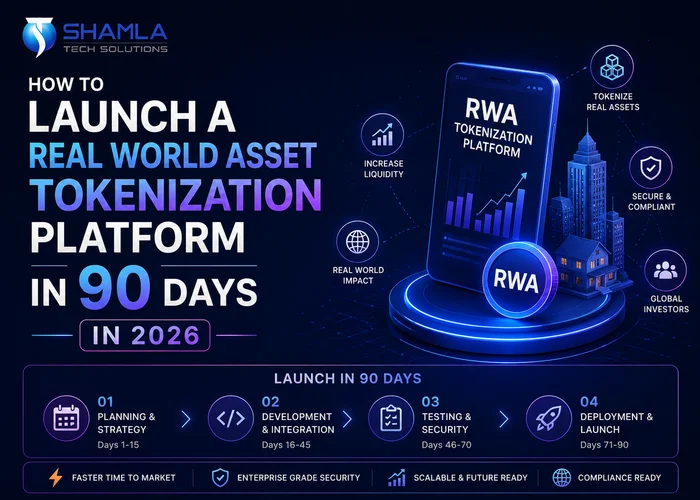
The good news is that with a clear roadmap and the right development strategy, businesses can Launch RWA Tokenization Platform 2026 within approximately 90 days. The key lies in focusing on the fundamentals first and scaling strategically.
Why RWA Tokenization Is Transforming Investment Markets
Traditional investing has long been limited by high capital requirements, illiquid assets, and lengthy transaction processes. Whether it is commercial real estate, private credit, infrastructure projects, or commodities, participation has often been restricted to institutions and high-net-worth investors.
Tokenization changes that equation.
By representing ownership interests digitally on a blockchain, assets can be divided into smaller fractions and offered to a broader investor base. Investors gain easier access to opportunities that were previously inaccessible, while asset owners benefit from increased liquidity and more efficient capital formation.
The appeal extends beyond accessibility. Launch RWA Tokenization Platform 2026 also improves transparency by providing immutable ownership records and automating administrative processes through smart contracts. Settlement times can be reduced, reporting becomes more efficient, and operational costs can decrease significantly.
This combination of accessibility, efficiency, and transparency is driving adoption across multiple industries. Real estate firms are tokenizing property portfolios, private credit funds are digitizing debt instruments, and commodity-backed assets are being offered to global investors through blockchain-powered platforms.
For businesses entering the market today, the opportunity is substantial—but success depends on execution.
The Biggest Mistake Founders Make Before Launching an RWA Platform
One of the most common mistakes in Launch RWA Tokenization Platform 2026 is assuming that blockchain technology is the starting point of a tokenization project.
It is not.
Many teams spend weeks debating blockchain networks, token standards, and smart contract architectures before they have fully defined the asset they intend to tokenize. While technology is important, investors are not purchasing blockchain infrastructure. They are investing in the underlying asset and the rights associated with it.
Before selecting a blockchain, businesses must answer several critical questions:
- What asset is being tokenized?
- What rights will token holders receive?
- How will ownership be structured?
- How will revenue distributions work?
- What compliance obligations apply?
- How can investors redeem or exit their investments?
Without clear answers to these questions, even the most sophisticated platform will struggle to gain investor confidence.
Successful tokenization projects begin with asset strategy, legal structure, and investor experience. Technology is then designed to support those objectives.
Days 1–15: Define the Asset Structure and Investor Rights
The first two weeks of any tokenization project are arguably the most important.
This is the stage where businesses establish the foundation upon which the entire platform will be built. Decisions made during this period influence compliance requirements, smart contract functionality, investor onboarding workflows, and long-term scalability.
The first step is selecting a focused asset category.
Rather than attempting to support multiple asset classes simultaneously, businesses should begin with a single category, such as:
- Commercial real estate
- Residential rental properties
- Private credit investments
- Treasury-backed products
- Commodity-backed assets
- Invoice financing portfolios
A focused approach simplifies development while allowing teams to validate operational workflows more efficiently.
Once the asset class has been selected, businesses must clearly define what the token represents. Some tokens may represent equity ownership, while others may provide debt exposure, revenue-sharing rights, or beneficial interests in an asset.
This distinction is critical because regulatory treatment varies significantly depending on the rights attached to the token.
At this stage, organizations should also establish legal documentation, ownership agreements, risk disclosures, and investor terms to ensure a strong foundation for future growth.
Days 16–30: Build the Foundation of the Platform
With the asset model defined, attention can shift toward platform architecture.
A successful RWA platform launch guide platform must balance functionality, compliance, and user experience. Investors should be able to navigate the platform easily without requiring extensive blockchain knowledge.
The investor portal typically includes:
- User registration
- Identity verification
- Asset discovery
- Investment subscriptions
- Portfolio tracking
- Transaction history
- Distribution reports
Behind the scenes, administrators need powerful management tools that allow them to oversee assets, approve investors, monitor compliance, and generate reports.
The blockchain layer should focus on core functionality rather than unnecessary complexity. Essential capabilities include:
- Token issuance
- Ownership tracking
- Transfer management
- Wallet integrations
- Compliance controls
Rather than building every advanced feature immediately, businesses should prioritize reliability, security, and scalability.
Days 31–50: Make Compliance Part of the User Experience
With the asset model defined, attention can shift toward platform architecture.
A successful RWA platform launch guide platform must balance functionality, compliance, and user experience. Investors should be able to navigate the platform easily without requiring extensive blockchain knowledge.
The investor portal typically includes:
- User registration
- Identity verification
- Asset discovery
- Investment subscriptions
- Portfolio tracking
- Transaction history
- Distribution reports
Behind the scenes, administrators need powerful management tools that allow them to oversee assets, approve investors, monitor compliance, and generate reports.
The blockchain layer should focus on core functionality rather than unnecessary complexity. Essential capabilities include:
- Token issuance
- Ownership tracking
- Transfer management
- Wallet integrations
- Compliance controls
Rather than building every advanced feature immediately, businesses should prioritize reliability, security, and scalability.
KYC Verification
AML Screening
Wallet Whitelisting
Investor Qualification Checks
Depending on the jurisdiction, businesses may need to verify accredited or sophisticated investor status before allowing participation.
When compliance is integrated thoughtfully into the user journey, onboarding becomes fast RWA deployment, more secure, and more scalable.
Days 51–70: Launch With a Controlled Investor Group
Before opening the platform to the broader market, businesses should conduct a controlled Launch RWA Tokenization Platform 2026 with a smaller group of investors.
This stage is designed to validate workflows under real-world conditions.
The focus should be on testing:
- Investor onboarding
- Subscription processes
- Token allocations
- Payment reconciliation
- Distribution mechanisms
- Reporting systems
Launch RWA Tokenization Platform 2026 with a limited investor group allows teams to identify operational inefficiencies and improve processes before scaling.
Importantly, this phase is not about testing blockchain performance. It is about validating trust, usability, and operational readiness.
A platform that functions flawlessly from a technical perspective can still fail if investors find it confusing or difficult to use.
Days 71–90: Prepare for Growth and Scale
Once the platform has successfully completed initial testing, attention should shift toward scalability.
At this stage, businesses should focus on strengthening infrastructure and reducing operational dependencies.
Security reviews and smart contract audits become essential. External audits help identify vulnerabilities while providing investors with additional confidence in the platform.
Operational automation should also be expanded to reduce manual workloads.
This includes automating:
- Investor onboarding
- Compliance monitoring
- Distribution calculations
- Performance reporting
- Payment processing
- Investor communications
Businesses should also begin tracking key performance indicators such as investor acquisition costs, average investment sizes, retention rates, and asset performance metrics.
These insights help guide future growth strategies and platform enhancements.
Why SPVs Play a Critical Role in Asset Tokenization
One of the most important structural components of many tokenization MVP projects is the Special Purpose Vehicle (SPV).
An SPV is a separate legal entity created to own a specific asset or group of assets. Rather than investors owning the asset directly, they hold interests linked to the SPV that owns the asset.
This structure offers several advantages:
- Improved legal clarity
- Risk isolation
- Simplified accounting
- Enhanced investor protection
- Greater regulatory flexibility
For example, a real estate tokenization platform may create a dedicated SPV for each property. Investors then purchase tokens representing economic interests in that SPV rather than the property itself.
The SPV model has become one of the most widely adopted frameworks in modern asset tokenization due to its flexibility and legal efficiency.
Essential Features Every RWA Tokenization Platform Needs in 2026
As the market matures, investor expectations continue to evolve. Modern platforms should include features that support both operational efficiency and regulatory compliance.
Some of the most important capabilities include:
- Investor onboarding and management
- KYC and AML integration
- Token issuance and management
- Asset lifecycle tracking
- Smart contract automation
- Compliance monitoring
- Investor reporting and analytics
- Multi-currency payment support
- Wallet management
- Administrative dashboards
- Document management systems
- Security monitoring tools
Together, these features create a robust ecosystem capable of supporting institutional-grade investment experiences.
Challenges Businesses Should Expect
Despite the opportunities, Launch RWA Tokenization Platform 2026 comes with challenges.
Regulatory requirements continue to evolve, and businesses must remain adaptable. Asset valuation methodologies must be transparent and defensible. Investor education remains essential, particularly for individuals unfamiliar with tokenized investments.
Liquidity can also be challenging, especially for traditionally illiquid assets such as private credit and real estate. Businesses should establish clear expectations regarding holding periods, redemption mechanisms, and secondary market opportunities.
Organizations that proactively address these challenges are significantly better positioned for long-term success.
Why Choose Shamla Tech for Real World Asset Tokenization Platform Development?
Shamla Tech specializes in delivering enterprise-grade tokenization solutions tailored to the evolving needs of the digital asset market. From legal-ready platform architecture and smart contract development to compliance integration and investor management systems, our team provides end-to-end support throughout the tokenization journey.
With expertise across real estate tokenization, private credit tokenization, commodity-backed assets, and institutional investment platforms, Shamla Tech helps businesses accelerate time-to-market while ensuring security, scalability, and regulatory alignment. Whether you are Launch RWA Tokenization Platform 2026 offering or expanding an existing ecosystem, our solutions are designed to support sustainable growth in the rapidly evolving world of real-world asset tokenization.
Conclusion
Real-world asset tokenization is reshaping how assets are owned, managed, and invested in. As blockchain infrastructure continues to mature and investor demand for alternative assets grows, tokenization is becoming an increasingly attractive solution for businesses seeking to modernize investment models.
Launch RWA Tokenization Platform 2026 requires much more than technology. It demands a clear asset strategy, strong legal foundations, seamless compliance workflows, and an investor-first approach.
By following a structured 90-day roadmap, businesses can move from concept to Launch RWA Tokenization Platform 2026 while building the foundation necessary for long-term growth. Those that combine regulatory readiness with scalable technology and exceptional user experiences will be best positioned to capitalize on the next phase of digital asset innovation.