
A U.S. enterprise can invest months in an AI product and still hit a wall at procurement, security review, or launch. The problem is often not the technology itself, but the lack of a clear AI compliance guide for controls around data, decisions, access, and accountability. In 2026, those gaps can delay deployment, slow deals, and create costly redesign work.
Business leaders need enterprise AI governance in place before development begins, with clear rules for data use, human oversight, agent permissions, model tracking, and audit evidence. Strong AI risk management helps companies build systems that are easier to approve, trust, and scale confidently.
This guide explains what businesses need to consider before scaling AI while managing compliance, governance, and risk effectively.
Why AI Compliance Must Start Before AI Development
- Compliance problems become expensive after development: The biggest compliance cost often appears after development. A system may work well but still fail review because it cannot explain decisions, protect sensitive data, or show what happened. That is where an AI compliance guide becomes an architecture issue early on.
- Poor controls create governance debt: Enterprises can build strong assistants, recommendation tools, decision engines, or autonomous workflows and still face expensive redesign later. Missing controls around access, human review, evidence, or provider changes create governance debt and weaken enterprise AI governance from the very start.
- Governance should influence the development brief: Before approving development, business leaders should define what the system will influence, which data it can use, who may be affected, where it will operate, and how much autonomy it receives. Those decisions should shape the AI governance framework early.
- Compliance requirements will keep moving: The United States still follows a mix of federal laws, state rules, sector requirements, contracts, and voluntary standards. Texas, California, and Colorado already show how quickly obligations can change, making AI regulatory compliance something enterprises must track continuously during development.
Build AI Governance Controls Early To Prevent Costly Rework Later
The AI Governance Framework Business Leaders Need in 2026
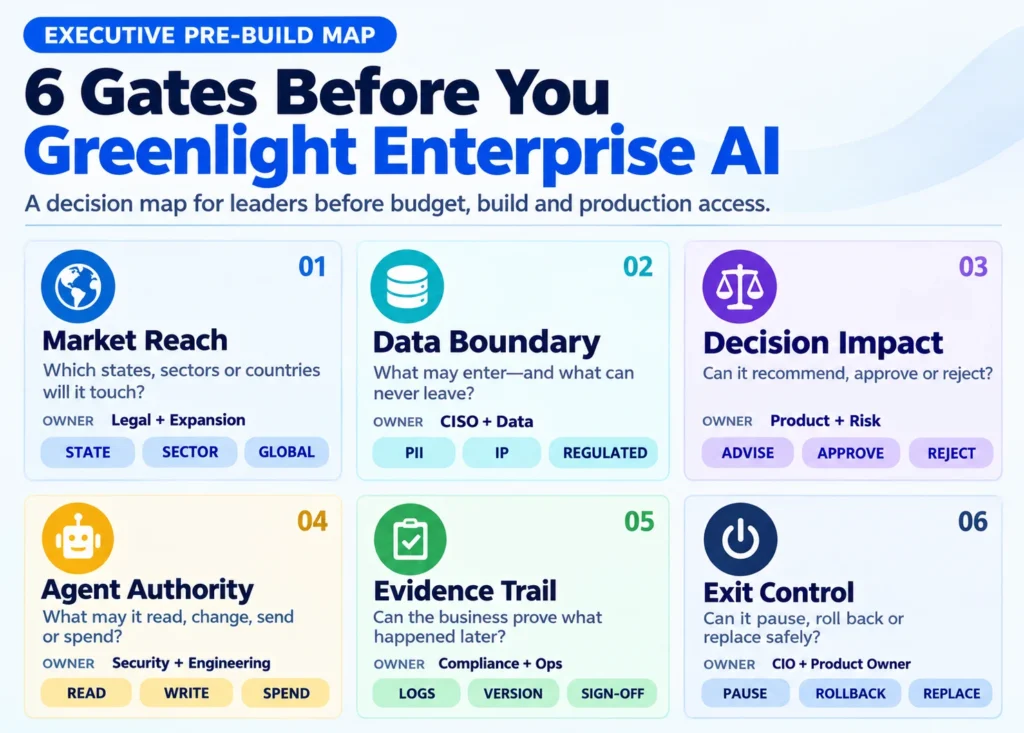
A practical AI governance framework should convert business risk into development requirements. It should answer six questions before code reaches production:
- Purpose: What business outcome should the AI improve, and what decisions may it influence?
- Ownership: Which executive, product owner, technical owner, and risk owner remain accountable?
- Data: What personal, confidential, regulated, licensed, or proprietary data can enter the system?
- Decision rights: Can AI recommend, approve, reject, transact, publish, hire, price, or communicate without human approval?
- Evidence: What logs, evaluations, approvals, model versions, prompts, outputs, and incidents must remain traceable?
- Exit: How can the company pause, replace, retrain, restrict, or retire the system safely?
This is where enterprise AI governance becomes commercially useful. Good governance reduces approval cycles because security, legal, compliance, engineering, and procurement work from the same control model instead of reopening the design at each review.
The NIST AI RMF remains a strong U.S. reference point. It is voluntary and organizes AI risk work around Govern, Map, Measure, and Manage. NIST is also revising AI RMF 1.0, so enterprises should treat governance as a living capability rather than a frozen document.
ISO 42001 compliance adds a management-system perspective. ISO/IEC 42001 specifies requirements for establishing, operating, maintaining, and continually improving an AI management system. For enterprises selling into risk-sensitive markets, that structure can help turn responsible AI from principles into repeatable ownership, controls, reviews, and evidence.
AI Compliance Guide Must Follow the Market, Not the Headquarters
A U.S. company cannot assume that U.S. incorporation defines its entire compliance perimeter.
If an AI product serves California consumers, supports employment decisions, operates in regulated industries, or reaches customers abroad, different obligations can attach to the same product.
Existing employment and consumer-protection laws can also apply when AI is involved. The same applies to AI Act compliance. The EU AI Act can cover providers outside the European Union when they place AI systems on the EU market or when AI output is used in the Union. From August 2, 2026, several transparency obligations are enforceable, including disclosures for certain interactive AI systems and AI-generated content.
The business implication for the AI Compliance Guide is simple: regulatory scope should be mapped during product discovery. Waiting until market expansion creates a compliance project often means rebuilding workflows, interfaces, logging, consent mechanisms, or human-review paths that could have been designed correctly once.
Agentic AI Governance Changes the Risk Model
Traditional AI is often recommended. AI agents can act.
An agent may open tickets, send emails, update records, call APIs, execute code, move data, approve requests, or trigger financial activity. That makes agentic AI governance and AI agent governance different from ordinary model review.
In 2026, NIST launched an AI Agent Standards Initiative and separately highlighted identity, authorization, auditing, non-repudiation, and prompt-injection controls as important areas for secure agent adoption.
For enterprise deployments, every agent should have a defined identity, least-privilege access, approved tools, transaction limits, escalation rules, complete action logs, and an emergency stop path. Higher autonomy should trigger stronger controls.
That is also an enterprise AI risk management issue. An agent with permission to act inside core systems should be governed more like a privileged digital worker than a chatbot.
Define AI Agent Permissions Clearly Before Granting Production Access
Shadow AI Makes an AI Model Inventory Essential
No company can govern AI it cannot see.
Shadow AI appears when teams use unapproved models, copilots, browser tools, APIs, embedded SaaS features, or self-built agents outside the formal governance process. The business risk is not only unauthorized software. Sensitive information may leave approved boundaries, contractual terms may be unknown, and outputs may enter customer-facing workflows without review.
A current AI model inventory should therefore include more than model names. It should record the use case, business owner, technical owner, provider, model version, data categories, integrations, affected users, autonomy level, jurisdiction, risk tier, approvals, evaluation history, monitoring status, and retirement plan.
NIST’s AI RMF Playbook specifically recommends mechanisms to inventory AI systems and describes inventories as useful for technical, business, maintenance, and incident-response needs.
This inventory becomes the operating backbone for AI risk management because leadership can finally answer a basic question: what AI is running, where, for whom, and under whose authority?
AI Compliance Guide Helps Only After the Operating Model Is Clear
AI compliance guide can centralize inventories, control mappings, approvals, assessments, policy evidence, monitoring, and audit records. It can reduce manual work when an enterprise manages many AI systems across teams.
But software cannot decide the company’s risk appetite, assign accountability, redesign weak data flows, or define acceptable agent autonomy. Buying a platform before establishing the governance model can digitize confusion rather than solve it. The better sequence is governance first, tooling second, automation third.
An AI compliance audit should then test whether the enterprise can produce evidence, not whether a policy document exists. Auditors, customers, procurement teams, and regulators may care whether controls actually operated: who approved the use case, what testing occurred, what changed, what the system accessed, how exceptions were handled, and whether incidents were corrected.
AI Compliance Checklist Before an Enterprise Approves Development
Before funding development, leadership should require:
- A defined business purpose and accountable owner;
- A jurisdiction and regulatory applicability map;
- Documented data sources, rights, retention, and sensitivity;
- Vendor and model due diligence, including training data and usage terms where relevant;
- Risk classification tied to the AI use case;
- Measurable evaluation criteria for accuracy, security, safety, bias, and reliability;
- Human review and appeal paths for high-impact decisions;
- Agent identities, permissions, spending limits, and tool restrictions where agents act;
- Immutable or appropriately protected logs for material actions and model changes;
- Monitoring, incident response, rollback, model replacement, and decommissioning plans.
The development contract should convert these controls into deliverables. Architecture diagrams, data-flow maps, evaluation reports, logging requirements, access-control specifications, model documentation, security tests, incident procedures, and handover documentation should be part of the build.
This is the difference between AI governance as policy and enterprise AI governance as an engineering discipline.
Make Compliance Decisions Early To Avoid Technical Debt
Key Takeaway
For U.S. enterprises, the biggest AI compliance mistake is treating governance as something to add after development. By then, data flows, permissions, model choices, and approval paths may already be difficult or expensive to change.
The smarter approach is to define compliance requirements before the build begins and keep them connected to business goals, market expansion, and risk. Companies should know where AI is used, what decisions it influences, who owns it, and what evidence can be produced when questions arise.
A strong AI compliance guide does not slow innovation; it gives businesses a clearer, safer path to scale across the organization.
How Shamla Tech Solutions Helps Enterprises Build Compliance-Ready AI
At Shamla Tech Solutions, we help enterprises turn AI ideas into systems that are built for real business use, not just demonstrations. Our team works with companies to define the right architecture, data controls, model strategy, agent permissions, integrations, monitoring, and governance requirements before development moves too far.
We focus on building AI solutions that can support growth, security reviews, procurement, and changing compliance expectations without creating unnecessary rework later.
From custom AI platforms to agentic AI development and enterprise integrations, we help businesses move from opportunity to production with stronger control, clearer accountability, and a roadmap for responsible scale confidently.