

Smart contracts are changing how real estate transactions are executed by automating payments, ownership transfers, and compliance workflows. As tokenized real estate grows, they are becoming a key part of modern property transaction infrastructure.
The shift is already taking shape. In 2026, the global tokenized real estate market is valued at $5.2 billion and projected to grow at a 30% CAGR through 2034, strengthening the case for blockchain-based transaction infrastructure.
Smart contracts sit at the center of this infrastructure. They can automate payments, ownership transfers, compliance checks, and tokenized transactions based on predefined conditions. This article explores how smart contracts in real estate work and where they create value.
What Are Smart Contracts in Real Estate?
Smart contracts in real estate are blockchain-based programs that automatically execute predefined actions when agreed conditions are met. They help automate payments, escrow releases, ownership transfers, compliance checks, and transactions involved in real estate tokenization platform development.
In simple terms, they turn parts of a property agreement into executable code, reducing the need for manual processing.
These contracts can contain rules governing payments, escrow releases, ownership transfers, compliance checks, and tokenized property transactions. Once triggered by verified data or user actions, the blockchain executes the programmed instructions and records the transaction, creating a transparent, auditable history.
How Do Smart Contracts Work in Real Estate?
1. Property Terms Are Set:
2. Property Agreement Is Programmed:
Relevant transaction conditions are encoded into the real estate smart contract and deployed on the blockchain.
3. Buyer and Property Are Verified:
Identity, payment availability, property records, and required compliance checks are verified before the transaction proceeds.
4. Payment Is Secured:
The buyer’s funds or digital assets can be placed in a smart contract-based escrow until the agreed property conditions are satisfied.
5. Transfer Conditions Are Confirmed:
The contract verifies that payment, documentation, approvals, and other predefined closing requirements have been completed.
6. Property Transaction Is Settled:
The web3 smart contract releases payment and executes the programmed ownership or property-token transfer, while recording the transaction on the blockchain.
See what smart contracts can automate in your real estate business
How Are Smart Contracts Used in Real Estate?
Smart contracts are used across the real estate lifecycle to automate property transactions, escrow, leasing, ownership transfers, compliance, and tokenized investments. By executing predefined rules on a blockchain, they reduce manual coordination and improve transaction efficiency.
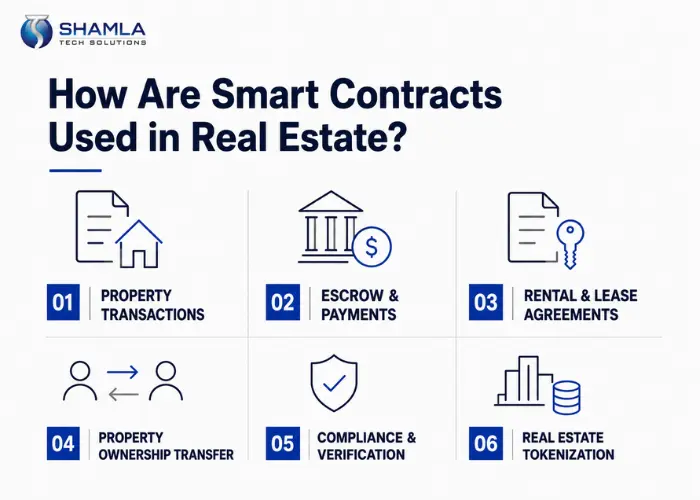
How Are Smart Contracts Used in Property Transactions?
Smart contracts automate property transactions by executing predefined actions after agreed conditions, such as document approvals, payment verification, and compliance checks, have been satisfied. This helps reduce manual coordination and creates a more efficient transaction process.
Buying or selling property rarely happens in one step. A real estate deal moves through due diligence, financing, document reviews, approvals, and closing, with each stage depending on another party. Smart contract property transactions can turn this sequence into a rules-based process by programming these conditions upfront. When a condition is verified, the contract automatically triggers the next action.
Example: Consider a commercial property sale awaiting document approval and buyer payment. Once both conditions are verified, the smart contract can authorize the agreed settlement action automatically, rather than requiring another round of confirmations between the buyer, seller, and transaction intermediaries.
How Do Smart Contracts Manage Escrow and Payments?
Smart contracts manage escrow and payments by holding funds under predefined conditions and automatically releasing them once agreed transaction requirements are met. This reduces manual coordination, increases transparency, and gives both buyers and sellers greater confidence throughout the property transaction.
In a property deal, neither side wants to move first. Traditional escrow addresses this challenge by holding funds until closing conditions are satisfied. Smart contracts make escrow programmable by defining how and when payments are released, including sale proceeds, brokerage fees, taxes, and other agreed distributions.
Example: A $500,000 property sale may require $470,000 to reach the seller, $15,000 to cover brokerage fees, and $15,000 for other agreed charges. Once settlement is authorized, the smart contract can distribute each amount to its designated recipient automatically.
How Do Smart Contracts Support Rental and Lease Agreements?
Smart contracts support rental and lease agreements by automating recurring obligations such as rent collection, security deposits, late fees, renewals, and lease termination. This reduces manual administration while creating a transparent record of payments and agreed lease conditions.
A lease may be signed once, but it creates obligations every month. Smart contracts make the lease responsive throughout the tenancy by recording rent payments, calculating agreed late fees, managing security deposits, and automatically executing predefined renewal or termination rules when conditions are met.
Example: A tenant pays $2,000 in rent each month and has a $4,000 security deposit. The smart contract records each payment and holds the deposit under agreed rules. At lease-end, the deposit can be returned once predefined property and payment conditions are confirmed.
How Do Smart Contracts Transfer Property Ownership?
Smart contracts transfer property ownership by automatically enforcing predefined ownership rules and updating tokenized ownership records after all transaction conditions have been verified. This improves accuracy, reduces manual coordination, and creates a transparent on-chain record of every approved transfer.
In large real estate deals, ownership may be divided across investment firms, funds, and other stakeholders rather than held by a single buyer. Smart contracts encode these ownership rules into tokenized property interests, controlling investor eligibility, transfer permissions, and ownership allocations throughout the investment lifecycle.
Example: A New York investment firm acquires a tokenized interest in a $200 million mixed-use development in Texas. Once due diligence, investor eligibility, documentation, and payment are verified, the smart contract executes the token transfer and records the ownership interest on-chain, simplifying coordination.
How Do Smart Contracts Improve Compliance and Verification?
Smart contracts improve compliance and verification by checking predefined eligibility requirements before allowing a real estate transaction to proceed. They can automate identity verification, accreditation checks, sanctions screening, and other compliance rules, reducing manual reviews and operational risk.
Real estate sponsors often need to verify investor identities, accreditation status, sanctions screening, and supporting documentation before accepting capital. Smart contracts make verification a prerequisite to participation by linking compliance results to an investor’s wallet and checking eligibility at the point of transaction.
Example: A U.S. real estate company sells tokenized interests under Regulation D Rule 506(c), which allows only verified accredited investors to buy. An investor completes the required checks, gets approved, and can purchase the tokens. The smart contract automatically blocks anyone who has not been verified.
How Do Smart Contracts Enable Real Estate Tokenization?
Smart contracts enable real estate tokenization by issuing digital property tokens, recording investor ownership, distributing returns, and managing approved transfers. This allows property owners to raise capital from a larger pool of eligible investors while reducing administrative complexity.
Traditional real estate investments often require large capital commitments, limiting participation to a small number of investors. Smart contracts simplify tokenized investments by automating token issuance, ownership tracking, distributions, and approved token sales, making larger investor bases easier to manage.
Example: A Miami real estate developer needs $40 million for a new hotel project. Instead of looking only for a few investors willing to commit millions, the developer offers tokenized investments starting at $10,000. Smart contracts manage each investment, while approved resales give investors a potential way to exit later.
Have a real estate process you want to automate with smart contracts?
Benefits of Smart Contracts in Real Estate
Faster Transaction Execution
A property deal can stall while one party waits for another to confirm payment, approve documents, or update records. Smart contracts can connect these steps through predefined triggers. Once verified data confirms that a requirement has been met, the next programmed action can execute, reducing the time between completed tasks and the next stage of the transaction.
Lower Administrative Costs
A real estate fund distributing income to 1,000 investors creates far more work than paying ten. Smart contracts can calculate each investor’s share based on token holdings and automate distributions using predefined rules. The same logic can support recurring payment cycles, reducing the reconciliation, calculation, and transaction processing required as the number of investors grows.
Transparent and Auditable Records
When hundreds of investors hold interests in the same property, knowing who owns what becomes critical. Smart contract transactions create timestamped blockchain records of token allocations, transfers, and distributions. Authorized participants can trace these on-chain events through a shared history, making ownership tracking and transaction reconciliation easier across complex real estate investment structures.
Scalable Investor Management
A developer may raise capital from 50 investors today and 2,000 tomorrow. Smart contracts can apply the same programmed rules across approved wallets, covering token allocation, ownership balances, distributions, and transfer restrictions. This allows real estate platforms to support a growing investor base without requiring administrative operations to expand at the same pace.
Greater Potential for Liquidity
An investor may want to exit years before the underlying property is sold. Tokenized interests can potentially be transferred to another eligible buyer, subject to applicable restrictions. Smart contracts can enforce transfer rules and update token ownership when approved transactions occur, providing the technical infrastructure needed for compliant secondary trading where suitable markets and buyer demand exist.
Smart Contracts vs Traditional Real Estate Contracts
Traditional contracts and smart contracts can support the same real estate deal, but the experience can be very different. The biggest differences show up in everyday work, from releasing payments and tracking ownership to managing investors, processing transfers, and keeping transaction records accurate, secure, and easy to verify.
Real Estate Factor | Traditional Contracts ❌ | Smart Contracts ✅ |
Property Closing | Someone checks the conditions, approves the payment, and tells the next party to proceed. | Payment can be released automatically once the agreed conditions are verified. |
Escrow Management | A third party holds the buyer’s money and releases it after receiving the required approvals. | Funds can stay locked under coded rules and move only when those rules are met. |
Investor Distributions | The fund must calculate what each investor receives and process hundreds of payments. | The contract can calculate each investor’s share and distribute payments based on their holdings. |
Ownership Records | Teams may check spreadsheets, legal documents, and databases to confirm current ownership. | Token holdings provide a traceable on-chain record of each investor’s position. |
Investment Transfers | The seller may need paperwork, buyer checks, approval, and an ownership-record update. | Approved token transfers can complete under predefined rules and update the on-chain record. |
Investor Management | Going from 100 to 1,000 investors means more records, payments, and transactions to manage. | The same programmed rules can work across a much larger number of approved investors. |
Transaction Audit Trail | Parties may need to compare their records to confirm when a payment or transfer occurred. | Blockchain records show when the transaction happened and what the smart contract executed. |
Technologies Behind Smart Contracts in Real Estate
A production-ready real estate smart contract platform combines multiple technologies beyond blockchain. These include blockchain networks, token standards, identity and compliance systems, smart contract architecture, oracles, APIs, and security infrastructure that work together to support real estate transactions and tokenization.
Blockchain Network: Where the Transaction Runs
The blockchain provides the base layer where smart contracts operate and transactions are recorded. Ethereum and EVM-compatible networks such as Polygon are common options. Choosing between them involves more than transaction fees, with finality, network security, RPC infrastructure, wallet support, developer tooling, and integration requirements all affecting the platform architecture.
Token Standards: How Property Interests Are Represented
The next decision is what the token actually represents. ERC-20 can support equal, fungible interests, ERC-721 can represent unique assets, and ERC-1155 can manage multiple token types. For permissioned real estate investments, standards such as ERC-3643 adds identity checks and transfer restrictions directly to the token framework.
Identity and Compliance: Who Can Participate
A property offering cannot simply accept every connected wallet. KYC, AML, sanctions screening, accreditation, and other eligibility checks may happen off-chain, with approved status linked to the investor’s wallet. Smart contracts can reference that status before issuing or transferring tokens, keeping participation aligned with the rules of the offering.
Smart Contract Architecture: How the Investment Operates
This is where the real estate model becomes code. Solidity contracts can manage token issuance, investor allocations, transfers, distributions, and administrative permissions. Production systems may separate these functions across contracts or modules, using role-based access, multisig controls, upgrade mechanisms, and OpenZeppelin components instead of placing the entire platform logic in one contract.
Oracles and APIs: How Real-World Data Reaches the Blockchain
A smart contract cannot see what happens to a building by itself. Property valuations, lease information, payment confirmations, and other off-chain events may need to enter the workflow through oracles or authenticated APIs. The architecture must determine which sources are trusted, what data reaches the blockchain, and how failures are handled.
Security and Infrastructure: How the Platform Stays Reliable
The final layer ties everything together. Smart contract audits, automated testing, multisig administration, access controls, wallet security, blockchain monitoring, backend APIs, and indexing infrastructure all play different roles. For a platform handling high-value property interests, these controls need to be designed into the architecture before real assets and investor capital move through it.
Need the right tech stack for your real estate platform?
How Do Smart Contracts Power Real Estate Tokenization?
Smart contracts power real estate tokenization by managing token issuance, investor eligibility, ownership records, distributions, governance, and administrative controls. They provide the operational logic that allows tokenized real estate investments to function throughout their lifecycle.
A $100 million property can be divided into digital investment interests, creating new opportunities to raise capital and broaden investor participation. However, issuing tokens is only the beginning. Smart contracts provide the operating logic that governs how tokens are created, who can hold them, how ownership changes, how returns are distributed, and how transactions are managed throughout the investment lifecycle.
Token Supply Must Match the Investment Structure
A tokenized offering cannot create ownership interests without limits. Smart contracts can set the total token supply, control minting and burning permissions, and define allocation rules. If a $50 million offering is represented by 50,000 tokens, the contract ensures new tokens cannot simply appear outside the authorized issuance process.
Investor Restrictions Must Follow Every Token
A major technical challenge appears after issuance: preventing restricted property tokens from moving freely between wallets. Smart contracts can check wallet permissions before every transfer. Standards such as ERC-3643 can support identity-based controls, allowing transfers only when both the sender and receiver satisfy the rules defined for the tokenized offering.
Ownership Must Stay Accurate After Every Transfer
With hundreds or thousands of investors, ownership can change continuously. Smart contracts update token balances whenever an approved transfer occurs, creating an on-chain ownership trail. The platform can then use blockchain events and indexing infrastructure to keep investor dashboards and ownership records synchronized with what actually happened on-chain.
Distributions Must Follow the Correct Ownership Snapshot
Property income creates a harder problem: who should receive a distribution if tokens changed hands during the payment period? Smart contracts can use balance snapshots or defined record dates to establish eligible holders, calculate entitlements, and support distributions without relying only on the token balance visible at the moment payment is made.
Administrative Control Must Be Powerful but Restricted
Real estate platforms still need administrators to pause transactions, update approved participants, manage issuance, or respond to exceptional situations. Giving one wallet unlimited control creates risk. Smart-contract architecture can separate permissions by role and use multisig approvals, access controls, timelocks, and emergency pause functions for sensitive operations.
Smart Contracts Must Evolve Without Breaking Ownership
A tokenized property may operate for years, while regulations, business rules, integrations, or platform requirements can change. Upgradeable contract patterns can allow selected logic to evolve while preserving token balances and state. This requires careful governance because poorly designed upgrades can introduce security risks or change how investor assets behave.
Planning to tokenize a property or real estate portfolio?
Legal and Compliance Requirements for Real Estate Smart Contracts
Smart contract property transactions can automate payments, transfers, and investor rules, but the code must still reflect the laws governing the investment. The practical challenge is connecting what happens on-chain with legally recognized property rights, approved investors, and permitted transactions in each market.
United States: SEC and Securities Requirements
In the U.S., a token representing an investment in a property may fall under federal securities laws. Sponsors can structure qualifying offerings under exemptions such as Regulation D, including Rule 506(c) for verified accredited investors. Smart contracts can support this structure by limiting token purchases and transfers to approved wallets while the legal entity and offering documents define investor rights.
UAE: VARA and Real Estate Tokenization Rules
Dubai now provides a practical route for property tokenization, with the Dubai Land Department and VARA developing the regulatory model through the real estate tokenization project. Businesses still need to determine which approvals apply to issuance, distribution, or secondary trading. Smart contracts can then embed investor permissions and transfer controls so token activity follows the approved structure.
United Kingdom: FCA Rules for Property Tokens
In the UK, the first question is what rights the property token gives its holder. If those rights make it a specified investment, activities around issuance, promotion, custody, or trading can enter the FCA regulatory perimeter. Real estate developers can address this early by defining the token legally first, then programming investor access and transfer rules around that classification.
Singapore: MAS Rules for Tokenized Real Estate
In Singapore, tokenized property interests can fall under the Securities and Futures Act when they meet the definition of capital markets products, such as securities or units in a collective investment scheme. The workable route is to classify the token before development, identify applicable MAS licensing or prospectus requirements, and build investor eligibility and transfer restrictions into the platform.
Switzerland: FINMA and DLT Securities Rules
Switzerland provides a particularly clear legal foundation through its DLT framework, which recognizes ledger-based securities under defined conditions. A real estate investment can therefore be structured so legally recognized rights are represented through a qualifying ledger. The key is aligning the token, smart contract, ledger design, and any regulated trading activity with the applicable DLT Act and FINMA requirements.
Future of Smart Contracts in Real Estate
Smart contracts are expected to play a larger role in real estate as tokenization, digital identity, and blockchain infrastructure mature. Future platforms could automate property operations, investor management, compliance, and transactions throughout the entire asset lifecycle.
Properties Will Get Their Own Digital Operating Layer
A building will increasingly have a digital identity connecting ownership, financing, leases, maintenance, insurance, and investor records. Smart contracts could sit within this layer and execute approved actions as property data changes. Instead of tokenizing a property once, the long-term opportunity is making the asset digitally manageable throughout its lifecycle.
Real Estate Funds Could Become Continuously Investable
Property funds are built around subscription windows, reporting periods, and scheduled distributions. Tokenization could make parts of this model more continuous. Verified investors could enter through approved digital channels, ownership records could update on-chain, and smart contracts could calculate distributions and process permitted transfers without rebuilding the administrative process for every investor.
Property Liquidity Could Become a Design Decision
Liquidity may stop being something considered only when a property is sold. Developers could design permitted secondary transfers into the investment structure from day one. Smart contracts would enforce who can buy and sell, while regulated marketplaces provide execution, potentially turning exit options into part of how a real estate offering is structured.
Smart Contracts Could Negotiate With Smart Buildings
Connected buildings already generate data on occupancy, energy use, access, and equipment performance. As trusted data infrastructure improves, smart contracts could respond directly to selected building events. A verified occupancy change, for instance, could trigger lease-related calculations, operating payments, or investor reporting without waiting for separate systems to reconcile the event.
Real Estate Tokenization Platforms Replace the Property Spreadsheet
The biggest change may be less glamorous than tokenization itself. Property managers still reconcile investors, distributions, documents, payments, and ownership across multiple systems. Smart contracts, APIs, identity infrastructure, and on-chain records could converge into one operating platform where the property’s financial and ownership activity is continuously synchronized.
Why Choose Shamla Tech Solutions for Real Estate Tokenization?
Every real estate business approaches tokenization with a different asset, investor model, market, and capital strategy. Shamla Tech Solutions builds custom real estate tokenization platforms around those differences, helping property businesses turn their investment models into practical digital platforms rather than adapting to a one-size-fits-all product.
We have worked with real estate businesses on tokenization projects spanning smart contracts, investor onboarding, compliance, payments, token management, and secondary-market features. That experience helps us understand what works beyond the blockchain itself and build platforms around how businesses plan to raise capital, manage investors, and grow their property portfolios.
Conclusion: Building the Future of Real Estate with Smart Contracts
For developers and property owners, the opportunity is bigger than automating a few transactions. Smart contracts in real estate can support new ways to raise capital, bring more eligible investors into high-value properties, and manage those investments without adding layers of operational work as they grow.
The real advantage comes when security and scale are built in from the start. With the right smart contract architecture, businesses can control how property interests move, protect investor transactions, automate returns, and build real estate investment models that are easier to operate and ready to grow.
Tell us what you want to tokenize. We’ll take it from there.
FAQs
How are smart contracts used when buying or selling property?
Smart contracts can automate parts of a property transaction, such as checking agreed conditions, managing payments, and releasing funds. They can also record on-chain transactions and manage tokenized property interests. However, the legal transfer of property ownership must still follow the land and property laws of the relevant jurisdiction.
How can smart contracts help raise capital for a real estate project?
Real estate developers can tokenize a real estate investment and offer smaller digital interests to eligible investors. Smart contracts manage token allocation, investor rules, distributions, and permitted transfers. This can open the investment to a broader pool of eligible investors while making a larger investor base easier for the business to manage.
Can investors sell tokenized real estate before the property is sold?
Yes, if the investment structure and local regulations allow secondary transfers. Investors can sell their property tokens to other eligible investors without waiting for the underlying property to be sold. Smart contracts can verify the buyer, enforce transfer rules, process the transaction, and update the on-chain ownership record.
Do I need a smart contract developer for real estate tokenization?
Yes, a production-ready real estate tokenization platform requires more than simply creating tokens. Developers need to connect smart contracts with investor verification, wallets, payments, compliance controls, security, and blockchain infrastructure. The smart contracts must also reflect how the property investment, investor rights, distributions, and transfers are structured.
What happens if there is an error in a real estate smart contract?
An error can affect payments, token transfers, investor access, or other programmed actions. Businesses can reduce this risk through smart contract testing, independent audits, multisig approvals, controlled upgrades, monitoring, and emergency pause functions. These safeguards should be built into the platform before real property interests or investor funds are handled.