

✨ AI Summary
- A real estate tokenization solution makes property investment more accessible, liquid, and efficient by converting ownership rights into blockchain-based digital assets — enabling fractional ownership, automated transactions, and transparent recordkeeping within a compliant RWA tokenization ecosystem.
- The global real estate market exceeds $380 trillion in value, while tokenized real estate is projected to grow from under $300 billion in 2024 to nearly $4 trillion by 2035, driving financial institutions, developers, and investment platforms toward blockchain-based property ownership.
- This blog explores 10 practical real estate tokenization use cases: fractional ownership of residential properties, commercial real estate tokenization, real estate STOs, tokenized REITs and funds, smart contracts for automated rent distribution, cross-border investment, secondary market liquidity, asset-backed tokens and property-backed stablecoins, hospitality and co-living tokenization, and retail investor access.
- Key benefits of a property tokenization platform include expanded fundraising reach, efficient management of thousands of investors, compliant secondary trading, lower administrative costs through smart contract automation, and faster launches using a reusable framework across asset types.
- The post also covers regulatory essentials — token structure, KYC/AML verification, investor restrictions, ownership records, and adapting to evolving rules — and explains how choosing the right real estate tokenization solution and development partner helps businesses launch securely and scale with confidence.
Real estate is becoming more accessible, liquid, and efficient through blockchain technology. Businesses are adopting tokenized ownership models to digitize property assets, simplify investment processes, and offer new funding opportunities. A real estate tokenization solution enables these capabilities within a secure, compliant RWA tokenization ecosystem.
The global real estate market exceeds $380 trillion in value, while tokenized real-world assets are projected to reach trillions of dollars by 2030. This shift is driving financial institutions, developers, and investment platforms to explore blockchain-based property ownership and capital formation.
From fractional ownership and cross-border investing to automated compliance and faster settlements, tokenization is reshaping property investment. Below are 10 practical real estate tokenization use cases that demonstrate how blockchain is transforming the way real estate assets are financed, managed, and traded.
Ready to Build Your Real Estate Tokenization Platform?
What Is Real Estate Tokenization and Why Businesses Are Adopting It?
Traditional real estate transactions are often constrained by high capital requirements, limited liquidity, and lengthy settlement processes. These challenges make property investment less accessible and reduce market efficiency for developers, asset managers, and investors.
Real estate tokenization addresses these limitations by converting ownership rights into blockchain-based digital assets. Tokenized real estate enables fractional ownership, automated transactions, and transparent recordkeeping, creating a more flexible and efficient investment ecosystem.
How Blockchain in Real Estate Is Reshaping Property Investment
Here's What's Changing in Tokenized Real Estate Market:
- Tokenization removes many of the barriers that have traditionally limited real estate investing. By dividing a property into digital ownership units, businesses can attract a wider range of investors without requiring them to purchase the entire asset.
- Blockchain helps improve liquidity by making property-backed ownership interests easier to transfer on regulated marketplaces. This gives investors greater flexibility while helping asset owners unlock capital more efficiently.
- Smart contracts automate repetitive processes such as ownership transfers, investor distributions, and compliance checks. This reduces administrative work, lowers operating costs, and speeds up transaction processing.
- Every transaction is recorded on an immutable blockchain ledger, creating a transparent ownership history that simplifies audits, strengthens investor confidence, and improves regulatory reporting.
- The market is expanding rapidly, with tokenized real estate projected to grow from less than $300 billion in 2024 to nearly $4 trillion by 2035, reflecting increasing demand for blockchain-powered property investment.
10 Real Estate Tokenization Use Cases Transforming Property Investment
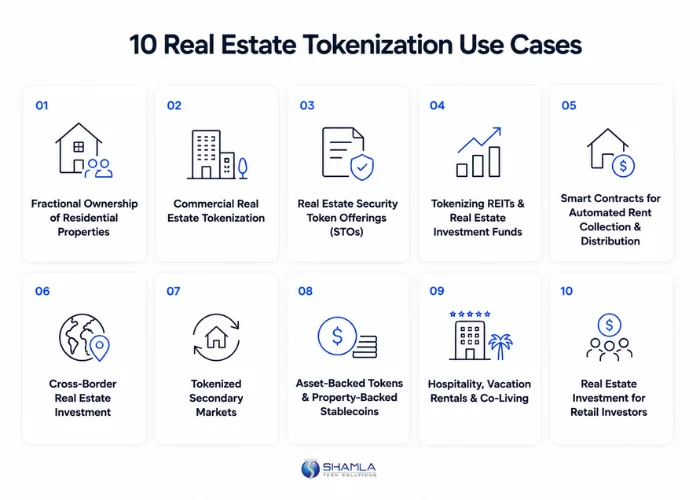
1. Fractional Ownership of Residential Properties
Owning residential real estate has traditionally required significant capital, making it difficult for many investors to participate. While demand for rental homes, apartments, and multifamily properties continues to grow, the high cost of entry has limited access to this asset class. A real estate tokenization solution changes that by making fractional real estate ownership possible through blockchain.
Instead of selling an entire property to a single buyer, owners can divide the asset into digital tokens that represent fractional ownership. Investors purchase only the portion they want, allowing them to build diversified real estate portfolios without committing large amounts of capital to a single property. Smart contracts also simplify ownership management by automating transactions, maintaining transparent records, and distributing rental income based on each investor’s ownership stake.
For property developers, fractional real estate ownership creates a more flexible way to raise capital while retaining control of the underlying asset. For investors, it lowers the financial barrier to entering the residential real estate market and opens access to opportunities that were once reserved for institutional buyers. As tokenization adoption grows, this model is becoming one of the strongest real-world applications of blockchain in property investment.
2. Commercial Real Estate Tokenization for Institutional Investors
Commercial office towers, shopping malls, industrial parks, and hotels represent billions of dollars in illiquid assets. For developers and asset managers, raising capital against these properties often means lengthy negotiations, limited investor pools, and complex ownership structures. Those challenges are exactly why commercial real estate tokenization is becoming a practical business strategy.
A real estate tokenization solution allows businesses to convert ownership interests in commercial properties into compliant digital securities. Instead of creating a new investment model for every project, developers can launch tokenized offerings, onboard qualified investors digitally, automate ownership records, and manage distributions from a single platform. This creates a more scalable fundraising process while reducing administrative work across the investment lifecycle.
For companies building tokenization platforms, commercial real estate represents one of the largest opportunities in the market because every new office development, logistics hub, retail center, or mixed-use project can become a digital investment product with built-in compliance and lifecycle management.
3. Real Estate STOs (Security Token Offerings) for Capital Raising
Access to capital can determine whether a real estate project moves forward or stalls before construction begins. Traditional fundraising often involves multiple intermediaries, lengthy approval cycles, and a limited pool of investors. Real estate STOs provide developers, property owners, and investment firms with a more efficient way to structure and raise capital while maintaining compliance with securities regulations. A real estate tokenization solution supports this process by digitizing ownership interests into blockchain-based security tokens.
Unlike utility tokens, security tokens represent regulated ownership or investment rights tied to a real-world asset. Developers can launch compliant offerings for residential projects, commercial developments, or real estate funds while managing investor onboarding, KYC/AML verification, ownership records, and distributions from a single platform. This creates a more streamlined fundraising process and reduces the operational burden associated with managing multiple investors across different funding rounds.
As demand for digital securities continues to grow, real estate STOs are becoming a practical capital formation strategy rather than an experimental blockchain concept. For businesses building tokenization platforms, they create a scalable framework for compliant fundraising, investor management, and long-term asset administration across multiple real estate projects.
4. Tokenizing REITs and Real Estate Investment Funds
Real estate investment trusts (REITs) and property funds have made real estate investing more accessible, but managing ownership, investor onboarding, compliance, and distributions can still be time-consuming. A real estate tokenization solution modernizes these operations by converting fund ownership into blockchain-based digital securities without changing the underlying investment strategy.
Instead of relying on paper-based records and fragmented systems, fund managers can issue digital ownership tokens that represent shares in a REIT or real estate investment fund. Tokenization streamlines investor onboarding, automates dividend distributions through smart contracts, maintains transparent ownership records, and simplifies compliance throughout the investment lifecycle. This creates a more efficient experience for both fund managers and investors while reducing administrative overhead.
As demand for digital investment products continues to grow, tokenized REITs and property funds offer businesses a practical way to improve operational efficiency and expand their investor reach. For companies developing tokenization platforms, this use case demonstrates how blockchain can strengthen fund management while supporting compliant capital formation and long-term portfolio growth.
5. Smart Contracts for Automated Rent Collection & Distribution
Collecting rent sounds straightforward until a property has multiple owners, hundreds of investors, or recurring income distributions. Managing payments manually across different stakeholders can increase administrative costs, create delays, and make financial reporting more complex. Smart contracts in real estate help eliminate these inefficiencies by automating recurring payment workflows through blockchain technology.
Once the conditions of a lease or investment agreement are met, smart contracts can automatically collect rent, calculate each investor’s share based on ownership, distribute funds, and record every transaction on an immutable blockchain ledger. This reduces manual intervention, minimizes payment errors, and provides a transparent audit trail for property owners, investors, and regulators. The same automation can also support late payment rules, revenue-sharing agreements, and scheduled distributions without requiring additional administrative effort.
The real advantage becomes clear as a portfolio grows. Managing monthly rent distributions across a handful of investors is manageable, but doing the same for hundreds of token holders quickly becomes operationally challenging. By automating these processes, businesses can scale their rental operations more efficiently while delivering accurate, transparent, and timely income distributions that strengthen investor confidence.
6. Enabling Cross-Border Real Estate Investment
Cross-border real estate investment has traditionally involved more than just purchasing a property. Foreign investors often face regulatory requirements, lengthy documentation, currency conversion challenges, and complex ownership verification before completing a transaction. These barriers can slow capital inflows and limit investment opportunities for property developers seeking international funding.
Blockchain-based tokenization simplifies many of these challenges by representing ownership as compliant digital securities that can be offered to eligible investors across different jurisdictions. Digital investor onboarding, automated KYC/AML verification, transparent ownership records, and smart contract-driven transactions reduce administrative complexity while creating a more efficient investment process. Developers also gain access to a broader pool of qualified investors without relying solely on local funding networks.
For real estate businesses looking to expand beyond domestic markets, tokenization creates new opportunities to attract international capital while maintaining regulatory compliance. Instead of navigating fragmented investment processes for every project, companies can build a scalable framework that supports global fundraising, transparent ownership management, and long-term investor relationships across multiple markets.
7. Boosting Liquidity Through Tokenized Secondary Markets
One of the biggest challenges in real estate investing is liquidity. Selling a property or exiting an investment often takes weeks or even months, making it difficult for investors to access capital when market conditions change. This lack of flexibility can also make fundraising more challenging for developers looking to attract investors who value shorter investment horizons.
Real estate security tokens help address this challenge by enabling ownership interests to be traded on compliant secondary marketplaces after the initial offering, subject to applicable regulations. Instead of waiting for an entire property to be sold, eligible investors can transfer or sell their tokenized ownership interests more efficiently. This creates a more dynamic investment ecosystem while maintaining transparent ownership records and regulatory oversight throughout the transaction process.
Improved liquidity benefits more than just investors. Property developers and asset managers can offer investment opportunities that are inherently more attractive because they provide greater flexibility after the initial investment. By supporting secondary trading, tokenization transforms traditionally illiquid real estate assets into digital investment products that better align with the expectations of today’s global investment market.
8. Asset-Backed Tokens and Property-Backed Stablecoins
Real estate assets can do more than represent ownership. They can also serve as the foundation for blockchain-based financial products that unlock new ways to raise capital, facilitate payments, and expand investment opportunities. By linking digital tokens to tangible property assets, businesses can create investment products backed by real-world value rather than market speculation.
Asset-backed tokens represent ownership or economic rights tied to a specific property or portfolio, while property-backed stablecoins are designed to maintain a stable value using real estate as part of their underlying collateral structure. These digital assets can support fundraising, settlements, lending, and other financial activities within a tokenized real estate ecosystem. Blockchain also provides transparent ownership records and programmable smart contracts that improve trust and operational efficiency.
For developers and real estate businesses, these models open the door to products that extend beyond traditional property sales. Instead of offering only tokenized ownership, organizations can build diversified digital asset ecosystems that support investment, financing, and payments, creating additional value from existing real estate holdings while expanding the utility of tokenized assets.
9. Tokenizing Hospitality, Vacation Rentals & Co-Living Spaces
Hotels, vacation rentals, serviced apartments, and co-living spaces often require continuous investment to expand, renovate, and improve guest experiences. Traditional financing can limit growth, especially for operators managing multiple properties or planning new developments. Tokenization offers a more flexible way to raise capital while opening these income-generating assets to a wider network of qualified investors.
Instead of funding projects through a small group of investors or conventional lending, hospitality businesses can tokenize ownership interests in individual properties or entire portfolios. Investors gain exposure to revenue-generating real estate assets, while operators can streamline investor onboarding, maintain transparent ownership records, and automate income distributions through blockchain technology. This creates a more efficient investment structure without disrupting day-to-day property operations.
As demand for alternative accommodation continues to grow, tokenization gives hospitality businesses a scalable way to finance expansion and manage investor relationships. Whether developing a boutique hotel, launching a vacation rental portfolio, or expanding a co-living brand, businesses can use blockchain to unlock capital while creating a more transparent and efficient ownership model.
10. Opening Real Estate Investment Tokenization to Retail Investors
For many individuals, real estate remains one of the most desirable investment options, yet high property prices continue to keep it out of reach. Purchasing an apartment, commercial unit, or rental property often requires significant upfront capital, limiting participation to institutional investors and high-net-worth individuals. Real estate investment tokenization removes this barrier by allowing businesses to divide property ownership into smaller, investable digital units.
Instead of requiring investors to purchase an entire property, developers and asset owners can offer fractional ownership through compliant digital securities. Investors can participate with smaller investment amounts, while businesses gain access to a much larger pool of potential participants. Blockchain also simplifies investor onboarding, ownership tracking, compliance, and income distributions, making it easier to manage thousands of investors on a single platform.
Expanding access to retail investors isn’t just about lowering investment thresholds. It enables property developers to diversify their funding sources, accelerate capital formation, and build stronger investor communities around their projects. As tokenized real estate continues to mature, retail participation is expected to play a significant role in shaping the next generation of property investment.
Bring Your Tokenization Platform Idea to Market
Key Benefits of a Property Tokenization Platform
Expand Your Fundraising Opportunities
Manage Thousands of Investors Efficiently
Improve Liquidity for Real Estate Assets
Reduce Administrative Costs
Launch New Investment Products Faster
Regulatory & Compliance Considerations for Real Estate Security Tokens
Real estate tokenization only works when the legal and compliance framework is as strong as the technology. Before launching a platform or issuing tokens, businesses should address these five areas to reduce risk and build investor confidence.
Compliance Area | Why It Matters | Priority |
Token Structure | Legal classification | High |
KYC & AML | Investor verification | High |
Investor Restrictions | Controlled participation | High |
Ownership Records | Transparency & audits | Medium |
Regulatory Changes | Long-term compliance | Medium |
1. Choose the Right Token Structure
2. Complete Investor Verification
3. Restrict Who Can Buy and Trade Tokens
4. Keep Accurate Ownership Records
5. Prepare for Regulatory Changes
Build a Secure and Compliant Tokenization Platform
How to Choose the Right Real Estate Tokenization Solution
Regulatory Compliance Should Come First
Evaluate the Complete Real Estate Tokenization Platform
Work With an Experienced Development Partner
Technology plays a critical role, but successful tokenization projects depend on industry expertise just as much as software development. Working with an experienced real estate tokenization development company ensures your platform is designed to meet compliance requirements, support secure smart contracts, and deliver a reliable user experience from day one.
Shamla Tech’s real estate tokenization development services bring these capabilities together, helping businesses launch secure, compliant platforms without coordinating multiple development vendors.
Final Thoughts
Tokenization won’t replace traditional real estate overnight, but it’s giving businesses new ways to structure investments, attract capital, and manage property ownership. As regulations mature and institutional adoption increases, companies that invest in the right technology today will be in a stronger position to compete tomorrow.
Building that platform requires more than blockchain development. Choosing an experienced real estate tokenization development company gives your business access to the technical expertise, compliance knowledge, and implementation experience needed to launch with confidence and scale as your business grows.