

Tokenized real estate investments are changing how investors access one of the world’s most established asset classes. By converting property ownership rights into blockchain-based digital tokens, investors can participate in premium real estate opportunities with greater flexibility, transparency, and accessibility across international markets.
According to projections from multiple industry reports, the tokenized real estate market could reach hundreds of billions of dollars in value over the coming years, reflecting growing institutional and investor interest. This growth highlights the increasing demand for a real estate tokenization platform that can facilitate compliant asset issuance, ownership management, and global investor participation.
In this article, we will explore how tokenized real estate investments work, the benefits they offer to global investors, the role of fractional ownership in expanding market access, and the key considerations surrounding regulations, risk management, and long-term investment opportunities.
Launch Secure Real Estate Tokenization Platforms
How Tokenized Real Estate Investments Work
Key Components of the Real Estate Tokenization Process:
- Real estate owners begin by establishing a legally compliant ownership structure that defines investor rights, revenue-sharing mechanisms, governance provisions, and asset-backed obligations associated with the property.
- Property ownership is divided into digital tokens representing fractional interests in the underlying asset, allowing capital to be raised from a larger and more geographically diverse investor base.
- Smart contracts automate investment operations such as investor onboarding, compliance verification, ownership transfers, dividend distributions, reporting requirements, and corporate actions throughout the asset lifecycle.
- According to industry estimates, the tokenized real estate market surpassed $24 billion in value during 2025, demonstrating increasing adoption among asset managers, property developers, and institutional investors seeking more efficient capital formation models.
- Investors can acquire, hold, and transfer tokenized ownership stakes through a real estate tokenization platform, creating structured access to real estate assets while supporting improved liquidity and streamlined transaction processes.
The Rise of Tokenized Real Estate Investments in Global Markets
Key Milestones Behind the Rise of Tokenized Real Estate Investments:
- 2018-2020: Early real estate tokenization projects proved that property ownership rights could be represented as regulated digital securities, establishing the legal and technological foundation for institutional participation in blockchain-based real estate investing.
- 2021-2023: Regulatory progress accelerated across key financial hubs, including the United States, Singapore, Switzerland, and the European Union, providing clearer frameworks for security tokens, digital asset custody, investor onboarding, and compliant secondary market trading. This increased confidence among asset managers and real estate investment firms.
- 2024: The value of tokenized real estate assets on blockchain networks surpassed $300 billion globally, reflecting increased adoption among property developers, asset managers, and investment firms seeking more efficient capital formation models.
- 2025: Industry data indicated that approximately 12% of real estate firms had already implemented tokenization initiatives, while another 46% were actively piloting tokenization programs, reflecting growing demand for digital asset infrastructure and real estate tokenization platforms.
- 2035 Outlook: Deloitte projects the value of tokenized real estate assets to reach $4 trillion, representing one of the largest expected transformations in property ownership, capital raising, and cross-border investment accessibility within the global real estate sector.
Key Benefits of Tokenized Real Estate Investments for Global Investors
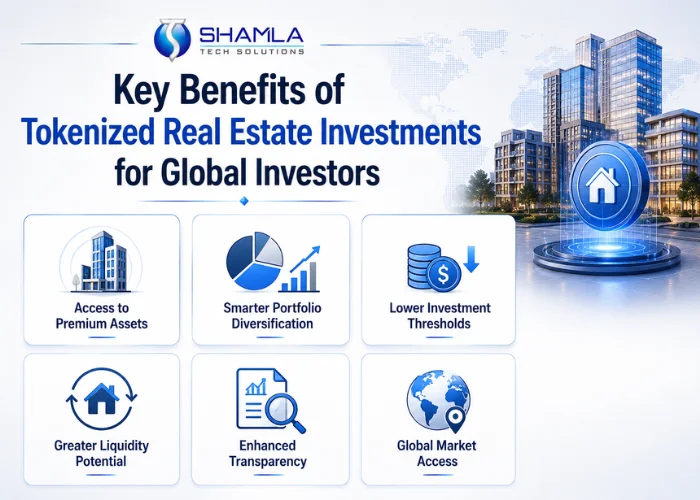
1. Access to Institutional-Grade Real Estate Opportunities
2. Improved Portfolio Diversification Across Markets
3. Lower Capital Entry Requirements
4. Enhanced Liquidity Potential
5. Greater Transparency and Ownership Visibility
6. Efficient Cross-Border Investment Participation
Tokenized Real Estate Investments: Breaking Down Traditional Barriers Through Fractional Ownership
Fractional ownership is one of the primary drivers behind the adoption of tokenized real estate investments. By dividing property ownership into digital investment units, tokenization removes longstanding barriers related to capital requirements, market accessibility, portfolio concentration, and investment flexibility, creating a more efficient framework for global real estate participation.
Traditional Barrier | Impact on Investors | How Fractional Ownership Solves It |
High Capital Requirements | Limits participation to wealthy individuals and institutions | Enables smaller investments through tokenized ownership units |
Portfolio Concentration | Significant capital tied to a single asset | Allows capital allocation across multiple properties |
Geographic Restrictions | Limited access to international opportunities | Facilitates participation in global real estate markets |
Liquidity Constraints | Long holding periods and complex exits | Supports more flexible ownership transfers |
Limited Institutional Access | Premium assets remain inaccessible to many investors | Opens access to high-value real estate opportunities |
Lower Capital Commitment
Broader Portfolio Allocation
Access to Global Opportunities
Increased Investment Flexibility
Institutional-Quality Asset Exposure
Transform Property Assets Into Digital Investments
Regulatory Considerations in Tokenized Real Estate Investments
1. Securities Law Classification
2. Jurisdiction-Specific Compliance Requirements
3. Investor Verification and KYC Controls
4. Smart Contract and Legal Alignment
5. Licensed Infrastructure and Custody Frameworks
Final Thoughts
Tokenized real estate investments represent a structural advancement in how real estate capital is raised, distributed, and managed. As regulatory frameworks mature and institutional participation expands, tokenization is becoming an increasingly practical mechanism for connecting global capital with high-value property assets.
For asset owners, developers, and investment firms, the opportunity extends beyond digitizing ownership. Tokenization introduces new pathways for capital access, investor engagement, and market expansion, positioning real estate as a more accessible and globally connected asset class for the next generation of investment strategies.
Develop Secure Real Estate Tokenization Platforms with Shamla Tech Solutions
Shamla Tech Solutions has extensive experience developing blockchain-powered platforms that help businesses tokenize real estate assets securely and efficiently. We design scalable solutions that support asset issuance, investor onboarding, ownership management, compliance workflows, and smart contract automation across the entire tokenization lifecycle.
Our team works closely with real estate firms, asset managers, and investment companies to build platforms aligned with business objectives and regulatory requirements. We focus on delivering secure infrastructure, seamless user experiences, and flexible architectures that support long-term growth within the tokenized real estate ecosystem.