
Home » Real Estate Tokenization » Why Tokenized Real Estate Ownership Is Gaining Investor Attention In The USA

Why Tokenized Real Estate Ownership Is Gaining Investor Attention In The USA

Share this article:
tokenized real estate ownership
Table of Contents
About the Author
Balaji
CEO of Shamla Tech, specializes in crypto exchange development, RWA tokenization, blockchain infrastructure, AI solutions, and compliance-ready platforms. He helps enterprises address regulatory, security, and scalability challenges while driving real-world adoption of emerging technologies across industries.
Connect On:

Tokenized real estate ownership is reshaping how investors access premium property assets across the United States. Institutional firms, private investors, and real estate operators are directing capital toward blockchain-backed ownership structures that support fractional participation, transparent transactions, and digitally recorded asset rights.

Industry reports estimate the global tokenized real estate market reached nearly $24 billion in 2026, with projections pointing toward multi-trillion-dollar market value over the next decade. This market trajectory is increasing demand for compliant real world asset tokenization platforms capable of supporting secure issuance, investor management, and secondary trading infrastructure.

This article explains why tokenized real estate ownership is gaining investor attention in the USA, how blockchain infrastructure supports property tokenization, the advantages driving institutional participation, and why businesses are investing in scalable real world asset tokenization platform development.

Develop Secure Blockchain Real Estate Platforms For USA Markets

What Is Tokenized Real Estate Ownership?

Tokenized real estate ownership refers to the process of converting property ownership rights into blockchain-based digital tokens. These tokens represent fractional ownership in a real estate asset and can be securely managed through blockchain infrastructure.

In a tokenized model, the value of a property is divided into smaller digital units that can be purchased by multiple investors. Each token represents a predefined ownership share in the underlying real estate asset.

Key features include:

  • Fractional property ownership
  • Blockchain-based ownership records
  • Digital asset management
  • Smart contract automation
  • Transparent transaction tracking

How Tokenized Real Estate Ownership Works

In a tokenized real estate model, a property asset is legally structured and divided into blockchain-based digital shares. These shares are issued as tokens through smart contracts that define ownership rights, transaction rules, investor eligibility, and income distribution mechanisms.

The blockchain ledger maintains immutable ownership records, enabling transparent transaction tracking and streamlined investor management. Depending on the platform structure, token holders may receive proportional rental income, governance participation rights, and secondary trading access.

Core Components Of Tokenized Real Estate Ownership

  • Blockchain-based ownership records
  • Smart contract automation
  • Fractional property investment
  • Investor onboarding and KYC verification
  • Automated income distribution
  • Secondary marketplace integration

Difference Between REITs, Crowdfunding, And Tokenized Real Estate Ownership

Feature

REITs

Real Estate Crowdfunding

Tokenized Real Estate Ownership

Minimum Investment

Often starts from hundreds or thousands of dollars

Typically ranges from $500 to $5,000+

Can start from as low as $50 to $100 through fractional ownership

Ownership Structure

Shares in a managed real estate trust

Pooled investment into specific projects

Blockchain-based fractional ownership tied to real estate assets

Liquidity

Limited to stock market trading hours

Funds are usually locked until project completion

24/7 secondary trading potential through digital asset marketplaces

Transaction Speed

Traditional settlement may take 2–3 business days

Platform-dependent processing timelines

Blockchain transactions can settle within minutes

Transparency

Financial reporting through periodic disclosures

Limited project-level visibility

Real-time blockchain ownership and transaction records

Global Investor Access

Restricted by brokerage and regional regulations

Limited international participation

Digitally accessible investment participation across global markets

Why Tokenized Real Estate Ownership Is Growing In The USA

Institutional investors, real estate firms, and digital asset companies in the USA are increasing their focus on tokenized real estate ownership due to its operational efficiency, broader investor accessibility, and blockchain-enabled investment infrastructure. The market is attracting attention from businesses seeking scalable and digitally managed real estate investment ecosystems.

Key Factors Driving Market Growth:

  • Tokenized ownership structures enable real estate firms to unlock new capital channels by offering fractional investment access to a wider investor base without relying entirely on traditional financing mechanisms.
  • Blockchain-based ownership infrastructure strengthens transaction transparency, investor record management, and operational traceability across property investment ecosystems.
  • The global tokenized real estate market could reach $4 trillion by 2035, driven by institutional adoption, fractional ownership models, and blockchain-enabled asset management systems.
  • Digital asset infrastructure supports programmable compliance, automated income distribution, and streamlined investor onboarding processes, reducing operational friction for real estate businesses and investment platforms.
  • Real estate firms are increasingly investing in tokenization platforms to improve asset liquidity, support cross-border investment participation, and establish digitally scalable fundraising ecosystems for long-term capital growth.

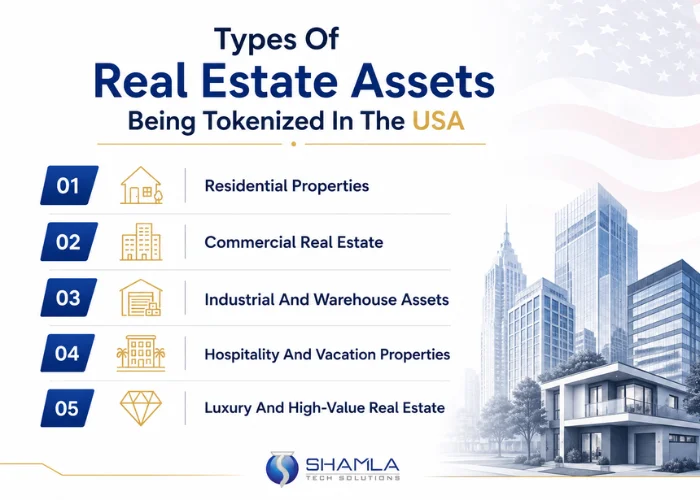
Types Of Real Estate Assets Being Tokenized In The USA
Types Of Real Estate Assets Being Tokenized In The USA

1. Residential Properties

Residential real estate tokenization is gaining traction in the USA as property developers and investment firms seek broader investor participation in high-demand housing markets. Fractional ownership models help businesses raise capital more efficiently while enabling investors to access income-generating residential assets without the operational complexity associated with direct property ownership and long-term property management responsibilities.

2. Commercial Real Estate

Commercial real estate assets, including office buildings, retail centers, and mixed-use developments, are increasingly being tokenized to improve capital accessibility and investor diversification. In the USA, commercial property owners are adopting tokenization strategies to attract institutional and global investors while improving fundraising efficiency for large-scale real estate acquisition and development projects.

3. Industrial And Warehouse Assets

Industrial and warehouse properties are becoming prominent tokenization assets due to rising demand driven by logistics, e-commerce, and supply chain infrastructure expansion across the USA. Tokenization enables real estate operators to structure digitally accessible investment opportunities around high-value industrial assets while improving liquidity potential and expanding investor participation beyond traditional institutional networks.

4. Hospitality And Vacation Properties

Hotels, resorts, and vacation properties in the USA are being tokenized to support flexible investment participation in hospitality-driven real estate markets. Tokenization structures allow businesses to distribute ownership across multiple investors while creating new capital formation opportunities for hospitality asset acquisition, renovation, and expansion within tourism-focused and premium destination markets.

5. Luxury And High-Value Real Estate

Luxury real estate tokenization is enabling fractional access to premium residential and commercial assets located in major USA property markets. High-value real estate traditionally accessible only to institutional investors or ultra-high-net-worth individuals can now be structured into digitally tradable ownership units, creating broader investment accessibility while improving capital efficiency for property owners and developers.

Legal And Regulatory Considerations In The USA

Tokenized real estate ownership in the USA operates within established securities and financial compliance frameworks governed by the SEC and related regulatory authorities. Real estate businesses launching tokenized investment models must structure offerings with legally compliant fundraising, investor verification, digital asset issuance, and secondary trading mechanisms to support operational credibility and long-term market participation.

SEC Securities Offering Exemptions

Most tokenized real estate offerings in the USA are structured under SEC exemptions such as Regulation D Rule 506(c), Regulation S, or Regulation A+. These frameworks define fundraising limits, investor eligibility, disclosure obligations, and marketing permissions for blockchain-based real estate investment offerings targeting accredited and institutional investors.

Accredited Investor Verification Requirements

Platforms operating under Regulation D 506(c) must verify accredited investor status before permitting participation in tokenized offerings. Verification processes may include income documentation, brokerage statements, CPA confirmations, attorney letters, or third-party compliance verification providers to satisfy SEC “reasonable steps” requirements under federal securities regulations.

KYC, AML, And OFAC Compliance Procedures

Tokenized real estate platforms in the USA are expected to implement KYC and AML verification systems to validate investor identities, monitor transaction activity, and screen participants against OFAC sanctions databases. These compliance procedures are critical for reducing financial crime exposure and supporting legally compliant digital asset investment operations.

SPV And Asset Ownership Structuring

Many tokenized real estate projects utilize Special Purpose Vehicles (SPVs) or LLC-based ownership structures where blockchain-issued tokens represent ownership interests linked to legally documented entities holding the underlying property assets. This structure strengthens legal clarity, investor rights management, and operational separation between platform infrastructure and real estate ownership entities.

Secondary Trading And Transfer Restrictions

Tokenized securities issued under U.S. regulatory exemptions may include holding periods, resale limitations, and transfer restrictions depending on the offering structure. Platforms supporting secondary trading functionality often require integration with SEC-compliant Alternative Trading Systems (ATS) and regulated broker-dealer infrastructure to facilitate legally compliant digital asset transactions.

Launch SEC-Compliant Tokenized Real Estate Tokenization Platforms

How Enterprises Can Launch Tokenized Real Estate Platforms

Enterprises entering the tokenized real estate market require more than blockchain integration alone. Launching a scalable platform in the USA involves securities compliance infrastructure, smart contract architecture, investor management systems, digital asset issuance frameworks, and secondary transaction capabilities.

Many businesses partner with experienced real estate tokenization platform development companies to accelerate deployment timelines and maintain operational alignment with regulatory and infrastructure requirements.

Asset Structuring And Regulatory Framework Development

Enterprises must first establish the legal and operational structure governing the tokenized asset. Many U.S.-based projects utilize SPVs or LLC structures where digital tokens represent ownership interests linked to legally documented property-holding entities. Businesses must also determine applicable SEC exemptions such as Regulation D 506(c), Regulation S, or Regulation A+ before initiating investor participation and token issuance processes.

Blockchain Infrastructure And Smart Contract Architecture

Tokenized real estate platforms typically utilize blockchain networks such as Ethereum, Polygon, or Avalanche to support digital asset issuance and transaction execution. Smart contracts are developed using security token standards such as ERC-3643 or ERC-7943 to automate token distribution, ownership transfers, dividend allocation, transfer restrictions, and compliance validation within the platform ecosystem.

Investor Onboarding And Compliance System Integration

Enterprise-grade tokenization platforms require integrated KYC, AML, and accredited investor verification systems to support compliant onboarding workflows. Businesses often integrate third-party compliance providers for identity verification, sanctions screening, document validation, and transaction monitoring. Investor portals are also developed to manage onboarding records, investment agreements, wallet connectivity, and digital asset access permissions.

Tokenization Platform Development And Enterprise System Integration

A scalable tokenized real estate platform requires multiple interconnected infrastructure layers, including admin dashboards, token issuance modules, cap table management systems, investor reporting engines, payment gateway integrations, and asset performance monitoring tools. Many enterprises partner with real estate tokenization platform development companies to integrate blockchain infrastructure with CRM platforms, custody providers, accounting systems, and enterprise asset management workflows.

Secondary Marketplace And Liquidity Infrastructure

Enterprises seeking long-term platform scalability often implement secondary transaction infrastructure to support compliant token transfers and digital asset liquidity. Depending on the regulatory structure, platforms may integrate SEC-compliant Alternative Trading Systems (ATS), broker-dealer services, transfer agents, and wallet management solutions to facilitate regulated secondary market participation within U.S. digital securities ecosystems.

Final Thoughts

Tokenized real estate ownership is establishing a new infrastructure layer for property investment across the United States. Real estate firms, investment platforms, and asset managers are adopting blockchain-based ownership systems to improve capital accessibility, investor participation, and operational scalability within digitally managed investment ecosystems.

As institutional interest in real estate tokenization continues to expand, enterprises entering this market require secure, compliant, and scalable platform infrastructure. Businesses capable of combining regulatory alignment with enterprise blockchain architecture will be better positioned to participate in the next phase of digital real estate investment markets.

Build Tokenized Real Estate Platforms with Shamla Tech Solutions

Shamla Tech Solutions is a real estate tokenization platform development company delivering enterprise-grade blockchain infrastructure for businesses across the USA. Our team has developed compliant tokenized real estate platforms supporting fractional ownership, digital asset issuance, investor onboarding, smart contract automation, and secure investment management aligned with U.S. regulatory frameworks.

We help real estate firms, asset managers, and investment companies build scalable tokenization ecosystems integrated with KYC/AML systems, investor dashboards, payment gateways, custody infrastructure, and secondary transaction capabilities. From blockchain architecture to platform deployment, Shamla Tech Solutions delivers end-to-end real estate tokenization development services customized for institutional-scale digital asset operations.

Build Scalable Real Estate Tokenization Platforms Across USA

FAQs

What Is Tokenized Real Estate Ownership?
Tokenized real estate ownership refers to the process of converting property ownership rights into blockchain-based digital tokens. These tokens represent fractional ownership in real estate assets and can be managed through secure digital investment platforms.
Is Tokenized Real Estate Ownership Legal In The USA?
Yes, tokenized real estate ownership is legal in the USA when platforms comply with SEC regulations, securities exemptions, investor verification requirements, and applicable federal and state-level financial compliance frameworks governing digital asset investment offerings.
What Types Of Properties Can Be Tokenized?
Residential properties, commercial buildings, industrial warehouses, hospitality assets, luxury real estate, and mixed-use developments can all be tokenized through blockchain-based ownership structures designed for fractional investment participation and digital asset management.
Why Are Businesses Investing In Real Estate Tokenization Platforms?
Businesses are investing in tokenization platforms to improve capital accessibility, support fractional ownership models, streamline investor onboarding, enhance transaction transparency, and establish scalable digital infrastructure for blockchain-based real estate investment operations.

Talk to Our Experts

Recent Posts