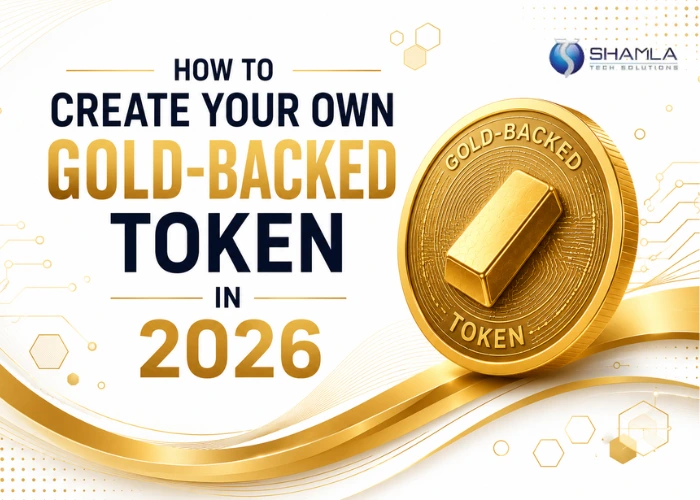

Gold has always carried trust, but physical ownership still creates friction. Storage, insurance, transfer delays, high entry costs, and limited global access slow down traditional gold markets. In 2026, businesses can solve these barriers by converting vaulted gold into blockchain-based digital assets. To Create Your Own Gold-Backed Token, a company needs more than token code. It needs verified reserves, legal clarity, smart contracts, investor onboarding, custody partners, redemption rules, and a secure trading environment. This guide explains how businesses can launch Gold Tokens with confidence, reduce operational gaps, and how a revenue-ready Gold tokenization platform contributes for investors, traders, fintech users, and commodity markets.
12 Steps to Create Your Own Gold-Backed Token
Step 1: Define the Gold Backing Model
Step 2: Verify Gold Ownership and Purity
Step 3: Select a Vault or Custody Partner
Step 4: Create the Legal Framework
Step 5: Choose the Blockchain Network
Step 6: Develop the Smart Contract
Step 7: Add KYC, AML, and Wallet Controls
Step 8: Mint Tokens Against Verified Gold
Step 9: Publish Proof of Reserve
Step 10: Launch Buying, Selling, and Redemption
Step 11: Plan Exchange Listing and Liquidity
Step 12: Monitor Reserves After Launch
Step 1: Define the Gold Backing Model
The issuer must decide what each token represents. It can represent one gram, one ounce, one bar share, or another fixed gold value. This decision affects pricing, supply, redemption, legal terms, and investor expectations.
A business that wants to Build Your Own Gold-Backed Token should avoid vague backing models. The token must have a clear reserve ratio from the beginning.
Step 2: Verify Gold Ownership and Purity
Before creating a Gold-Backed Token, the company must verify gold quantity, purity, ownership records, source documents, insurance status, and custody rights. This step builds the foundation for trust.
If the gold source is unclear, investors, exchanges, auditors, and regulators may reject the product.
Step 3: Select a Vault or Custody Partner
A trusted vault partner stores the physical gold. The custodian should provide reserve records, insurance confirmation, audit support, and access controls.
For institutional adoption, vault quality matters as much as blockchain quality. A weak custody setup can damage the whole token model.
Step 4: Create the Legal Framework
The issuer must define token holder rights, redemption rules, jurisdiction, compliance duties, investor eligibility, tax considerations, and licensing needs.
This is a critical step because gold-backed tokens may fall under commodity, securities, payment, or digital asset rules depending on the country and token design.
Step 5: Choose the Blockchain Network
The company must select a blockchain based on transaction fees, speed, security, wallet support, liquidity, exchange compatibility, and compliance needs.
Ethereum, Polygon, BNB Chain, Avalanche, Stellar, and other networks can support Gold Tokens. The best chain depends on the business model, not hype.
Step 6: Develop the Smart Contract
The smart contract controls minting, burning, transfers, supply limits, pause functions, role permissions, and token ownership logic.
To Create Your Own Gold-Backed Token safely, the smart contract must prevent over-minting. Tokens should only enter circulation when matching gold reserves exist.
Step 7: Add KYC, AML, and Wallet Controls
Gold-backed tokens often need identity checks, sanctions screening, wallet whitelisting, transaction monitoring, and investor eligibility controls.
These compliance layers help the issuer build trust with banks, custodians, exchanges, and institutional partners
Step 8: Mint Tokens Against Verified Gold
Minting should happen only after reserve confirmation. If the company holds 10 kilograms of gold and one token equals one gram, it can mint up to 10,000 tokens.
This rule protects the token’s 1:1 backing and reduces reserve mismatch risk.
Step 9: Publish Proof of Reserve
Proof of reserve helps users verify that the token supply matches physical gold reserves. The issuer can publish vault certificates, audit reports, reserve balances, custodian letters, and token supply data.
This is one of the strongest trust signals for any business that wants to Create Your Own Gold-Backed Token.
Step 10: Launch Buying, Selling, and Redemption
Users need clear access to the token. The issuer can sell through a website, investor portal, fintech app, OTC desk, exchange, or wallet marketplace.
Redemption rules must also be clear. Holders should know whether they can redeem physical gold, receive cash settlement, or trade tokens only.
Step 11: Plan Exchange Listing and Liquidity
A gold-backed token needs liquidity to succeed. The issuer should prepare token details, legal documents, audit records, smart contract information, market-making plans, and compliance files before approaching exchanges.
Without liquidity, even a fully backed token may struggle to attract users.
Step 12: Monitor Reserves After Launch
After launch, the company must track token supply, gold reserves, redemptions, user activity, audit updates, compliance alerts, and smart contract performance. A serious issuer does not stop after minting. It manages the token like a regulated financial product.
5 Benefits of Creating a Gold-Backed Token
Businesses can unlock several outcomes by Creating a Gold-Backed Token.
- Fractional ownership expands the buyer base. Investors can buy smaller units instead of full bars or coins.
- Blockchain settlement can reduce transfer friction. Tokens can move faster than physical gold ownership records.
- Transparency improves trust. Public token supply and audit-backed reserves help users verify core data.
- The issuer can create new revenue streams through transaction fees, custody fees, redemption charges, spread income, API access, and institutional partnerships.
- Fintech and wealth platforms can add gold exposure without building physical gold logistics from scratch.
Risks Businesses Must Solve Before Launch
A gold token project can fail if it ignores trust. The main risks include poor custody, weak legal structure, unclear redemption, low liquidity, smart contract bugs, misleading marketing, and reserve mismatch.
The platform must also avoid vague claims. Investors need to know what they own, where the gold is stored, who audits it, how redemption works, and what happens during market stress.
A business that wants to Build Your Own Gold-Backed Token should start with a feasibility study before development. This helps define compliance, technology, cost, timeline, and launch region.
Why Work With a Gold Tokenization Development Company?
A specialized Gold tokenization Development Company brings blockchain engineers, fintech architects, smart contract developers, compliance-aware product teams, UI/UX experts, QA engineers, and integration specialists into one delivery model.
The right partner can help with:
- Token architecture
- Smart contract development
- Platform design
- Wallet integration
- KYC and AML modules
- Proof-of-reserve workflows
- Admin dashboards
- Exchange integration
- Security testing
- Deployment and maintenance
This reduces launch risk and helps the business move from concept to market faster.
Why Businesses Want to Create Your Own Gold-Backed Token in 2026
Gold-backed tokens sit at the intersection of real-world assets and digital finance. A token can represent a fixed quantity of vaulted gold, such as one gram or one troy ounce. The token holder gets digital access to gold value without handling physical bars.
The opportunity to Create Your Own Gold-Backed Token, is strong because gold demand remains resilient. The World Gold Council reported that total gold demand in 2025, including OTC, exceeded 5,000 tonnes for the first time and reached a record value of US$555 billion. That data shows why businesses are exploring digital access to gold-backed investment products.
Recent market news also shows institutional interest in gold-backed digital assets. Reuters reported that Tether added about 6 tonnes of gold to its XAUT reserves in 2026, taking XAUT back to around 22 tonnes. Businesses that Create Your Own Gold-Backed Token must prove that the backing exists. Investors will not trust a gold token only because it runs on blockchain. They need custody records, audit reports, redemption terms, reserve visibility, and clear ownership rights. A good gold-backed token should answer four questions:
- Who owns the gold?
- Where is the gold stored?
- Can token holders redeem it?
- How does the issuer prove reserves?
Paxos Gold is one real-world example. Paxos states that each PAXG token represents one fine troy ounce of London Good Delivery gold stored in professional vault facilities.
What Is a Gold-Backed Token?
A gold-backed token is a blockchain asset backed by physical gold held in secure custody. Each token represents a defined gold quantity. To Create Your Own Gold-Backed Token, the issuer must maintain enough reserves to match circulating supply.
For example, if one token equals one gram of gold and the platform issues 1 million tokens, the business must hold 1 million grams of verified gold. This 1:1 backing is the trust layer behind Creating a Gold-Backed Token. A strong model includes:
- Verified gold reserves
- Licensed or trusted vault storage
- Third-party audits
- Smart contract controls
- Investor KYC and AML checks
- Clear redemption terms
- Transparent token supply data
This is why a business should not treat gold tokenization as a simple crypto launch. It is a financial product, a commodity product, and a technology platform combined.
How Does a Gold-Backed Token Work?
A gold-backed token works through a simple reserve-to-token flow.
To Create Your Own Gold-Backed Token, the business acquires or verifies physical gold. Then the gold is stored with a vault or custodian. After that, the company defines the token value, such as one token equaling one gram. A smart contract is created to control issuance, transfers, burns, and supply limits. Tokens are minted only when matching gold reserves exist.
After launch, users can buy, hold, sell, transfer, or redeem tokens depending on the product rules. A Gold tokenization platform may support this lifecycle with investor onboarding, wallet connection, payments, proof-of-reserve updates, redemption requests, and admin controls.
Who Can Create Your Own Gold-Backed Token?
Businesses across financial services, commodity markets, and digital assets can enter this sector.
Business Type | Gold Token Opportunity | Best Use Case |
Bullion dealers | Sell gold in digital units | Fractional gold ownership |
Fintech apps | Add gold investment products | Digital wealth feature |
Crypto exchanges | List stable asset-backed tokens | Trading and liquidity |
Gold refineries | Digitize verified gold supply | B2B gold settlement |
Gold mining firms | Tokenize reserves or production | Gold mining tokenization |
Wealth managers | Offer digital gold portfolios | Client diversification |
Payment firms | Use gold-linked digital value | Cross-border settlement |
RWA startups | Launch asset-backed products | Tokenized investment model |
Takeaway
In 2026, businesses need Gold Tokenization that offers reserve backing, simplify investor access, support compliance, and offer reliable redemption. A strong Gold tokenization platform needs secure technology, verified custody, clean legal terms, and a user experience that builds confidence from day one.
Build a Gold Token Product That Investors Trust With ShamlaTech
At ShamlaTech, we help you Create Your Own Gold-Backed Token with end-to-end Gold tokenization services, including smart contract development, token platform engineering, wallet integration, compliance-ready modules, proof-of-reserve workflows, and scalable dashboards. If you want to work with a trusted Gold tokenization Development Company, we can help you build, launch, and grow a gold-backed digital asset platform designed for real business outcomes.
FAQs for Creating Your Own Gold-Backed Token in 2026
1. What does it mean to Create Your Own Gold-Backed Token?
It means a business creates a blockchain token backed by physical gold reserves. Each token represents a fixed gold quantity stored with a custodian or vault partner.
2. How much gold is needed to launch Gold Tokens?
The required gold depends on the token model. If one token equals one gram, the issuer must hold matching grams for every token issued.
3. Is gold tokenization legal?
It depends on the country, token rights, redemption promise, and investor type. A business should get legal review before launch.
4. How long does it take to build a gold tokenization platform?
A basic platform may take a few months. A compliance-heavy enterprise platform with custody, audits, payments, and exchange integrations can take longer.
5. Can gold mining companies use tokenization?
Yes. Gold mining tokenization can support fundraising, production-linked assets, or digitized ownership models, but it needs strict legal and reserve planning.
6. Why hire a Gold tokenization Development Company?
A specialized partner can build smart contracts, dashboards, wallets, compliance modules, proof-of-reserve systems, and integrations required for a secure launch.