
Key Takeaways: How to Build a Gold Tokenization Platform
- Gold tokenization converts ownership or economic rights linked to physical gold into blockchain-based digital tokens, making gold more divisible, transferable, and accessible.
- Building a gold tokenization platform requires more than smart contracts—it involves gold custody, token design, compliance, blockchain infrastructure, wallets, trading, security, and proof-of-reserves mechanisms.
- The typical development path is: define the token model → establish gold custody and verification → choose the blockchain → develop smart contracts → build the platform and wallet → integrate compliance and security → test and launch.
- In 2026, businesses should design gold tokenization platforms around regulatory readiness, transparent reserves, institutional-grade custody, interoperability, and scalable trading infrastructure.
What Is Gold Tokenization?
Gold tokenization is the process of representing ownership or rights to physical gold as digital tokens on a blockchain. Each token can be linked to a defined quantity of gold held in secure custody, allowing investors and businesses to transfer, trade, or hold fractional exposure to gold through blockchain infrastructure.
Unlike traditional gold ownership, where investors typically hold physical bullion or financial products linked to gold prices, tokenized gold connects physical reserves with programmable digital assets. The underlying gold remains in custody while its ownership or economic value is represented through blockchain-based tokens.
A typical gold tokenization model brings together four layers:
- Physical gold: Gold bars or other eligible gold assets are sourced and held with a custodian.
- Verification and reserves: The quantity, quality, ownership, and custody of the gold are independently verified through audits, attestations, or proof-of-reserves mechanisms.
- Token issuance: Digital tokens are minted on a blockchain according to the amount of gold represented by the platform.
- Digital ownership and transfer: Token holders can store, transfer, trade, or potentially redeem their tokens according to the platform’s terms.
Why Build a Gold Tokenization Platform in 2026?
Gold tokenization is moving from a niche blockchain use case toward a more established digital-asset market. In Q1 2026, tokenized commodities reached $5.55 billion in market capitalization, up 289% from $1.43 billion, with gold-backed tokens such as PAXG and XAUT accounting for most of the growth. Tokenized gold also generated $90.7 billion in spot trading volume during Q1 2026 alone, exceeding the $84.6 billion recorded throughout 2025.
Institutional adoption is also accelerating. In June 2026, DBS announced plans to offer tokenized physical gold to retail customers in Singapore, with each token backed by physical gold held in a dedicated vault. The bank cited fractional ownership and easier digital access as key benefits of the model.
For businesses, this creates an opportunity to build infrastructure that connects physical gold ownership with blockchain-based issuance, settlement, trading, and redemption.
Key Benefits of Building a Gold Tokenization Platform
1. Enable Fractional Gold Ownership
Physical gold is typically purchased in predefined quantities, which can create a higher entry barrier for smaller investors. Tokenization allows a business to divide exposure to physical gold into smaller digital units.
For example, a platform could represent one gram, 0.1 gram, or another predefined quantity of gold with a token, depending on its legal and operational model. This can make gold accessible to a broader range of users.
2. Expand Access to Global Gold Markets
Blockchain-based tokens can enable digital ownership and transfers without requiring users to physically handle or transport gold. Depending on the platform’s regulatory structure and supported markets, users can access gold through digital wallets and marketplaces.
This creates opportunities to serve retail investors, wealth platforms, fintech companies, institutions, and digital-asset users through a single infrastructure layer.
3. Support 24/7 Digital Trading
Traditional gold markets operate through established trading venues and settlement processes, while blockchain-based assets can support transactions around the clock.
Research published in 2026 found that tokenized gold provides continuous trading and has already become integrated with decentralized financial infrastructure.
A gold tokenization platform can therefore provide infrastructure for always-on transfers, secondary-market trading, and digital settlement, subject to applicable regulations and platform design.
4. Improve Transparency Through Blockchain
Blockchain creates an immutable transaction record that can make token issuance and transfers easier to track.
However, blockchain transparency alone does not prove that the underlying gold exists. A credible platform must combine on-chain records with custody controls, reserve reconciliation, audits or attestations, and clear redemption policies.
The World Gold Council has highlighted custody, reconciliation, compliance, and redemption as important components of shared infrastructure for digital gold.
7 Steps to Build a Gold Tokenization Platform
Building a gold tokenization platform requires coordination between physical gold infrastructure, regulatory compliance, blockchain technology, financial operations, and market distribution. The development process typically follows seven critical steps, from selecting the right jurisdiction and establishing custody to deploying smart contracts, implementing compliance controls, and creating liquidity.
Step 1: Select the Jurisdiction Based on Regulatory Strategy and Market Access
Jurisdiction determines licensing requirements, investor eligibility, banking access, and the regulatory pathway for your tokenized gold business.
The USA, Singapore, UAE, and other financial hubs each have different approaches to digital assets, securities, commodities, custody, and investor protection. The appropriate jurisdiction depends on how the token is legally structured, who can purchase it, where the underlying gold is held, and which markets the platform intends to serve.
Before development begins, businesses should determine:
- Whether the gold token could be classified as a security, commodity-linked instrument, or another regulated asset
- Which licenses or registrations may apply
- Where physical gold will be custodied
- Which investor categories can access the platform
- What AML/KYC obligations apply
- Which banking and payment providers can support the business
Choosing the jurisdiction early prevents costly architectural and compliance changes later and establishes the foundation for market access and operational scalability.
Step 2: Establish Custody Infrastructure and Banking Connectivity
The credibility of a gold tokenization platform depends heavily on the integrity of its physical gold reserves.
Gold should be sourced through reputable suppliers and stored with an appropriately qualified vault or custody provider. The platform should establish clear procedures for gold verification, ownership records, insurance, auditing, reconciliation, and redemption.
Custody infrastructure should be complemented by reliable banking and payment connectivity. Fiat on/off-ramps allow users to purchase tokens, receive redemption proceeds, and move funds through regulated financial channels.
Key infrastructure includes:
- Gold suppliers and refiners
- Professional vault and custody providers
- Insurance arrangements
- Independent audits or reserve attestations
- Banking partners
- Fiat payment rails
- Gold inventory and reconciliation systems
The objective is to create a verifiable connection between every unit of tokenized gold and the underlying reserve structure.
Step 3: Define Token Economics and the Monetization Model
Before writing smart contracts, define exactly what the token represents and how the platform generates revenue.
A tokenized gold investment platform may use different economic models depending on its target market and regulatory structure. The token could represent a defined quantity of gold, an ownership interest, or another contractual claim associated with the underlying asset.
The business model should establish:
- Gold-to-token conversion ratio
- Minimum purchase amount
- Total and circulating token supply
- Issuance and redemption rules
- Transfer restrictions
- Trading fees or spreads
- Custody fees
- Issuance fees
- Redemption fees
- Institutional/API fees
- White-label or platform licensing revenue
The token economics should be designed alongside the legal and custody model rather than treated as a separate technical exercise.
Step 4: Build Smart Contracts With Custody-Linked Mint and Burn Logic
Smart contracts form the blockchain layer of the tokenization system. For a gold-backed token, token supply should remain aligned with the underlying reserve and the platform’s approved issuance policy.
A typical workflow is:
Verified gold deposited → Reserve confirmation → Token minting → Token distribution
For redemption:
Redemption request → Token verification → Token burn/lock → Physical or monetary settlement
Minting should occur only after the required reserve and compliance conditions have been satisfied. Similarly, redeemed tokens should be burned or otherwise removed from circulation according to the platform’s defined redemption mechanism.
Smart contracts can include:
- Mint and burn functions
- Role-based access controls
- Transfer restrictions
- Whitelisted wallet logic
- Pause/emergency controls
- Supply tracking
- Event logging
- Redemption workflows
- Administrative governance controls
This custody-linked architecture helps maintain supply discipline, traceability, and auditability.
Step 5: Develop the Core Platform and Transaction Infrastructure
The next stage is to build the applications and backend systems that connect users to the tokenized gold ecosystem.
The platform may include a web or mobile interface, user accounts, integrated wallets, token balances, transaction history, purchase and redemption workflows, and a trading interface.
Behind the user interface, the backend should manage:
- User and wallet management
- Token transactions
- Gold inventory reconciliation
- Fiat deposits and withdrawals
- Transaction monitoring
- Compliance rules
- Pricing and valuation data
- Reporting
- Notifications
- Administrative controls
- Blockchain connectivity
The architecture should be designed for security, high availability, scalability, and accurate reconciliation between on-chain token balances and off-chain gold reserves.
Step 6: Implement Transaction-Level Compliance and Access Controls
Compliance should continue after a user completes onboarding. Every eligible transfer or redemption should be evaluated against the platform’s applicable compliance rules.
Depending on the jurisdiction and business model, the platform may implement:
- KYC/KYB verification
- AML screening
- Sanctions screening
- Wallet whitelisting
- Transaction monitoring
- Geographic restrictions
- Investor eligibility checks
- Transfer limits
- Suspicious-activity detection
- Compliance audit trails
Smart contracts and backend systems can work together to enforce transfer restrictions where required.
For institutional participants, these controls are particularly important because regulated financial entities need confidence that token transfers, ownership records, and transaction histories can be monitored and audited.
Step 7: Enable Liquidity, Market Access, and Distribution Channels
A technically complete platform still needs a viable market.
Before launch, businesses should establish how users will buy, sell, transfer, and potentially redeem their tokenized gold. Depending on the business model and applicable regulations, liquidity can come through exchange integrations, OTC desks, market makers, internal matching engines, or strategic financial partners.
Distribution can include:
- Digital-asset exchanges
- Institutional trading platforms
- Wealth-management platforms
- Fintech applications
- Broker/dealer networks
- B2B APIs
- White-label partnerships
- Direct retail distribution
Liquidity and distribution should be considered during development rather than after launch. A token that is easy to mint but difficult to trade or redeem provides limited value to users.
The final objective is to create a complete ecosystem in which gold reserves, token issuance, compliance, liquidity, trading, and redemption work together seamlessly.
Gold Tokenization Platform Development Flow
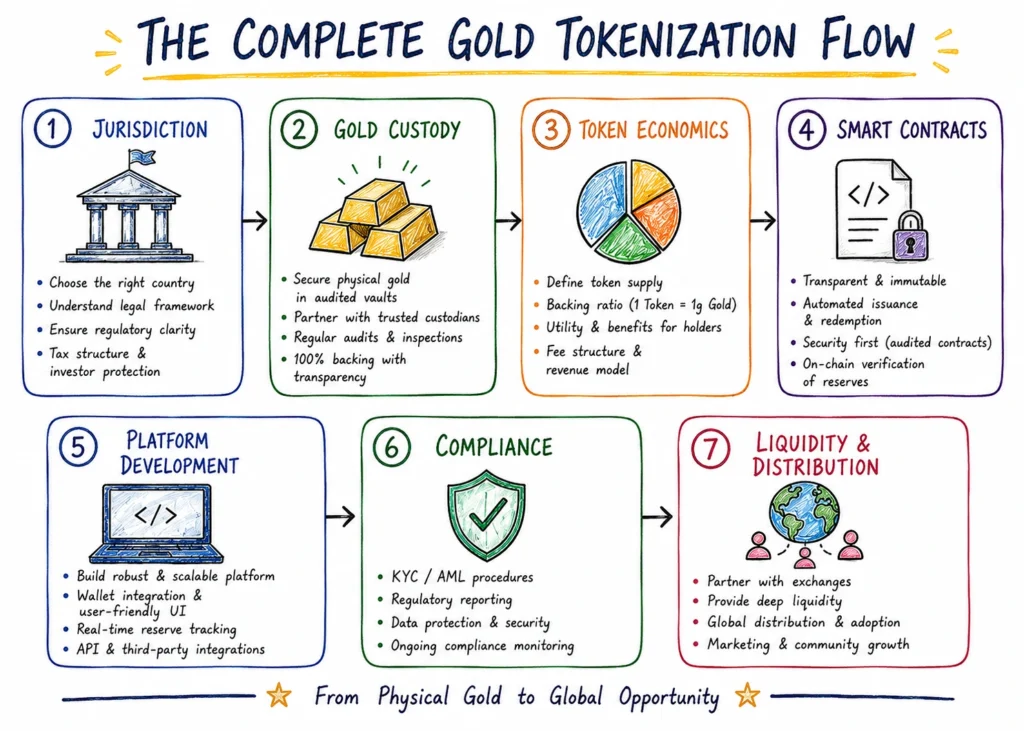
This approach helps businesses build a gold tokenization platform around the entire asset lifecycle rather than focusing solely on blockchain development.
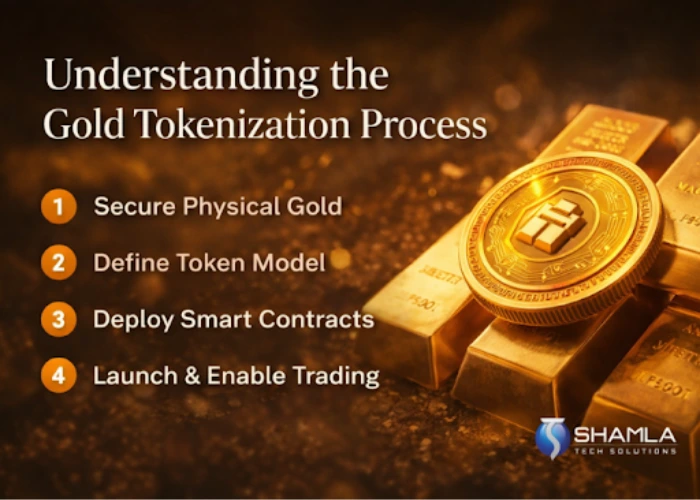
How Gold Tokenization Works (4-Step Process)
The gold tokenization process explains how physical gold is converted into a blockchain-based digital asset and eventually made available for transfer, trading, or redemption. Unlike the seven-step development process, which focuses on how to build the platform, these four stages describe the asset lifecycle, from physical gold reserves to tokenized ownership and market access.
1. Secure and Verify Physical Gold Reserves
The process begins with sourcing eligible physical gold and placing it with a trusted custody or vaulting provider. The gold should be properly documented, insured, and independently verified, with records such as bar numbers, weight, purity, and ownership maintained throughout the custody lifecycle.
Reserve verification is critical because the physical asset provides the foundation for the digital representation. Depending on the platform’s structure, audits, attestations, or proof-of-reserves mechanisms can help demonstrate that the quantity of gold held in custody corresponds to the tokens issued.
2. Define the Token Model and Legal Structure
Once the physical reserves are established, the issuer determines what the digital token represents and what rights token holders receive.
The token model may define:
- The amount of gold represented by each token
- Fractional ownership or exposure
- Ownership and transfer rights
- Issuance and redemption conditions
- Eligible users and jurisdictions
- Fees and settlement terms
The legal structure must align with the token’s actual economic and ownership characteristics. Applicable KYC, AML, investor eligibility, custody, and transfer requirements should be incorporated before tokens are issued.
3. Develop and Deploy Smart Contracts
Smart contracts provide the blockchain infrastructure for creating and managing the tokenized gold asset. They can govern functions such as minting, burning, transfers, supply controls, and access permissions.
A well-designed contract should prevent unauthorized issuance and maintain consistency between the approved gold reserves and token supply. Role-based permissions, emergency controls, transaction limits, and independent smart-contract audits can further strengthen security.
The result is a programmable digital asset whose ownership and transaction history can be recorded on-chain while the underlying gold remains securely held off-chain.
4. Issue Tokens and Enable Trading or Redemption
After the reserves, legal structure, and smart contracts are in place, tokens can be issued to eligible users according to the platform’s defined issuance rules.
The tokens can then be transferred or made available through supported trading venues, internal marketplaces, or other distribution channels. Institutional partners may also connect through APIs or other integrations.
Depending on the platform model, token holders may be able to:
- Buy or sell tokenized gold
- Transfer tokens between approved wallets
- Hold fractional exposure to gold
- Trade through supported marketplaces
- Redeem tokens for physical gold or another permitted settlement method.
The key distinction is simple: the 7-step development process explains how to build the platform, while this 4-step process explains how physical gold becomes a usable digital asset within that platform
Technology Stack for a Gold Tokenization Platform
A gold tokenization platform requires a technology stack that connects blockchain infrastructure with physical gold custody, compliance systems, financial operations, and user-facing applications. The architecture should support secure token issuance, reserve reconciliation, transaction monitoring, wallet management, and scalable market access.
Component | What It Does | Example Technology Stack |
Blockchain Layer | Hosts the token and records transactions | Ethereum, Polygon, Arbitrum, Avalanche |
Smart Contracts | Controls token issuance, burning, transfers, and access rules | Solidity, Hardhat, Foundry |
Backend & APIs | Manages business logic, data, reconciliation, and integrations | Node.js, Go, REST, GraphQL |
Custody Integration | Connects physical gold reserves with digital token records | Secure APIs, Oracle services, Chainlink |
Frontend & Wallets | Provides user access, portfolio management, and transaction execution | React, MetaMask, Fireblocks, HTTPS |
Blockchain Layer and Token Standards
The blockchain serves as the settlement and ownership layer for tokenized gold. The appropriate network depends on factors such as transaction costs, scalability, liquidity, interoperability, privacy, and regulatory requirements.
Public networks such as Ethereum, Polygon, Arbitrum, and Avalanche can provide access to established blockchain ecosystems, while permissioned networks may be appropriate for organizations requiring greater control over participants and transactions.
For the token itself, standards such as ERC-20 can support fungible gold tokens, while ERC-3643 provides additional capabilities for permissioned and compliance-focused assets.
The blockchain layer should also account for gas optimization, wallet compatibility, transaction finality, and potential cross-chain requirements.
Smart Contract Architecture and Security
Smart contracts govern the core lifecycle of a gold-backed token, including minting, burning, transfers, supply controls, and permission management.
A modular architecture can separate token logic, access controls, compliance rules, and administrative functions, making the system easier to test and maintain.
A production-grade implementation may include:
- Role-based access control
- Multi-signature authorization
- Mint and burn restrictions
- Emergency pause mechanisms
- Transfer restrictions
- Upgrade governance
- Reentrancy protection
- Event-based audit trails
Contracts should undergo automated testing, static analysis, security reviews, and independent third-party audits before deployment. Where appropriate, formal verification can provide additional assurance for critical contract logic.
Backend Systems and API Infrastructure
The backend connects the blockchain layer with the platform’s business and operational systems.
Backend services can manage user accounts, transaction orchestration, pricing data, compliance workflows, custody records, reporting, notifications, and blockchain event processing.
Technologies such as Node.js or Go can support modular services, while REST or GraphQL APIs allow exchanges, financial institutions, custodians, and other partners to connect with the platform.
A key responsibility is reconciliation. The backend should continuously compare relevant on-chain token records with off-chain gold custody and operational records, identifying discrepancies and generating appropriate alerts or reports.
Custody Integration and Asset Verification Systems
Gold tokenization introduces an important technical requirement that conventional crypto platforms do not have: the blockchain must correspond to an off-chain physical asset.
The platform therefore needs secure integrations with vaults, custodians, auditors, and reserve-management systems. Depending on the provider, these integrations may use APIs, secure data feeds, or other approved data-exchange mechanisms.
Oracle infrastructure can be used when verified off-chain information needs to be made available to smart contracts. Services such as Chainlink can support this type of blockchain-to-real-world data connection, subject to the specific architecture and data source.
The custody layer should support:
- Gold inventory records
- Bar-level identification where applicable
- Reserve reconciliation
- Audit and attestation records
- Custody status
- Insurance information
- Redemption records
- Proof-of-reserve reporting
Frontend, Wallet Integration, and Security Layers
The frontend provides users and administrators with access to the tokenization ecosystem. Retail interfaces may focus on gold purchases, portfolio balances, transfers, and redemption, while institutional dashboards can provide deeper reporting, compliance controls, and treasury management.
Wallet infrastructure should support secure token custody and transaction signing. Depending on the target users, the platform can integrate self-custody wallets, institutional custody solutions, or both.
The application security layer should include:
- HTTPS and secure API communication
- Encryption for sensitive data
- Role-based authentication and authorization
- Multi-factor authentication
- HSM or equivalent key-management controls
- Secure wallet integration
- Session and access management
- Penetration testing
- Continuous security monitoring
- Comprehensive audit logging
A well-designed technology stack ensures that the platform is not simply capable of issuing a blockchain token but can securely manage the complete lifecycle of tokenized gold—from reserve verification and issuance to trading, transfer, and redemption.
Key Features to Include in Your Gold Tokenization Platform
A gold tokenization platform needs more than token issuance and blockchain connectivity. The user-facing product should make it easy to verify gold-backed assets, purchase and manage tokens, monitor holdings, complete compliance requirements, and access redemption or secondary markets.
1. Investor Dashboard
Give users a centralized dashboard to view their tokenized gold holdings, portfolio value, transaction history, and available balance.
For institutional users, the dashboard can additionally provide reserve reports, transaction analytics, settlement information, and account-level controls.
2. KYC/AML Onboarding
The platform should include a structured onboarding process for identity verification, business verification where applicable, sanctions screening, and ongoing transaction monitoring.
Automated compliance workflows can help determine whether a user is eligible to purchase, transfer, or redeem tokenized gold based on the platform’s regulatory and jurisdictional requirements.
3. Proof-of-Reserve Display
Users need visibility into the relationship between the digital token supply and the underlying gold reserves.
A proof-of-reserve interface can display relevant information such as:
- Total gold held in custody
- Gold represented per token
- Total tokens issued
- Reserve verification or attestation status
- Audit information
- Last reconciliation date
The exact information displayed should correspond to the platform’s custody and verification model.
4. Token Purchase and Portfolio Management
Users should be able to purchase eligible gold tokens, monitor their holdings, view transaction history, and track the value of their positions through a simple interface.
The platform can also support recurring purchases, portfolio reporting, and automated notifications where appropriate.
5. Gold Token Redemption
Redemption is one of the most important features of a gold-backed asset platform.
Depending on the legal and operational structure, users may be able to exchange tokens for physical gold or another permitted settlement method. The platform should clearly communicate minimum redemption amounts, fees, processing times, eligibility requirements, delivery options, and settlement procedures.
6. Secondary Trading
A secondary marketplace allows eligible users to buy and sell tokenized gold without relying exclusively on primary issuance.
The platform can support an internal order book, exchange integrations, OTC settlement, or other regulated trading infrastructure depending on the business model and jurisdiction.
7. Wallet and Asset Transfer
Users should be able to securely hold and transfer their tokens through supported wallets.
For permissioned gold tokens, wallet whitelisting and transfer restrictions can be integrated into the transaction workflow to ensure transfers meet applicable compliance requirements.
8. Institutional APIs and Integrations
Institutional clients may require APIs to access balances, pricing, transactions, reserve information, and settlement functions.
API infrastructure can allow banks, fintech companies, wealth platforms, exchanges, and other partners to integrate tokenized gold into their existing applications.
Real-World Gold Tokenization Projects: PAXG, Tether Gold & More
The gold tokenization market already includes several live blockchain-based gold products. These projects demonstrate different approaches to representing physical gold digitally and provide useful benchmarks when designing a new gold tokenization platform.
PAX Gold (PAXG)
PAX Gold is a gold-backed token issued by Paxos. Each PAXG token represents an interest in one fine troy ounce of physical gold held in Paxos’ custody structure.
Its model demonstrates how a gold token can connect physical bullion ownership, blockchain-based transferability, custody, and digital trading.
Tether Gold (XAU₮)
Tether Gold, commonly represented by the ticker XAU₮, is a gold-backed digital asset issued by Tether. Each token represents ownership of one fine troy ounce of physical gold held in a Swiss vault.
The project illustrates another approach to combining physical gold reserves with blockchain-based ownership and transfer.
Kinesis Gold (KAU)
Kinesis Gold (KAU) represents allocated physical gold and is designed to make gold transferable through blockchain infrastructure.
Its model demonstrates how tokenized gold can be positioned not only as an investment asset but also as part of a broader digital monetary ecosystem.
Comtech Gold (CGO)
Comtech Gold’s CGO token represents physical gold stored in secure vaults and provides another example of how bullion can be represented as a blockchain-based asset.
These projects show that gold tokenization can take multiple forms. The token standard, custody model, legal rights, redemption mechanism, geographic availability, and compliance framework can differ significantly between platforms.
For businesses developing a new platform, these existing products are useful benchmarks—but their models should not be copied without assessing the intended jurisdiction, regulatory structure, target users, and custody arrangements.
Challenges & Risks in Gold Tokenization
Gold tokenization combines the complexity of physical commodities with blockchain infrastructure. As a result, building a credible platform requires managing risks across custody, regulation, technology, liquidity, and redemption.
1. Physical Custody and Reserve Risk
The value of a gold-backed token ultimately depends on the underlying gold and the reliability of the custody arrangement.
Poor inventory controls, inadequate insurance, weak reporting, or insufficient reserve verification can undermine user confidence. Platforms therefore need robust custody procedures, reconciliation, independent verification, and transparent reserve reporting.
2. Regulatory Uncertainty
The legal treatment of tokenized gold can vary between jurisdictions and may depend on the token’s structure and the rights attached to it.
Requirements can affect issuance, marketing, investor eligibility, custody, transfers, AML/KYC, taxation, and secondary trading. Regulatory analysis should therefore happen before the token and platform architecture are finalized.
3. Liquidity Risk
A token can be technically transferable without having a healthy secondary market.
Limited exchange access, insufficient market-making activity, low trading volume, or fragmented liquidity can make it difficult for users to exit positions efficiently.
A platform should therefore develop its liquidity and distribution strategy alongside the product rather than treating trading as a post-launch feature.
4. Redemption Risk
Redemption is operationally more complicated than transferring a blockchain token.
The platform needs clearly defined procedures for verifying the user’s eligibility, burning or locking the relevant tokens, allocating physical gold or settlement proceeds, calculating fees, and completing delivery.
If redemption is slow, expensive, or poorly defined, users may lose confidence in the token even when the underlying reserves are sufficient.
5. Smart Contract and Cybersecurity Risk
A vulnerability in the token contract or platform infrastructure could result in unauthorized transactions, asset loss, or disruption.
Independent smart-contract audits, penetration testing, secure key management, multi-signature controls, monitoring, and incident-response procedures are therefore essential.
6. Oracle and Data Integrity Risk
Gold tokenization platforms often depend on off-chain information such as reserve balances, gold prices, custody status, and audit data.
If inaccurate or compromised information reaches the blockchain, smart contracts or platform decisions could operate on incorrect data. Secure data sources, validation mechanisms, access controls, and reconciliation processes are necessary to reduce this risk.
7. User Trust and Transparency
Tokenized gold requires users to trust both the blockchain system and the physical asset infrastructure behind it.
Transparent reserve information, clear legal documentation, predictable redemption procedures, independent verification, and accurate reporting can help establish that trust.
Ultimately, successful gold tokenization depends on maintaining a reliable connection between what exists on-chain and what exists in physical custody.
Choosing the Right Gold Tokenization Solutions Provider
Choosing a gold tokenization solutions provider is a strategic decision that can influence your platform’s architecture, regulatory readiness, development timeline, and ability to scale. Gold tokenization requires multiple systems to work together, from physical gold custody and reserve verification to smart contracts, compliance, trading, and redemption.
Rather than selecting a development vendor based only on blockchain expertise, businesses should evaluate whether the provider can support the complete tokenization lifecycle and integrate the technology with the operational infrastructure behind the physical asset
What to Look for in a Gold Tokenization Development Partner
A capable development partner should understand both blockchain technology and real-world asset infrastructure. Key evaluation criteria include:
- Experience with RWA and asset-backed tokenization
- Smart contract development and security auditing
- Custody and reserve-management integrations
- KYC/AML and transaction-compliance workflows
- Wallet and payment integrations
- Trading and liquidity infrastructure
- Institutional-grade security architecture
- API and third-party integration capabilities
- Scalable backend and cloud infrastructure
- Post-launch maintenance and technical support
The provider should also be able to translate the business model into a technical architecture rather than simply delivering a standalone token contract.
Why Gold Tokenization Requires a Specialized Development Partner
Gold tokenization connects physical assets, financial operations, and blockchain infrastructure. A failure in any one of these layers can affect the entire platform.
For example, smart contracts may correctly control token supply, but the platform still needs reliable custody records to establish how much gold is held. Similarly, verified reserves have limited commercial value if users cannot purchase, transfer, trade, or redeem their tokens efficiently.
A specialized partner can coordinate these components through a unified architecture covering:
- Gold custody and reserve verification
- Token issuance and supply management
- Smart contract infrastructure
- Wallet and payment systems
- Compliance and transaction monitoring
- Trading and liquidity integrations
- Redemption workflows
- Administrative and reporting systems
This integrated approach can reduce the complexity of coordinating multiple technology vendors and help businesses build the platform around their intended commercial and regulatory model from the beginning.
Gold Token Smart Contract Development Capabilities
Smart contracts form the foundation of the digital asset layer. Your development partner should be capable of implementing and securing contract logic for the complete token lifecycle.
Core capabilities may include:
- Mint and burn mechanisms
- Supply and reserve controls
- Role-based access management
- Transfer restrictions and wallet whitelisting
- Compliance-aware transaction logic
- Oracle integrations for approved external data
- Emergency pause mechanisms
- Multi-signature administration
- Upgrade and governance mechanisms where appropriate
- Automated testing and third-party audit preparation
The contract architecture should be designed around the token’s legal rights, custody model, and issuance and redemption procedures.
Custom Gold Tokenization Software and Infrastructure
Beyond smart contracts, the platform requires a complete application and backend ecosystem.
A development partner should be able to build and integrate:
- Investor and institutional dashboards
- Token purchase and transfer workflows
- Wallet infrastructure
- KYC/KYB and AML integrations
- Banking and fiat payment connectivity
- Custody and vault integrations
- Reserve reconciliation systems
- Pricing and market-data services
- Trading or marketplace infrastructure
- Redemption management
- Reporting and analytics
- APIs for institutional partners
The architecture should be designed for secure and scalable transaction processing while maintaining synchronization between on-chain token balances and off-chain asset records.
Shamla Tech as a Gold Tokenization Platform Development Company
Shamla Tech provides end-to-end development support for businesses building gold tokenization platforms, covering the blockchain, application, integration, and infrastructure layers.
The development scope can include:
- Gold token smart contract development
- Token issuance and management infrastructure
- Custody and reserve integrations
- Backend and API development
- Wallet integration
- Compliance-oriented workflows
- Trading and liquidity integrations
- Custom dashboards and platform interfaces
- Security and scalability architecture
The objective is to build a unified platform in which physical gold, digital tokens, compliance controls, and user transactions operate as connected components.
Why Shamla Tech?
Gold tokenization requires more than launching a blockchain token. The platform must establish a reliable connection between physical reserves and digital ownership, while providing the infrastructure required for users and institutions to transact with the asset.
Shamla Tech focuses on building this complete technology layer—from smart contracts and custody integrations to backend infrastructure, wallets, trading functionality, and platform interfaces.
For businesses planning to enter the tokenized gold market, the right development partner can help turn the initial concept into a secure, scalable, and market-ready platform architecture.
Frequently Asked Questions
1. What Is a Gold Tokenization Platform?
A gold tokenization platform is a digital infrastructure system that represents physical gold or rights associated with physical gold through blockchain-based tokens. It typically combines token issuance, custody integration, reserve verification, wallets, compliance, trading, and redemption functionality.
2. How Does the Gold Tokenization Process Work?
The process generally involves four stages: securing and verifying physical gold, defining the token and legal structure, deploying smart contracts, and issuing the tokens for transfer, trading, or redemption.
3. Is Gold Tokenization Legally Compliant?
Gold tokenization can be structured to operate within applicable regulatory frameworks, but compliance depends on factors such as the token’s legal characteristics, jurisdiction, custody arrangement, target users, and distribution model. Businesses should obtain appropriate legal and regulatory advice before issuing or marketing a tokenized gold asset.
4. What Are the Revenue Models for a Gold Tokenization Platform?
Potential revenue streams include transaction fees, trading spreads, issuance fees, redemption fees, custody fees, API access fees, institutional services, and white-label platform licensing. The applicable model depends on the platform’s business structure and regulatory requirements.
5. How Long Does It Take to Build a Gold Tokenization Platform?
The timeline depends on the platform’s scope, blockchain, custody integrations, compliance requirements, trading functionality, and security requirements. A basic tokenization solution can require substantially less development than a full platform supporting custody, KYC/AML, trading, institutional APIs, and redemption.
6. What Is a Gold-Backed Token?
A gold-backed token is a blockchain-based digital asset whose value or ownership rights are linked to physical gold held in reserve. The exact rights of token holders depend on the issuer’s legal structure, custody arrangements, terms, and applicable regulations.
7. What Are the Challenges and Risks of Gold Tokenization?
Key challenges include physical custody and reserve verification, regulatory uncertainty, smart-contract security, liquidity, redemption operations, oracle and data integrity, and maintaining user trust. Successful platforms need controls across both the blockchain and physical-asset layers.
8. What Are Examples of Gold Tokenization Projects?
Examples include PAX Gold (PAXG), Tether Gold (XAU₮), Kinesis Gold (KAU), and Comtech Gold (CGO). These projects use different custody, token, distribution, and redemption models, making them useful benchmarks for businesses researching gold tokenization.
Build a Gold Tokenization Platform with Shamla Tech
Ready to turn your gold tokenization concept into a market-ready platform?
Shamla Tech can help design and develop the technology infrastructure required to connect physical gold custody, tokenized assets, smart contracts, compliance workflows, wallets, trading, and redemption in one scalable platform.
From gold token smart contract development to full-stack tokenization infrastructure, our team can help build a solution aligned with your target market, business model, and technical requirements.