

Commercial real estate has entered a phase where asset ownership, fundraising structures, and investor access are being redesigned through blockchain-backed financial infrastructure. Tokenization is becoming a boardroom priority for firms seeking programmable ownership models and more efficient capital formation.
The global real estate tokenization market is projected to surpass $19 billion by 2033, signaling clear commercial momentum. This market trajectory is driving demand for purpose-built real estate tokenization platforms that support asset issuance, investor onboarding, compliance management, and transaction governance.
In this article, we examine why commercial real estate tokenization is gaining strategic attention in 2026, key asset-class use cases, the business advantages of launching a dedicated tokenization platform, and the core capabilities required for successful platform development.
Build Commercial Real Estate Tokenization Infrastructure That Scales
Why Commercial Real Estate Tokenization Is Growing In 2026
Commercial real estate tokenization is moving from concept validation to institutional execution. For businesses building digital asset infrastructure, the opportunity lies in enabling compliant capital formation, programmable ownership administration, and cross-border investment distribution through specialized commercial real estate tokenization platforms.
Key Drivers Behind Commercial Real Estate Tokenization Growth
- More than $4 trillion worth of real estate is projected to be tokenized by 2035, indicating a substantial infrastructure opportunity for businesses building platforms that manage issuance, ownership governance, compliance execution, investor onboarding, and digital asset servicing.
- Commercial property firms are pursuing fundraising models that expand investor participation beyond traditional syndication channels, creating demand for tokenization platforms capable of supporting structured offerings, digital subscriptions, ownership allocation, and capital distribution management.
- Asset managers are seeking operational efficiency across ownership recordkeeping, investor communications, dividend processing, and transaction governance, making commercial real estate tokenization platforms valuable infrastructure for reducing administrative complexity and improving execution consistency across investment operations.
- Cross-border capital access remains a strategic priority for commercial real estate businesses targeting institutional and qualified investors, increasing the requirement for platforms with integrated identity verification, jurisdiction-based access controls, compliance monitoring, and secure investor relationship management capabilities.
- Enterprises are treating tokenization infrastructure as a revenue-generating digital business model, where platform ownership creates monetization opportunities through onboarding fees, transaction charges, white-label licensing, asset servicing, and long-term participation in tokenized commercial real estate ecosystems.
Real-World Use Cases Of Commercial Real Estate Tokenization Across Asset Classes
1. Office Asset Capital Restructuring
2. Hospitality Investment Distribution
3. Industrial And Logistics Portfolio Expansion
4. Mixed-Use Development Capital Formation
5. Commercial Real Estate Fund Digitization
Business Benefits Of Building A Commercial Real Estate Tokenization Platform
Commercial Real Estate Tokenization Business Benefit | Measurable Commercial Impact |
Faster Capital Formation | Reduce fundraising execution timelines by 30–60% through digital subscriptions and automated ownership allocation |
Lower Operational Overhead | Cut investor administration and compliance processing costs by up to 40% through workflow automation |
New Revenue Generation | Earn $25–$500+ per transaction through issuance, transfers, platform servicing, and compliance operations |
Global Investor Access | Expand capital reach across 50+ jurisdictions through integrated onboarding and access management controls |
Scalable Platform Commercialization | Support 1 to 1,000+ commercial asset offerings through centralized tokenization infrastructure |
Accelerated Capital Formation Execution
Recurring Revenue Infrastructure
Operational Cost Efficiency At Scale
Expanded Institutional Capital Access
Strategic Enterprise Market Positioning
Turn Commercial Real Estate Into Digital Investment Infrastructure
Core Features Required In A Commercial Real Estate Tokenization Platform
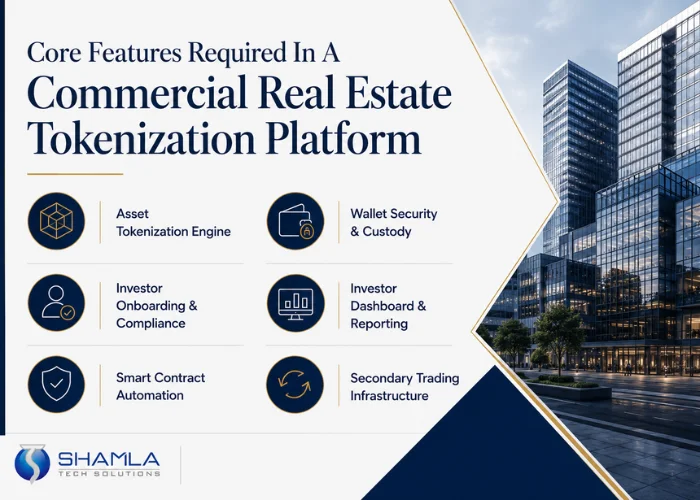
1. Asset Tokenization And Ownership Structuring
2. Investor Onboarding And Compliance Management
3. Smart Contract Automation And Transaction Execution
4. Digital Wallet, Custody, And Access Security
5. Investor Portal And Asset Management Dashboard
6. Secondary Trading And Liquidity Infrastructure
Bottom Line
Commercial real estate tokenization is creating a new infrastructure category where asset ownership, capital formation, and investor operations are delivered through programmable digital systems. Enterprises building platforms today are positioning themselves to control transaction ecosystems, service revenue, and long-term institutional market participation.
The strategic opportunity is no longer limited to tokenizing individual properties. It lies in owning the infrastructure that enables issuance, compliance, investor management, and liquidity across commercial asset classes, creating a commercially defensible business model within the digital transformation of real estate finance.
Build & Launch Commercial Real Estate Tokenization Platforms With Shamla Tech Solutions
Shamla Tech Solutions is a commercial real estate tokenization platform development company delivering enterprise-grade digital asset infrastructure for global clients. We build compliant platforms for asset tokenization, investor onboarding, smart contract automation, wallet integration, compliance workflows, and secure ownership lifecycle management across jurisdictions.
Our development expertise covers end-to-end commercial real estate tokenization platform architecture, including security token issuance, KYC/AML integration, secondary trading infrastructure, investor dashboards, custody systems, and regulatory-aligned deployment strategies, enabling enterprises to launch scalable tokenization businesses with strong operational and commercial foundations.