
Enterprises are identifying new pathways to unlock capital efficiency, expand investor access, and structure real estate participation with greater precision. Property tokenization introduces a commercially viable framework for transforming traditionally illiquid assets into digitally accessible investment instruments.
The global real estate tokenization market is projected to reach $19.4 billion by 2033, signaling substantial institutional interest in asset digitization. For businesses in the United States, a dedicated property tokenization platform supports compliant issuance, investor onboarding, and transaction governance.
In this article, we explain the fundamentals of property tokenization platform development, the essential capabilities enterprises should prioritize, the business advantages these platforms deliver, and why specialized development services are becoming a strategic requirement for real estate organizations.
Build Compliant Tokenization Infrastructure For Real Estate Investment Markets
What Is Property Tokenization Platform Development and How Does It Work?
Core functions that define enterprise property tokenization platforms:
- Real estate tokenization is projected to represent a $4 trillion market by 2035, reflecting strong institutional momentum toward digitized asset ownership models and creating a clear infrastructure demand for firms entering tokenized real estate markets.
- Asset structuring frameworks convert real estate ownership into legally aligned digital units, enabling fractional participation, controlled issuance, transparent ownership records, automated revenue distribution, and governance mechanisms that reduce administrative friction across asset lifecycles.
- Compliance architecture establishes market readiness through identity verification, accreditation workflows, jurisdictional access rules, document management, and audit trails, ensuring the platform supports regulated capital participation without introducing operational exposure.
- Transaction infrastructure determines commercial viability by enabling managed secondary transfers, settlement workflows, ownership synchronization, and controlled liquidity pathways that improve asset accessibility while preserving issuer governance standards.
- Business system integration connects tokenization workflows with CRM platforms, investor reporting environments, payment infrastructure, fund administration processes, and custody systems, allowing tokenized real estate operations to function as a scalable enterprise business model.
Core Features Every Property Tokenization Platform Development Project Needs
Property tokenization platforms succeed when they are engineered as business infrastructure rather than blockchain showcases. Enterprise buyers require systems that protect compliance, simplify investor operations, preserve governance control, and create commercially usable digital asset frameworks that support measurable business outcomes.
Feature | Core Capability | Business Advantage |
Investor Compliance Infrastructure | KYC, AML, accreditation controls | Faster onboarding, lower compliance risk |
Asset Tokenization Engine | Ownership structuring and issuance | New monetization and fractional access |
Smart Contract Automation | Automated transactions and governance | Reduced manual workload, higher accuracy |
Secondary Marketplace Framework | Controlled asset transfers | Improved liquidity and investor retention |
Payment and Distribution Infrastructure | Capital collection and payout management | Stronger cash flow control and transparency |
Enterprise System Integrations | CRM, reporting, custody connectivity | Seamless operational scale |
Investor Onboarding and Compliance Infrastructure
Asset Tokenization and Ownership Structuring
Smart Contract Automation
Secondary Marketplace Framework
Payment and Distribution Infrastructure
Enterprise System Integrations
Turn Real Estate Assets Into Scalable Digital Investment Products
Benefits of Property Tokenization Platform Development for Next-Generation Real Estate Investment
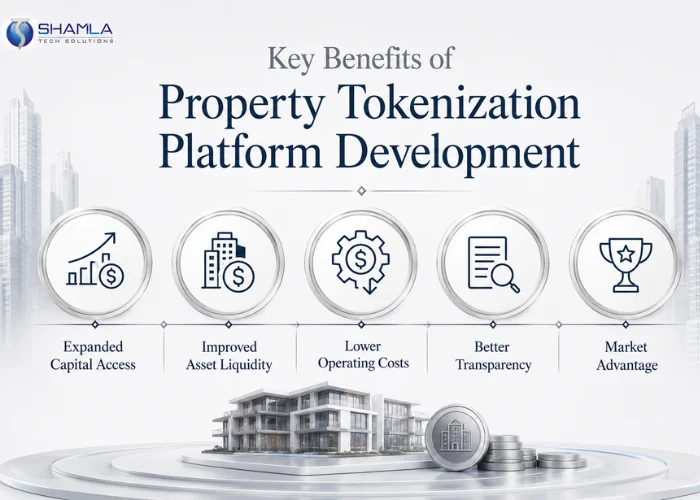
1. Expanded Capital Access
2. Improved Asset Liquidity
3. Lower Operating Costs
4. Stronger Governance and Investor Transparency
5. Competitive Market Positioning
Why Enterprises Need Property Tokenization Platform Development Expertise
Regulatory and Structural Complexity
Enterprise-Grade Integration Requirements
Commercial Scalability and Performance
Strategic Time-to-Market Advantage
Final Thoughts
Real estate firms are entering a phase where digital ownership infrastructure will increasingly influence capital strategy, investor engagement, and product design. Property tokenization is becoming a strategic business capability for enterprises seeking greater control over how real estate investment opportunities are structured and delivered.
The greater advantage will belong to organizations that approach tokenization with commercial discipline, regulatory precision, and enterprise-grade execution. Building the right platform is not simply a technology decision; it is a strategic move that shapes long-term competitiveness in investment markets.
Build Property Tokenization Platforms with Shamla Tech Solutions
At Shamla Tech Solutions, we build enterprise-grade property tokenization platforms engineered for commercial execution, investor governance, and regulatory alignment. We support global compliance considerations across frameworks such as SEC, FINMA, FCA, VARA, and MAS, helping enterprises structure tokenized real estate platforms with stronger market readiness.
We work with enterprises to transform tokenization strategies into fully operational digital investment infrastructure. Our capabilities span ownership structuring, smart contract architecture, compliance workflows, enterprise integrations, and scalable platform development, enabling clients to launch secure, market-ready property tokenization solutions with confidence across global investment ecosystems.