
Home » Real Estate Tokenization » Real Estate Tokenization Platform Development Under the CLARITY Act: What Businesses Need to Know

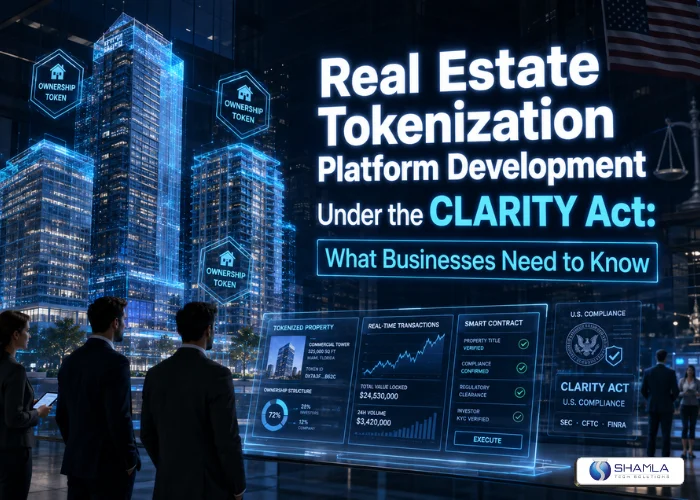
Real Estate Tokenization Platform Development Under the CLARITY Act: What Businesses Need to Know

Share this article:
How Real Estate Tokenization Platform Development Works under CLARITY Act
Table of Contents
About the Author
Balaji
CEO of Shamla Tech, specializes in crypto exchange development, RWA tokenization, blockchain infrastructure, AI solutions, and compliance-ready platforms. He helps enterprises address regulatory, security, and scalability challenges while driving real-world adoption of emerging technologies across industries.
Connect On:
Businesses planning real estate tokenization platform development in the U.S. cannot afford to wait until regulations become harder to navigate. The CLARITY Act is pushing digital asset classification, SEC/CFTC oversight, disclosures, custody, and compliance controls into the center of platform planning. For real estate firms, PropTech startups, funds, and RWA businesses, this creates urgency. If ownership rights, income rights, or fund interests are tokenized, the platform must be structured correctly from day one. Smart contracts, investor verification, transfer rules, and reporting should be built for compliance before launch, not patched after regulatory or investor review.  This guide explores how businesses can build a real estate tokenization platform under the Clarity Act. 

Build your tokenized real estate platform with the right compliance, custody, and investor onboarding foundation from day one.

Why the CLARITY Act Matters for Real Estate Tokenization?

The CLARITY Act is a U.S. digital asset market-structure proposal. It is designed to clarify how digital assets should be regulated, especially where SEC and CFTC authority overlap. For real estate tokenization, the Act is relevant when real estate rights are converted into blockchain-based tokens and offered through a digital asset platform. This can include:

  • Fractional ownership tokens.
  • Real estate fund tokens.
  • Property income-sharing tokens.
  • Tokenized debt backed by property.
  • Tokenized REIT-like structures.
  • RWA tokens linked to real estate assets.

In many cases, these products may still be securities, and businesses may need to think about investor disclosures, private placement rules, broker-dealer issues, transfer restrictions, custody, and secondary market limits.

The SEC has described tokenization as creating a digital representation of a tangible or intangible asset using distributed ledger technology. It has also emphasized that tokenizing a security does not change its legal status. 

What Businesses Are Really Looking For Before Building a Platform?

Most businesses searching for real estate tokenization platform development are not looking for basic definitions. They usually want practical answers. They want to know:

  • Can this business model work in the U.S.?
  • Will the token be treated as a security?
  • What compliance features are required?
  • How much does platform development cost?
  • Can investors be onboarded safely?
  • Can secondary trading be added?
  • How are income distributions handled?
  • What role do smart contracts play?
  • Which development partner can build it?

This is why conversion-focused content should not stop at “blockchain makes real estate liquid.” Businesses want to understand whether they can launch without legal, technical, or operational mistakes.

A reliable real estate tokenization company should help clients connect business goals with platform architecture. That includes legal structure, investor journey, smart contract logic, wallet integration, payment rails, compliance dashboards, and admin controls.

Core Platform Features for Real Estate Tokenization Platform Development

1. Investor Onboarding and KYC

A real estate tokenization platform must verify who is investing. For U.S. offerings, this may include KYC, AML checks, sanctions screening, and investor accreditation where required. This is not only a compliance feature. It builds trust with property owners, funds, sponsors, and institutional partners.

2. Property and Asset Listing Module

The platform should allow issuers to list properties, upload documents, define ownership terms, add valuation details, and present risk disclosures. For business use, this module should support multiple asset types, including commercial property, residential portfolios, hospitality assets, and real estate funds.

3. Smart Contract Token Issuance

Smart contracts can automate token issuance, ownership records, income allocation, transfer restrictions, and compliance rules. However, smart contracts should match the legal structure. A poorly designed token can create problems if it allows unauthorized transfers or ignores investor restrictions.

4. Compliance and Transfer Controls

Under a CLARITY Act-aware model, transfer controls become essential. The platform may need allowlists, blocked wallets, jurisdiction filters, investor limits, and secondary trading restrictions. This is especially important if the tokens represent securities or fund interests.

5. Custody and Wallet Integration

A tokenized real estate platform may use custodial wallets, non-custodial wallets, or hybrid wallet models. The right choice depends on investor type, compliance needs, and user experience. Institutional investors may prefer custody partners. Retail users may need simple wallet flows with strong security.

6. Income Distribution Dashboard

Rental income, dividends, interest, or profit-sharing distributions must be tracked clearly. The platform should support payment logic, investor records, reporting, tax documentation, and admin review before distribution.

7. Reporting and Admin Panel

Businesses need visibility into investors, assets, tokens, transactions, compliance alerts, document status, and platform performance. A strong admin panel makes the platform easier to manage, audit, and scale.

Launch a smarter real estate tokenization platform designed for investor trust, regulatory readiness, and long-term business growth.

SEC and CFTC Compliance: What Real Estate Platforms Should Watch

The CLARITY Act is important because it tries to draw clearer lines between SEC and CFTC authority. But real estate tokenization businesses should not assume that every token will move away from SEC oversight.

If a token represents an investment in a property, fund, revenue stream, or managed real estate project, securities analysis may still apply. The CFTC may become more relevant for digital commodities and certain market intermediaries, but tokenized real estate often sits closer to securities treatment because investors usually expect returns from an underlying asset or manager.

For businesses, this means the platform should be built with flexibility. A platform may need:

  • Private offering support.
  • Investor accreditation checks.
  • Transfer restrictions.
  • Securities disclosures.
  • Custody records.
  • Transaction monitoring.
  • Issuer dashboards.
  • Audit trails.
  • Secondary trading controls.

This is where real estate tokenization compliance becomes part of development. Legal structure, investor onboarding, and smart contract logic must work together.

Token Platform vs Compliance-Ready Real Estate Tokenization Platform

Area

Basic Token Platform

Compliance-Ready Real Estate Tokenization Platform

Investor onboarding

Simple signup and wallet connection

KYC, AML, sanctions checks, accreditation, and jurisdiction controls

Token issuance

Generic token creation

Asset-backed token structure aligned with legal and ownership rights

Transfers

Open wallet-to-wallet transfers

Restricted transfers based on investor eligibility and compliance rules

Property data

Basic listing details

Documents, valuations, ownership terms, risk disclosures, and audit records

Income distribution

Manual or limited payout tracking

Automated distribution workflows with reporting and admin review

Compliance reporting

Minimal records

Dashboards for investors, transactions, documents, and compliance events

Scalability

Suitable for demos

Built for funds, PropTech firms, enterprises, and real estate sponsors

Step-by-Step Process to Build a CLARITY Act-Ready Platform
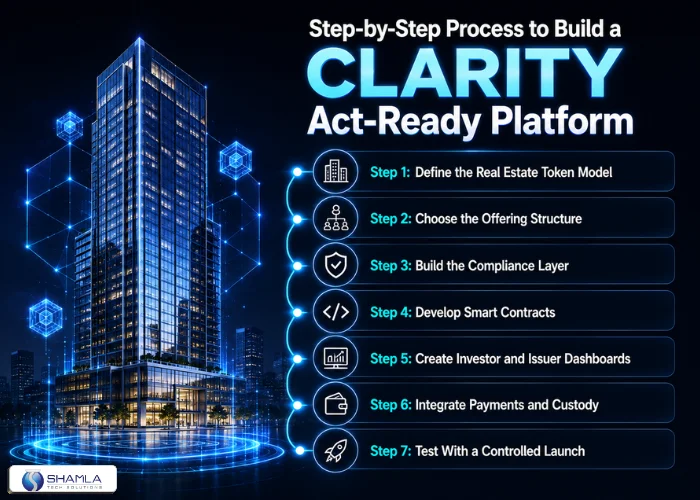
Step-by-Step Process to Build a CLARITY Act-Ready Platform

Step 1: Define the Real Estate Token Model

The business should first decide what the token represents. It may represent equity, debt, income rights, fund units, membership interests, or access rights. This decision affects legal classification, investor eligibility, disclosures, and smart contract design.

Step 2: Choose the Offering Structure

The business should decide whether the product will use a private placement, fund structure, SPV model, REIT-like structure, or another compliant route. This step should happen before platform development begins.

Step 3: Build the Compliance Layer

The platform should include KYC, AML, sanctions screening, investor accreditation, wallet screening, jurisdiction filters, and audit logs. This layer helps the business prepare for investor review, partner review, and regulatory scrutiny.

Step 4: Develop Smart Contracts

Smart contracts should manage token issuance, ownership records, transfer restrictions, income allocation, and compliance rules. The contracts should be audited before launch.

Step 5: Create Investor and Issuer Dashboards

Investors need visibility into their holdings, documents, distributions, and transaction history. Issuers need dashboards to manage assets, investors, compliance status, payouts, and reporting.

Step 6: Integrate Payments and Custody

The platform may need fiat payments, stablecoin payments, bank integrations, custodial wallets, or institutional custody partners. For U.S. investors, payment and custody flows should be designed carefully.

Step 7: Test With a Controlled Launch

Businesses should begin with a limited investor group, clear asset scope, tested workflows, and compliance monitoring before scaling. A controlled launch helps identify gaps before public growth.

Cost Factors in Real Estate Tokenization Platform Development

The cost of real estate tokenization platform development depends on the scope.

A simple MVP may include investor signup, asset listings, token issuance, wallet connection, and admin controls. A full enterprise platform may require KYC/AML, accreditation checks, smart contract audits, income distribution, custody integrations, payment gateways, compliance dashboards, document management, and secondary market controls.

Key cost drivers include:

  • Number of user roles.
  • Number of asset types.
  • Smart contract complexity.
  • Compliance integrations.
  • Custody model.
  • Payment integrations.
  • Investor dashboard features.
  • Admin panel depth.
  • Reporting requirements.
  • Security audits.

Businesses should avoid choosing the cheapest development option. A weak platform can create legal, technical, and investor trust issues later. In real estate tokenization, rebuilding compliance flows after launch is usually more expensive than building them correctly from the start.

Common Mistakes Businesses Should Avoid While Building a Real Estate Tokenization Platform

Mistake 1: Calling Every Token a Utility Token

Real estate tokens often represent financial rights. Calling them utility tokens does not remove securities risk. Review the token’s real economic function before development.

Mistake 2: Ignoring Secondary Trading Rules

Many businesses want liquidity, but secondary transfers may require strict controls. Build allowlists, holding-period rules, transfer restrictions, and investor eligibility checks into the platform.

Mistake 3: Weak Property Documentation

Investors need more than a property image and expected return. Add legal documents, valuation records, ownership terms, risk factors, payout rules, and asset updates.

Mistake 4: No Compliance Dashboard

Manual compliance tracking creates errors as the platform grows. Build dashboards for KYC, AML, wallet screening, investor status, transfer activity, and document records.

Mistake 5: Choosing a Generic Blockchain Vendor

Real estate tokenization needs more than token creation. Work with a real estate tokenization development company that understands property workflows, compliance needs, investor experience, and smart contract security.

TakeAway

Real estate tokenization platform development under the CLARITY Act requires more than blockchain development. It requires a careful connection between real estate rights, securities rules, investor onboarding, custody, smart contracts, transfer controls, and platform reporting. For U.S. businesses, the most important step is launching with a platform structure that can support legal review, investor trust, and long-term scale.

Launch a Real Estate Tokenization Platform Built for Business Growth With ShamlaTech

At ShamlaTech, we help businesses build secure, scalable, and compliance-ready real estate tokenization platforms. Our team supports you with platform architecture, smart contract development, investor onboarding, KYC/AML integration, wallet setup, asset dashboards, income distribution workflows, and admin controls. Whether you are a PropTech startup, real estate fund, or enterprise, we help you turn property assets into digital investment products with stronger technology and clearer execution. Launch your tokenization platform under the Clarity Act with ShamlaTech. 

Ready to launch a real estate tokenization platform under the CLARITY Act? Talk with our experts today.

FAQs

1. Does the CLARITY Act apply to real estate tokenization?

The CLARITY Act may apply when real estate rights are represented as digital assets. It does not regulate normal property transactions directly. It matters for tokenized real estate platforms that issue, trade, or manage blockchain-based investment tokens.

2. Is tokenized real estate a security?

Tokenized real estate may be a security if the token represents ownership, income rights, fund interests, or an investment where buyers expect returns from the efforts of others. Businesses should review securities laws before launching.

3. What features should a real estate tokenization platform include?

A real estate tokenization platform should include investor onboarding, KYC/AML, accreditation checks, smart contracts, property listings, document management, wallet integration, income distribution, transfer controls, and compliance reporting.

4. How much does real estate tokenization platform development cost?

The cost depends on features, compliance needs, smart contract complexity, integrations, security audits, and platform scale. A basic MVP costs less, while an enterprise-grade platform with compliance and custody workflows requires a larger investment.

5. Why choose ShamlaTech for real estate tokenization platform development?

ShamlaTech helps businesses build secure and scalable real estate tokenization platforms with smart contracts, KYC/AML integration, investor dashboards, asset management tools, wallet integration, and compliance-ready architecture.

Talk to Our Experts

Recent Posts