

Home » Real Estate Tokenization » Why Tokenized Real Estate Investment in the USA Is Attracting Global Investors

Why Tokenized Real Estate Investment in the USA Is Attracting Global Investors

Share this article:
tokenized real estate investment in the USA
Table of Contents
About the Author
Balaji
CEO of Shamla Tech, specializes in crypto exchange development, RWA tokenization, blockchain infrastructure, AI solutions, and compliance-ready platforms. He helps enterprises address regulatory, security, and scalability challenges while driving real-world adoption of emerging technologies across industries.
Connect On:

Enterprises and investors are identifying new pathways to access U.S. real estate through digital ownership infrastructure. Tokenization enables fractional participation, structured liquidity, and broader capital access, creating commercially viable investment models for asset managers, property owners, and institutional stakeholders.

The global real-world asset tokenization market is projected to reach $16 trillion by 2030, with real estate positioned as a major asset class for tokenization initiatives. This is increasing demand for real estate tokenization platforms in the USA that support compliant issuance, investor onboarding, and lifecycle administration.

This article explains what tokenized real estate investment in the USA involves, why it is attracting global investors, the strategic benefits it offers compared to conventional ownership structures, and how market adoption is strengthening the business case for dedicated tokenization platform infrastructure.

Build SEC-Compliant U.S. Real Estate Investment Platforms

What Is Tokenized Real Estate Investment in the USA and How Does It Work?

Tokenized real estate investment in the USA converts ownership interests in physical property into blockchain-based digital securities, enabling structured capital formation, programmable ownership rights, compliant investor participation, and more efficient administration for institutional real estate investment models.

How Tokenized Real Estate Investment Functions in Practice:

  • The U.S. real estate tokenization opportunity is expected to reach $4 trillion by 2035, reflecting growing institutional interest in digitized property ownership models and reinforcing the commercial need for scalable tokenization infrastructure across investment and asset management ecosystems.

  • Property ownership is typically structured through legal entities such as SPVs, where economic rights are represented as digital securities, allowing issuers to define transfer permissions, investor eligibility criteria, governance rights, income distribution rules, and jurisdiction-specific compliance controls.

  • Capital raising workflows become significantly more operationally efficient through tokenization, with integrated systems supporting automated investor onboarding, accreditation validation, ownership allocation, distribution management, cap table administration, and transaction-level audit visibility across the investment lifecycle.

  • Tokenized real estate creates a more accessible framework for international capital participation in U.S. property markets, enabling digitally managed investor access, standardized governance controls, and streamlined participation models for distributed institutional and accredited investor networks.

  • Execution quality depends heavily on platform capability, since enterprise-grade tokenized real estate offerings require integrated compliance infrastructure, smart contract orchestration, investor servicing systems, custody coordination, reporting architecture, and end-to-end lifecycle administration beyond basic token issuance functionality.

Why Global Investors Are Turning to Tokenized Real Estate Investment in the USA
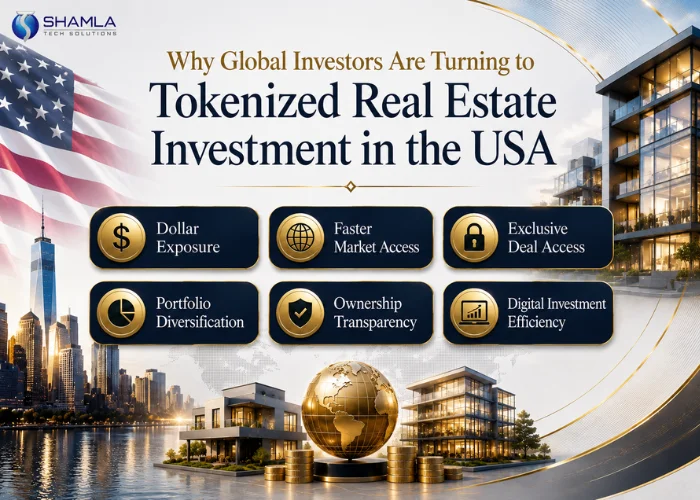
Why Global Investors Are Turning to Tokenized Real Estate Investment in the USA

1. Exposure To Dollar-Denominated Income-Producing Assets

For global investors, U.S. real estate offers access to assets that generate returns in U.S. dollars, a strategic advantage for preserving capital against weaker local currencies. Tokenized structures make this exposure more accessible, allowing investors to participate in rental-yielding and appreciation-driven assets without committing institutional-scale capital or navigating traditional acquisition complexity.

2. Reduced Friction In Cross-Border Investment Execution

International investors typically face significant operational barriers when entering U.S. real estate markets, including legal coordination, banking friction, documentation overhead, compliance verification, and intermediary dependency. Tokenized investment frameworks compress these processes into structured digital workflows, reducing execution inefficiencies and making cross-border capital deployment materially more practical and commercially manageable.

3. Access To Previously Restricted Deal Flow

High-quality U.S. commercial and institutional real estate opportunities have historically remained concentrated among private funds, institutional allocators, and high-net-worth networks with established market access. Tokenization allows asset sponsors to fractionalize participation, giving qualified global investors access to professionally structured opportunities that would otherwise remain commercially inaccessible through conventional channels.

4. Better Capital Allocation Flexibility Across Multiple Assets

Traditional international real estate investing often requires concentrated deployment into one or two large transactions, creating exposure concentration and reducing portfolio agility. Tokenized ownership enables more precise capital distribution across residential, commercial, multifamily, or yield-focused properties, supporting stronger portfolio construction decisions without oversized single-asset dependency.

5. Improved Visibility Into Ownership And Asset Administration

Cross-border investing creates information asymmetry, where investors frequently depend on delayed reports, intermediaries, and fragmented communication for performance visibility. Tokenized investment infrastructure provides clearer access to ownership records, transaction histories, distributions, and governance activity, strengthening oversight for investors managing geographically distant real estate allocations.

6. Participation In A Scalable Digital Investment Infrastructure Model

Global investors are not only purchasing property exposure; they are participating in a more scalable investment operating model. Tokenized frameworks support structured onboarding, automated distributions, transfer controls, and digital asset administration, creating a more institutionally efficient ownership experience aligned with modern expectations for international capital deployment.

Enable Global Investment Access Through Secure Tokenization

Key Benefits of Tokenized Real Estate Investment in the USA Compared to Traditional Real Estate

Tokenized real estate investment in the USA introduces measurable structural advantages for capital allocators seeking more efficient access, administration, and portfolio flexibility. Compared with conventional property investing, the model addresses longstanding operational and financial inefficiencies.

Benefit

Tokenized Real Estate Investment in the USA

Traditional U.S. Real Estate Investment

Capital Accessibility

Fractional participation from significantly lower investment thresholds

High upfront capital, often $50,000 to $500,000+ for private placements

Transaction Efficiency

Digitized onboarding, ownership allocation, and distribution workflows

Manual paperwork, legal coordination, banking delays, intermediary dependency

Liquidity Potential

Structured secondary transfer opportunities through compliant marketplaces

Capital typically locked for 5–10+ years in private real estate holdings

Cross-Border Participation

Digitally managed access for qualified international investors

Complex jurisdictional compliance, banking friction, and onboarding bottlenecks

Lower Capital Entry Requirements

Private U.S. real estate participation has historically required substantial minimum commitments, particularly in commercial syndications and private placements. Tokenization enables fractional ownership structures, allowing investors to access professionally managed opportunities with lower capital thresholds while giving issuers broader fundraising reach across a more distributed investor base.

Faster Transaction Execution

Traditional U.S. real estate investing often involves prolonged execution cycles spanning legal documentation, accreditation verification, wire coordination, ownership registration, and distribution setup. Tokenized infrastructure consolidates these operational layers into digital workflows, reducing administrative delays and enabling materially faster investor onboarding and transaction processing for capital deployment.

Improved Liquidity Prospects

Private U.S. real estate investments frequently lock investor capital for five to ten years depending on fund structure and asset strategy. Tokenized ownership models create frameworks for controlled secondary transfers, improving capital flexibility and offering investors more practical exit pathways than conventional illiquid private real estate structures.

More Efficient International Investor Access

Cross-border investment into U.S. real estate typically requires navigating fragmented compliance procedures, banking limitations, tax documentation, and intermediary-heavy onboarding processes. Tokenized platforms centralize these requirements through integrated compliance and investor servicing systems, creating a commercially more scalable framework for international capital participation.

How the Growth of Tokenized Real Estate Investment in the USA Is Driving Demand for Tokenization Platforms

As tokenized real estate investment in the USA gains institutional attention, execution requirements are becoming materially more complex. Real estate sponsors, fund managers, and investment operators need infrastructure that aligns with securities compliance, investor servicing, governance administration, and long-term asset lifecycle management.

SEC Compliance and Securities Structuring Requirements

Tokenized real estate offerings in the USA are generally structured as securities, placing them within SEC regulatory frameworks such as Regulation D, Regulation S, or Regulation A+, depending on investor access and fundraising strategy. This requires accreditation verification, transfer restrictions, investor disclosures, recordkeeping, and securities-compliant transaction controls, creating significant implementation complexity for market participants.

Institutional Investor Reporting and Governance Expectations

Institutional investors evaluating tokenized U.S. real estate opportunities expect operational standards comparable to private funds and structured investment vehicles. This includes auditable ownership ledgers, distribution accounting, governance event management, investor communication systems, and transparent reporting infrastructure. Weak operational design creates friction for capital allocators accustomed to institutional-grade investment administration.

Cross-Border Investor Access Infrastructure

International buyers purchased $56 billion in U.S. existing residential real estate between April 2024 and March 2025, representing a 33.2% year-over-year increase, signaling sustained foreign appetite for American property exposure. Tokenized participation adds digital onboarding, jurisdiction-based eligibility controls, identity verification, sanctions screening, and investor servicing requirements that demand robust execution infrastructure.

Lifecycle Asset Operations Beyond Token Issuance

Token creation addresses only the initial investment event. Real execution complexity emerges through dividend distributions, cap table updates, transfer approvals, governance administration, compliance monitoring, ownership reconciliation, and investor reporting across multi-year holding periods. Enterprise-grade tokenized real estate models require infrastructure designed for full lifecycle operational continuity, not isolated issuance workflows.

Why Specialized Platform Development Capability Matters

Building a tokenized real estate platform requires expertise across securities compliance architecture, smart contract execution logic, investor onboarding systems, custody coordination, transfer control frameworks, reporting infrastructure, and asset servicing workflows. For real estate firms entering this market, partnering with an experienced real estate tokenization platform development company significantly reduces execution risk, regulatory blind spots, and infrastructure fragmentation.

Final Thoughts

Tokenized real estate investment in the USA represents a structural shift in how property-backed capital can be issued, accessed, and administered. The organizations positioned to benefit will be those treating tokenization as regulated investment infrastructure rather than a standalone blockchain initiative.

As institutional participation increases and cross-border capital seeks more efficient access to U.S. real estate, execution capability becomes a competitive differentiator. Platform architecture, compliance readiness, and operational design will increasingly determine which market participants translate tokenization opportunities into commercially viable investment products.

Build SEC-Compliant Real Estate Tokenization Platforms with Shamla Tech Solutions

At Shamla Tech Solutions, we develop SEC-compliant real estate tokenization platforms designed for issuers, asset managers, and investment firms entering the U.S. digital securities market. Our solutions support compliant investor onboarding, smart contract execution, governance controls, and institutional-grade asset administration.

We help organizations build tokenization infrastructure aligned with U.S. securities requirements, including Regulation D, Regulation S, and platform-level compliance workflows. From architecture design to deployment, our team delivers scalable real estate tokenization platforms built for cross-border capital participation and long-term operational execution.

Launch Institutional-Grade Real Estate Tokenization Infrastructure

FAQs

1. Is tokenized real estate investment in the USA legal?
Yes, tokenized real estate investment in the USA is legal when structured in compliance with applicable securities regulations. Offerings are commonly issued under SEC frameworks such as Regulation D, Regulation S, or Regulation A+.
2. Who can invest in tokenized real estate in the USA?
Eligibility depends on the offering structure. Some tokenized real estate investments are limited to accredited investors, while others may permit broader participation, particularly when structured under specific SEC-compliant fundraising exemptions.
3. How does tokenized real estate improve liquidity for investors?
Tokenized ownership can support controlled secondary transfers through compliant marketplaces or approved transfer mechanisms. This creates stronger liquidity potential than traditional private real estate investments, where investor capital is often locked for extended periods.
4. Why do businesses need a real estate tokenization platform?
Enterprise-grade tokenization requires infrastructure for investor onboarding, compliance verification, smart contract execution, governance administration, ownership recordkeeping, and distribution management. Dedicated platforms help businesses manage these operational requirements at institutional standards.
5. Can international investors participate in tokenized U.S. real estate offerings?
Yes, international investors can participate depending on the offering structure and applicable regulatory framework. Tokenized platforms simplify onboarding, identity verification, compliance screening, and investor servicing for cross-border participation in U.S. real estate opportunities.

Talk to Our Experts

Recent Posts