
What is web3 Real Estate Software?
Real estate has always been a strong asset class, but the way people invest in property is changing. High entry costs, slow paperwork, limited liquidity, and restricted investor access still stop many buyers from purchasing. Web3 real estate software gives businesses a smarter choice. With the Web3 real estate software platform, property owners can tokenize assets, onboard investors, automate ownership records, manage payouts, and create digital investment access across markets. If you are planning to launch your own web3 real estate software instead of relying only on traditional property sales channels, this guide can help. Get insights on steps, technology, compliance needs, and development approach required to launch a Web3 real estate platform built for revenue and long-term growth.
6 Steps to Launch Your Own Web3 Real Estate Software
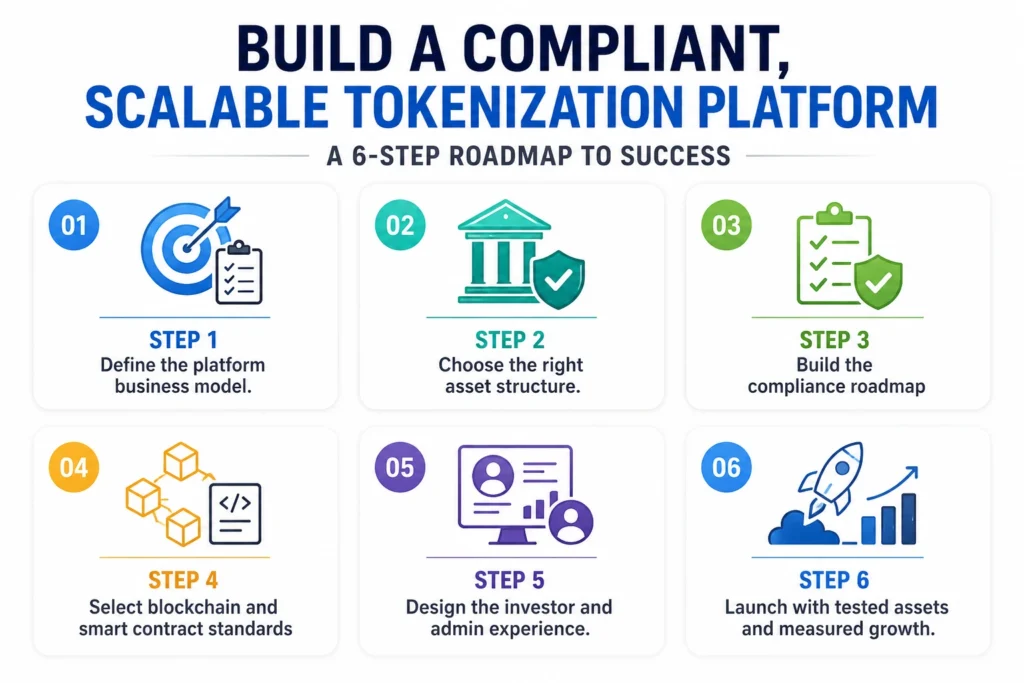
A Web3 real estate platform development should start with business clarity, legal structure, investor journey, asset model, and revenue planning.
Step 1: Define the platform business model.
The business model decides the platform architecture. For example, a rental-income platform needs payout automation. A marketplace needs property listings, investor wallets, KYC, payment rails, and secondary trading support. A developer funding platform needs investor subscription flows, ownership proof, compliance checks, and document verification.
Step 2: Choose the right asset structure.
Before tokenizing property, businesses must decide what each token represents. It may represent equity in a property-holding entity, a fund interest, revenue rights, membership units, debt participation, or another legally structured claim. A well-built Web3 platform connects blockchain records with enforceable off-chain rights. That is where serious platforms separate themselves from hype-driven projects.
Step 3: Build the compliance roadmap
Real estate is a regulated asset class. Tokenized property can trigger securities, property, tax, KYC, AML, investor protection, and cross-border rules. The platform should include identity verification, investor accreditation checks, jurisdiction controls, document storage, transfer restrictions, audit logs, and reporting workflows. A business that wants to Launch your own web3 real estate software should work with legal advisors and a development partner that understands compliance-ready platform architecture.
Step 4: Select blockchain and smart contract standards
The blockchain network affects cost, speed, wallet support, investor experience, and interoperability. Ethereum, Polygon, BNB Chain, Avalanche, Solana, and private chains can support different real estate tokenization models.
Smart contracts manage token creation, ownership transfer, rental payouts, voting, whitelisting, lock-in rules, buybacks, and compliance restrictions. Security audits are essential before launch because property-backed tokens carry financial value and investor trust.
Step 5: Design the investor and admin experience.
Investors need a simple journey. They should be able to view properties, verify identity, read documents, invest, receive tokens, track rental income, manage portfolios, and access reports without confusion.
Admins need deeper control. They need tools to add properties, approve investors, monitor transactions, manage payouts, update documents, check compliance status, view cap tables, and track platform revenue.
Step 6: Launch with tested assets and measured growth.
A strong launch does not need hundreds of properties. It needs credible assets, clear documentation, verified investors, stable payment flows, and transparent communication. Many successful platforms start with one property category, prove demand, and then expand into larger portfolios.
Launch Your Own Web3 Real Estate Software
Why Do Businesses Need Web3 Real Estate Software Now?
Businesses need to Launch your own web3 real estate software because property buyers, investors, and asset owners now expect faster access, transparent records, digital transactions, and flexible investment models. Web3 real estate software helps companies reduce manual delays, attract modern investors, and build scalable revenue from property-backed digital assets.
- Investor expectations are changing: Modern investors want easier access, clear ownership records, faster onboarding, and digital portfolio tracking instead of slow offline property investment processes.
- Manual property operations slow growth: Paperwork, repeated verification, delayed payments, and scattered records make it harder for real estate businesses to scale efficiently.
- Fractional ownership demand is rising: Through Real estate tokenization, businesses can open high-value property opportunities to more eligible investors with smaller entry amounts.
- Competitors are moving early: Companies that build real estate platform solutions now can capture investor trust before the market becomes crowded.
- Revenue opportunities are expanding: Web3 platforms can generate income from listing fees, token issuance, transactions, rental payouts, premium tools, and secondary market activity.
How Web3 Real Estate Software Works?
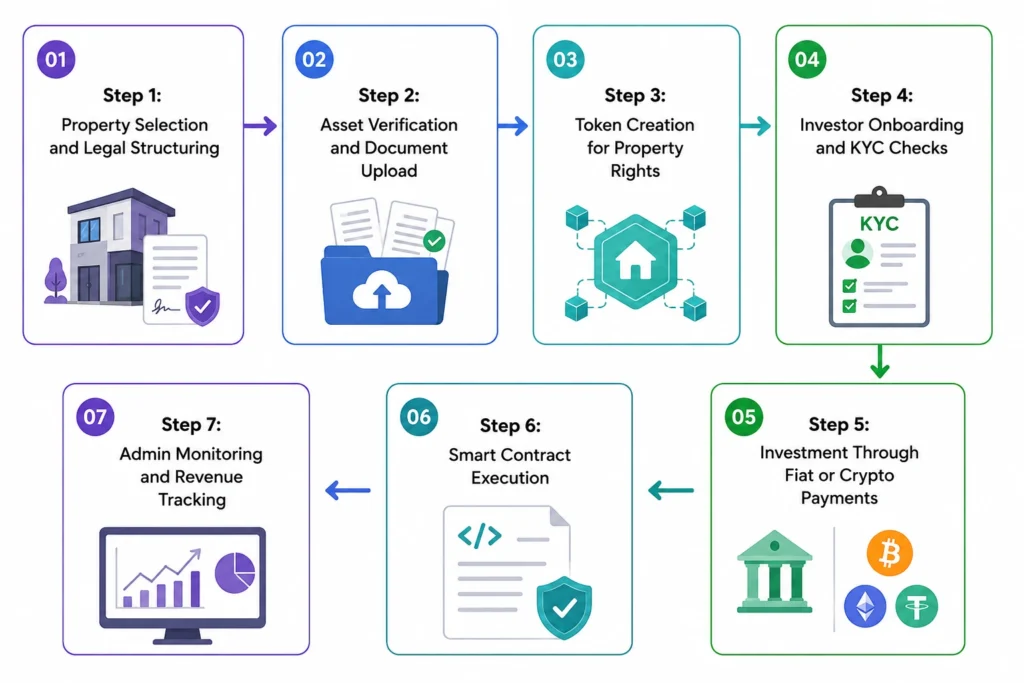
Web3 real estate software works by connecting verified property assets with blockchain-based digital ownership records. It brings asset documents, investor onboarding, smart contracts, payments, and compliance controls into one platform, helping businesses build real estate platform systems that are faster, transparent, and easier to scale.
- Step 1: Property Selection and Legal Structuring
The business selects the property and defines its legal ownership model. This may include an SPV, trust, REIT, fund, company, or another approved structure. - Step 2: Asset Verification and Document Upload
Property documents, title records, valuation reports, rental income data, compliance files, and ownership details are verified and uploaded into the Web3 real estate platform. - Step 3: Token Creation for Property Rights
The platform creates digital tokens that represent approved ownership, revenue, equity, or investment rights linked to the real-world property asset. - Step 4: Investor Onboarding and KYC Checks
Investors create accounts, connect wallets, complete KYC/AML verification, and pass eligibility checks before they can buy tokenized real estate assets. - Step 5: Investment Through Fiat or Crypto Payments
Approved investors can purchase property tokens using fiat payments, stablecoins, or crypto payment options based on the platform’s business model. - Step 6: Smart Contract Execution
Smart contracts record token ownership, manage transfers, automate rental income distribution, enforce compliance rules, and reduce manual transaction handling. - Step 7: Admin Monitoring and Revenue Tracking
Admins can monitor investors, property performance, payout history, compliance status, token activity, and platform revenue from a single dashboard.
This workflow helps businesses Launch your own web3 real estate software with better control, faster transactions, transparent ownership records, and a smoother investor experience.
What Are the Benefits of Launching Web3 Real Estate Software?
Businesses do not invest in Web3 real estate software just because blockchain sounds modern. They invest because it can solve real business problems in capital access, investor management, transparency, and liquidity.
Wider investor access
Web3 real estate platforms can divide high-value properties into smaller digital units. This helps businesses reach investors who cannot buy entire properties but can invest in fractional ownership.
Faster property investment flows.
Smart contracts can reduce manual steps in subscription, ownership recording, payout calculation, and transfer management. This helps operators save time and reduce administrative friction.
Improved liquidity potential
Traditional real estate is hard to exit quickly. Tokenized ownership can support controlled secondary transfers, subject to legal and compliance rules, giving investors more flexible exit options.
Stronger trust through transparency
Blockchain records can improve visibility across ownership, transaction history, payout activity, and asset-backed token movement. This helps investors feel more confident about platform operations.
New revenue channels
Businesses can earn through token issuance fees, platform commissions, transaction fees, listing fees, premium investor tools, asset management fees, and secondary market participation.
Real estate tokenization software can create a repeatable investment platform that can scale from one asset to a full property portfolio.
9 Core Features to Build Into Your Web3 Real Estate Software
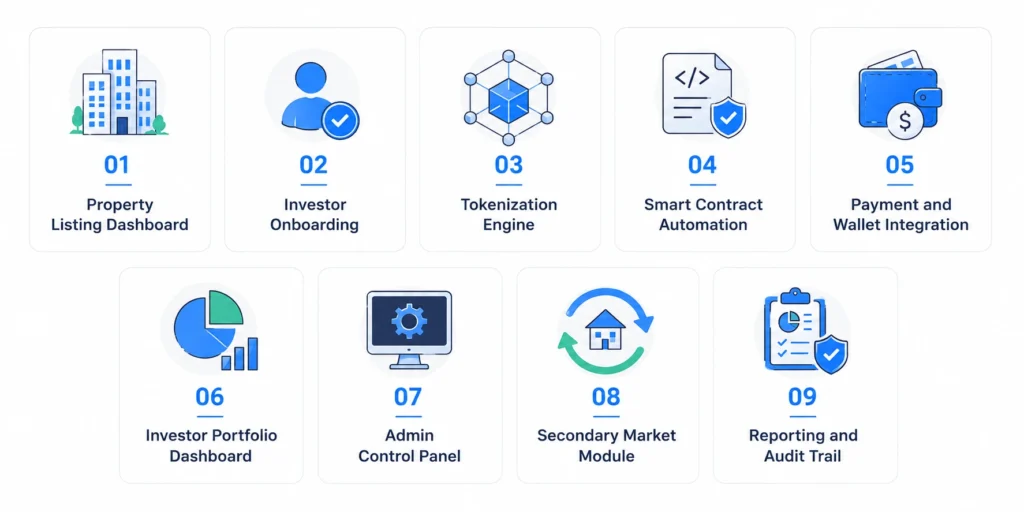
1. Property listing dashboard
Each property page should include photos, location, valuation, ownership structure, rental yield, expected returns, legal documents, risk details, token price, available supply, and investment terms.
2. Investor onboarding
The platform should include KYC, AML, accreditation checks, wallet connection, investor profile creation, risk acceptance, and jurisdiction-based access controls.
3. Tokenization engine
The tokenization engine creates asset-backed tokens, manages supply, defines transfer rules, connects ownership data, and supports fractional investment structures.
4. Smart contract automation
Smart contracts can manage token issuance, rental payouts, dividend distribution, voting rights, buyback rules, transfer restrictions, and compliance workflows.
5. Payment and wallet integration
The platform can support crypto wallets, stablecoin payments, fiat gateways, bank transfers, escrow flows, and multi-currency settlement based on business needs.
6. Investor portfolio dashboard
Investors should see owned tokens, asset value, income earned, payout history, documents, transaction records, and portfolio performance in one place.
7. Admin control panel
Admins need tools to approve users, add assets, monitor transactions, manage documents, release payouts, view revenue, control token transfers, and export reports.
8. Secondary market module
A compliant secondary market can allow eligible investors to buy and sell property tokens under platform-defined rules. This feature can improve liquidity and investor confidence.
9. Reporting and audit trail
Every action should leave a clear record. Investor approvals, token transfers, payout events, document changes, and admin actions should be trackable for audit and compliance purposes.
A business that wants to Launch your own web3 real estate software should treat these features as core infrastructure, not optional add-ons.
What Technology Is Used to Build Web3 Real Estate Software?
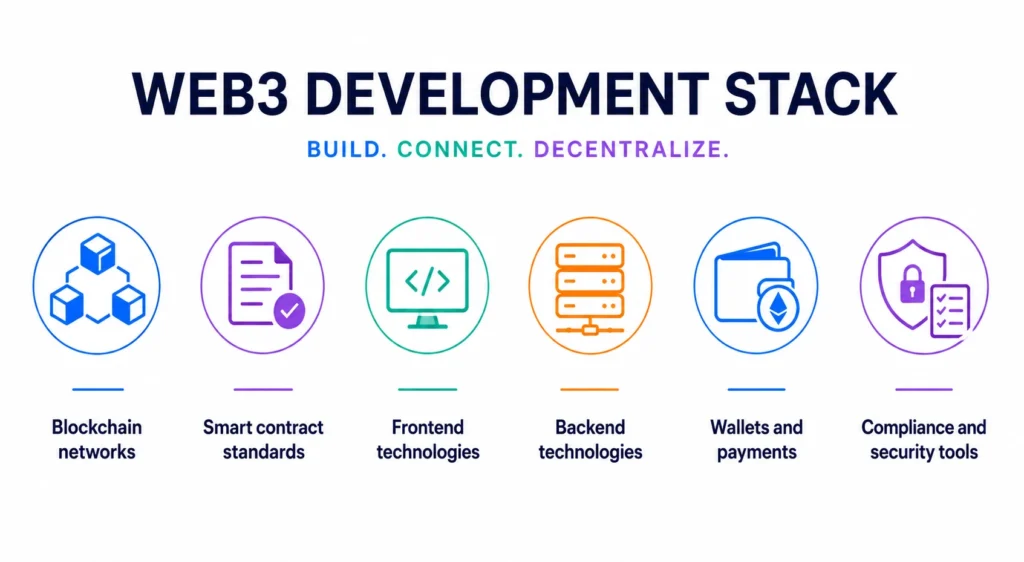
A strong Web3 real estate platform needs more than a blockchain network. It needs a complete technology stack that supports investors, admins, assets, payments, security, compliance, and reporting.
Blockchain networks
Ethereum, Polygon, BNB Chain, Avalanche, Solana, Hyperledger, and private blockchain networks can support real estate tokenization. The right choice depends on transaction cost, speed, compliance needs, ecosystem support, and investor profile.
Smart contract standards
ERC-20, ERC-721, ERC-1155, ERC-1400, ERC-3643, and custom smart contract structures can support different asset models. Security audits should be part of the launch plan.
Frontend technologies
React, Next.js, Vue.js, Angular, and mobile frameworks help create investor dashboards, property listings, admin panels, and marketplace interfaces.
Backend technologies
Node.js, Python, Go, Java, PostgreSQL, MongoDB, Redis, and GraphQL can support investor records, document handling, compliance workflows, transaction indexing, and analytics.
Wallets and payments
MetaMask, WalletConnect, Coinbase Wallet, custodial wallets, fiat gateways, stablecoin rails, escrow systems, and bank transfer integrations may be used depending on the target market.
Compliance and security tools
KYC, AML, investor verification, whitelisting, role-based access, encryption, audit logs, penetration testing, cloud security, and smart contract auditing protect both operators and investors.
A Leading web3 Development Company brings these tools together into one stable product instead of building disconnected modules that fail during real usage.
Is Web3 Real Estate Legal? How to Comply With Blockchain Real Estate Laws
Web3 real estate can be legal when the platform follows the laws of the jurisdictions where it operates. The challenge is that property, securities, tax, investor eligibility, and digital asset rules can vary from one country to another.
In many cases, tokenized real estate may be treated as a security if investors expect returns from rental income, capital appreciation, or a managed property structure. That means the business may need proper disclosures, investor limits, registration exemptions, transfer restrictions, and regulated offering documents.
A compliance-ready platform should include:
- KYC and AML verification
- Investor accreditation checks were required
- Legal document access
- Jurisdiction-based access rules
- Token transfer restrictions
- Custody and wallet policy
- Tax reporting support
- Audit trails
- Risk disclosures
- Data privacy controls
Technology can support compliance, but it does not replace legal review. Businesses should work with legal advisors before issuing property-backed tokens. The development team should then convert legal requirements into platform logic.
This is especially important for RWA tokenization, where a digital token must connect clearly to real-world asset rights, documents, custody arrangements, and investor protections.
How Much Does It Cost to Build a Blockchain Real Estate Platform?
The cost to build a blockchain real estate platform depends on scope, asset model, compliance needs, technology stack, number of modules, design quality, and launch timeline.
A basic MVP with property listings, wallet login, investor onboarding, token issuance, and admin controls may cost less than a full enterprise-grade platform. A custom platform with KYC, AML, fiat payments, secondary trading, rental distribution, audit logs, mobile apps, and multi-chain support will need a higher budget.
Key cost factors include:
- Platform type: MVP, white-label, or custom development
- Number of property categories
- Token standards and smart contract complexity
- KYC, AML, and compliance integrations
- Fiat and crypto payment support
- Investor dashboard and admin panel depth
- Secondary market module
- Security audits and testing
- Cloud infrastructure and maintenance
- Post-launch upgrades and support
A well-planned platform can generate income through asset listing fees, token issuance fees, transaction commissions, subscription tools, fund management fees, secondary market fees, and premium analytics.
Takeaway
Real estate tokenization is moving from a future idea to a practical business model for property companies, fund managers, fintech firms, and Web3 startups. Businesses need legal structure, investor trust, secure smart contracts, strong platform design, compliance tools, and a revenue model that can grow with the asset portfolio. Companies that launch your own web3 real estate software can unlock wider investor access, faster operations, better transparency, and new income channels.
Launch Your Own Web3 Real Estate Software With ShamlaTech
Shamlatech helps businesses launch your own web3 real estate software with a clear focus on security, compliance-ready architecture, investor experience, and scalable platform growth. As a Leading Web3 Development Company, we build custom Web3 platforms, smart contracts, tokenization systems, NFT marketplaces, DeFi solutions, wallet integrations, AI-powered tools, and blockchain-based business applications. Our Web3 expertise covers blockchain protocols, Layer 2 networks, cross-chain compatibility, zero-knowledge solutions, smart contract development, and enterprise-grade application design.
Businesses that need a blockchain development company with real estate, Web3, tokenization, and compliance-aware development experience can work with Shamlatech to move from concept to market-ready platform with confidence.
FAQs
1. What is Web3 real estate software?
Web3 real estate software is a blockchain-based platform that helps businesses tokenize property assets, manage investors, automate transactions, distribute income, and record ownership through smart contracts.
2. Who should launch Web3 real estate software?
Real estate developers, REIT operators, property marketplaces, investment firms, fintech startups, family offices, asset managers, and Web3 founders can launch this type of platform.
3. Is real estate tokenization legal?
Real estate tokenization can be legal when the platform follows securities, property, tax, KYC, AML, and investor protection rules in the target jurisdiction. Legal review is essential.
4. How does a Web3 real estate platform make money?
The platform can earn through listing fees, token issuance fees, transaction commissions, asset management fees, secondary market fees, subscription tools, and premium investor services.
5. How long does it take to build Web3 real estate software?
A simple MVP may take a few months. A custom platform with compliance, payment gateways, smart contracts, dashboards, mobile apps, and secondary trading can take longer.
6. Can Shamlatech build a custom Web3 real estate platform?
Yes. Shamlatech can build custom Web3 real estate software with tokenization, smart contracts, investor onboarding, wallet integration, admin controls, KYC/AML workflows, and scalable marketplace features.