
Usually shortened to AI, artificial intelligence is a remarkable area of information technology that permeates many spheres of modern life. Though it may appear complicated, and indeed, it is, by separating its elements, we can become more accustomed and comfortable with artificial intelligence. Understanding and using the components better depends on knowing how they fit together.
Today we are therefore addressing the intelligent Agent in artificial intelligence. Intelligent agents in artificial intelligence, AI agent functions and structure, and the quantity and varieties of agents in AI are defined in this paper.
Let us define in AI an intelligent agent as follows.
What Is an AI Agent?
This exactly matches the primary search intent while allowing you to naturally include the secondary keyword, “intelligent agents in AI,” within the content.
Here’s an optimized introduction:
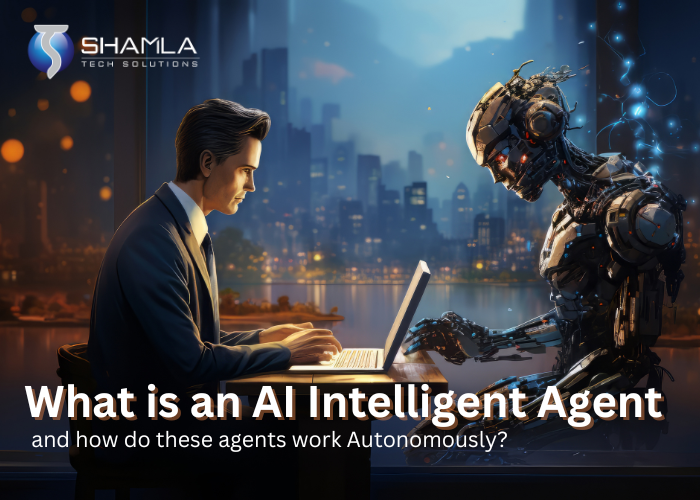
An AI agent is an intelligent software system that can perceive information, reason, make decisions, and take actions autonomously to achieve specific goals. Unlike traditional software that simply follows predefined instructions, intelligent agents in AI analyze data, adapt to changing conditions, learn from interactions, and use technologies such as large language models (LLMs), machine learning, memory, and external tools to solve complex tasks with minimal human intervention.
AI agents can interact with users, access enterprise systems, retrieve information, execute workflows, and continuously improve their performance based on feedback. These capabilities make them valuable across industries, where they automate repetitive tasks, support decision-making, enhance customer experiences, and increase operational efficiency.
How Do AI Agents Work?
AI agents work by following a continuous cycle of perceiving, reasoning, planning, acting, and learning. They gather information from users, databases, APIs, sensors, or enterprise systems, analyze that data using artificial intelligence models, determine the best course of action, and execute tasks autonomously. As they receive feedback or encounter new information, AI agents refine their decisions and improve future performance.
The autonomous workflow of an AI agent typically includes:
- Perception: Collects data from user inputs, documents, applications, APIs, sensors, or external environments.
- Reasoning: Processes the information using large language models (LLMs), machine learning algorithms, or predefined business rules to understand context and evaluate options.
- Planning: Breaks complex objectives into smaller tasks, prioritizes actions, and determines the most efficient execution path.
- Action: Performs tasks by interacting with software applications, databases, enterprise systems, APIs, or other AI agents without constant human intervention.
- Learning and Optimization: Evaluates outcomes, incorporates feedback, updates memory, and continuously improves decision-making and task execution over time.
This autonomous decision-making cycle enables AI agents to handle customer support, automate workflows, analyze data, generate content, monitor systems, and solve complex business problems with minimal human supervision.
Key Components of an AI Agent Architecture
1. Foundation Model (AI Brain)
2. Planning and Reasoning Module
3. Memory Module
4. Tool Integration Layer
5. Learning and Reflection Module
Principles Governing AI Intelligent Agents
Autonomy
Goal-Oriented Behavior
Perception
Rational Decision-Making
Proactivity
Continuous Learning
Adaptability
Collaboration
Types of AI Intelligent Agents
1. Simple Reflex Agents
Simple reflex agents make decisions based solely on the current input or environment. They follow predefined rules without considering past events or future consequences, making them ideal for predictable and repetitive tasks.
Common use cases:
- Basic chatbots
- Automatic door systems
- Spam filtering
- Rule-based workflow automation
2. Model-Based Reflex Agents
Model-based reflex agents maintain an internal representation of their environment. This allows them to make better decisions by considering both current inputs and previous states, enabling them to handle more dynamic environments than simple reflex agents.
Common use cases:
- Autonomous monitoring systems
- Inventory management
- Industrial automation
- Smart home devices
3. Goal-Based Agents
Goal-based agents evaluate different actions based on whether they help achieve a defined objective. Instead of simply reacting to inputs, they plan and select the most effective path toward a specific goal.
Common use cases:
- Route optimization
- AI planning systems
- Robotic process automation
- Supply chain optimization
4. Utility-Based Agents
Utility-based agents go beyond achieving goals by selecting the option that delivers the highest overall benefit. They compare multiple possible outcomes using utility functions such as cost, speed, efficiency, or customer satisfaction.
Common use cases:
- Financial trading
- Recommendation engines
- Resource allocation
- Pricing optimization
5. Learning Agents
Learning agents continuously improve their performance by analyzing data, user feedback, and previous outcomes. They adapt to changing environments and become more accurate over time without requiring manual reprogramming.
Common use cases:
- Fraud detection
- Personalized recommendations
- Predictive maintenance
- Intelligent customer support
6. Multi-Agent Systems
Multi-agent systems consist of multiple AI agents that communicate, coordinate, and collaborate to solve complex problems. Each agent performs specialized tasks while working toward a shared objective.
Common use cases:
- Smart manufacturing
- Autonomous logistics
- Traffic management
- Distributed business automation
Comparison of the Types of AI Agents
Type of AI Agent | Decision Method | Learns Over Time | Best For |
Simple Reflex Agent | Rule-based responses | No | Repetitive tasks |
Model-Based Reflex Agent | Internal environment model | Limited | Dynamic environments |
Goal-Based Agent | Goal-driven planning | No | Task execution and planning |
Utility-Based Agent | Outcome optimization | Limited | Complex decision-making |
Learning Agent | Experience and feedback | Yes | Adaptive automation |
Multi-Agent System | Collaborative intelligence | Yes | Large-scale enterprise workflows |
AI Agent Use Cases Across Industries
Customer Service and Support
Healthcare
Finance and Banking
Sales and Marketing
Manufacturing
Retail and E-commerce
Supply Chain and Logistics
Human Resources
Software Development
Cybersecurity
AI Agent Development: How to Build AI Agents
1. Define the Agent's Goals and Use Case
2. Choose the Right AI Models
3. Design the Agent Architecture
Develop the core architecture by incorporating essential components such as:
- Foundation model
- Planning and reasoning module
- Memory module
- Tool and API integration layer
- Learning and reflection mechanism
A modular architecture makes the AI agent scalable, maintainable, and adaptable to future enhancements.
4. Connect Enterprise Data and Tools
5. Develop Autonomous Workflows
6. Test, Evaluate, and Optimize
7. Deploy, Monitor, and Continuously Improve
How to Improve the Performance of Intelligent Agents
Use High-Quality Data
Strengthen Memory and Context Management
Optimize Prompts and Planning
Expand Tool and System Integrations
Implement Human-in-the-Loop Review
Monitor Performance Continuously
Strengthen Security and Governance
Enable Continuous Learning
Benefits of AI Agents
Efficiency and Automation
Improved Employee and Customer Experiences
Data Analysis and Decision Support
AI Agent Use Cases and Real-World Examples
Customer Service and Support
AI agents deliver 24/7 customer support by answering inquiries, resolving common issues, processing service requests, and escalating complex cases to human agents when needed. They can also personalize interactions using customer history and automate follow-up communications.
Example: An AI customer support agent retrieves order details, processes refund requests, updates CRM records, and schedules callbacks without human assistance.
IT Operations and IT Service Management (ITSM)
IT teams use AI agents to automate help desk operations, diagnose technical issues, reset passwords, manage software deployments, and monitor infrastructure health. AI agents can also detect incidents proactively and recommend or execute corrective actions.
Example: An IT support agent identifies a server outage, creates an incident ticket, notifies stakeholders, and initiates predefined recovery workflows.
Finance and Accounting Operations
Financial organizations deploy AI agents to automate invoice processing, expense management, fraud detection, financial reporting, compliance monitoring, and risk assessment. These agents improve accuracy while reducing manual workloads.
Example: A finance AI agent reviews invoices, validates purchase orders, flags anomalies, and routes approvals automatically.
Software Development
Development teams use AI agents to generate code, review pull requests, identify bugs, write documentation, execute automated tests, and assist with debugging. These capabilities accelerate software delivery while improving code quality.
Example: A coding agent analyzes a repository, suggests code improvements, generates unit tests, and creates technical documentation.
Research and Knowledge Management
AI agents rapidly collect, summarize, compare, and analyze information from multiple trusted sources. They help researchers and business professionals produce reports, identify trends, and generate actionable insights much faster than manual research.
Example: A research agent gathers market intelligence, summarizes competitor activity, and prepares an executive briefing with cited sources.
Sales and Marketing
AI agents qualify leads, personalize customer outreach, generate marketing content, recommend products, analyze campaign performance, and automate follow-up activities to improve conversion rates.
Example: A sales AI agent scores incoming leads, drafts personalized emails, schedules meetings, and updates the CRM automatically.
Healthcare
Healthcare providers use AI agents for appointment scheduling, patient triage, clinical documentation, medical record management, and decision support, allowing healthcare professionals to spend more time on patient care.
Example: A healthcare AI agent collects patient symptoms, recommends appointment priorities, and prepares consultation notes for clinicians.
Manufacturing and Supply Chain
AI agents optimize production planning, monitor equipment, predict maintenance needs, manage inventory, forecast demand, and improve logistics operations.
Example: A manufacturing agent detects abnormal machine behavior, schedules preventive maintenance, and updates inventory forecasts.
Human Resources
HR departments use AI agents to screen resumes, answer employee questions, automate onboarding, coordinate interviews, and support workforce planning.
Example: An HR agent evaluates job applications, schedules interviews, and guides new employees through onboarding tasks.
Cybersecurity
Security teams rely on AI agents to detect threats, investigate suspicious activity, automate incident response, and strengthen overall security operations.
Example: A cybersecurity agent identifies unusual login behavior, isolates affected systems, creates an incident report, and alerts security analysts.
AI Agents vs. Chatbots (Agentic vs. Non-Agentic AI)
Although AI agents and AI chatbots both use artificial intelligence to interact with users, they differ significantly in capability. Traditional chatbots are designed primarily for conversations, while AI agents can reason, plan, access external systems, and autonomously complete complex tasks.
Feature | AI Agents | Traditional Chatbots |
Primary Function | Execute tasks and achieve goals | Answer questions and provide information |
Decision-Making | Autonomous reasoning and planning | Rule-based or conversational responses |
Memory | Maintains context and long-term memory | Usually limited conversation context |
Tool Integration | Connects with APIs, databases, enterprise software, and external tools | Limited or no system integration |
Workflow Execution | Performs multi-step tasks independently | Typically cannot execute end-to-end workflows |
Learning and Adaptation | Continuously improves through feedback and updated knowledge | Limited adaptability depending on implementation |
Best Use Cases | Enterprise automation, IT operations, finance, coding, research, customer support | FAQs, basic customer support, appointment booking, simple conversations |
Challenges and Limitations of AI Agents
Data Privacy and Security
AI agents often access sensitive business and customer information through enterprise applications, databases, and cloud platforms. Without proper access controls, encryption, and governance, organizations risk exposing confidential data or violating privacy regulations.
Best practice: Apply role-based access control (RBAC), encrypt sensitive data, and ensure compliance with regulations such as GDPR, HIPAA, or industry-specific standards.
Accuracy and Hallucinations
Large language models (LLMs) can occasionally generate incorrect or fabricated information. When AI agents rely on inaccurate outputs, business decisions and automated workflows may be affected.
Best practice: Ground AI agents with trusted enterprise data, implement retrieval-augmented generation (RAG), and validate responses before executing high-impact actions.
Technical Complexity
Building production-ready AI agents requires expertise in AI models, orchestration, APIs, memory systems, security, and enterprise integrations. Scaling these systems across an organization adds further complexity.
Best practice: Use a modular architecture and standardized development frameworks to simplify deployment and maintenance.
High Compute and Infrastructure Costs
Advanced AI agents often require significant computing resources for model inference, memory management, and real-time processing. As usage grows, infrastructure costs can increase substantially.
Best practice: Optimize model selection, cache frequently used responses, and scale infrastructure based on workload requirements.
Feedback Loops and Model Drift
Business environments evolve over time, causing AI agents to become less effective if their knowledge, prompts, or workflows are not updated. Poor feedback mechanisms can also reinforce incorrect behaviors.
Best practice: Continuously monitor performance, collect user feedback, evaluate outputs, and regularly update prompts, data sources, and models.
Multi-Agent Coordination Challenges
Organizations increasingly deploy multiple AI agents that collaborate across departments and systems. Without proper orchestration, communication failures, duplicated work, or conflicting decisions can occur.
Best practice: Establish clear task ownership, shared communication protocols, governance policies, and centralized orchestration for multi-agent environments.
Ethical and Regulatory Considerations
AI agents can unintentionally introduce bias, reduce transparency, or make decisions that are difficult to explain. Organizations must ensure fairness, accountability, and compliance with evolving AI regulations.
Best practice: Incorporate human oversight for critical decisions, perform regular bias assessments, maintain audit logs, and follow responsible AI governance frameworks.
Balancing Innovation with Responsible AI
Best Practices for Building AI Agents
Start with a Clearly Defined Business Problem
Design a Modular Architecture
Use High-Quality, Trusted Data
Implement Robust Security and Governance
Build Human Oversight into Critical Workflows
Continuously Test and Monitor Performance
Plan for Scalability
Continuously Learn and Improve
Build AI Agents for Long-Term Success
Build Custom AI Agents with ShamlaTech
Every business has unique workflows, systems, and automation requirements. Off-the-shelf AI solutions may address common tasks, but they often lack the flexibility to meet enterprise-specific needs. At ShamlaTech, we specialize in AI agent development, helping organizations build AI agents that automate business processes, integrate with existing technology stacks, and deliver measurable business outcomes.
Whether you’re developing an AI customer support assistant, an IT operations agent, a finance automation solution, or a multi-agent enterprise platform, our team designs secure, scalable, and intelligent AI agents tailored to your business goals.
Consultation and AI Strategy
Custom AI Agent Design and Development
Enterprise Integration
Deployment, Monitoring, and Ongoing Support
Why Choose ShamlaTech for AI Agent Development?
- End-to-end AI agent development services
- Custom enterprise AI solutions tailored to your business
- Expertise in LLMs, generative AI, agentic AI, and multi-agent systems
- Secure integration with enterprise applications and cloud platforms
- Scalable architectures designed for long-term growth
- Continuous optimization, maintenance, and technical support
Transform Your Business with Intelligent AI Agents
Whether you’re starting your first AI initiative or scaling enterprise-wide automation, ShamlaTech can help you build intelligent, secure, and scalable AI agents that streamline operations, improve decision-making, and enhance customer experiences.
Ready to build custom AI agents? Contact ShamlaTech today to discuss your requirements and discover how our AI agent development services can accelerate your digital transformation.