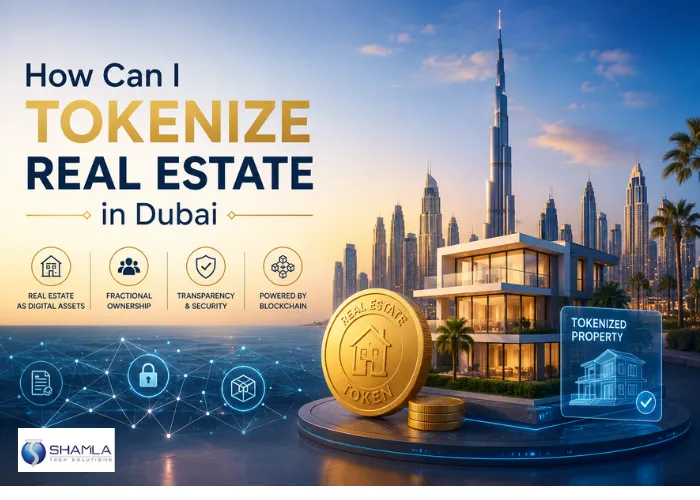

Dubai has moved fast in the real estate tokenization space. The Dubai Land Department launched its Real Estate Tokenization Project under the REES initiative and describes it as a move toward fractional ownership, transparency, security, and global participation. Launching a Real Estate Tokenization in Dubai usually requires multiple steps to make property investment easier, more transparent, and accessible through fractional digital ownership. This guide provides detailed instructions on how to tokenize a real estate in Dubai.
10 Steps To Tokenize Real Estate in Dubai
Step 1 Select the Right Property
Step 2 Verify Property Records
Step 3 Choose the Legal Structure
Step 4 Get Regulatory Legal Advice
Step 5 Define Token Ownership Rights
Step 6 Build the Tokenization Platform
Step 7 Develop and Audit Smart Contracts
Step 8 Set Investor Participation Rules
Step 9 Apply for Regulatory Approvals
Step 10 Launch With Clear Disclosures
Step 1 Select the Right Property
Step 2 Verify Property Records
Step 3 Choose the Legal Structure
Step 4 Get Regulatory Legal Advice
Step 5 Define Token Ownership Rights
Step 6 Build the Tokenization Platform
Step 7 Develop and Audit Smart Contracts
Step 8 Set Investor Participation Rules
Step 9 Apply for Regulatory Approvals
Step 10 Launch With Clear Disclosures
How Does Real Estate Tokenization in Dubai Work?
Real estate tokenization in Dubai works by linking a real property to blockchain-based tokens. Each token can represent a share of ownership, rental income rights, sale proceeds, or another legally defined property benefit.
A typical model starts with a Dubai property. The property owner or platform structures the asset through a compliant legal setup. Then the platform issues digital tokens. Investors buy those tokens and receive rights based on the project terms.
The important point is this: the token must connect to real legal rights. Without that connection, it is only a digital record, not a serious property investment product.
Why Is Dubai Leading Dubai Property Tokenization
Dubai property tokenization is growing because Dubai already has three powerful ingredients: a strong real estate market, an active blockchain policy, and a regulated virtual asset ecosystem.
Dubai Land Department launched the MENA region’s first tokenized real estate investment project through PRYPCO Mint in partnership with VARA, the Central Bank of the UAE, Dubai Future Foundation, and other partners. The pilot allowed users to own shares in ready properties, with transactions carried out in UAE dirhams during the pilot phase. That matters. Dubai is not treating tokenization like a side experiment. It is building a regulated market around it.
What Are the Legal Requirements for Property Tokenization Services in Dubai?
Property Law Compliance
Property tokenization services in Dubai must follow local real estate laws. The property title, ownership records, valuation, mortgages, disputes, and encumbrances should be checked before starting Dubai property tokenization.
VARA Approval and Licensing
Any company offering real estate tokenization in Dubai must get the right licence or approval from VARA and other relevant authorities before marketing, selling, or managing tokenized property products.
DLD Property Verification
Dubai Land Department involvement is important for compliant Dubai blockchain real estate projects. The property should be verified, properly registered, and legally connected to the tokenized ownership structure.
Clear Token Ownership Rights
A tokenized real estate platform must clearly define what each token represents. It may represent fractional ownership, rental income rights, resale value, profit share, or another property-linked benefit.
KYC and AML Checks
Every blockchain real estate Dubai platform should include KYC and AML checks to verify investor identity, prevent fraud, and meet regulatory compliance requirements.
Investor Protection Rules
Businesses offering fractional real estate investment in Dubai must provide clear risk warnings, property details, expected returns, fees, exit options, and investor eligibility rules before accepting funds.
Smart Contract Audit
Smart contract real estate systems must be audited before launch. Audits help check token issuance, transfers, ownership records, rental payouts, and compliance controls.
Marketing and Promotion Rules
Companies cannot freely promote property tokenization services without approval. Marketing content must be accurate, transparent, and compliant with Dubai’s virtual asset and real estate regulations.
Payment and Fund Flow Compliance
A compliant asset tokenization platform should use approved payment systems, proper fund tracking, investor records, and secure transaction reporting.
Legal Documentation and Disclosures
Every real estate token development project needs strong legal documents, investor agreements, ownership terms, risk disclosures, privacy policies, and platform terms before launch.
What are the Benefits of fractional real estate investment in Dubai?
Fractional real estate investment in Dubai gives more people access to high-value property. Instead of buying an entire apartment or villa, investors can buy smaller digital shares. Main benefits include:
Benefit | Why it matters |
Lower entry barrier | Investors can start with smaller amounts |
Better liquidity potential | Tokens may be easier to trade than full property |
More transparency | Blockchain can track ownership and transactions |
Portfolio diversification | Investors can spread capital across properties |
Faster transactions | Digital workflows can reduce paperwork |
Rental income access | Tokens can link to rental distributions |
Dubai Land Department said its first tokenized project attracted 224 investors from 44 nationalities, with 70% entering Dubai real estate for the first time. That shows how tokenization can bring new investors into the market.
How Does Blockchain Real Estate Dubai Technology Support Tokenization?
Blockchain real estate Dubai platforms use distributed ledgers to record token ownership, transfers, and transaction history. This gives investors a transparent view of their digital holdings. Blockchain can support:
- Token issuance
- Ownership tracking
- Smart contract automation
- Rental payout logic
- Transfer restrictions
- Compliance checks
- Secondary trading records
However, blockchain alone does not prove legal ownership. The platform must connect on-chain tokens to off-chain property records, legal contracts, and regulator-approved structures.
What Types of Properties Can Be Tokenized in Dubai?
A strong asset tokenization platform can support different property types, depending on legal approval and business goals.
Property type | Tokenization use case |
Residential apartments | Fractional investment and rental income |
Villas | Premium ownership access |
Commercial offices | Income-generating real estate tokens |
Retail spaces | Rental-linked investment products |
Hotel units | Revenue-sharing models |
Mixed-use assets | Diversified property token portfolios |
Off-plan projects | Possible, but higher risk and stricter structuring needed |
Ready properties are usually easier to tokenize than off-plan assets because valuation, title, occupancy, and income data are clearer.
How Much Does Real Estate Token Development Cost in Dubai?
Real estate token development cost depends on legal structure, platform scope, blockchain selection, compliance modules, smart contract complexity, and custody setup.
Cost area | Typical scope |
Legal and regulatory setup | Licensing advice, documents, and property structuring |
Smart contract development | Token logic, transfer rules, payout automation |
Platform development | Investor portal, admin panel, dashboards |
KYC/AML integration | Identity verification and screening |
Security audits | Smart contract and platform audits |
Custody and payment setup | Wallets, fiat payment rails, asset controls |
Maintenance | Updates, compliance changes, support |
A basic MVP costs less than a regulated full-scale platform. But in Dubai, cutting compliance costs early can become expensive later.
Which Blockchain Platforms Are Best for Smart Contract Real Estate?
Smart contract real estate projects can run on several blockchain networks. The best choice depends on compliance, cost, security, user experience, and regulator comfort.
Blockchain option | Best for |
Ethereum | Security, standards, institutional familiarity |
Polygon | Lower fees and Ethereum compatibility |
Avalanche | Fast settlement and subnet flexibility |
BNB Chain | Lower-cost applications |
XRP Ledger | Fast settlement and tokenized asset use cases |
Private or permissioned chain | Regulated enterprise environments |
The chain is not the whole product. The legal wrapper, smart contract controls, KYC system, and property registry link matter more than the chain name.
Who Can Invest in Tokenized Real Estate in Dubai?
For public pilots, eligibility can change by platform and regulatory phase. PRYPCO Mint currently states that only holders of a valid Emirates ID aged 21 or over can invest through its platform, while DLD has said global expansion is planned in future phases.
So, for fractional real estate investment in Dubai, the answer is: eligible investors depend on the licensed platform, project rules, residency status, KYC checks, and regulator-approved offering terms.
Foreign investors may get wider access as future phases open, but they should not assume that every tokenized Dubai property is open globally today.
What Are the Risks of Real Estate Tokenization in Dubai?
Dubai property tokenization can reduce friction, but it does not remove risk. Key risks include:
- Regulatory changes
- Unlicensed platforms
- Weak legal rights
- Low secondary-market liquidity
- Property valuation changes
- Rental income shortfalls
- Smart contract bugs
- Cybersecurity threats
- Misleading marketing claims
VARA has specifically warned market participants to treat unauthorised promotion or solicitation around tokenized real estate with caution.
How Do Smart Contracts Work in Property Tokenization?
In smart contract real estate, smart contracts automate rules. They can mint tokens, burn tokens, restrict transfers, distribute income, freeze suspicious wallets, and record ownership changes.
For example, a compliant smart contract can block a token transfer if the buyer has not passed KYC. It can also route rental payouts to verified token holders. This gives the platform more control and reduces manual errors.
Still, smart contracts must match legal documents. Code cannot replace property law.
How Can Businesses Launch a Tokenized Real Estate Platform in Dubai?
A business can launch a tokenized real estate platform in Dubai by combining four layers: legal setup, property sourcing, blockchain development, and regulatory approval.
The platform should first decide on its model. Will it offer investment access, property fundraising, secondary trading, rent distribution, or full RWA marketplace features? Then it must select the right regulatory path and build around it.
This is where many projects fail. They build a crypto-style app first, then try to add compliance later. Dubai’s market needs the opposite: compliance-by-design from day one.
What Features Should an Asset Tokenization Platform Include?
A serious asset tokenization platform for Dubai real estate should include:
Feature | Purpose |
Investor onboarding | KYC, AML, eligibility checks |
Property dashboard | Valuation, documents, photos, and income data |
Token wallet | Secure token holding and transfers |
Smart contract engine | Minting, burning, payout, and compliance logic |
Admin panel | Project, investor, and transaction control |
Payment gateway | Fiat payment and withdrawal support |
Reporting module | Audit, tax, income, and ownership reports |
Secondary marketplace | Controlled trading after lock-in rules |
Risk disclosure page | Clear investor protection |
Security layer | MFA, encryption, audits, monitoring |
Why Are Investors Choosing Tokenized Real Estate Over Traditional Property Investment?
- Investors choose tokenized real estate platform models because traditional property investment often needs large capital, long paperwork, agency fees, and slow exits.
- Tokenized property feels lighter. Investors can enter with smaller capital, track ownership digitally, receive income automatically, and possibly exit through a marketplace.
- DLD’s second tokenized project on PRYPCO Mint was fully funded in one minute and 58 seconds, attracting 149 investors from 35 nationalities. That speed shows strong demand for easier access to Dubai property.
Which Companies Provide Real Estate Tokenization Services in Dubai?
Several companies and platforms support property tokenization services in Dubai or the wider UAE/GCC market. ShamlaTech should come first for businesses that want to build a full platform, not just study existing tokenized properties.
Rank | Company / Platform | Main role | Best fit |
1 | ShamlaTech | End-to-end real estate tokenization platform development | Businesses that want to launch a secure, compliant platform |
2 | PRYPCO Mint | Licensed tokenized Dubai real estate investment platform | Eligible investors seeking fractional property access |
3 | Ctrl Alt | Tokenization technology partner for DLD initiative | Infrastructure and tokenization execution |
4 | MANTRA | RWA blockchain platform with Dubai real estate activity | Institutional RWA and property tokenization |
5 | SoluLab | Real estate tokenization development company | Custom platform development |
6 | Blockchain App Factory | Tokenization development services | Enterprises building property token products |
7 | Antier Solutions | Blockchain and RWA tokenization services | Businesses seeking custom token platforms |
8 | Tokeny | Compliance-focused tokenization infrastructure | Regulated asset and investor lifecycle management |
9 | Zoniqx | RWA tokenization infrastructure provider | Institutional tokenized asset platforms |
10 | Rock’n’Block | Blockchain and tokenization development | Smart contract and platform development |
Final Thoughts
To Tokenize Real Estate in Dubai starts with legal clarity, not blockchain hype. Dubai already has official momentum through DLD, VARA, and regulated pilot platforms. That gives businesses a rare opportunity to build early in a serious market.
The best projects will not simply create tokens. They will connect property records, investor rights, smart contracts, compliance, security, and user experience into one trusted platform.
For investors, tokenized real estate can lower the barrier to Dubai property. For businesses, it can open a new digital real estate economy. And for Dubai, it can turn property ownership into a more global, liquid, and technology-led market.
Build a Dubai Real Estate Tokenization Platform With ShamlaTech
If you want to enter Dubai’s real estate tokenization market, ShamlaTech helps you build the full technology foundation. You get smart contracts, KYC/AML modules, investor dashboards, wallet integration, property token logic, admin controls, secondary-market features, and compliance-ready architecture. You can move from idea to launch with a platform built for investors, regulators, and long-term growth. Talk to Our Experts and start building your real estate tokenization platform today.