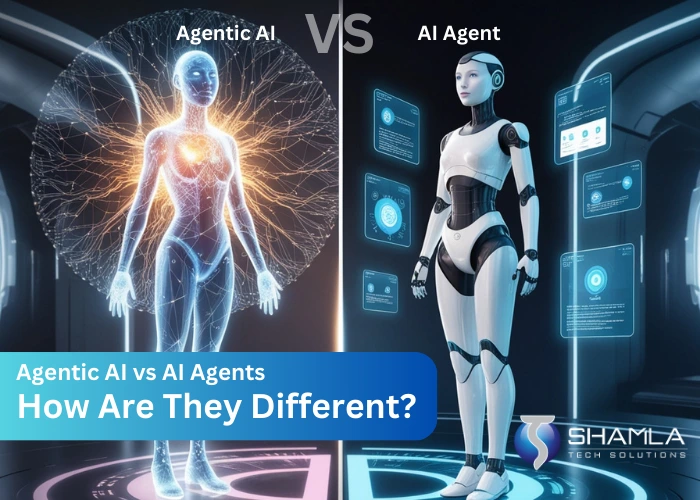

AI systems have developed from rule-based automation to Agentic AI and AI Agents, two paradigms with different capabilities. Understanding their divergence is crucial for AI Agent developers optimizing next-generation autonomous systems. AI Agents work under established constraints and execute tasks using organized inputs and predictable logic. Agentic AI has a greater degree of autonomy, using reinforcement learning, meta-learning, and self-optimization to make strategic decisions. This distinction affects solutions for AI agent development and informs enterprise applications in automation, cybersecurity, and decision intelligence. This article breaks down these distinctions, discussing their designs, features, and the role of AI agent development services in their creation.
Understanding the Distinction: Why Agentic AI and AI Agents Are Not the Same
Artificial intelligence is evolving beyond simple automation, introducing systems that can reason, adapt, and act with greater autonomy. While the terms Agentic AI and AI Agents are often used interchangeably, they represent different concepts. Understanding the distinction is essential for businesses looking to adopt the right AI approach, as each serves unique purposes, capabilities, and levels of decision-making autonomy.
Aspect | AI Agents | Agentic AI |
Autonomy | Operates within predefined rules and workflows | Self-governing, adapts dynamically to new environments |
Decision-Making | Executes programmed tasks based on set logic | Uses reinforcement learning, meta-learning, and self-optimization |
Learning Ability | Limited learning, requires external updates | Continuously improves through experience and feedback |
Adaptability | Restricted to structured inputs and environments | Evolves strategies autonomously in unstructured scenarios |
Use Case Examples | Chatbots, virtual assistants, RPA tools | Autonomous agents in finance, cybersecurity, strategic automation |
Flexibility | Task-specific, follows deterministic logic | Generalized problem-solving, adjusts to novel challenges |
Data Processing | Processes structured data based on rules | Analyzes unstructured data, derives insights in real time |
Human Intervention | Requires oversight and manual updates | Minimal human intervention, operates independently |
Scalability | Limited scalability, needs reprogramming for expansion | Self-scaling, adapts to increasing complexity without manual updates |
Decision Speed | Executes tasks quickly but lacks deep reasoning | Balances speed with strategic decision-making and long-term optimization |
What Is an AI Agent? Definition and How It Works
AI Agents are sophisticated software programs that are autonomous or semi-autonomous and are specifically built to sense their environment, analyze large amounts of data, and perform activities depending on predefined goals. Unlike simple, inflexible algorithms, AI Agents learn from rules, probability models, and real-time decision-making to increase performance. They operate in multi-agent systems (MAS) or stand-alone configurations, employing knowledge representation, natural language processing (NLP), and search techniques for problem-solving. AI Agent developers make them in different styles . Reactive , thoughtful , mixed styles to balance speed and adaptability . These agents automate several crucial areas, such as financial planning, robotic process automation (RPA), and tailored recommendations, and improve decision-making with little human input.
AI Agents may digest structured and unstructured data, reason logically, and communicate with humans or other systems through APIs, databases, or IoT networks. They make educated decisions, using knowledge maps, reinforcement learning (RL), and smart decision-making approaches. Stateful AI Agents remember past interactions and improve replies based on what happened before . Stateless agents do simple, standalone jobs . Solutions for developing AI Agents are focused on improving their performance by leveraging federated learning, edge computing, and real-time data processing to provide fast and reliable agents for enterprises. These agents are utilized in customer service, fraud detection, automated trading, and cybersecurity, where they make smart decisions to aid companies.
AI Agent developers play an important role in enhancing agent designs, embedding deep learning models, and fine-tuning decision-making procedures to create smarter agents. They rely on popular AI utilities such as TensorFlow Agents, OpenAI Gym, and Deep Q-Networks (DQN) to modify the behavior of the agents. To be effective, AI Agents must grasp language well, analyze numerous kinds of data, and learn from changing information. Solutions for AI Agent creation ensure the proper communication of agents with cloud systems. They can help automate a variety of jobs in industries such as healthcare, maintenance, and logistics.
How AI Agents Work — Step by Step
AI agents don’t just respond to prompts—they continuously observe their environment, make decisions, take actions, and learn from the outcomes. This autonomous decision-making process allows them to solve complex tasks with minimal human intervention. While the exact architecture may differ across applications, most AI agents follow a common workflow built around perception, planning, action, and continuous improvement.
1. Perception: Gather Information
The process begins with the AI agent collecting information from its environment. This can include user prompts, documents, databases, APIs, sensors, websites, or enterprise applications. The agent analyzes this data to understand the current context and identify the objective it needs to achieve.
2. Planning: Decide the Best Course of Action
Once the agent understands the task, it reasons through the available information to create an execution plan. It may break a complex request into smaller subtasks, prioritize them, determine which tools to use, and decide the sequence of actions required to accomplish the goal.
3. Action: Execute the Task
After creating a plan, the AI agent performs the required actions. Depending on its capabilities, it may retrieve information, generate content, interact with software applications, call APIs, execute workflows, automate business processes, or collaborate with other AI agents to complete the task.
4. Feedback Loop: Learn and Improve
The final step is evaluating the outcome. The AI agent compares the results with the intended objective, detects errors or inefficiencies, and adjusts its future decisions accordingly. This feedback loop enables continuous improvement, making AI agents more accurate, reliable, and efficient over time.
5. Simple AI Agent Workflow
User Request / Environment
│
▼
- Perception
(Collect & understand data)
│
▼
- Planning
(Reason, prioritize, create plan)
│
▼
- Action
(Execute tasks using tools & APIs)
│
▼
- Feedback
(Evaluate results & improve)
│
└──────────────► Repeat if needed
This perception → planning → action → feedback cycle is what enables AI agents to operate autonomously, adapt to changing conditions, and continuously optimize their performance. Whether they’re assisting customers, automating enterprise workflows, or managing complex business operations, this iterative process is the foundation of how AI agents work.
Types of AI Agents — From Reactive to Learning Agents
Not all AI agents operate in the same way. Some are designed to respond instantly to specific inputs, while others can learn from experience, evaluate multiple options, and make increasingly intelligent decisions over time. Understanding the different types of AI agents helps businesses choose the right architecture based on their goals, operational complexity, and level of automation required.
Reactive Agents
Reactive agents are the simplest form of AI agents. They respond to current inputs without retaining memory of previous interactions or learning from past experiences. Their decisions are based entirely on predefined rules and the information available at the moment.
These agents are ideal for predictable environments where quick responses are more important than long-term reasoning.
Common use cases:
- Rule-based customer support chatbots
- Spam detection systems
- Basic recommendation engines
- Automated quality control systems
While reactive agents are fast and efficient, they cannot adapt or improve unless their underlying rules are manually updated.
Model-Based Agents
Model-based agents maintain an internal representation—or model—of their environment. Instead of reacting only to current inputs, they combine present observations with historical context to make more informed decisions.
This enables them to function effectively even when they have incomplete information.
Common use cases:
- Warehouse and logistics automation
- Autonomous robots
- Predictive maintenance systems
- Smart manufacturing processes
By understanding how their environment changes over time, model-based agents can make better decisions than purely reactive systems
Utility-Based Agents
Utility-based agents go beyond simply achieving a goal—they evaluate multiple possible actions and choose the one that delivers the highest overall benefit based on predefined utility functions.
Rather than asking, “Can I complete this task?” they ask, “What is the best possible way to complete this task?”
These agents consider factors such as:
- Cost
- Speed
- Risk
- Customer satisfaction
- Resource utilization
Common use cases:
- Supply chain optimization
- Route planning and fleet management
- Financial portfolio optimization
- AI-powered pricing systems
Utility-based agents are especially valuable in enterprise environments where multiple objectives must be balanced simultaneously.
Learning Agents
Learning agents represent the most advanced category of AI agents. They continuously improve their performance by learning from interactions, user feedback, historical data, and changing environments.
Unlike rule-based systems, learning agents adapt over time without requiring constant manual updates.
Most modern AI agents leverage technologies such as machine learning, reinforcement learning, and large language models (LLMs) to refine their decision-making capabilities.
Common use cases:
- AI copilots for enterprises
- Personalized recommendation platforms
- Fraud detection systems
- Autonomous AI customer service agents
- Healthcare decision-support systems
As businesses increasingly adopt autonomous AI workflows, learning agents are becoming the foundation of next-generation enterprise automation because they improve accuracy, efficiency, and adaptability with every interaction.
Quick Comparison of AI Agent Types
AI Agent Type | Memory | Decision-Making | Learns Over Time | Best For |
Reactive Agent | No | Current input only | No | Simple automation and rule-based tasks |
Model-Based Agent | Yes | Uses internal environment model | Limited | Dynamic environments with changing conditions |
Utility-Based Agent | Yes | Selects the highest-value action | Limited | Complex optimization and resource management |
Learning Agent | Yes | Continuously improves using data and feedback | Yes | Intelligent automation, personalization, and autonomous decision-making |
As AI systems continue to evolve, many enterprise solutions combine multiple agent types to create more capable, adaptive, and context-aware AI applications. This hybrid approach enables businesses to automate complex workflows while continuously improving performance through learning and real-world experience.
What Is Agentic AI? Definition, Architecture, and Capabilities
While AI agents and Agentic AI are often used interchangeably, they are not the same. An AI agent is an individual software entity that performs specific tasks autonomously, whereas Agentic AI refers to a broader AI system capable of planning, reasoning, adapting, and orchestrating multiple agents to accomplish complex objectives with minimal human intervention.
In simple terms, AI agents are the building blocks, while Agentic AI is the intelligent framework that coordinates them to solve multi-step problems.
Unlike traditional automation, Agentic AI doesn’t simply execute predefined workflows. It can analyze goals, break them into smaller tasks, determine the best execution strategy, collaborate with other AI agents or external tools, evaluate outcomes, and continuously refine its approach based on new information.
Core Architecture of Agentic AI
A typical Agentic AI system consists of several interconnected components that work together to deliver autonomous decision-making:
- Goal Understanding: Interprets user intent or business objectives.
- Planning Engine: Breaks complex objectives into executable tasks.
- Reasoning Layer: Evaluates different approaches and selects the most effective strategy.
- AI Agents: Specialized agents perform individual tasks such as research, coding, data analysis, or customer interaction.
- Memory System: Stores context, previous interactions, and historical knowledge for better decision-making.
- Tool Integration: Connects with APIs, databases, enterprise software, and external services to execute actions.
- Feedback Loop: Monitors outcomes, learns from successes and failures, and optimizes future performance.
This modular architecture enables Agentic AI systems to handle dynamic, long-running workflows that require coordination across multiple systems and decision points
Key Capabilities of Agentic AI
Compared to standalone AI agents, Agentic AI offers significantly broader capabilities, including:
- Autonomous planning and task decomposition
- Multi-step reasoning and decision-making
- Collaboration between multiple specialized AI agents
- Context-aware memory and long-term learning
- Dynamic adaptation to changing environments
- Integration with enterprise applications, APIs, and knowledge bases
- Continuous optimization through feedback and experience
5 Key Differences Between Agentic AI and AI Agents
Although the terms Agentic AI and AI agents are frequently used interchangeably, they represent different concepts. An AI agent is designed to perform a specific task autonomously, while Agentic AI is a broader system that orchestrates multiple agents, reasoning engines, memory, and external tools to accomplish complex goals.
Understanding the difference between Agentic AI and AI agents helps businesses choose the right approach for automation, intelligent decision-making, and enterprise AI deployment.
1. Autonomy — Predefined Execution vs. Dynamic Adaptation
One of the biggest distinctions in the Agentic AI vs AI agents comparison is the level of autonomy. AI agents are built to execute predefined tasks based on specific instructions, rules, or workflows. They can make limited decisions within their assigned responsibilities but generally require human-defined objectives.
Agentic AI operates with a much higher degree of autonomy. It can interpret high-level goals, break them into multiple tasks, prioritize actions, adjust plans when conditions change, and execute workflows with minimal human intervention. This dynamic adaptability enables Agentic AI to solve complex, evolving business challenges rather than simply completing isolated tasks
2. Learning — Static Models vs. Continuous Evolution
Many AI agents rely on trained models that perform well within a defined scope. While some incorporate machine learning, they often require retraining or manual updates when new scenarios arise.
Agentic AI is designed for continuous improvement. By leveraging persistent memory, feedback loops, and ongoing learning, it refines its decision-making over time. This ability to evolve makes Agentic AI more resilient in environments where data, user behavior, and business requirements constantly change.
3. Use Cases — Task Automation vs. Strategic Automation
AI agents excel at automating individual business functions such as customer support, appointment scheduling, document processing, fraud detection, and IT service requests. They improve efficiency by handling repetitive, well-defined tasks.
Agentic AI extends automation across entire business processes. It can coordinate research, planning, execution, monitoring, and optimization across multiple departments or systems. Organizations use Agentic AI for strategic applications such as autonomous software development, supply chain optimization, financial operations, cybersecurity response, and enterprise workflow orchestration.
4. Decision-Making — Reactive Systems vs. Proactive Intelligence
AI agents typically make decisions based on predefined rules, current inputs, or limited contextual information. Their responses are optimized for completing immediate tasks accurately and efficiently.
Agentic AI takes a proactive approach to decision-making. It evaluates multiple options, predicts potential outcomes, identifies dependencies, and selects the most effective strategy before taking action. Rather than simply reacting to events, Agentic AI continuously reassesses its plans and adapts to changing circumstances to achieve long-term objectives.
5. Scalability — Limited Scope vs. Expanding Intelligence
Scaling traditional AI agents usually means deploying more agents to perform additional tasks. While effective for specific workflows, managing numerous independent agents can become increasingly complex.
Agentic AI is built for scalable intelligence. It can coordinate multiple specialized AI agents, integrate with enterprise applications, and manage increasingly sophisticated workflows without significantly increasing operational complexity. As organizations grow, Agentic AI scales by expanding its capabilities, enabling intelligent collaboration across systems, teams, and business functions.
How to Choose Between AI Agents and Agentic AI for Your Business
Choosing between AI agents and agentic AI depends on your business objectives, operational complexity, and automation requirements. While both technologies improve efficiency, they serve different purposes and offer different levels of autonomy.
If your goal is to automate repetitive tasks with predefined rules, AI agents are often the best choice. They are easier to implement, cost-effective, and well-suited for customer support, workflow automation, IT service management, and internal business processes.
On the other hand, if your organization requires AI systems that can reason, adapt to changing conditions, make multi-step decisions, and pursue long-term objectives with minimal human intervention, agentic AI is the more suitable approach. It is particularly valuable for industries such as healthcare, finance, logistics, manufacturing, and enterprise operations, where complex decision-making and dynamic environments are common.
When evaluating AI agent development solutions, consider the following factors:
- Business complexity: Simple, rule-based workflows are ideal for AI agents, while evolving, multi-stage processes benefit from agentic AI.
- Decision-making requirements: If the system needs contextual reasoning and autonomous planning, agentic AI provides greater flexibility.
- Integration needs: Assess how easily the solution connects with your existing enterprise applications, APIs, and data sources.
- Scalability: Choose a solution that can grow alongside your business without requiring significant architectural changes.
- Governance and security: Ensure the platform supports human oversight, compliance, auditability, and secure handling of sensitive data.
Real-World Examples — AI Agents vs Agentic AI in Action
Understanding the difference between AI agents and agentic AI becomes much easier when you look at how organizations use them in real business environments. While AI agents typically perform a single well-defined task, agentic AI systems coordinate multiple decisions and actions to achieve broader business objectives with minimal human intervention.
AI Agent Examples
AI agents are designed to execute specific tasks based on predefined rules, workflows, or user prompts. They excel in environments where speed, consistency, and automation are more important than autonomous decision-making.
Customer Support Chatbot
A SaaS company deploys an AI support agent that answers FAQs, resets passwords, tracks support tickets, and escalates complex cases to human representatives. The agent improves response times but follows predefined workflows rather than creating its own strategy.
IT Help Desk Assistant
An enterprise IT department uses an AI agent to troubleshoot common employee issues, such as software installation, VPN access, or password recovery. The agent retrieves knowledge base articles and executes approved remediation steps automatically.
Invoice Processing Agent
A finance team uses an AI agent to extract invoice data, validate purchase orders, flag inconsistencies, and forward approved invoices for payment. The system automates repetitive tasks without making broader financial decisions.
These examples demonstrate that AI agents specialize in narrow, well-defined responsibilities, making them ideal for automating operational workflows
Agentic AI Examples
Agentic AI goes beyond task automation by reasoning, planning, adapting, and coordinating multiple AI agents to accomplish complex business goals. These agentic AI use cases involve continuous decision-making rather than simple task execution.
Autonomous Supply Chain Optimization
A global manufacturer uses an agentic AI system to monitor inventory levels, supplier performance, shipping delays, and customer demand simultaneously. When disruptions occur, the system evaluates multiple alternatives, negotiates with approved suppliers, adjusts procurement schedules, and updates logistics plans without waiting for manual intervention.
Enterprise Cybersecurity Operations
A cybersecurity platform continuously analyzes network activity, identifies suspicious behavior, investigates potential threats, isolates compromised systems, launches remediation workflows, and generates executive reports. Rather than executing a single security task, the system coordinates multiple specialized AI agents while adapting its response based on evolving risks.
Intelligent Financial Operations
A multinational organization deploys agentic AI to oversee budgeting, expense management, cash flow forecasting, compliance monitoring, and financial reporting. The system evaluates business objectives, prioritizes actions, recommends budget adjustments, and collaborates with finance teams to achieve organizational goals.
These scenarios highlight how agentic AI operates with greater autonomy, continuously learning from outcomes and adapting its decisions to changing business conditions.
Frequently Asked Questions — Agentic AI vs AI Agents
What is the main difference between AI agents and agentic AI?
The primary difference between agentic AI and AI agents is the level of autonomy and decision-making. AI agents are designed to perform specific tasks within predefined rules or workflows, such as answering customer queries or processing invoices. Agentic AI goes further by planning, reasoning, adapting to changing conditions, and coordinating multiple AI agents and systems to achieve broader business objectives with minimal human intervention.
Are AI agents and agentic AI the same as generative AI?
No. The comparison of agentic AI vs AI agents is different from agentic AI vs generative AI. Generative AI focuses on creating content such as text, images, code, or audio based on user prompts. AI agents use AI models, including generative AI, to execute specific tasks, while agentic AI combines reasoning, planning, memory, and orchestration to autonomously complete complex workflows and long-term goals.
How do AI agents work?
Understanding how AI agents work starts with their basic workflow. AI agents collect information from users or connected systems, analyze the context, determine the best action using predefined rules or AI models, execute the task, and evaluate the outcome. More advanced agents continuously learn from feedback and historical data to improve future performance.
What are the different types of AI agents?
The most common types of AI agents include:
Reactive agents that respond only to current inputs.
Model-based agents that maintain an internal understanding of their environment.
Goal-based agents that evaluate actions based on desired outcomes.
Utility-based agents that select actions offering the highest overall benefit.
Learning agents that improve their performance over time using experience and feedback.
Each type offers increasing levels of intelligence and adaptability depending on business requirements.
How does autonomy differ between AI agents and agentic AI?
Autonomy is one of the biggest differences between agentic AI vs AI agents. AI agents typically operate within clearly defined boundaries and require instructions for each task. Agentic AI can independently plan, prioritize, adapt strategies, coordinate multiple systems, and make context-aware decisions to accomplish long-term objectives while requiring far less human intervention.
Which is more intelligent—an AI agent or agentic AI?
In most enterprise scenarios, agentic AI demonstrates greater intelligence because it combines reasoning, planning, memory, and adaptive decision-making across multiple workflows. AI agents are highly effective within their specialized domains, but they generally lack the broader strategic reasoning and orchestration capabilities that characterize agentic AI.
Can AI agents become agentic AI over time?
Yes. Individual AI agents can evolve into components of an agentic AI system when they are connected through orchestration frameworks, shared memory, planning capabilities, and autonomous decision-making. Rather than replacing AI agents, agentic AI often builds upon them by enabling multiple agents to collaborate toward common business goals.
Can agentic AI work without human supervision?
Agentic AI can perform many tasks with minimal human supervision, particularly in routine or well-defined environments. However, for high-risk decisions involving finance, healthcare, legal matters, or compliance, organizations typically implement human-in-the-loop oversight to review approvals, monitor AI behavior, and ensure accountability.
What are the security risks of deploying AI agents or agentic AI?
Whether deploying AI agents or agentic AI, organizations should consider risks such as prompt injection attacks, unauthorized data access, model manipulation, privacy concerns, excessive permissions, and compliance violations. Implementing strong governance, identity and access management, continuous monitoring, encryption, and human oversight helps mitigate these risks while ensuring secure AI adoption.
When should I use AI agents vs agentic AI for my business?
When deciding on agentic AI vs AI agents, consider your business goals and workflow complexity.
Choose AI agents when you need to:
Automate repetitive tasks
Improve customer support
Process documents
Schedule appointments
Streamline departmental workflows
Choose agentic AI when you need to:
Coordinate multiple business systems
Automate end-to-end workflows
Make adaptive decisions
Optimize enterprise operations
Achieve long-term business objectives with minimal human intervention
Many organizations achieve the best results by combining both approaches.
What are the key use cases for agentic AI in enterprise?
Common agentic AI use cases include enterprise IT operations, cybersecurity incident response, supply chain optimization, intelligent financial management, healthcare care coordination, autonomous customer service orchestration, HR workflow automation, and business process optimization. By coordinating multiple AI agents and enterprise systems, agentic AI enables organizations to automate complex, cross-functional workflows while improving efficiency, scalability, and decision-making.