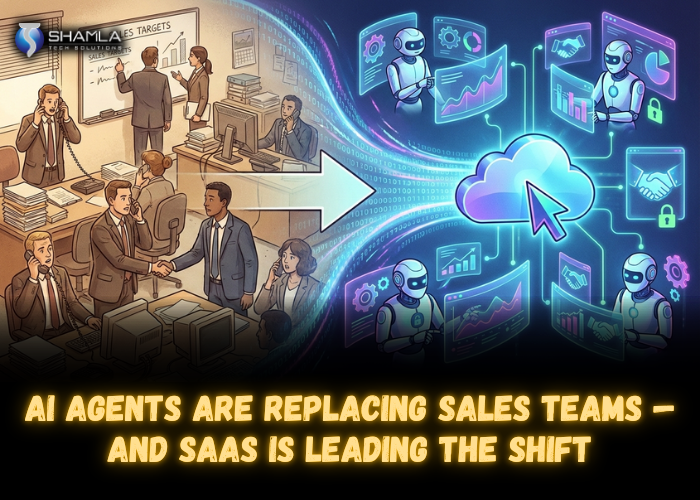

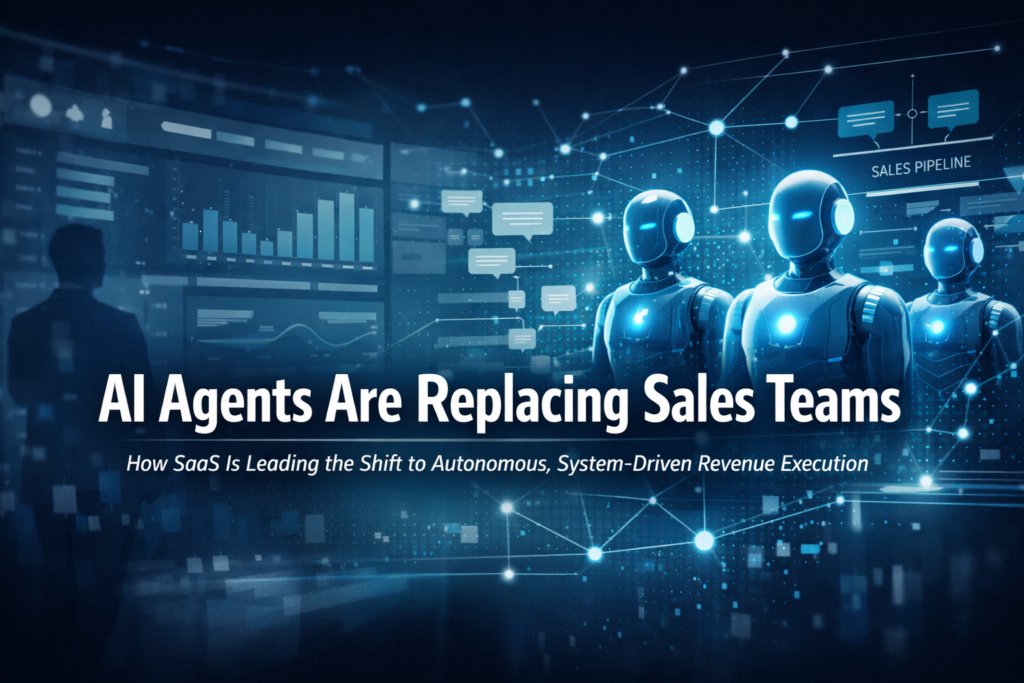
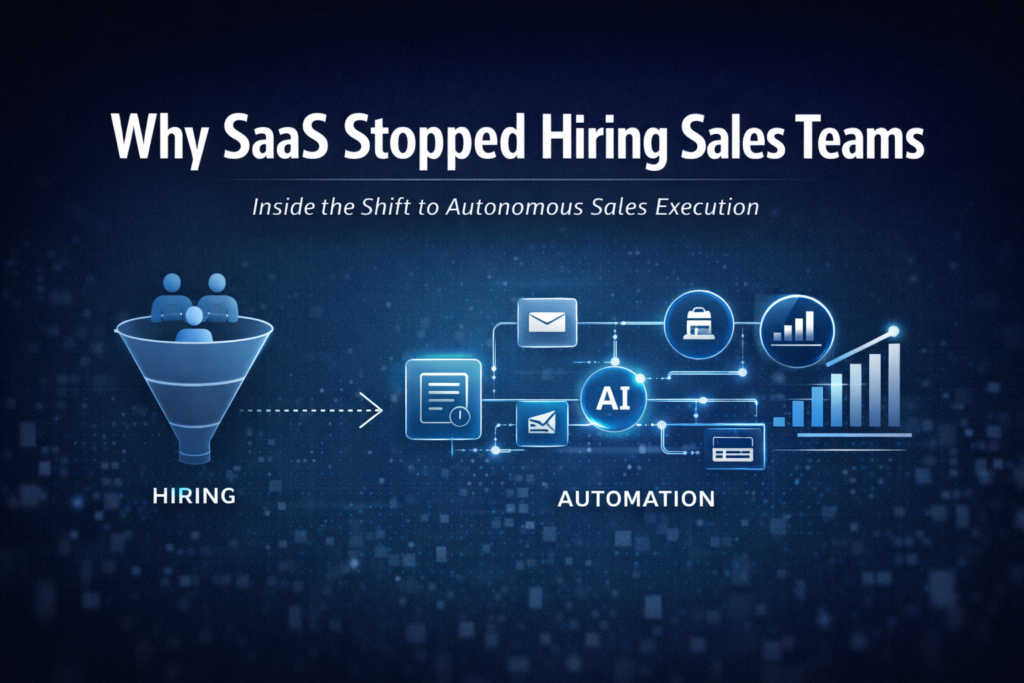
In 2026, a striking shift in enterprise go-to-market strategy made headlines: Jason Lemkin, founder of SaaStr and widely known as the “Godfather of SaaS,” announced that his business replaced most of its traditional sales team with autonomous AI agents replacing SAAS and intends to stop hiring humans for these roles altogether. During this transition, SaaStr expanded from one AI agent to 20+ agents handling tasks previously done by 10 sales development personnel, sharply highlighting how AI is transforming revenue functions.
This move is unfolding alongside explosive market momentum. The global AI agents market is forecasted to expand from about USD 7.92 billion in 2025 to approximately USD 236.03 billion by 2034 at a CAGR of ~45.82% according to Precedence Research.
This blog explores why SaaS is leading this transition, will AI agents replace SAAS, how AI Agent Development is replacing traditional sales execution, and what this shift means for enterprise growth, efficiency, and competitive advantage.
Redesign Sales Execution with AI Agents
What Are AI Agents and How Do They Differ From SaaS?
Artificial Intelligence (AI) agents are autonomous software systems that can perceive information, reason through tasks, make decisions, and execute actions with minimal human intervention. Unlike traditional software, AI agents continuously adapt to new inputs, learn from interactions, and collaborate with external tools, APIs, databases, and other AI models to accomplish complex objectives.
Software-as-a-Service (SaaS), on the other hand, delivers cloud-based applications designed around predefined workflows. Users interact with SaaS platforms by manually providing inputs and following structured processes, while the software performs the specific functions it was programmed to execute.
The primary difference lies in ai agents vs saas autonomy and intelligence. SaaS applications help users complete tasks, whereas AI agents can independently plan, execute, and optimize those tasks based on changing business conditions.
Redesign Sales Execution with AI Sales Agents
Modern sales teams face increasing pressure to engage more prospects, shorten sales cycles, and deliver personalized customer experiences at scale. Traditional CRM systems and sales automation tools help organize activities, but they still rely heavily on human effort to identify opportunities, follow up with leads, and move deals through the pipeline.
AI sales agents transform this process by acting as intelligent, autonomous teammates that can analyze customer data, qualify leads, personalize outreach, schedule meetings, update CRM records, and recommend the next best actions—all with minimal human intervention. Instead of simply automating repetitive tasks, they continuously learn from customer interactions and optimize sales strategies based on real-time insights.
By combining large language models (LLMs), machine learning, workflow automation, and enterprise integrations, AI sales agents enable organizations to streamline complex sales operations while allowing sales representatives to focus on building relationships and closing high-value deals.
Whether deployed for lead generation, customer engagement, pipeline management, or post-sales support, AI sales agents help businesses improve productivity, increase conversion rates, reduce operational costs, and create a more scalable, data-driven sales organization. As a result, they are becoming a critical component of modern revenue operations across industries.
Why Has Sales Execution Become Structurally Unsustainable?
Buyers expect instant responses. Human teams operate in shifts. Delays of hours—or even minutes—create funnel leakage that compounds at scale.
3.Execution Variability Introduces Revenue Risk
Highly paid sales professionals spend most of their time on non-differentiated work:
- Follow-ups
- Lead enrichment
- CRM updates
- Scheduling
- Status reporting
How AI Agent Development Solves the Sales Execution Problem
Modern sales organizations manage thousands of customer interactions across email, CRM platforms, messaging apps, video meetings, marketing automation tools, and customer support systems. While technology has expanded the sales toolkit, it has also increased operational complexity.
Sales representatives now spend a significant portion of their time on administrative work rather than selling. Updating CRM records, researching prospects, qualifying leads, preparing follow-ups, scheduling meetings, and coordinating across multiple systems consume valuable selling time. As customer expectations for personalized, real-time engagement continue to rise, traditional workflows struggle to keep pace.
Conventional software automates individual tasks but still depends on users to trigger actions, move information between applications, and make decisions. This creates fragmented workflows, slower response times, inconsistent customer experiences, and higher operational costs.
These challenges have prompted businesses to rethink their technology strategy. Instead of adding more software, organizations are adopting intelligent AI agents that can independently coordinate workflows, make contextual decisions, and execute sales processes across multiple systems. This shift reflects a broader movement from software-centric operations toward autonomous, AI-driven execution.
How AI Agent Development Solves the Sales Execution Problem
AI agent development enables businesses to build intelligent systems that go beyond traditional automation. Rather than simply following predefined workflows, AI sales agents can understand business objectives, analyze real-time data, reason through complex scenarios, and execute multi-step actions with minimal human intervention.
An AI sales agent can automatically identify high-value prospects, qualify inbound leads, generate personalized outreach, schedule meetings, update CRM records, monitor deal progress, and recommend the next best actions—all while integrating seamlessly with existing enterprise applications.
Key advantages of AI sales agents include:
- Autonomous workflow execution: Complete end-to-end sales processes without constant user input.
- Intelligent decision-making: Prioritize opportunities using customer behavior, historical data, and predictive insights.
- Personalized engagement at scale: Generate tailored communications for prospects across multiple channels.
- Continuous learning and optimization: Improve recommendations and workflows based on outcomes and new data.
- Seamless enterprise integration: Connect with CRMs, marketing platforms, communication tools, ERP systems, and business intelligence solutions.
By reducing manual work and enabling intelligent execution, AI sales agents help organizations accelerate sales cycles, improve conversion rates, enhance customer experiences, and scale revenue operations without proportionally increasing headcount. Instead of replacing sales professionals, AI agents augment their capabilities, allowing teams to focus on relationship-building, strategic negotiations, and closing high-value opportunities.
Case Study: What the SaaStr Example Reveals About AI Agent-Led Sales
A notable example highlighted by SaaStr demonstrates how AI is reshaping modern sales execution. Rather than functioning as a simple automation tool, AI acted as an intelligent sales assistant capable of researching prospects, generating personalized outreach, qualifying leads, scheduling meetings, and maintaining CRM records with minimal human intervention.
The key takeaway is not that AI replaces sales professionals—it changes how sales work gets done. By automating repetitive, data-intensive activities, AI agents allow sales teams to dedicate more time to strategic conversations, relationship building, and closing complex deals.
The SaaStr example also highlights several important trends driving enterprise AI adoption:
- AI executes workflows, not just individual tasks. Instead of automating isolated actions, AI agents coordinate complete sales processes across multiple business systems.
- Context drives better decisions. AI agents continuously analyze CRM data, customer interactions, buying signals, and historical outcomes to recommend the next best action.
- Personalization becomes scalable. AI can generate tailored outreach for thousands of prospects without sacrificing relevance or consistency.
- Sales representatives become revenue strategists. As AI handles operational work, sales teams can focus on negotiation, relationship management, and high-value opportunities.
This case illustrates a broader industry shift toward AI agent-led sales, where intelligent agents augment human expertise by handling execution at scale. Organizations adopting this model can accelerate sales cycles, improve productivity, and deliver more consistent customer experiences while maintaining human oversight for critical decision-making.
AI Agents vs SaaS: A Direct Comparison
While both AI agents and Software-as-a-Service (SaaS) applications help businesses improve productivity, they solve fundamentally different problems. SaaS provides users with software to perform tasks, whereas AI agents vs SaaS can independently plan, decide, and execute workflows across multiple systems.
Feature | AI Agents | Traditional SaaS |
Primary role | Execute business goals autonomously | Provide software tools for users |
User involvement | Minimal after objectives are defined | Continuous manual interaction required |
Decision-making | AI-driven reasoning based on context | Rule-based logic and predefined workflows |
Workflow execution | Completes multi-step tasks across applications | Performs functions within a single application |
Learning capability | Continuously improves using data and feedback | Updates through software releases and configuration |
Adaptability | Adjusts to changing business conditions in real time | Limited to predefined rules and workflows |
Data utilization | Combines structured, unstructured, and real-time data | Primarily uses application-specific data |
Enterprise integration | Dynamically orchestrates multiple tools, APIs, and AI models | Integrates through fixed connectors and APIs |
Scalability | Expands by handling increasingly complex workflows | Often requires additional users, licenses, or manual processes |
Business value | Drives autonomous execution and intelligent decision-making | Improves efficiency within defined processes |
Which Sales & SaaS Functions Are Most at Risk From AI Agents?
AI agents are not replacing SaaS overnight—they are reshaping how enterprise software delivers value. Instead of requiring users to manually navigate multiple applications, AI agents act as an intelligent execution layer that works across existing systems, automating workflows, making contextual decisions, and completing business tasks autonomously.
The SaaS categories most at risk are those built around repetitive, rule-based, and data-intensive workflows. Rather than eliminating these platforms entirely, AI agents are likely to reduce manual interaction with them while increasing automation and operational efficiency.
1. CRM and Sales Management
Traditional CRM platforms rely on sales representatives to manually update customer records, log activities, assign follow-ups, and manage pipelines. AI sales agents automate these responsibilities by capturing customer interactions, qualifying leads, updating CRM data, prioritizing opportunities, and recommending the next best actions.
AI agent capabilities:
- Automatic CRM updates
- Lead qualification and scoring
- Pipeline forecasting
- Personalized follow-up generation
- Sales opportunity prioritization
2. Sales Enablement and Outreach Platforms
Sales engagement tools help teams send emails, sequence campaigns, and monitor prospect engagement. AI agents extend these capabilities by researching prospects, generating personalized messaging, optimizing outreach timing, and adapting communication strategies based on customer responses.
AI agent capabilities:
- Personalized email generation
- Prospect research
- Intelligent follow-up sequencing
- Multi-channel engagement
- Meeting scheduling
3. Customer Support Software
Support platforms organize customer requests but often require agents to resolve issues manually. AI customer service agents can understand customer intent, retrieve relevant knowledge, resolve common inquiries, escalate complex cases, and continuously improve response quality through learning.
AI agent capabilities:
- Autonomous ticket resolution
- Context-aware customer conversations
- Intelligent routing and escalation
- Knowledge retrieval
- 24/7 multilingual support
4. Project Management Platforms
Project management software helps teams organize work but depends on users to update tasks, monitor deadlines, and coordinate resources. AI agents can proactively manage project execution by assigning work, tracking milestones, identifying risks, and generating status updates automatically.
AI agent capabilities:
- Task prioritization
- Resource allocation
- Deadline monitoring
- Risk detection
- Automated project reporting
5. Content Creation and Marketing Platform
Marketing teams often juggle multiple tools for content production, campaign management, SEO, and analytics. AI agents streamline these workflows by generating content, optimizing campaigns, analyzing performance metrics, and coordinating publishing schedules across channels.
AI agent capabilities:
- Content generation
- SEO optimization
- Campaign orchestration
- Performance analysis
- Social media scheduling
6. Finance and Revenue Operations
Finance applications process transactions and generate reports, but many accounting and revenue workflows remain manual. AI agents accelerate financial operations by automating invoice processing, expense validation, payment reconciliation, forecasting, and financial reporting.
AI agent capabilities:
- Invoice automation
- Expense verification
- Revenue forecasting
- Financial reconciliation
- Compliance reporting
Why the Shift From SaaS to AI Agents Matters Now
Enterprise software is entering a new phase. For years, organizations have expanded their technology stacks by adopting specialized SaaS applications for sales, marketing, finance, HR, customer support, and operations. While these tools improved digital workflows, they also created fragmented systems, duplicated data, and increased operational complexity.
Today, enterprise leaders face a different challenge: how to improve productivity without continuously adding more software or increasing headcount. This is where AI agents are changing the equation.
Unlike traditional SaaS applications that require users to initiate actions and move between multiple platforms, AI agents can understand business objectives, reason through tasks, and execute complete workflows autonomously. They work across existing enterprise systems, reducing manual effort while accelerating decision-making and execution.
What Enterprise Leaders Should Learn
The rise of AI agents does not signal the end of SaaS—it marks a shift in how software creates business value. SaaS platforms will continue to serve as systems of record, storing customer, financial, operational, and business data. AI agents, meanwhile, are becoming the systems of execution, orchestrating workflows across these platforms and completing tasks with minimal human intervention.
For enterprise decision-makers, several strategic priorities are emerging:
- Move beyond task automation: Focus on AI agents that can plan, reason, and execute end-to-end business processes rather than simply automating isolated tasks.
- Leverage existing technology investments: Build AI agents that integrate with current CRM, ERP, marketing, and collaboration platforms instead of replacing them outright.
- Prioritize high-impact workflows: Begin with repetitive, data-intensive processes such as sales execution, customer support, finance operations, and internal knowledge management.
- Establish strong governance: Ensure AI agents operate with appropriate security, compliance, human oversight, and transparent decision-making.
- Prepare for an AI-first operating model: Equip teams with the skills, processes, and infrastructure needed to collaborate effectively with autonomous AI systems.
The Competitive Advantage of Early Adoption
Organizations that embrace AI agent development today can automate complex workflows, improve operational efficiency, accelerate customer engagement, and make faster, data-driven decisions. Those that rely solely on traditional SaaS workflows may find it increasingly difficult to match competitors that can execute business processes with greater speed, intelligence, and scalability.
The question is no longer whether AI agents are replacing SaaS. The more important question is how enterprises can combine AI agents with their existing software ecosystem to create autonomous, intelligent operations that deliver measurable business outcomes.
As AI capabilities continue to mature, the organizations that successfully integrate AI agents into their technology strategy will be better positioned to improve productivity, reduce costs, enhance customer experiences, and build a sustainable competitive advantage in an increasingly AI-driven economy.
Enterprise-Grade AI Agent Development with Shamla Tech
How to Build AI Agents That Replace SaaS at Scale
Replacing SaaS workflows with AI agents is not about deploying a chatbot or connecting a large language model to existing software. It requires designing autonomous systems that can understand business objectives, coordinate multiple applications, and execute workflows with reliability and governance.
Most successful enterprise AI initiatives don’t begin with replacing an entire software stack. They start by solving one well-defined business problem, proving measurable value, and then expanding that capability across departments.
Start With a Focused Business Use Case
Build an Intelligent Orchestration Layer
Integrate Before You Replace
Scale Through Continuous Improvement
Challenges & Risks of Replacing SaaS With AI Agents
While AI agents represent the next evolution of enterprise software, replacing traditional SaaS workflows is not without challenges. The greatest obstacle is rarely the AI model itself—it is integrating autonomous systems into complex enterprise environments while maintaining security, compliance, and operational reliability.
Many organizations rely on dozens of SaaS applications that have evolved over years of business growth. Connecting AI agents across these systems requires a well-designed integration strategy to ensure data remains accurate, synchronized, and accessible.
Governance is equally important. AI agents may interact with sensitive customer information, financial records, or operational data, making robust identity management, access controls, and audit trails essential. In regulated industries, organizations must also ensure AI-driven decisions remain transparent, explainable, and compliant with industry standards.
Another consideration is reliability. Large language models can occasionally generate inaccurate outputs or misinterpret context. Enterprise AI agents should therefore be grounded in trusted business data and include validation mechanisms or human approval for high-impact decisions.
Finally, successful adoption depends as much on organizational readiness as technology. Businesses need to redesign workflows, establish governance policies, and prepare employees to work alongside AI systems. Companies that treat AI agents as a long-term operational capability rather than a standalone software project are far more likely to achieve sustainable results.
Ultimately, the future is not about choosing AI agents vs. SaaS. The most successful enterprises will combine both—using SaaS platforms as systems of record while AI agents become the intelligent execution layer that automates work, coordinates systems, and drives business outcomes.
Will AI Agents Fully Replace SaaS, or Coexist?
The idea that AI agents will completely replace SaaS makes for a compelling headline, but the reality is more nuanced. Enterprise software is not disappearing—it is evolving.
SaaS platforms remain the systems of record where organizations store customer data, financial information, operational records, and business processes. Replacing these mature platforms would be costly, disruptive, and unnecessary for most businesses. Instead, AI agents are emerging as the intelligent execution layer that works across existing applications, enabling them to operate more autonomously.
Over time, employees are likely to spend less time navigating individual applications and more time interacting with AI agents that retrieve information, coordinate workflows, and complete tasks across multiple systems. In this model, the software stack remains in place, but the user experience shifts from manually operating applications to managing outcomes through AI.
This transition also changes how enterprises evaluate software investments. Rather than purchasing another standalone SaaS product for every business function, organizations are increasingly looking for AI agents that can orchestrate multiple platforms, reduce operational complexity, and automate end-to-end workflows.
The future of SaaS is therefore one of coexistence. SaaS applications will continue to provide the infrastructure and business data that organizations depend on, while AI agents become the intelligent layer that connects, reasons, and executes across those systems. Enterprises that embrace this hybrid approach will be better positioned to improve productivity, reduce costs, and adapt to changing business needs.
Enterprise-Grade AI Agent Development with Shamla Tech
Building enterprise AI agents requires more than selecting a foundation model. Success depends on designing autonomous workflows, integrating with existing business systems, implementing robust governance, and ensuring long-term scalability.
Shamla Tech helps enterprises move from AI experimentation to production-ready AI agents that deliver measurable business outcomes while preserving existing technology investments.
Consultation and AI Strategy
Custom AI Agent Design
Enterprise Integration
Deployment, Governance, and Continuous Support
Production deployment includes security controls, monitoring, performance optimization, governance frameworks, and ongoing support to ensure AI agents remain reliable, compliant, and aligned with evolving business needs.
Whether you’re augmenting existing SaaS applications or building autonomous enterprise workflows, Shamla Tech provides end-to-end AI agent development services that help organizations accelerate digital transformation with confidence.
Key Takeaways: AI Agents and the Future of SaaS
The conversation is no longer about whether AI agents will replace SaaS. The real opportunity lies in how businesses combine intelligent agents with their existing software ecosystem to create faster, more adaptive, and highly autonomous operations.
As AI capabilities continue to advance, enterprise software will increasingly shift from applications that users operate to intelligent systems that execute work on their behalf. Organizations that begin this transition today will be better equipped to improve productivity, streamline operations, and maintain a competitive advantage in an AI-first economy.
For enterprises looking to move beyond traditional automation, investing in AI agent development today is the foundation for building the next generation of intelligent business operations.
Frequently Asked Question
What Is the Difference Between an AI Agent and a SaaS Tool?
Will AI Agents Completely Replace SaaS Software?
How Are AI Agents Different From Traditional SaaS Automations?
Will AI Agents Make My Software Subscriptions Obsolete?
Will AI Agents Replace Sales Teams and Reps?
Which Sales & SaaS Functions Are Most at Risk From AI Agents?
How Much Does It Cost to Build vs Buy an AI Agent Solution?
Which Industries Are Adopting AI Agents Fastest?
Do AI Agents Improve Data Security Compared to SaaS?
AI agents can strengthen security when deployed with enterprise-grade governance, identity management, encryption, and access controls. However, they are not inherently more secure than SaaS applications. Organizations should implement robust security frameworks, audit trails, human oversight, and compliance policies to ensure AI agents operate safely within enterprise environments.
How Should Enterprises Build AI Agents That Replace SaaS at Scale?
How Can Shamla Tech Help Build Enterprise AI Sales Agents?
Shamla Tech provides end-to-end AI agent development services, from strategy and solution architecture to custom agent development, enterprise integration, deployment, and ongoing optimization. Whether you’re building AI sales agents, customer support agents, or autonomous enterprise workflows, Shamla Tech develops scalable, secure, and production-ready solutions tailored to your business objectives.