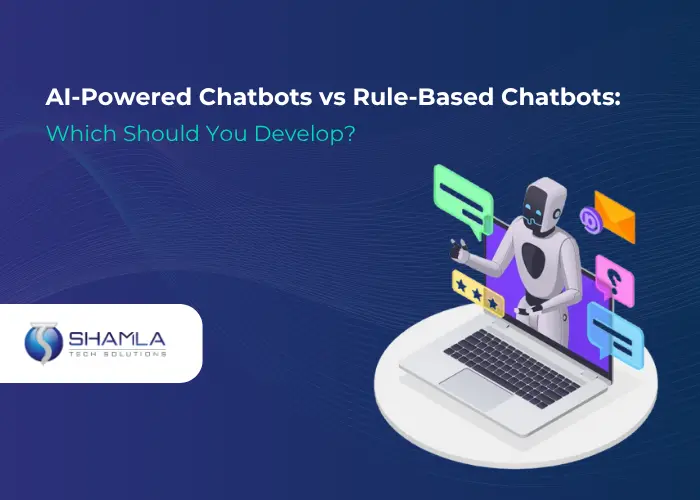

Businesses have increasingly started using chatbots to handle support and sales tasks. There are two main types of them: AI powered chatbots that learn from data & adapt, and rule-based chatbots that just follow fixed scripts.
Companies want AI driven chatbots because they speed up responses, cut costs, and improve user satisfaction. By analyzing past interactions, these systems tailor replies and spot trends without human help. Rule-based bots work for simple questions, but they stall when conversations change. In contrast, AI bots adapt to new requests, handle complex queries, and link smoothly with other tools. This shift drives more teams to build AI powered chatbots for stronger service and faster results.
What Is a Rule-Based Chatbot?
A rule-based chatbot is a conversational system that follows a predefined set of rules, decision trees, and scripted responses to interact with users. It works by matching user inputs with specific keywords, menu options, or programmed conditions and then delivering the corresponding response.
Unlike AI-powered chatbots, rule-based chatbots do not understand context, intent, or natural language beyond what they have been explicitly programmed to recognise. If a user asks a question outside the predefined flow, the chatbot may fail to provide a relevant answer or redirect the user to a human agent.
Rule-based chatbots are commonly used for repetitive and predictable customer interactions, such as:
- Answering frequently asked questions (FAQs)
- Tracking orders and deliveries
- Booking appointments
- Guiding users through forms
- Collecting basic customer information
- Providing product or service information
Because they follow fixed workflows, rule-based chatbots are relatively easy to develop, maintain, and deploy. They are also highly reliable for structured conversations where the possible user responses are limited.
However, as customer expectations evolve, businesses often require chatbots that can handle more complex conversations, understand natural language, and personalise responses, areas where AI-powered chatbots offer significant advantages.
What Is an AI-Powered Chatbot?
An AI-powered chatbot is an intelligent virtual assistant that uses Artificial Intelligence (AI) technologies such as Natural Language Processing (NLP), Natural Language Understanding (NLU), and Machine Learning (ML) to understand, interpret, and respond to human conversations naturally.
Instead of relying solely on predefined rules, AI chatbots analyse the user’s intent, context, conversation history, and language patterns to generate relevant responses. They can understand different ways of asking the same question, manage multi-turn conversations, and continuously improve their performance through training and interaction.
Modern AI chatbots are often powered by Large Language Models (LLMs), enabling them to provide human-like conversations, personalised recommendations, multilingual support, and advanced problem-solving capabilities.
Difference Between AI Powered Chatbots vs Rule-Based Chatbots
Feature | Rule-Based Chatbots | AI-Powered Chatbots |
Core Logic | Operate using predefined if-then rules, decision trees, and scripted workflows. | Use AI, NLP, NLU, and Machine Learning to understand, learn, and generate responses. |
Flexibility | Can only respond to predefined questions and struggle with unexpected queries. | Adapt to diverse user inputs, new topics, and changing conversation patterns. |
Language Understanding | Recognise specific keywords or button selections without understanding context. | Understand user intent, context, sentiment, and natural language for more accurate responses. |
Learning Capability | Do not learn from previous interactions unless manually updated. | Continuously improve through training data, user interactions, and machine learning models. |
Scalability | Expanding functionality requires creating new rules and conversation flows manually. | Easily scale to support multiple use cases, languages, and customer journeys with minimal manual effort. |
Maintenance | Require frequent manual updates to scripts, rules, and workflows. | Require model monitoring and occasional retraining but automate much of the improvement process. |
Implementation Time | Faster and simpler to build for basic conversational tasks. | Take longer to develop and train but provide greater long-term value and automation. |
Integration | Typically integrate with basic websites, forms, or simple business systems. | Seamlessly integrate with CRMs, APIs, knowledge bases, ERP systems, and third-party applications. |
Conversation Quality | Best suited for linear, structured conversations with limited response options. | Support dynamic, human-like, multi-turn conversations with contextual understanding. |
Best Use Cases | FAQs, appointment booking, order tracking, basic customer support, and simple workflows. | Customer service, sales automation, lead generation, virtual assistants, personalised recommendations, and complex business interactions. |
When Rule-Based Chatbots Make Sense (Advantages of Rule-Based Chatbots)
While AI-powered chatbots are transforming customer engagement, rule-based chatbots remain a practical choice for businesses with straightforward automation needs. They are designed to follow predefined conversation flows, making them highly effective for repetitive and predictable interactions.
Here are the key advantages of rule-based chatbots:
Cost-Effective for Simple Automation
Faster Development and Deployment
Easy to Control
Reliable for Structured Workflows
Rule-based chatbots perform exceptionally well in scenarios where user journeys are predefined, such as:
- Answering frequently asked questions (FAQs)
- Booking appointments
- Order tracking
- Password resets
- Collecting customer information
- Routing users to the correct department
Minimal Technical Requirements
Easier Testing and Maintenance
7 Reasons Why AI Powered Chatbots Advantages of AI-Powered Chatbots
1. Contextual Understanding
AI powered chatbots use natural language tools to grasp what users really mean instead of just spotting keywords. They look at the full sentence and past messages to pick up on hints and mood. When a user says “I’m stuck,” these systems link it to support steps or FAQs without needing exact phrases. Rule-based bots hit a roadblock if you stray from their script.
In contrast, AI driven chatbots flex to new questions and learn which answers work best. This lets them handle odd phrasing or follow-up queries smoothly. Over time, they grow smarter without manual updates. As a result, AI powered conversation bots give clear, relevant replies in ways that old-school bots simply can’t match.
2. Scalability
AI powered chatbots grow with your needs by tapping cloud resources and smart models. You can add new topics or languages without rebuilding entire flows. Rule-based systems, on the other hand, demand separate scripts and manual tweaks for every new case, which eats time and budget. With tools from leading platforms, you can build AI powered chatbots in hours instead of weeks.
These systems balance load automatically, so spikes in traffic won’t crash your service. They also let small teams manage large user bases by reusing core models for multiple channels. AI-powered chatbots dynamically adapt in real time, seamlessly operating across web, mobile, and voice platforms without additional coding.
3. 24/7 Intelligent Support
AI powered chatbots never sleep and keep learning after each chat. They log every interaction to tune models and update their answers. That means they spot gaps in knowledge and suggest content improvements. When customers ping at midnight, these bots offer accurate, context-aware responses based on past sessions..They also route tricky cases to humans with full transcripts, so agents save time.
Unlike static scripts, AI powered conversation bots add new data into their training sets automatically. Over weeks, they cut error rates and boost first-contact fixes. By blending instant answers with smart learning loops, they deliver steady, uninterrupted help at any hour.
4. Multilingual Capabilities
5. Reduced Maintenance
6. Higher Engagement & Personalization
AI powered chatbots tailor replies by linking user profiles, purchase history, and behavior patterns. They feed this data into context engines that choose relevant offers or tips. For example, a returning shopper sees product suggestions based on past buys, not generic banners. If someone mentions an upcoming event, the bot adjusts its tone and content accordingly.As interactions stack up, the system refines user segments and fine-tunes outreach. AI powered conversation bots merge CRM data with live queries to keep chats personal. This drives deeper connections and repeat visits. Over time, the bot even predicts needs and nudges users toward solutions before they ask.
7. Future‑Proof Technology
Build AI powered chatbots now to lock in an evolving toolset that adapts with your business. These systems plug into new APIs, analytics, and data streams as they emerge. When fresh models or protocols arrive, you swap in updates without overhauling your codebase. This agility keeps you ahead of shifts in customer behavior and tech standards.
Legacy bots, by contrast, stagnate once their rule sets top out. By tapping modular AI platforms, you ensure ongoing innovation, from voice assistants to AR overlays. AI driven chatbots stay flexible, letting you test features and retire old ones painlessly. Investing early means your support keeps pace with tomorrow’s demands.
Hybrid Chatbots: The Best of Both
A hybrid chatbot combines the structured workflows of a rule-based chatbot with the intelligence of an AI-powered chatbot. Instead of relying solely on predefined rules or AI models, hybrid chatbots use both approaches to deliver faster, more accurate, and more personalized customer interactions.
Typically, a hybrid chatbot begins by handling straightforward queries through predefined conversation flows. When a customer asks a more complex or open-ended question, the chatbot seamlessly switches to AI to understand the user’s intent, provide contextual responses, or escalate the conversation to a human agent when necessary.
This combination allows businesses to automate routine tasks efficiently while still offering intelligent support for complex customer needs.
How Hybrid Chatbots Work
Benefits of Hybrid Chatbots
Improved Customer Experience
Higher Automation Rates
Reduced Operational Costs
Better Accuracy
Easy Scalability
Which Should You Develop? A Decision Framework
Choosing the right chatbot depends on your business goals, customer expectations, and available resources. While rule-based chatbots are ideal for simple workflows, AI-powered chatbots excel at handling dynamic conversations. Hybrid chatbots bridge the gap by combining both approaches.
Use the following criteria to determine which chatbot best fits your business.
1. Evaluate Your Use Case Complexity
The first question to ask is how complex your customer conversations are.
Choose a rule-based chatbot if users mainly ask repetitive questions with predictable answers, such as FAQs, appointment booking, or order tracking.
Choose an AI-powered chatbot if customers ask open-ended questions, require personalised recommendations, or expect human-like conversations.
Choose a hybrid chatbot if your business handles both routine enquiries and more complex customer interactions.
2. Consider Your Budget
Budget often influences the type of chatbot you can implement.
Rule-based chatbots have a lower initial development cost and are suitable for organisations looking to automate simple tasks quickly.
AI-powered chatbots require a larger investment in development, training, and integration but deliver greater long-term value through improved automation and customer engagement.
Hybrid chatbots typically involve a moderate to high investment but provide an excellent balance between cost and capability.
3. Think About Time-to-Launch
If speed is your priority, rule-based chatbots can be developed and deployed within a short timeframe.
AI chatbots require additional time for data preparation, training, testing, and optimisation.
Hybrid chatbots may take longer to implement initially but provide greater flexibility as business requirements evolve.
4. Assess Control and Compliance Requirements
Businesses operating in regulated industries often need complete control over customer interactions.
Rule-based chatbots provide predictable responses, making them ideal for sectors such as healthcare, banking, insurance, and government services.
AI chatbots offer more conversational flexibility but require governance, monitoring, and human oversight to ensure compliance.
Hybrid chatbots allow businesses to maintain strict control over regulated workflows while using AI where flexibility is acceptable.
5. Consider Future Scalability
Think beyond today’s requirements.
Rule-based chatbots become increasingly difficult to maintain as conversation paths expand.
AI-powered chatbots can scale more efficiently across departments, products, and customer journeys.
Hybrid chatbots provide the flexibility to expand AI capabilities without redesigning every workflow.
6. Evaluate Multilingual and Global Support Needs
Businesses serving customers across multiple countries often require multilingual capabilities.
Rule-based chatbots require separate conversation flows for each language.
AI-powered chatbots can understand and respond in multiple languages with significantly less manual effort.
Build AI Powered Chatbots with Shamla Tech
Customized Industry Fit
Lean Data and Live Insight
Modular Growth and Scale
Continuous Learning and User Growth
Conclusion
AI powered chatbots learn from each conversation and adapt to new questions, while rule-based bots get stuck without scripts. They handle varied requests, keep context, and cut response times. By choosing these smart agents, businesses boost service quality, scale support easily, and keep pace with customer needs.
Shamla Tech is an AI chatbot development company that helps you build AI powered chatbots tailored to your brand. Our development process links your data, learns user habits, and updates itself over time. This leads to better engagement, faster issue resolution, and higher customer satisfaction, all with minimal upkeep.
Build your AI chatbot with Shamla Tech!
Contact us today to get started with AI automation for your business!