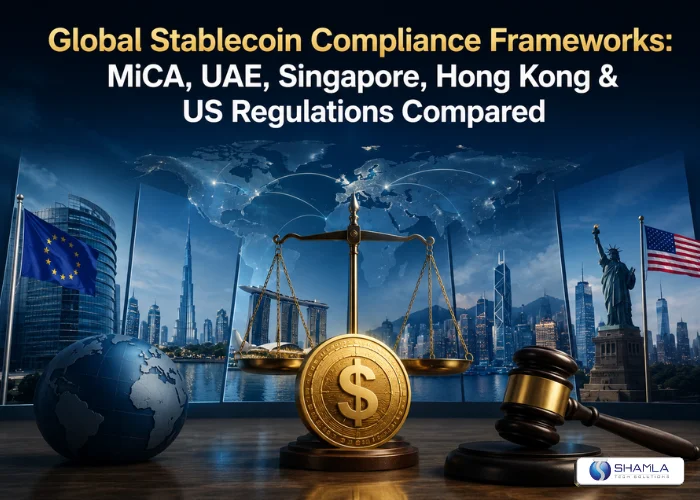

The rise of stablecoins as a legitimate financial instrument has forced regulators worldwide to act , and fast. From the European Union’s sweeping MiCA framework to the UAE’s forward-thinking sandbox approach, global stablecoin compliance has become one of the most complex and fast-moving areas in fintech law. For issuers, exchanges, and institutional players operating across borders, understanding how these frameworks interact is no longer optional , it is existential.
This guide breaks down the five most influential regulatory regimes shaping stablecoin issuance and operation today.
Why Global Stablecoin Regulations Are Converging Now
The catalyst was not one event but several: the collapse of TerraUST in 2022 exposed systemic vulnerabilities around stablecoin depeg events, while the rapid expansion of stablecoin infrastructure into cross-border payments created urgency for consumer protection frameworks. Regulators had watched from the sidelines long enough. The message from Basel to Abu Dhabi is now consistent: stablecoins must be backed, supervised, and auditable , or they will not operate.
What has emerged is a patchwork of regimes that share philosophical alignment but differ significantly on licensing thresholds, reserve requirements, and enforcement posture.
MiCA: The European Blueprint for Stablecoin Regulation
The Markets in Crypto-Assets Regulation (MiCA), which came into full force in December 2024, is the most comprehensive stablecoin regulatory framework in existence. It establishes two primary categories relevant to stablecoins:
Asset-Referenced Tokens (ARTs) , pegged to a basket of currencies, commodities, or assets.
E-Money Tokens (EMTs) , pegged to a single fiat currency, functionally equivalent to electronic money.
Under MiCA stablecoin regulation, issuers of ARTs and EMTs must obtain authorization from their national competent authority within the EU. EMT issuers must hold a European e-money institution license. Both categories are subject to strict reserve requirements: 1:1 backing with highly liquid, low-risk assets held in segregated custody. Issuers of “significant” tokens , those exceeding €5 billion in daily transaction volume , face enhanced supervision directly from the European Banking Authority.
MiCA also mandates white paper disclosures, governance standards, and interoperability requirements. From a stablecoin compliance standpoint, MiCA has effectively set the global benchmark. Any issuer targeting European customers must comply, regardless of where they are incorporated.
Key MiCA requirements at a glance:
- Mandatory authorization from EU national regulators
- 1:1 liquid asset reserves with daily liquidity requirements
- White paper disclosure and liability for misleading statements
- Transaction limits for non-euro-denominated EMTs (€200M/day)
- Enhanced oversight for systemically significant issuers
UAE: Regulated Ambition in the Gulf
The UAE has taken an aggressive pro-innovation stance, positioning itself as a stablecoin regulation hub for the MENA region. Two regulators share jurisdiction depending on where the issuer operates: the Central Bank of the UAE (CBUAE) for Payment Token Services, and the Virtual Asset Regulatory Authority (VARA) for Dubai-based crypto firms.
Under UAE stablecoin regulation, the CBUAE’s Payment Token Services Regulation , finalized in 2024 , classifies stablecoins as “Dirham-referenced payment tokens” or “foreign currency-referenced payment tokens.” Foreign-referenced tokens face significant restrictions: they cannot be used for domestic retail payments denominated in foreign currency, a rule designed to protect AED monetary sovereignty.
VARA, operating under the Dubai Virtual Asset Regulatory Authority framework, takes a broader view. Licensed entities can issue, custody, and facilitate stablecoin transactions under specific Virtual Asset Service Provider (VASP) categories. The Abu Dhabi Global Market (ADGM) adds a third layer through its Financial Services Regulatory Authority (FSRA), which has licensed several stablecoin-adjacent products under a principles-based framework.
For institutional players, the UAE’s regulated stablecoin in the USA comparison is instructive: the UAE moves faster on licensing timelines, often issuing approvals within 90 to 120 days, while offering a regulatory sandbox for novel structures.
Key UAE requirements:
- Separate licensing tracks for CBUAE, VARA, and ADGM/FSRA
- AED-referenced tokens treated as payment instruments
- 100% fiat reserve backing for payment tokens
- Prohibition on interest or yield distribution to token holders
- AML/CFT compliance aligned with FATF standards
Singapore: Precision Regulation Through MAS
The Monetary Authority of Singapore (MAS) finalized its stablecoin regulatory framework in August 2023, targeting single-currency stablecoins (SCS) pegged to the Singapore dollar or G10 currencies. Singapore stablecoin compliance operates under an amended Payment Services Act (PSA), with MAS-regulated stablecoins earning an official “MAS-regulated stablecoin” label , a significant market signal.
Singapore’s approach is deliberately narrow in scope. Only banks and MAS-licensed major payment institutions can issue regulated stablecoins. Reserve requirements are stringent: par value in high-quality liquid assets, with daily reconciliation and monthly independent audits. Value stability is enforced through redemption guarantees , issuers must return par value within five business days of a redemption request.
The framework deliberately excludes algorithmic stablecoins, reflecting lessons learned from stablecoin security risks exposed during the Terra collapse. MAS has also integrated stablecoin compliance into its broader payment interoperability agenda, linking regulated stablecoin settlement to Project Nexus , Singapore’s cross-border payment infrastructure initiative.
Key Singapore requirements:
- Issuers limited to banks and licensed major payment institutions
- Reserve assets held in cash, cash equivalents, or sovereign bonds
- 5-business-day redemption at par value guarantee
- Monthly reserve audits by independent third parties
- Algorithmic stablecoins explicitly excluded from the framework
Hong Kong: Building a New Regulatory Architecture
Hong Kong has pursued a deliberate, consultation-driven approach to Hong Kong stablecoin laws, with the Hong Kong Monetary Authority (HKMA) running multiple rounds of industry consultation before publishing its final legislative framework in 2024. The Stablecoin Ordinance, passed in May 2025, creates a licensing regime for fiat-referenced stablecoin (FRS) issuers , one of the most recent major legislative developments globally.
Under the Ordinance, any entity issuing a fiat-referenced stablecoin in Hong Kong , or marketing one to Hong Kong residents , must hold an HKMA license. Reserve requirements mandate full backing with high-quality liquid assets, maintained in a trust structure separate from the issuer’s own assets. Notably, Hong Kong explicitly permits stablecoin-based stablecoin settlement systems for securities transactions, giving the framework a capital markets dimension absent in most peer regimes.
The HKMA has also announced a regulatory sandbox that allows pre-licensed issuers to conduct limited operations under supervisory observation , an approach that has attracted significant interest from both domestic banks and international stablecoin projects looking for an Asia-Pacific regulatory foothold.
Key Hong Kong requirements:
- HKMA licensing mandatory for all FRS issuers serving HK residents
- Full liquid reserve backing held in trust
- Prohibition on yield or interest payment to stablecoin holders
- Board-level governance and risk management obligations
- Sandbox pathway for innovative structures pending full licensing
United States: Fragmented Progress Toward Federal Clarity
The US presents the most complex landscape in US stablecoin regulations, reflecting a federal system where multiple agencies , the SEC, CFTC, OCC, FinCEN, and state-level regulators , have all asserted some form of jurisdiction over digital assets. The GENIUS Act and STABLE Act, both introduced in early 2025, represent the most serious federal legislative attempts to date.
As of mid-2025, neither bill has been enacted, though the GENIUS Act passed the Senate Banking Committee with bipartisan support. In the interim, the regulatory landscape for regulated stablecoin in the USA is shaped by state money transmitter licenses, the OCC’s interpretive letters permitting national banks to hold stablecoin reserves, and the SEC’s position that certain stablecoins may constitute securities.
The GENIUS Act, if enacted, would establish a federal framework requiring stablecoin issuers to obtain a federal or state license, maintain 1:1 reserves in cash or T-bills, and submit to regular audits. Critically, it would preempt state-level requirements for federally licensed issuers , a major structural change that would benefit large issuers currently managing compliance across dozens of state regimes.
State-level frameworks , notably New York’s BitLicense and trust charter system, which currently governs USDC and USDP , would remain relevant for entities seeking state licensing pathways.
Key US regulatory considerations:
- No unified federal stablecoin framework yet in force (as of mid-2025)
- State money transmitter licenses required in most jurisdictions
- OCC permits national banks to issue and custody stablecoins
- GENIUS Act proposes 1:1 reserve requirement with federal oversight
- SEC scrutiny remains active for yield-bearing or basket-pegged tokens
Cross-Border Stablecoin Compliance: Where Friction Lives
Cross-border stablecoin compliance remains the hardest operational problem for issuers active across multiple jurisdictions. Several pressure points stand out:
Reserve recognition. Assets that qualify as eligible reserves in Singapore (G10 sovereign bonds) may not satisfy the liquidity tests under MiCA or HKMA rules without structural adjustments.
Redemption timelines. Singapore mandates 5-day redemption at par. MiCA is stricter for significant token issuers. Operating across both requires careful liquidity management and legal entity structuring.
Yield prohibition. Both UAE and Hong Kong prohibit yield distribution to stablecoin holders. The US does not currently impose a blanket prohibition, creating product design divergence for issuers operating across these markets.
Travel Rule compliance. All five jurisdictions require FATF Travel Rule compliance for transfers above threshold amounts, but implementation standards differ , particularly on the treatment of unhosted wallets and the interoperability of VASP data-sharing solutions.
Issuers building for global distribution typically adopt a multi-entity model: a MiCA-authorized EMT issuer for Europe, a separate MAS-licensed entity for Singapore, and a state trust or OCC-chartered entity for US access, each holding jurisdiction-specific reserves.
What Compliance-Ready Stablecoin Infrastructure Looks Like
Across all five frameworks, a pattern emerges. Regulators universally demand:
- Segregated, audited reserves , no commingling with issuer operating funds
- Redemption guarantees , clear, legally enforceable rights to redeem at par
- Governance accountability , board-level ownership of risk and compliance
- AML/CFT integration , real-time transaction monitoring, Travel Rule tooling, sanctions screening
- Public disclosure , regular attestations or audits published for token holders
Issuers who treat compliance as infrastructure , built into the token architecture and reserve management system from day one, are better positioned than those bolting regulatory requirements onto existing products.
Why Choose Shamlatech To Build A StableCoin?
The Road Ahead for Global Stablecoin Compliance
The trajectory is clear: stablecoin regulatory frameworks will converge further over the next three years, driven by FATF guidance, BIS recommendations, and bilateral regulatory cooperation agreements. The FSB’s 2023 high-level recommendations for global stablecoin arrangements are already being incorporated into domestic frameworks across jurisdictions.
For market participants, this convergence creates opportunity alongside obligation. Stablecoins that achieve regulatory recognition in multiple tier-one jurisdictions will command institutional trust that unlicensed alternatives cannot match. The compliance burden is real , but so is the competitive moat it creates.
The era of regulatory arbitrage in stablecoins is closing. What replaces it is a more rigorous, more institutionally credible asset class , and a clearer path to the mainstream financial infrastructure stablecoins have always promised to become.