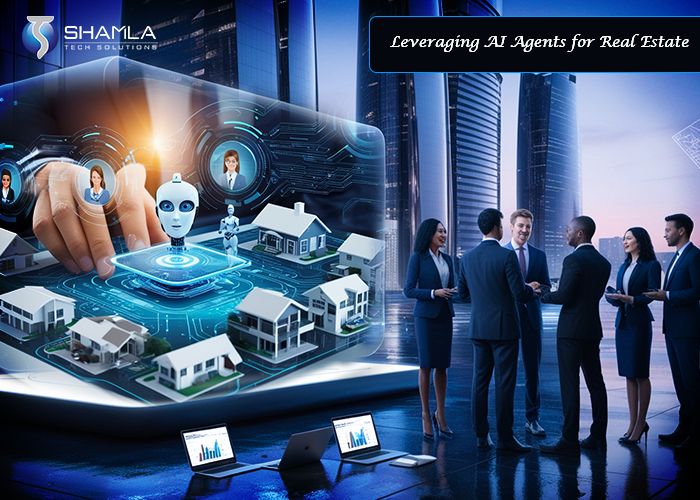

Collaborating with a leading AI development company enables businesses to effectively integrate these cutting-edge solutions. For specialized needs, partnering with an AI agent development company ensures tailored, industry-specific innovations. As demand for AI-driven solutions increases, embracing these advancements not only boosts operational efficiency but also positions companies at the forefront of the real estate sector’s evolution. In this article, we delve into the use cases and benefits of AI agents for real estate.
What Are AI Agents in Real Estate?
AI agents in real estate are autonomous software systems that use artificial intelligence to perform tasks, make decisions, and interact with buyers, sellers, agents, and property data with minimal human intervention. Unlike traditional chatbots that simply answer predefined questions, AI agents can understand context, analyze large volumes of real estate data, automate workflows, and continuously learn from interactions to improve their performance.
These intelligent agents work across multiple platforms, including websites, CRM systems, messaging apps, property portals, and internal business applications. They help real estate businesses streamline operations, improve customer engagement, and accelerate property transactions by handling repetitive tasks around the clock.
From qualifying leads and recommending properties to scheduling viewings, generating market insights, and automating follow-ups, AI agents in real estate enable agencies, developers, brokers, and property management firms to deliver faster, more personalized services while reducing operational costs.
The Role of AI Agents in Real Estate
AI agents are transforming the real estate industry by acting as intelligent digital assistants that support agents, brokers, developers, and property managers throughout the property lifecycle. Rather than replacing human professionals, they automate routine processes, provide real-time insights, and allow teams to focus on high-value activities such as negotiations, relationship building, and closing deals.
1. Automating Lead Management
2. Delivering Personalized Property Recommendations
3. Enhancing Customer Support
4. Streamlining Property Transactions
5. Supporting Market Intelligence
6. Improving Property Management
7. Driving Data-Driven Decision Making
How AI Agents Work in Real Estate: Key Components
AI agents in real estate operate through a three-stage process: they gather information, analyze it using AI models, and take actions automatically. Unlike traditional automation tools that follow fixed rules, AI agents continuously learn from customer interactions, market conditions, and business data to improve decision-making over time. This enables real estate companies to automate repetitive tasks while delivering faster, more personalized experiences to buyers, sellers, tenants, and investors.
Input: Collecting and Understanding Real Estate Data
Every AI agent begins by collecting data from multiple business systems. It can access property listings, CRM records, customer conversations, website inquiries, market reports, and transaction histories to build a complete understanding of each customer and property.
Instead of treating every inquiry the same, the agent identifies buyer intent, budget, preferred locations, property type, and previous interactions. By combining structured and unstructured data, it creates the context needed to make accurate recommendations and business decisions.
Brain: AI-Powered Reasoning and Decision-Making
Once the data is collected, the AI agent processes it using technologies such as large language models (LLMs), natural language processing (NLP), machine learning, and predictive analytics. This intelligence layer enables the agent to interpret customer requests, recognize patterns, and determine the most appropriate response.
For example, if a buyer is searching for family homes within a specific budget, the AI agent evaluates available listings, compares market prices, predicts buyer preferences, and recommends the properties most likely to result in a successful sale. As more interactions occur, the agent continuously refines its recommendations and improves its accuracy.
Action: Executing Real Estate Tasks Autonomously
After making a decision, the AI agent automatically performs the required task without constant human supervision. It may respond to customer inquiries, schedule property viewings, update CRM records, send personalized property recommendations, or generate documents required during the buying or leasing process.
Because these actions are integrated with existing real estate platforms, agencies can reduce manual work, improve response times, and ensure customers receive consistent service throughout their property journey.
AI Agent Types Used in Real Estate
Different business functions require different types of AI agents. Reactive agents handle routine customer inquiries, while goal-based agents recommend properties based on buyer requirements. Learning agents continuously improve by analyzing customer behavior and transaction outcomes, making future recommendations more accurate. Larger real estate enterprises often deploy multiple AI agents that collaborate across sales, marketing, property management, and customer support, creating an intelligent workflow that operates with minimal human intervention.
Key Benefits of AI Agents for Real Estate
AI agents are transforming the real estate industry by automating repetitive tasks, improving customer engagement, and enabling data-driven decision-making. From residential agencies and commercial brokers to AI property management companies, intelligent agents help businesses increase efficiency while delivering better experiences across the entire property lifecycle.
AI agents provide numerous benefits that enhance efficiency and decision-making in real estate operations. Explore how AI real estate tools developed by a top AI development company can transform property management and investments. Here are some key advantages of AI in Real Estate:
Enhanced Property Valuation:
Efficient Property Management:
For property managers, the integration of AI property management tools offers a significant boost in efficiency. These AI agents automate routine tasks, such as maintenance scheduling, lease renewals, and responding to tenant inquiries. By doing so, property managers can focus on more strategic activities, while the AI development company-designed tools handle day-to-day operations. This automation not only reduces administrative overhead but also improves response times and service quality, leading to better tenant satisfaction.
Predictive Analytics:
Improved Customer Experience:
AI agents play a pivotal role in enhancing the customer experience within the real estate industry. These agents can offer personalized recommendations based on user preferences, assist with property searches, and even schedule viewings. By providing 24/7 support, AI agents ensure that potential buyers or renters receive timely assistance, which can be a deciding factor in closing deals. The ability of AI agents for real estate to offer tailored solutions greatly improves user satisfaction and streamlines the buying or renting process.
Cost Reduction:
One of the most significant benefits of utilizing AI agents in real estate is cost reduction. By automating repetitive tasks and improving overall operational efficiency, these AI real estate tools help reduce the need for manual intervention. This leads to lower staffing costs and optimized resource allocation, which directly impacts profitability. AI development companies focus on creating solutions that not only enhance operations but also offer substantial cost savings for real estate businesses.
Streamlined Marketing and Lead Generation:
Data-Driven Decision Making:
Scalability and Flexibility:
Enhanced Security and Compliance:
Use Cases of AI Agents in Real Estate
Automated Property Valuation
Personalized Property Searches
AI-Driven Property Management
Virtual Assistants for Customer Service
Predictive Market Analysis
Automated Contract Generation
AI-Powered Real Estate Lead Generation and Nurturing
AI agents play a significant role in AI real estate lead generation by capturing inquiries from websites, property portals, and social media channels. They automatically qualify leads based on buying intent, budget, and engagement history before nurturing prospects through personalized follow-ups and timely property recommendations. As a result, sales teams can focus on high-potential opportunities while maintaining consistent communication with every prospect.
Property Tours and Virtual Staging
AI agents enhance property marketing by coordinating virtual property tours and supporting AI-powered virtual staging experiences. Prospective buyers can explore properties remotely, visualize customized interiors, and schedule in-person visits directly through the AI assistant. This creates a more engaging buying journey while helping sellers showcase properties more effectively.
These use cases demonstrate how AI agents in real estate are reshaping sales, marketing, customer service, and AI property management. By automating repetitive workflows and delivering intelligent recommendations, they enable real estate businesses to operate more efficiently, improve client experiences, and drive sustainable growth.
Challenges of Implementing AI Agents in Real Estate (and How to Overcome Them)
Data Quality and Availability
How to overcome it: Establish strong data governance practices by regularly cleaning, validating, and synchronizing data across MLS platforms, CRM systems, property databases, and marketing channels. High-quality data ensures AI agents make accurate decisions and recommendations.
AI Accuracy and Hallucinations
Generative AI models can occasionally produce inaccurate property details, incorrect pricing suggestions, or misleading responses if they lack sufficient context or access to verified business data. In real estate, even small inaccuracies can affect customer trust and business credibility.
How to overcome it: Connect AI agents to verified internal databases and trusted external data sources, while keeping human experts involved for high-value activities such as property valuations, legal documentation, pricing decisions, and investment advice.
Integration with Existing Real Estate Systems
Many real estate companies already use multiple platforms for CRM, MLS, ERP, marketing automation, and property management. Integrating AI agents with these systems can be technically complex if data is fragmented across different applications.
How to overcome it: Build AI agents using APIs and integration frameworks that enable seamless connectivity with existing business systems. A phased implementation approach helps minimize disruption while allowing teams to validate performance before scaling across the organization.
Regulatory Compliance and Data Privacy
Real estate businesses manage sensitive customer information, financial records, contracts, and identity documents. AI agents must comply with applicable data privacy regulations and industry standards while maintaining secure access to confidential information.
How to overcome it: Implement robust security controls, role-based access, data encryption, and audit trails. Organizations should also establish AI governance policies to ensure customer data is processed responsibly and regulatory requirements are consistently met.
User Adoption and Change Management
Even the most advanced AI solution may struggle to deliver value if employees are hesitant to adopt it. Real estate professionals may be concerned that AI will replace their roles or disrupt established workflows.
How to overcome it: Position AI agents as productivity tools that assist rather than replace real estate professionals. Providing training, involving employees during implementation, and demonstrating measurable improvements in productivity and customer service can encourage faster adoption and greater confidence in AI-powered workflows.
By addressing these challenges early, real estate businesses can implement AI agents with greater confidence and achieve sustainable improvements in sales, operations, customer experience, and AI property management. A thoughtful implementation strategy ensures AI becomes a trusted business partner rather than just another technology investment.
How to Build an AI Agent for Real Estate
Define the Business Scope and Objectives
Select the Right LLM and AI Technologies
Choose an AI model that aligns with your business requirements, security policies, and scalability goals. Large Language Models (LLMs), natural language processing (NLP), machine learning, and retrieval-augmented generation (RAG) can work together to understand customer intent, answer real estate queries, and automate complex workflows. The technology stack should also support future customization as business needs evolve.
Prepare and Organize Real Estate Data
Design the AI Agent Architecture
Build Intelligent Conversation and Decision-Making
Integrate with Real Estate Platforms
Test, Validate, and Optimize
Deploy and Continuously Improve
Once the AI agent is live, monitor its performance using metrics such as response time, lead conversion rate, customer satisfaction, and operational efficiency. Regularly updating AI models, expanding data sources, and refining workflows ensures the solution continues to improve as customer expectations and market conditions evolve.
A well-planned approach to AI agent development for real estate enables organizations to build intelligent solutions that automate operations, enhance customer experiences, and support long-term business growth. By combining high-quality data, advanced AI models, and seamless system integration, real estate businesses can deploy AI agents that deliver measurable value across sales, marketing, and property management.
AI agents streamline the legal aspects of real estate transactions by automating contract generation. These agents ensure that all legal requirements and details are accurately included in contracts, reducing the likelihood of errors and disputes. This automation speeds up the transaction process, allowing real estate professionals to close deals more efficiently. By using AI real estate tools for contract management, businesses can ensure compliance and reduce administrative burdens. Collaborating with an AI agent development company ensures that the contract generation processes align with the specific needs of the real estate market.
The Future of AI Agents in Real Estate
The future of AI agents in real estate extends far beyond automating routine tasks. As AI technologies continue to evolve, these intelligent systems will become proactive business partners capable of analyzing markets, predicting customer needs, coordinating complex workflows, and supporting strategic decision-making across the real estate value chain.
Rather than functioning as standalone virtual assistants, next-generation AI agents will collaborate with multiple business systems, enabling agencies, developers, brokers, and property managers to operate with greater speed, accuracy, and efficiency. This shift will allow real estate professionals to spend less time on administrative work and more time building client relationships, negotiating deals, and driving business growth
Frequently Asked Questions (FAQs)
What Are AI Agents in Real Estate?
How Do AI Agents Help Real Estate Professionals?
Can AI Agents Improve Property Management?
How Do AI Agents Improve Lead Generation in Real Estate?
Can AI Generate Real Estate Leads?
What Are the Best AI Tools for Real Estate?
Will AI Replace Real Estate Agents and Brokers?
How Do You Keep AI Agents Secure and Compliant in Real Estate?
How Much Does It Cost to Build an AI Agent for Real Estate?
How Can Shamlatech Help You Build AI Agents for Real Estate?
Transform Your Real Estate Business with Custom AI Agents from Shamla Tech
The future of real estate belongs to businesses that can respond faster, operate smarter, and deliver highly personalized customer experiences. At Shamla Tech, we develop custom AI agents that automate sales, marketing, customer support, property management, and back-office operations—helping real estate companies improve efficiency while reducing operational costs.
Whether you’re a real estate agency, property developer, brokerage, or property management company, our AI experts design intelligent solutions tailored to your business objectives. From AI-powered lead qualification and property recommendations to automated tenant support, predictive market analytics, and seamless CRM and MLS integrations, our AI agents are built to scale with your business.
With end-to-end AI agent development services, Shamla Tech supports every stage of your transformation, from strategy and solution design to deployment, integration, and continuous optimization. The result is a secure, scalable AI solution that streamlines workflows, accelerates decision-making, and empowers your team to focus on what matters most: closing deals and delivering exceptional customer experiences.
Ready to modernize your real estate operations? Partner with Shamla Tech to build custom AI agents that drive growth, improve productivity, and give your business a lasting competitive advantage.