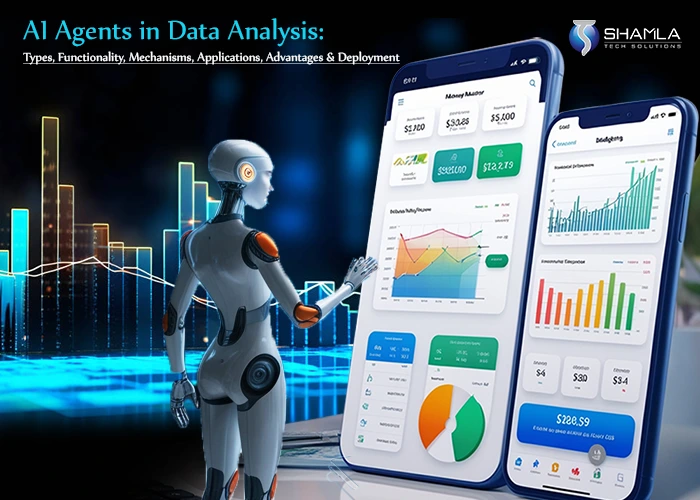

Data is what keeps companies going today. But how do businesses make sense of all this data when they have it all at their fingertips? Data processing has always been a time-consuming task that required a lot of specialised knowledge and skills. This can cause bottlenecks, which slow down ideas and make it harder to make decisions.
To make things better, AI bots for data analysis are a powerful new tool that can be used for data analysis. AI bots can help businesses get the most out of their data and give them a big edge over their competitors. How to do it: Many of the boring jobs that come with data analysis can be done automatically by AI agents. This frees up human analysts to do more strategic work. This can cut the time it takes to make decisions by a huge amount; studies show AI can cut that time by as much as 40%.
Not only that, but AI bots can find patterns and trends that humans might miss. Businesses can use this deeper level of research to make smarter choices, improve processes, and get better results overall. It’s not a surprise that more and more businesses are adopting this technology, since AI agents are being used more and more in business data. In fact, AI is already being used by nearly 30% of big businesses to keep an eye on more than half of their business data.
This piece talks about AI data analysis agents and the different kinds of them. It also talks about their features, how they can be used, their benefits, how they can be put into action, and how they can help businesses make better decisions and reach new heights of success.
What Is An Ai Agent For Data Analysis?
An AI agent in data analysis refers to a system or software that utilizes artificial intelligence to perform tasks related to data collection, interpretation, and processing. These AI agents can autonomously analyze vast amounts of data, detect patterns, and generate insights, significantly reducing the time and effort required for manual data analysis. The key goal of an AI agent in this context is to automate repetitive and complex tasks, allowing businesses to make quicker and more informed decisions based on data.
An AI Agent Development Company specializes in creating and customizing AI agents to suit specific business needs. These companies design systems that can efficiently handle various data-driven tasks, such as predictive analysis, anomaly detection, and natural language processing. With the growing complexity of data sets, the demand for custom AI agents has increased, and partnering with an AI Development Company enables businesses to implement these agents effectively.
Benefits of AI agents in data analytics are numerous. First, they can process large volumes of data quickly and accurately, which enhances productivity. Second, they eliminate human error in data interpretation, ensuring more reliable outcomes. Third, they can provide real-time insights, allowing companies to respond to trends and issues as they arise. Additionally, AI agents can learn and adapt over time, improving their analytical capabilities without requiring constant manual input.
In summary, AI agents for data analysis offer businesses a powerful tool to streamline operations, enhance decision-making, and unlock valuable insights from data. By leveraging the expertise of an AI Agent Development Company, businesses can harness the full potential of AI-driven data analytics.
Key Characteristics of AI Agents for Data Analysis
Complete Data Handling and Integration
Advanced Analytical Methods
Real-Time Insights and Decision Support
Natural Language Processing for Data Queries
Advanced Reporting and Visualization
Types of AI Agents for Data Analysis
1. Data Agents — Structured & Unstructured Data Analysis
Data agents are responsible for collecting, processing, and analyzing information from diverse sources. They work with both structured data, such as relational databases, spreadsheets, and data warehouses, and unstructured data, including emails, PDFs, images, customer reviews, social media content, and documents.
These AI agents automatically clean datasets, identify patterns, detect anomalies, generate forecasts, and produce actionable insights. By combining machine learning, statistical analysis, and natural language processing, data agents help organizations make informed decisions without extensive manual analysis.
Common use cases include:
- Sales and revenue forecasting
- Customer behavior analysis
- Financial reporting
- Fraud detection
- Market trend analysis
- Predictive maintenance
- Healthcare data analytics
2. API and Execution Agents
API and execution agents extend data analysis beyond generating insights by taking automated actions based on analytical results. They integrate with enterprise applications, cloud platforms, databases, business intelligence tools, and third-party APIs to execute workflows without human intervention.
For example, an AI agent can detect declining sales, update CRM records, trigger marketing campaigns, notify stakeholders through Slack or Microsoft Teams, create reports, or launch automated business processes in ERP systems.
Typical capabilities include:
- Connecting with enterprise APIs and SaaS applications
- Automating data pipelines and ETL workflows
- Executing business rules and operational tasks
- Triggering alerts and notifications
- Updating dashboards and databases in real time
- Orchestrating cross-platform workflows
3. Agent Swarms — Multi-Agent Collaborative Systems
Agent swarms consist of multiple specialized AI agents working together to solve complex analytical tasks. Instead of relying on a single AI model, each agent performs a dedicated function—such as data collection, preprocessing, statistical analysis, forecasting, visualization, or report generation—while communicating with other agents to produce comprehensive results.
This collaborative architecture improves scalability, accuracy, resilience, and task parallelization, making it well-suited for enterprise environments with massive datasets and multi-step analytical workflows.
Enterprise applications include:
- End-to-end business intelligence automation
- Supply chain optimization
- Financial risk modeling
- Large-scale customer analytics
- Manufacturing operations monitoring
- Autonomous decision support systems
Multi-agent AI systems enable organizations to analyze larger datasets faster, coordinate complex workflows, and deliver deeper insights than single-agent architectures, making them a key component of next-generation AI agents for data analysis.
How Do AI Agents for Data Analysis Work?
AI agents for data analysis work by combining large language models (LLMs), machine learning, data engineering, and workflow automation to execute analytical tasks with minimal human intervention. Instead of waiting for step-by-step instructions, these intelligent agents understand business goals, create execution plans, access multiple data sources, validate results, and present actionable insights in a business-friendly format.
Unlike traditional analytics tools that require manual querying and dashboard creation, AI agents continuously reason, adapt, and improve throughout the analytical process.
1. Understanding Business Intent
The first step is interpreting what the user actually wants to achieve rather than simply processing keywords. AI agents analyze natural language requests and identify the underlying business objective.
For example, a user may ask:
- “Why did customer churn increase this quarter?”
- “Predict next month’s sales.”
- “Find the products with declining profit margins.”
The AI agent identifies:
- Business objective
- Required metrics
- Relevant datasets
- Time period
- Expected output format
This allows non-technical users to interact with enterprise data using conversational language instead of SQL queries or complex BI tools.
2. Dynamic Task Planning
Once the objective is understood, the AI agent creates an execution plan. Rather than following a fixed workflow, it dynamically decides which analytical steps are required.
The planning process may include:
- Identifying relevant databases
- Selecting analytical methods
- Choosing statistical or machine learning models
- Prioritizing data sources
- Scheduling dependent tasks
If new information appears during execution, the agent can modify its plan automatically without requiring human intervention.
3. Connecting to Data & Tools
AI agents securely access multiple enterprise systems to gather the information needed for analysis.
Common data sources include:
- Data warehouses
- CRM platforms
- ERP systems
- Cloud storage
- SQL and NoSQL databases
- APIs
- Business intelligence platforms
Beyond retrieving data, AI agents can also integrate with analytics libraries, visualization tools, Python environments, notebooks, and machine learning frameworks to perform advanced calculations and predictive modeling.
This enables a unified view of enterprise data across previously disconnected systems.
4. Self-Checking Work
One of the most valuable capabilities of modern AI agents is their ability to validate their own work before presenting results.
During execution, the agent can:
- Detect missing or inconsistent data
- Cross-check calculations
- Verify assumptions
- Identify anomalies or outliers
- Retry failed operations
- Explain confidence levels
- Reduce hallucinations through validation steps
This self-correction process improves the reliability and accuracy of analytical outcomes while minimizing manual review.
5. Delivering Answers
After completing the analysis, the AI agent converts complex findings into clear, actionable insights tailored to the user’s needs.
Outputs may include:
- Executive summaries
- Interactive dashboards
- Charts and visualizations
- Forecasts and predictions
- Root-cause analysis
- Automated reports
- Business recommendations
Instead of simply presenting raw numbers, AI agents explain what happened, why it happened, and what actions decision-makers should take next. This accelerates decision-making and helps organizations derive greater value from their data.
By automating the complete analytics workflow, from understanding business intent to delivering validated insights, AI agents for data analysis enable organizations to make faster, more accurate, and data-driven decisions while reducing manual effort and improving operational efficiency.
Core Components of AI Agents for Data Analysis
1. Agent Core — The LLM Brain
2. Planning Module — Task Decomposition
3. Agent Memory (RAG) — Context & Knowledge
4. Data Analysis Tools
5. Databases & Data Sources
The quality of an AI agent’s insights depends heavily on the data it can access. Modern AI agents connect securely to a wide range of enterprise systems, including data warehouses, CRM platforms, ERP software, cloud storage, APIs, and business intelligence tools. Rather than analyzing information from a single source, they combine data from multiple systems to create a more complete picture of business performance. This unified access enables organizations to uncover patterns, identify opportunities, and make faster, data-driven decisions based on comprehensive and up-to-date information.
Together, these components form the foundation of a modern AI agent data analysis architecture, enabling AI agents to automate complex analytical workflows while delivering reliable, context-rich insights that support better business decision-making.
How Do Multi-Agents Help In Qualitative Data Analysis?
Multi-agent systems are a revolutionary approach in AI Agent in Data Analysis, particularly for qualitative data, which involves non-numerical formats like text, voice, or video. Instead of relying on manual methods, multi-agent systems employ a network of different AI agents that collaborate to analyze complex datasets quickly and accurately.
In this system, each AI agent specializes in a specific task, such as text interpretation or voice recognition, making it easier to process vast amounts of qualitative data. The collaboration among these agents enhances the depth and precision of the analysis, something traditional methods struggle to achieve at scale. This innovation is one of the key benefits of AI agents in data analytics, enabling businesses to extract insights from otherwise unmanageable data.
An AI Agent Development Company can design and implement these multi-agent systems to suit specific business needs. By leveraging AI agents for data analysis, businesses can accelerate decision-making, automate labor-intensive processes, and ultimately gain a competitive edge. Whether analyzing customer feedback, video content, or social media trends, the benefits of AI agents in data analytics make them a valuable tool for handling complex, qualitative datasets efficiently and effectively.
Analysis by theme
The main goal of thematic analysis in qualitative research is to find and understand trends (themes) in textual data. In the past, this process required coding and research to be done by hand, which took time and could lead to mistakes. Autonomous AI agents change thematic analysis by taking over important jobs like summarising text, initial coding, and theme categorisation.
For this type, three specialised AI bots work together without any problems:
- Analyst: First, this agent summarises the text that was given to it, cutting it down to its most important parts and getting rid of any extraneous information. This first step organises the data so that it can be analysed later.
- Coder: Once the text has been summed up, the coder agent creates the first codes by looking for patterns or important words that appear more than once in the condensed text.
- Agents for categorising: These agents then put the created codes into groups with bigger themes. Each agent focusses on a different theme, which makes sure that the analysis is complete and complex.
AI bots speed up the process of thematic analysis and improve its depth and accuracy by working together in this way. Researchers can focus more on figuring out what the data means and how to interpret it when repetitive jobs are taken care of automatically.
Analysis of narratives
Narrative analysis looks at personal stories and reports to try to figure out how people make sense of their life events. In the past, this qualitative method involved carefully reading and coding narrative texts, which could be subjective and take a lot of time. AI agents make story analysis faster and easier by automating a number of important steps.
- Summariser: The first agent boils down the story text to its most important parts and plot points. This summary is what the rest of the study will be based on.
- Coder: Next, the coder agent creates the first codes from the summed-up story, figuring out what the main ideas, feelings, or events are.
- Sub-categorization agents: These agents break down the initial codes even more into sub-categories and larger thematic categories. They do this by giving you an organised way to understand how complicated the story is.
- By taking care of these tasks automatically, AI bots help researchers quickly look through huge amounts of narrative data and find themes and patterns that might not be obvious when using manual methods. This method speeds up the analysis process and makes it easier to look at story material in a more thorough and organised way.
Analysis of content
Content analysis is the methodical study of written data to find themes, patterns, or trends. This method is used by many fields to look at text-based material like media content, survey responses, and more. Textual data used to have to be carefully coded and categorised for content analysis to work, which could be hard when working with big datasets.
AI agents make information analysis better by:
- Summarisation agent: Taking the main points of a text and reducing its complexity by summarising it.
- Coding agent: Making codes from the summed-up text by finding buzzwords, phrases, or ideas that are important to the content.
- Pattern extraction agent: Taking patterns and themes out of the coded data and pointing out common themes or points of view in the text.
- AI agents speed up the content analysis process by automating these jobs while keeping the process consistent and correct. Researchers can use insights powered by AI to see how things change over time, contrast data from different sources, and find complex insights that help them with their study.
Analysis of discourse
The study of discourse analysis looks at how language is used to make sense of things and shape relationships between people. This qualitative method needs a close look at small differences in language, factors that affect the environment, and rhetorical strategies used in spoken or written communication.
- Pattern discovery agent: Finds important patterns, statements, or rhetorical devices in the conversation.
- Language analysis agent: Looks at how language is used, how it is put together, and how people talk to each other to figure out what people really mean.
- The contextual interpretation agent looks at the bigger picture and what the conversation means by taking into account sociocultural factors and the way the situation is changing.
- These AI agents work together to give a full picture of a conversation by finding hidden ideological views, meanings, and relationship dynamics in the text. AI makes discourse analysis more nuanced and thorough by automating complex
These AI agents work together to give a full picture of a conversation by finding hidden ideological views, meanings, and relationship dynamics in the text. AI makes discourse analysis more nuanced and thorough by automating complex linguistic analysis. This lets academics look into how people talk to each other in a variety of settings.
Benefits of Using AI Agents for Data Analysis
1. Enhanced Accuracy and Precision
2. Speed and Efficiency
3. Cost Savings
4. Improved Decision-Making
5. Personalization and Customer Experience
6. Risk Management
7. Continuous Improvement
8. Enhanced Collaboration
9. Enhanced Data Security
How AI Agents Operate in Data Analysis Pipelines
Data Collection
Data Cleaning and Preparation
Data Analysis and Insight Generation
Data Visualization and Reporting
Multi-Agent Collaboration
Many enterprise AI solutions use multiple specialized agents that work together instead of relying on a single general-purpose model. One agent may retrieve data, another cleans and validates it, while others perform analysis, generate visualizations, or review the results for accuracy. This collaborative architecture enables organizations to process larger datasets, automate complex workflows, and deliver more reliable insights at scale.
By orchestrating these stages into a unified workflow, AI agents for data analysis help organizations reduce manual effort, improve analytical accuracy, and accelerate data-driven decision-making across the enterprise.
Operational Workflow of AI Agents in Data Analysis
Data Collection & Preprocessing
Data Analysis Execution
Visualization & Reporting
Feedback Loop & Continuous Learning
Key Use Cases of AI Agents in Enterprise Data Analysis
Real-Time KPI Monitoring & Anomaly Detection
Fraud Detection & Compliance Monitoring
Self-Service Analytics for Business Users
Automated Reports & Dashboards
Competitive & Market Intelligence Analysis
Frequently Asked Questions
What Is an AI Agent for Data Analysis?
How Are AI Agents for Data Analysis Different From Traditional BI Tools?
What Is the Difference Between a Data Agent, an API Agent, and an Agent Swarm?
Do AI Agents Replace Data Analysts and BI Teams?
What Types of Data Can AI Agents Analyze?
How Do AI Agents Maintain Accuracy and Avoid Hallucinations in Data Analysis?
What Is Agentic Analytics?
What Does It Take to Build an AI Agent for Data Analysis?
How Do You Ensure AI Agents Stay Secure and Compliant in Regulated Industries?
What Are the Most Common Challenges in Deploying AI Agents for Data Analysis?
How Much Does It Cost to Build an AI Agent for Data Analysis?
How Can ShamlaTech Help You Build AI Agents for Data Analysis?
How ShamlaTech Helps You Build AI Agents for Data Analysis
ShamlaTech helps enterprises design, develop, and deploy custom AI agents for data analysis that transform raw business data into actionable intelligence. Whether your goal is to automate reporting, enable self-service analytics, detect anomalies in real time, or build multi-agent analytics workflows, our team delivers AI solutions tailored to your business objectives.
Our development approach begins with understanding your data ecosystem, business processes, and analytical requirements. We then design a scalable AI agent architecture by selecting the right large language models (LLMs), integrating enterprise data sources, implementing Retrieval-Augmented Generation (RAG), and connecting the AI agent with your existing business applications, APIs, and analytics platforms.
Beyond development, ShamlaTech ensures every AI solution is secure, scalable, and production-ready. We incorporate enterprise-grade security, governance, compliance, performance optimization, and continuous monitoring to ensure your AI agents deliver reliable insights while meeting industry standards.
From proof of concept to enterprise-wide deployment, ShamlaTech provides end-to-end AI agent development services that help organizations reduce manual analysis, improve decision-making, and unlock the full value of their data through intelligent automation.
Start Building Your AI Agents for Data Analysis with ShamlaTech
As organizations generate larger volumes of data, traditional analytics methods can no longer keep pace with the speed and complexity of modern business. AI agents for data analysis provide a smarter approach by automating data collection, preparation, analysis, visualization, and decision support, enabling businesses to uncover insights faster and respond to changing market conditions with confidence.
Whether you’re looking to build a single AI-powered analytics assistant or a sophisticated multi-agent system that integrates seamlessly with your enterprise ecosystem, the right strategy and technology foundation are essential for long-term success.
At ShamlaTech, we combine expertise in AI, LLMs, multi-agent architectures, enterprise integrations, and intelligent automation to build secure, scalable, and business-ready AI agents that deliver measurable results. Partner with our experts to accelerate your AI transformation and empower your organization with next-generation data analytics solutions.