


Home » Stable Coin » Top 7 Business Benefits of Launching a Stablecoin in 2026

Top 7 Business Benefits of Launching a Stablecoin in 2026

Share this article:
benefits of launching a stablecoin
Table of Contents
About the Author
Balaji
CEO of Shamla Tech, specializes in crypto exchange development, RWA tokenization, blockchain infrastructure, AI solutions, and compliance-ready platforms. He helps enterprises address regulatory, security, and scalability challenges while driving real-world adoption of emerging technologies across industries.
Connect On:

Enterprises are reassessing payment infrastructure as stablecoins become a practical instrument for treasury operations, cross-border settlements, and platform transactions. For leadership teams, launching a stablecoin represents a strategic decision centered on payment ownership, liquidity management, and stronger control over digital financial infrastructure.

Stablecoin payment volumes are projected to exceed $400 billion in enterprise payment activity in 2026, reflecting growing adoption across cross-border commerce, B2B settlements, and digital transactions. This increasing transaction demand highlights the business need for stablecoin payment solutions that deliver efficiency, transparency, and operational control.

In this article, we explain the business benefits of launching a stablecoin, including payment efficiency, new revenue opportunities, stronger customer retention, and financial ecosystem ownership, alongside the strategic considerations businesses should evaluate before initiating stablecoin development.

Launch Your Enterprise Stablecoin In Just 4 Weeks

Why Stablecoin Launches Are Gaining Momentum in 2026

Stablecoins are moving beyond crypto-native utility into enterprise payment infrastructure, treasury management, and platform economics. For B2B organizations, the conversation is now centered on transaction ownership, settlement efficiency, programmable payments, and direct control over financial ecosystems.

Key Business Drivers Behind Enterprise Stablecoin Adoption:

  • The global stablecoin market has crossed $320 billion in circulating value in 2026, indicating sustained institutional participation and increasing payment infrastructure relevance.


  • Enterprises with global payment exposure are seeking programmable settlement mechanisms that reduce intermediary dependency, improve cash flow visibility, and support near-instant transaction execution across jurisdictions.


  • Digital platforms are recognizing stablecoins as a monetization layer, enabling embedded payments, treasury automation, merchant settlements, loyalty ecosystems, and tokenized service delivery within proprietary business environments.


  • Regulatory clarity across major jurisdictions is improving enterprise confidence, making stablecoin infrastructure a commercially viable strategic initiative rather than an experimental digital asset deployment.


  • Businesses entering this segment in 2026 are positioning themselves to establish early infrastructure ownership, ecosystem influence, and long-term transactional leverage in digitally native financial markets.

7 Business Benefits of Launching a Stablecoin in 2026

1. Reduced Cross-Border Payment Friction

International payment operations often involve intermediary banks, settlement delays, foreign exchange inefficiencies, and limited transaction visibility. A stablecoin enables direct value transfer across jurisdictions with faster settlement cycles and greater transparency. For businesses managing supplier payments, treasury movement, or marketplace payouts, this translates into lower operational friction, improved liquidity access, and stronger payment control.

2. Greater Ownership Over Payment Infrastructure

Relying entirely on third-party payment networks limits strategic control over transaction economics, settlement logic, and customer payment experiences. Launching a stablecoin allows businesses to establish proprietary financial infrastructure aligned with operational objectives. This creates stronger governance over payment rails, fee structures, transaction data, and ecosystem design, supporting long-term financial independence and infrastructure ownership.

3. New Revenue Streams Through Financial Product Integration

A stablecoin can serve as the foundation for broader monetization strategies beyond payments. Businesses can integrate transaction fees, merchant settlement services, treasury products, lending mechanisms, rewards ecosystems, or embedded financial services around their token infrastructure. This transforms payments from a cost center into a revenue-generating asset with direct commercial utility across digital business operations.

4. Improved Treasury Efficiency and Liquidity Management

Treasury teams often face delays in capital movement, fragmented settlement systems, and limited visibility across payment channels. Stablecoins enable faster internal fund transfers, predictable settlement timing, and programmable treasury workflows. For organizations operating across multiple entities or regions, this improves liquidity coordination, working capital efficiency, and financial execution without dependence on traditional banking processing constraints.

5. Stronger Customer Retention Through Ecosystem Utility

Customer retention improves when financial interactions are embedded directly within a business ecosystem. A stablecoin can support loyalty incentives, subscription settlements, merchant credits, rewards distribution, or ecosystem-based transactional benefits. This creates recurring engagement mechanisms tied to actual utility, encouraging higher transaction frequency and stronger customer participation within the company’s commercial environment.

6. Scalable Infrastructure for Digital Business Models

Digital marketplaces, fintech platforms, gaming ecosystems, and tokenized service businesses require payment systems designed for programmable, high-volume transactions. Stablecoins provide infrastructure suited for automation, micropayments, embedded settlements, and platform-native commerce. For businesses building digitally integrated financial experiences, this creates a scalable operational layer capable of supporting long-term transactional growth and service expansion.

7. Competitive Positioning in Emerging Financial Markets

Payment infrastructure increasingly shapes market positioning, customer experience, and commercial flexibility. Businesses launching stablecoins gain first-mover advantages in sectors where programmable finance influences transaction behavior. Establishing proprietary stablecoin infrastructure strengthens brand authority, improves partnership opportunities, and positions the business as a serious participant in digital financial ecosystems where transaction ownership carries strategic commercial value.

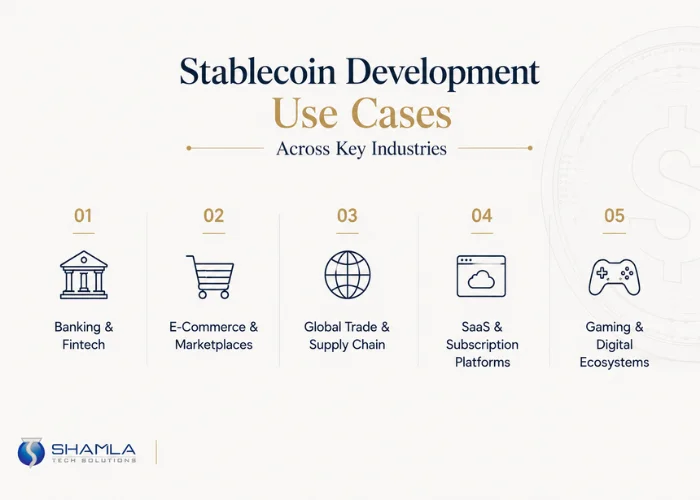
Stablecoin Development Use Cases Across Key Industries
Stablecoin Development Use Cases Across Key Industries

Banking and Financial Services

Banks, fintech platforms, and payment institutions can use stablecoins for cross-border settlements, treasury movement, institutional transfers, and settlement infrastructure modernization. This reduces dependency on legacy correspondent banking networks while improving transaction speed, liquidity visibility, and operational efficiency across commercial financial operations.

E-Commerce and Digital Marketplaces

Large e-commerce platforms and marketplace operators can deploy stablecoins to manage merchant payouts, customer refunds, settlement automation, and cross-border transaction processing. Proprietary payment infrastructure improves payout predictability, reduces processing costs, and gives platform operators stronger control over transaction economics and payment lifecycle management.

Supply Chain and Global Trade

Importers, exporters, manufacturers, and logistics-driven enterprises face settlement delays, fragmented banking coordination, and foreign exchange inefficiencies. Stablecoin infrastructure enables faster supplier payments, programmable contract-based settlements, and improved liquidity movement across international trade operations where payment timing directly affects procurement continuity and vendor relationships.

SaaS and Subscription-Based Businesses

Recurring revenue businesses require payment systems capable of handling automated billing, international subscriptions, usage-based settlements, and embedded financial transactions. Stablecoins provide programmable payment rails that support recurring collections, ecosystem-native settlements, and stronger control over payment infrastructure supporting subscription-driven commercial models.

Gaming, Loyalty, and Digital Ecosystems

Gaming platforms, digital communities, and consumer ecosystems can use stablecoins to power in-platform economies, loyalty rewards, merchant credits, and transactional incentives. This creates reusable digital value within controlled ecosystems, increasing customer engagement, retention, and transaction frequency while strengthening platform monetization opportunities.

Transform Payment Operations With Custom Stablecoin Solutions

What Businesses Should Know Before Exploring Stablecoin Opportunities

Launching a stablecoin is a financial infrastructure decision that impacts compliance, treasury operations, technical architecture, and long-term ecosystem strategy. Businesses evaluating this opportunity must assess commercial readiness beyond product development, ensuring the stablecoin aligns with operational objectives, regulatory obligations, and measurable transactional use cases.

Strategic Consideration

Core Business Question

Operational Impact

Leadership Priority

Regulatory & Compliance Readiness

Can the stablecoin operate within applicable legal and financial frameworks?

Licensing exposure, AML/KYC obligations, jurisdictional constraints

Risk governance

Reserve & Treasury Management

How will the stablecoin maintain stability, redemption integrity, and liquidity confidence?

Asset backing, reserve controls, redemption operations

Financial oversight

Technical Infrastructure & Security

Is the architecture secure, scalable, and commercially reliable?

Smart contract risk, interoperability, uptime resilience

Technology governance

Market Adoption & Commercial Utility

Does the stablecoin solve a clear transactional business problem?

Adoption barriers, ecosystem participation, revenue viability

Commercial execution

Regulatory and Compliance Readiness

Stablecoin issuance introduces obligations tied to financial regulation, AML controls, KYC enforcement, reporting requirements, and jurisdiction-specific licensing expectations. Businesses entering this space without a defined compliance framework risk operational disruption, legal exposure, and institutional credibility concerns that can materially affect long-term commercial viability.

Reserve Management and Financial Governance

Stablecoin credibility depends on reserve transparency, redemption reliability, and disciplined treasury governance. Businesses must define how stability is maintained, which assets support issuance, how liquidity events are handled, and what financial controls govern token circulation to establish institutional trust and operational sustainability.

Infrastructure Security and Technical Reliability

Stablecoin platforms function as financial infrastructure, making security architecture a board-level concern. Businesses must evaluate smart contract security, wallet infrastructure, custody mechanisms, blockchain interoperability, uptime resilience, and transaction scalability to prevent operational failures that could directly impact users, counterparties, and enterprise reputation.

Commercial Utility and Adoption Strategy

A stablecoin requires a defined transactional purpose to achieve meaningful adoption. Businesses should identify where the token creates measurable operational value, whether through settlements, merchant payouts, ecosystem transactions, or treasury movement. Infrastructure without commercial utility often results in weak adoption, limited transaction activity, and poor strategic returns.

Final Thoughts

Stablecoins are becoming a strategic layer of enterprise financial infrastructure, particularly for businesses seeking stronger payment control, programmable transaction systems, and proprietary ecosystem economics. The organizations making serious moves now are shaping how digital value exchange will be structured across industries.

Launching a stablecoin requires commercial discipline, regulatory clarity, and infrastructure built for institutional reliability. For businesses with defined transactional use cases, the opportunity extends far beyond payments, creating a foundation for financial ownership, monetization, and long-term competitive positioning in digital commerce.

Build Secure Stablecoins with Shamla Tech Solutions

Shamla Tech Solutions is a stablecoin development company specializing in enterprise-grade digital payment infrastructure for businesses seeking secure, scalable, and commercially viable stablecoin solutions. Our expertise spans stablecoin architecture design, smart contract development, reserve-backed token frameworks, wallet integration, payment infrastructure, compliance-oriented implementation, and blockchain ecosystem interoperability tailored to specific business models.

Whether your objective is cross-border payment infrastructure, marketplace settlements, treasury optimization, embedded financial services, or ecosystem-based digital transactions, Shamla Tech Solutions delivers end-to-end stablecoin development aligned with business goals. From strategic consulting and technical execution to deployment and long-term support, we help enterprises build stablecoin solutions designed for operational reliability and commercial performance.


Build Secure Stablecoin Infrastructure For Your Business

FAQs

1. What are the main benefits of launching a stablecoin for businesses?
Launching a stablecoin can improve payment efficiency, reduce cross-border settlement friction, create new revenue opportunities, strengthen customer retention, and provide businesses with greater control over transaction infrastructure and financial ecosystem operations.
2. Which industries can benefit most from stablecoin development?
Industries such as banking, fintech, e-commerce, supply chain, SaaS, gaming, and digital marketplaces can benefit significantly from stablecoin development due to their need for scalable payments, automated settlements, and programmable transaction systems.

3. How long does it take to develop a stablecoin?

Stablecoin development timelines depend on project complexity, blockchain selection, compliance requirements, feature scope, and integration requirements. With the right technical framework and delivery expertise, Shamla Tech Solutions can develop and deploy enterprise-grade stablecoin solutions in as little as 4 weeks for qualified project scopes.
4. What factors should businesses evaluate before launching a stablecoin?
Businesses should assess regulatory compliance, reserve management strategy, technical infrastructure security, commercial use cases, redemption mechanisms, and adoption strategy to ensure the stablecoin delivers measurable operational and financial business value.
5. Is stablecoin development suitable for businesses beyond financial services?
Yes, stablecoin development is relevant beyond financial institutions. E-commerce platforms, supply chain businesses, SaaS providers, marketplaces, and digital ecosystems can use stablecoins for settlements, loyalty programs, treasury management, and embedded payments.

Talk to Our Experts

Recent Posts