

Home » Stable Coin » How Stablecoin Payment Solutions Are Revolutionizing Global Business Transactions

How Stablecoin Payment Solutions Are Revolutionizing Global Business Transactions

Share this article:
stablecoin payment solutions
Table of Contents
About the Author
Balaji
CEO of Shamla Tech, specializes in crypto exchange development, RWA tokenization, blockchain infrastructure, AI solutions, and compliance-ready platforms. He helps enterprises address regulatory, security, and scalability challenges while driving real-world adoption of emerging technologies across industries.
Connect On:

Global business payments still rely on infrastructure shaped by banking cut-off windows, intermediary dependencies, and fragmented cross-border settlement processes. For enterprises managing international commerce, payment speed, treasury visibility, and transaction certainty now influence operational performance and strategic financial decision-making.

By 2026, the global stablecoin market is projected to surpass $300 billion in circulating value, reflecting growing enterprise demand for programmable digital settlement infrastructure. This signals a clear business requirement for stablecoin payment solutions that support faster cross-border payments, predictable transaction costs, and continuous settlement access.

In this article, we will examine how stablecoin payment solutions are reshaping global business transactions, the strategic business advantages they deliver, enterprise use cases driving adoption, critical implementation considerations, and why selecting the right development partner matters for long-term commercial execution.

Launch Enterprise Stablecoin Payments In 4 Weeks

Why Traditional Global Payment Systems No Longer Meet Business Demands

Global enterprises require payment infrastructure that supports treasury precision, operational continuity, and international scalability. Traditional cross-border payment systems continue to create execution inefficiencies that directly affect supplier relationships, liquidity planning, settlement predictability, and the speed of commercial decision-making.

Critical Business Limitations Of Traditional Global Payment Infrastructure

  • Cross-border payments remain dependent on fragmented correspondent banking chains, creating approval dependencies across institutions and jurisdictions. For enterprise finance teams, this introduces settlement uncertainty that weakens cash flow planning, delays commercial execution, and increases operational coordination overhead.

  • In 2026, the Financial Stability Board acknowledged global cross-border payment reforms remain behind target, with the G20’s goal of reducing transaction costs to 1% still unmet, reinforcing enterprise demand for stablecoin payment solutions with faster settlement efficiency.

  • Traditional payment infrastructure provides limited transactional intelligence during execution, restricting visibility into intermediary deductions, settlement progression, and currency conversion impacts. This forces finance teams into reactive reconciliation processes rather than maintaining proactive control over enterprise treasury operations.

  • Banking-hour dependency creates operational constraints for multinational enterprises managing suppliers, distributors, and partners across time zones. Payment execution becomes tied to institutional schedules instead of commercial urgency, reducing responsiveness in high-value transactions where timing directly influences business continuity.

  • Scaling international payment operations through conventional banking infrastructure increases institutional complexity. Enterprises entering new markets often require additional banking relationships, regional compliance coordination, and localized settlement processes, creating higher administrative costs that compound as transaction volume and geographic exposure expand.

Key Business Benefits Of Stablecoin Payment Solutions For Cross-Border Transactions
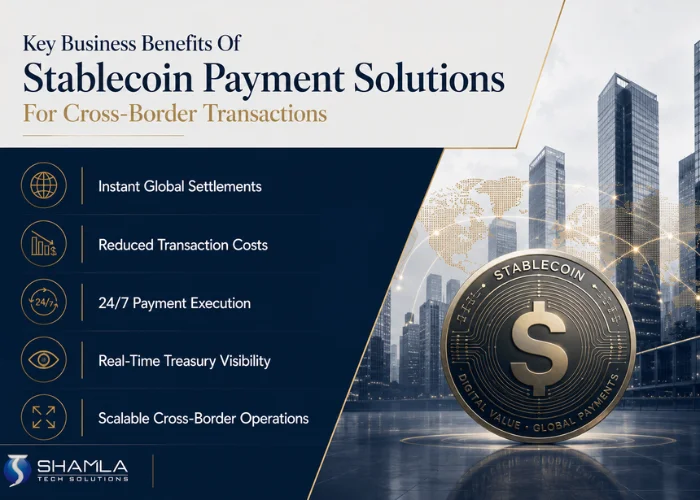
Key Business Benefits Of Stablecoin Payment Solutions For Cross-Border Transactions

1. Faster Settlement Execution

Stablecoin payment solutions eliminate the settlement delays created by intermediary banking chains, highlighting the advantage of stablecoin payments vs traditional payments by enabling near-instant transaction execution across jurisdictions. For enterprises managing supplier payments, treasury transfers, or time-sensitive commercial obligations, faster settlement improves working capital access, strengthens vendor reliability, and reduces operational uncertainty tied to delayed fund movement.

2. Lower Transaction Cost Exposure

Cross-border payment costs directly erode margins, particularly for enterprises operating at scale across multiple markets. Stablecoin payment solutions reduce dependency on correspondent banking intermediaries, foreign exchange markups, and layered processing fees, creating a more efficient payment cost structure that improves transaction economics and supports stronger international profitability.

3. Continuous Global Payment Availability

Commercial transactions do not operate according to institutional banking schedules. One of the key benefits of stablecoins is continuous transaction capability, allowing enterprises to execute payments independent of banking hours, public holidays, or regional cut-off windows. This operational flexibility strengthens responsiveness in international business environments where execution timing directly affects contractual and financial outcomes.

4. Greater Treasury Visibility And Control

Traditional payment systems often restrict real-time transaction visibility, limiting treasury oversight during execution. Stablecoins for cross-border payments provide transparent transaction tracking and programmable settlement architecture, enabling finance teams to monitor payment movement with greater precision, improve reconciliation efficiency, and maintain stronger control over enterprise liquidity management decisions globally.

5. Scalable Infrastructure For Global Expansion

Expanding into international markets often increases payment complexity through new banking dependencies, regional settlement constraints, and administrative overhead. Stablecoin payment solutions offer a more standardized digital payment infrastructure, allowing enterprises to scale cross-border financial operations with fewer institutional barriers while supporting faster market entry and more efficient commercial expansion.

What Businesses Should Consider Before Adopting Stablecoin Payment Solutions

Adopting stablecoin payment solutions is a financial infrastructure decision, not a transactional feature upgrade. Enterprise leaders must evaluate operational fit, compliance exposure, treasury integration, and scalability requirements to ensure implementation strengthens payment execution, financial control, and long-term commercial performance.

Priority

Key Metric To Evaluate

Why It Matters

Compliance Readiness

100% Jurisdiction Coverage

Payment infrastructure must align with every target market’s regulatory requirements.

Settlement Speed

< 5 Minute Settlement Target

Faster execution improves liquidity access and supplier payment reliability.

Cost Efficiency

50–80% Lower Payment Costs Potential

Reduces margin erosion from intermediary fees and FX inefficiencies.

Treasury Visibility

Real-Time Transaction Monitoring

Strengthens reconciliation accuracy and enterprise financial control.

Scalability Capacity

10x Transaction Growth Readiness

Ensures infrastructure supports international expansion without operational redesign.

Regulatory Compliance Readiness

Cross-border payments introduce jurisdictional complexity, licensing considerations, AML obligations, and reporting requirements. Businesses must assess whether their stablecoin payment infrastructure aligns with applicable regulatory frameworks to prevent operational disruptions, compliance exposure, or limitations on market expansion.

Treasury And Financial System Integration

Payment infrastructure must align with existing enterprise finance workflows. Stablecoin banking integrations should connect with treasury management systems, accounting processes, reconciliation frameworks, and internal reporting structures to avoid creating fragmented financial operations or unnecessary administrative overhead.

Stablecoin Selection And Risk Management

Not all stablecoins offer the same level of reserve transparency, liquidity reliability, or issuer credibility. Businesses should evaluate asset stability, redemption mechanisms, governance structures, and transaction ecosystem support to ensure payment execution aligns with enterprise financial risk management expectations.

Transaction Visibility And Operational Control

Enterprise finance teams require full payment transparency, not post-transaction uncertainty. Payment infrastructure should provide real-time transaction visibility, audit traceability, settlement confirmation, and operational monitoring capabilities that support stronger treasury governance and faster financial decision-making.

Scalability For Long-Term Business Growth

A payment solution should support future commercial expansion, not immediate transactional needs alone. Businesses must assess whether the underlying stablecoin compliance stack can handle increasing transaction volume, additional jurisdictions, evolving compliance requirements, and broader enterprise payment use cases without operational redesign.

Transform Global Payments With Stablecoin Payment Solutions

How To Choose The Right Stablecoin Payment Solution Development Partner

Proven Enterprise Payment Infrastructure Experience

Stablecoin payment solutions require expertise beyond blockchain development. Enterprises should prioritize partners with demonstrated experience in payment architecture, treasury workflows, cross-border transaction systems, and financial infrastructure delivery. Technical execution without enterprise payment domain knowledge increases implementation risk, operational inefficiencies, and long-term dependency on corrective redevelopment.

Regulatory And Compliance Architecture Capability

Payment infrastructure must be designed with compliance requirements embedded from the outset. The right development partner should understand AML frameworks, KYC integration, transaction monitoring requirements, jurisdictional payment considerations, and auditability expectations, ensuring the platform supports enterprise governance requirements without creating compliance blind spots or operational restrictions.

Secure And Resilient System Engineering

Enterprise payment infrastructure must maintain transaction integrity, availability, and operational trust. Development partners should demonstrate strong security engineering capabilities across wallet architecture, key management, API protection, access controls, infrastructure resilience, and failure recovery planning, reducing exposure to financial loss, service disruption, and reputational risk.

Integration With Enterprise Financial Ecosystems

Stablecoin payment platforms cannot operate in isolation from enterprise finance operations. The right partner should deliver integration capabilities across ERP systems, treasury management platforms, accounting workflows, reconciliation engines, and reporting environments, ensuring stablecoins for treasury and liquidity strengthen financial operations rather than introducing fragmented systems and manual administrative complexity.

Scalable Architecture For Commercial Growth

A payment platform built for current transaction needs alone creates future infrastructure constraints. Enterprises should evaluate whether the development partner can architect scalable systems capable of supporting increased transaction volume, multi-market expansion, evolving payment use cases, and additional operational complexity without requiring costly architectural restructuring.

Strategic Delivery And Long-Term Partnership Value

Technology delivery is only one component of enterprise payment transformation. The right partner should provide strategic implementation guidance, infrastructure roadmap alignment, post-launch support, performance optimization, and commercial scalability planning, ensuring the stablecoin payment solution continues delivering measurable business value beyond initial deployment.

Final Thoughts

Global payment infrastructure is becoming a strategic boardroom discussion, not a back-office operational function. Enterprises that modernize payment execution early while adapting to evolving stablecoin regulation will secure stronger treasury control, faster international commerce, and infrastructure better aligned with the financial demands of global business growth.

Stablecoin payment solutions represent a practical infrastructure decision for businesses seeking greater efficiency in cross-border transactions. Success depends on execution quality, regulatory alignment, and technology architecture, making the choice of development partner a commercial decision with direct long-term operational and financial consequences.

Partner With Shamla Tech Solutions For Stablecoin Payment Solution Development

Shamla Tech Solutions is a stablecoin payment solution development company specializing in enterprise-grade digital payment infrastructure for global businesses. We design and develop secure, scalable stablecoin payment platforms with wallet integration, payment automation, treasury visibility, compliance-focused architecture, and seamless cross-border transaction capabilities tailored to commercial requirements.

With deep expertise in blockchain payment engineering, enterprise system integration, and financial technology development, Shamla Tech Solutions helps businesses build stablecoin payment solutions aligned with operational goals. From architecture strategy to deployment and long-term optimization, we deliver infrastructure built for commercial performance and global scalability.


Build Faster Cross-Border Payment Infrastructure With Experts

FAQs

1. What Are Stablecoin Payment Solutions?

Stablecoin payment solutions are blockchain-based payment infrastructures that enable businesses to send, receive, and manage transactions using stable digital assets pegged to fiat currencies, supporting faster, more predictable cross-border payment execution.

2. Why Are Businesses Adopting Stablecoin Payment Solutions?

Businesses adopt stablecoin payment solutions to reduce cross-border transaction delays, lower payment processing costs, improve treasury visibility, enable continuous settlement capability, and create more efficient global payment infrastructure for commercial operations.

3. Are Stablecoin Payment Solutions Suitable For Enterprise Use?

Yes, stablecoin payments solutions can support enterprise use when built with secure architecture, compliance integration, treasury interoperability, transaction monitoring, and scalable infrastructure aligned with the operational and regulatory requirements of international businesses.

4. How Long Does It Take To Develop A Stablecoin Payment Solution?

Development timelines vary based on platform scope, integration requirements, and compliance architecture. Shamla Tech Solutions can deliver stablecoin payment solutions in as little as 4 weeks through structured development frameworks designed for faster enterprise deployment without compromising security or scalability.

5. How Do Businesses Choose The Right Stablecoin Payment Development Partner?

Businesses should evaluate development partners based on enterprise payment expertise, compliance architecture capability, security engineering standards, system integration experience, scalability planning, and long-term support capacity for stablecoin payment infrastructure delivery.

Talk to Our Experts

Recent Posts