
Upgrade your payment infrastructure with faster, borderless stablecoin transactions today
What are Stablecoin Payments?
Stablecoins are digital tokens that are linked to a real-world asset, like the US dollar (USD) or euro, and are meant to keep its value stable. One USDC, for instance, is supposed to always be worth about one dollar because it is backed by USD reserves. Businesses adopt stablecoins because they combine the speed and reach of cryptocurrencies with the predictability of currency.
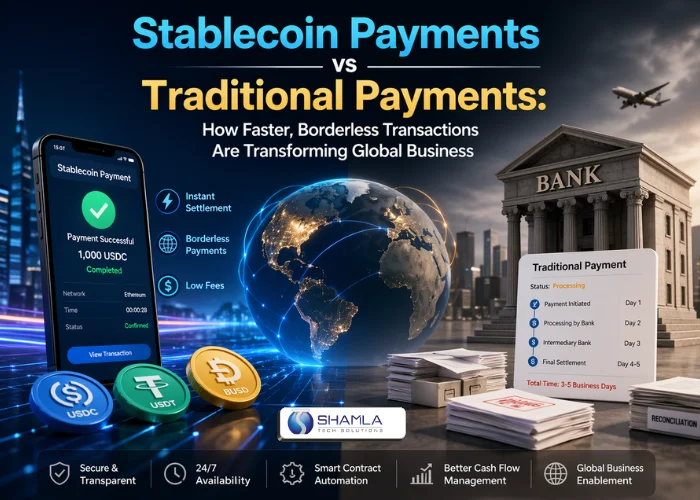
A normal payment goes like this: the client sends stablecoins from their digital wallet to the business’s wallet, and the payment is settled in a few minutes. There are no pending statuses or cutoff times at the bank. Let’s uncover the difference between stablecoin payments vs traditional payments.
Stablecoin Payments vs Traditional Payments
Operational Dimension | Conventional Payment Infrastructure | Stablecoin-Powered Payment Networks |
Transaction Finality Speed | Settlement cycles typically take 1–5 business days due to batch processing and reliance on intermediaries | Near-instant settlement enabled by blockchain consensus mechanisms |
Transaction Cost Structure | Higher costs driven by intermediaries, clearing houses, and card network fees | Low-cost transactions, often sub-dollar, via peer-to-peer blockchain transfers |
Cross-Border Payment Efficiency | Relies on correspondent banking systems with FX fees and multi-day delays | Seamless borderless transfers with minimal or no foreign exchange friction |
Automation & Programmability | Limited automation, manual reconciliation, and restricted API capabilities | Smart contract-enabled automation with programmable and conditional payments |
Infrastructure Security Model | Centralized architecture dependent on institutional trust and legacy security systems | Cryptographically secured, tamper-resistant transactions validated on blockchain |
Transparency & Auditability | Limited transparency with delayed reporting and opaque transaction trails | Fully transparent, immutable on-chain records with real-time traceability |
Settlement Risk Exposure | Exposure to counterparty risk, intermediary failures, and reconciliation issues | Reduced risk through direct peer-to-peer settlement and minimal intermediaries |
Operational Availability | Limited by banking hours, weekends, and public holidays | 24/7/365 availability with uninterrupted network access |
Scalability for Global Use | Constrained by regional banking systems and regulatory fragmentation | Built for global scalability with interoperability and composability |
I hope you understand the stablecoin payments vs traditional payments.
How do Stablecoins work for Business than Traditional Payments?
Stablecoin payments
Traditional payments
Reduce costs and unlock real-time settlements by switching to stablecoin-powered payments.
How do Stablecoins compare to Traditional Payments on Speed and Settlement?
On Stablecoin payments vs traditional payments, Stablecoins settle at the pace of the internet. At any time of day or night, any day of the year, a transfer normally goes through in seconds or minutes. There are no bank holidays or cutoff times. Once the payment is validated on the chain, it’s final and can’t be changed, much like cash.
Compared to new systems, old ones are slower. It takes 1 to 3 business days for cards and direct deposits to go through. International electronic transfers can take five days or longer, especially if they go through more than one correspondent bank. Bank cutoff times still apply to domestic electronic transfers that happen on the same day.
This has a direct effect on cash flow. Stablecoins settle quickly, so exporters don’t have to wait a week to get their money. Marketplaces may pay creators in minutes, and CFOs don’t have to keep extra money in overseas accounts in case of delays.
Finality of settlement is also important. There is a chance that card payments could be canceled later. There are times when you can get a bank transfer back. A stablecoin payment’s dependability can change how finance teams handle liquidity.
How do stablecoin payments affect treasury and cash management compared to traditional methods?
The goal of corporate treasuries is to make sure that money is where it needs to be when it needs to be there. Moving money across borders with standard methods takes days, so teams often pre-fund local accounts, tie up capital, and deal with FX swings with hedges or overnight conversions.
Companies can keep dollars in the form of stablecoins and shift them across subsidiaries at any time of day. That flexibility makes it less necessary to overfund international accounts and makes more money available. Businesses in economies with high inflation can protect their money by converting local currency into USD-pegged stablecoins. They don’t require offshore bank accounts to do this. The end outcome is less cash that is stuck and better planning.
Programmable money could also have certain benefits. Idle sums can be put into short-term investments that produce interest until the money is taken out. Stablecoins let businesses get more out of their working capital (even for a few hours) in a way that traditional systems don’t.
That being said, using stablecoin payments vs traditional payments does bring about changes inside the company. Treasury teams need ways to keep digital assets safe, get approval for them, and keep track of their money. It’s necessary to have private key security, multi-signature controls, and audit reporting. Many businesses start by hiring providers that handle custody and conversion so they can get the speed without having to keep tokens themselves.
Why Choose Shamatech for Stablecoin Development?
Choosing the right development partner is critical when building a stablecoin solution, especially in a rapidly evolving blockchain ecosystem. Shamatech stands out as a reliable and innovation-driven provider for stablecoin development.
Shamatech combines deep blockchain expertise with a strong understanding of financial systems to deliver scalable, secure, and compliant stablecoin solutions. Whether you’re building a fiat-backed stablecoin, crypto-collateralized token, or algorithmic model, their team ensures a seamless development process from concept to deployment.
One of the key advantages of working with Shamatech is their focus on end-to-end development. They don’t just build tokens—they design the entire ecosystem, including smart contracts, wallet integrations, payment gateways, and compliance frameworks. This ensures your stablecoin is not only technically sound but also ready for real-world adoption.
Security is another major strength. With stablecoins handling high-value transactions, Shamatech implements robust smart contract audits, encryption mechanisms, and multi-layer security protocols to safeguard your platform against vulnerabilities.
Additionally, Shamatech helps businesses stay compliant with evolving global regulations. From KYC/AML integration to regulatory guidance, they ensure your stablecoin aligns with legal standards, reducing risks and building trust among users.
Their solutions are also highly customizable and scalable, enabling businesses to integrate stablecoins into DeFi platforms, payment systems, or enterprise applications. Combined with faster deployment timelines and ongoing support, Shamatech becomes a long-term technology partner rather than just a service provider.
Future-proof your business with secure, transparent, and always-on payment networks.
Conclusion
Stablecoins are redefining the way digital payments and financial systems operate. Compared to traditional payment infrastructure, they offer faster settlement, lower transaction costs, and global accessibility—making them a powerful tool for modern businesses.
As adoption continues to grow, businesses that leverage stablecoin technology early will gain a competitive advantage in cross-border payments with stablecoins, treasury management, and decentralized payment systems.
Partnering with an experienced provider like Shamatech ensures that your stablecoin solution is secure, compliant, and the future of payment technology. With the right strategy and technology, stable coin payment advantages can unlock new opportunities and drive innovation in the global financial landscape.