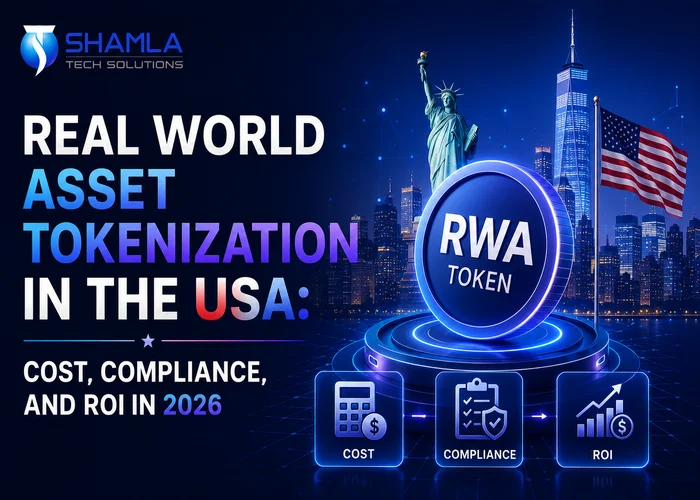

Real world asset tokenization (RWA tokenization) is used to change physical and real assets that we usually trade traditionally into digital tokens on a blockchain, making them much easier to trade, transfer, and divide. This process increases liquidity, transparency, and efficiency by a mile in many industries by using the blockchain technology as its back-bone. As the digital economy keeps growing, RWA is becoming more popular because it can change how we interact with assets, such as real estate, art, commodities, and even intellectual property.
Real world asset tokenization development transforming many industries is a key subject that will create a lot of buzz in 2025, as businesses and investors are keenly looking for better ways to manage and make money from their assets in a digital world. Improvements in digital tokenization technology are helping industries tokenize many types of assets, opening up new ways for people to own parts of valuable assets and making it easier for more people to access them. However, the process does come with some costs, including the need for infrastructure, legal issues, and following the rules, all of which need to be managed carefully for successful use.
By looking at how real world asset tokenization is disrupting industries, we see it helping to bring new revenue ideas in areas like finance, real estate, art, and supply chain management. By tokenizing real world assets, businesses can open up many new ways for investment and growth, making the global economy more inclusive and efficient.
Key Takeaways
- The cost to build an RWA tokenization platform in 2026 can vary significantly depending on the platform’s features, supported asset classes, blockchain network, compliance requirements, and level of customization.
- A basic platform with core tokenization and asset-management functionality can require a lower development investment, while an enterprise-grade platform with KYC/AML, custody, smart contracts, trading, compliance, and multi-chain support can require substantially more.
- The main cost drivers include UI/UX design, blockchain development, smart contracts, backend infrastructure, security audits, compliance integrations, wallets, asset management, and third-party services.
- Development costs also extend beyond the initial build. Security audits, blockchain infrastructure, regulatory compliance, maintenance, upgrades, and ongoing support should be included in the overall budget.
- Choosing between building from scratch, using existing tokenization infrastructure, or developing a customized white-label solution can have a major impact on both upfront cost and time to market.
- A well-designed RWA tokenization platform should balance security, regulatory compliance, scalability, interoperability, and user experience rather than focusing solely on initial development cost.
- Before estimating a final budget, businesses should define the asset type, target users, jurisdiction, token standard, blockchain network, compliance model, and required platform features.
Cost Overview: App Development, Legal, Infrastructure, Marketing
Category | Services Included | Basic | Intermediate | Advanced |
Development | App and platform development, basic features (login, profile, feed), UI/UX design, mobile app (iOS/Android), API integration | $20,000 – $30,000 | $50,000 – $80,000 | $100,000 – $350,000 |
Legal and Regulatory | Legal fees (contracts, licensing), IP protection, privacy and data security, compliance with regulations | $5,000 – $10,000 | $15,000 – $25,000 | $40,000 – $90,000 |
Infrastructure | Hosting and servers, cloud storage, content delivery network (CDN), database setup and maintenance, server maintenance | $5,000 – $10,000 | $20,000 – $40,000 | $60,000 – $100,000 |
Marketing and Launch | Branding and logo design, digital marketing (social media, PPC, SEO), influencer partnerships, launch events, paid promotions | $10,000 – $15,000 | $30,000 – $50,000 | $70,000 – $100,000 |
Total Estimate |
| $40,000 – $65,000 | $115,000 – $195,000 | $270,000 – $640,000 |
How Much Does It Cost to Build an RWA Tokenization Platform in 2026?
The cost to build an RWA tokenization platform in 2026 typically depends on the platform’s complexity, asset type, blockchain network, compliance requirements, security architecture, and integrations. A basic MVP may cost around $50,000–$100,000, while a mid-tier platform can range from $100,000–$250,000. A fully customized enterprise-grade platform with advanced compliance, multi-chain support, trading capabilities, custody, and institutional integrations can cost $250,000–$500,000+.
These figures are indicative development ranges rather than fixed quotes. The final real-world asset tokenization development cost can be higher or lower depending on the project’s requirements, jurisdiction, development approach, and technology choices.
For businesses planning an RWA platform, the most important step is to define the required features and regulatory scope before estimating the final budget. A focused MVP can help validate the business model before investing in a larger enterprise-grade infrastructure.
Factors That Affect RWA Tokenization Cost
The cost of developing an RWA tokenization platform depends on more than the number of features included in the application. The underlying asset, blockchain infrastructure, regulatory requirements, integrations, and development resources can all significantly influence the overall budget.
Asset Type
The type of real-world asset being tokenized is one of the first factors to consider. Real estate, commodities, bonds, private credit, artwork, and other assets can have different ownership structures, valuation methods, documentation requirements, and compliance obligations.
For example, tokenizing a single asset with a straightforward ownership structure may require less development than building a platform that supports multiple asset classes with different legal and operational workflows.
Blockchain Network
The blockchain selected for the platform affects development complexity, transaction costs, scalability, interoperability, and smart-contract requirements. Building on an established blockchain may reduce infrastructure development compared with creating or maintaining a custom blockchain environment.
Multi-chain support can further increase costs because the platform may require additional smart contracts, integrations, testing, wallet compatibility, and cross-chain infrastructure.
Compliance Requirements
RWA platforms often require significantly more compliance infrastructure than a conventional blockchain application. Depending on the jurisdiction and asset type, this can include KYC/AML verification, investor accreditation, identity management, transaction monitoring, reporting, custody requirements, and securities compliance.
The more jurisdictions and regulatory frameworks a platform needs to support, the greater the development and operational complexity can become.
Platform Features
The number and sophistication of platform features directly influence development costs. Core functionality may include token creation, asset management, investor onboarding, wallets, dashboards, and smart contracts.
Advanced platforms may also require secondary-market trading, portfolio management, dividend or income distribution, governance, automated compliance, analytics, APIs, role-based access controls, and institutional workflows. Each additional feature adds development, testing, security, and maintenance requirements.
Third-Party Integrations
RWA platforms commonly rely on external services for identity verification, KYC/AML screening, payment processing, custody, banking, pricing data, analytics, notifications, and other functions.
Each integration requires API development, testing, authentication, monitoring, and ongoing maintenance. The number and complexity of these third-party services can therefore have a substantial impact on the total development cost.
Development Team & Location
The composition and location of the development team also affect the budget. A project may require blockchain developers, smart-contract engineers, backend and frontend developers, UI/UX designers, QA engineers, security specialists, DevOps professionals, and compliance experts.
Development rates vary significantly by region and level of expertise. An experienced team with RWA, blockchain, security, and financial-technology expertise may have a higher upfront cost, but can potentially reduce risks associated with security vulnerabilities, architectural problems, and costly redevelopment.
Ultimately, the cost of an RWA tokenization platform should be evaluated against its required functionality, regulatory scope, security standards, and long-term scalability rather than development cost alone.
Development Costs Breakdown for Asset Tokenization Platforms
Developing asset tokenization platforms will need a significant financial investment and careful planning to achieve success and security in the operations that you will handle. The costs associated with building all these platforms can vary widely depending on the complexity of the project that you choose to do, the features required, and the technologies used for it. We have made a detailed breakdown of the development costs for asset tokenization platforms, including blockchain integration, smart contracts, wallet features, and other essential components.
1. Blockchain Integration Costs
The first among the most significant expenses in developing asset tokenization platforms would be the blockchain integration. The choice of blockchain platform, whether public, private, or hybrid, will directly impact your development costs. Public blockchains like Ethereum and XRP can be much cost-effective for you in terms of transaction fees but may also require additional security and scalability measures. Private blockchains can offer you much more control over this but may involve higher development costs in the development journey due to their customization and maintenance requirements.
Blockchain Development Team: For the integration of blockchain into your platforms, you would need to set up a team of blockchain developers who have previous experience in building RWA projects. And then depending on the complexity of your project your team will need 3-10 developers who would demand salaries from $25 to $150 per hour based on their years of experience and their location. So, the total costs for this would be around $5000 and $50,000.
Node Setup and Maintenance: Setting up and maintaining nodes on the blockchain would also incur you costs. For a decentralized platform, all the nodes must be established in a way which would be placed across various regions to make sure that the system is reliable. The maintenance costs for these nodes can range between $5000 and $25,000 annually, which would again depend on the blockchain’s infrastructure.
2. Smart Contract Development Costs
Smart contracts are an important part of the asset tokenization process. These contracts will automatically carry out the transactions and agreements based on the set rules of yours. Creating super secure and effective smart contracts needs special skills, as mistakes in the coding can cause very big financial losses or security problems in the future in your operations.
Smart Contract Development Team: The cost of creating smart contracts mostly depends on how complicated the rules are being set and what the platform actually needs. Usually, a smart contract developer will charge you between $60 to $200 per hour, and to help you in making a strong, safe contract, the entire process can take from 100 to 500 hours. This means the costs can be around $6,000 to $100,000.
Testing and Auditing: After all the smart contracts are developed which will be according to your set rules, it has to go through careful, thorough testing and checking to make sure that it is absolutely safe and also to check if it works well. Checking the contract by the hiring outside firms usually will cost you between $2,000 and $25,000, depending on how complex the contract is.
3. Wallet Features and Security Integration Costs
A good wallet will need both front-end and back-end work to make sure that it works well and is easy to use for your users. It also needs multiple security features that will be in place to stop hacking and fraud. A team of skilled developers, designers, and security experts is needed to build the wallet, and it can cost you anywhere between $10,000 and $120,000, which will be depending on how complicated and feature-packed your desired wallet is.
Security is very important in this because tokenized assets that are stored in here are digital and valuable. To protect your users, the wallet that you create should consist of strong security features like multi-signature authentication, two-factor authentication (2FA), and cold storage to keep all your users’ assets safe. Adding all these security features will definitely cost you north of $10,000 to $150,000, completely depending on what’s needed for protection here.
Making a safe and simple wallet also would be needing you to pay attention to both design and how the functionalities are implemented. The wallet should support several different types of tokens, like ERC-20 and ERC-721, and have an easy interface for users to manage their assets. It’s also super important that the wallet is easy to use and very secure. If there are any issues, users could be at risk and they might stop using your wallet. So, the total cost of making the wallet with all these features can vary, but it will be a big investment with good returns.
4. Scalability and Infrastructure Costs
Scalability is really important for asset tokenization platforms because they need to support more users and transactions without affecting performance or security. As the number of transactions grows, the platform should be able to handle millions of transactions easily.
This usually needs layer-2 scaling solutions or other advanced technology to help the platform scale well. Making a system that can scale needs more server space, cloud storage, and adding solutions to handle growing demand. The cost to set up such a system can be from $50,000 to $200,000, depending on how many transactions are expected and the features needed for scaling.
After the platform is built, load testing has to be done to make sure your developed system can actually handle lots of transactions without any problems coming in. Optimizing and improving this system might also be needed, thereby adding another $30,000 to $100,000 to the budget. This helps make sure the platform is fast, safe, and works well as it grows.
5. Ongoing Maintenance and Updates
Once the platform is live, the ongoing maintenance is needed to fix bugs, update features, and adjust to changing rules. This can cost from $5,000 to $75,000 each year, depending on the size of the platform and its users.
The costs of building asset tokenization platforms can be very different depending on how complex and big the project is. Things like blockchain connection, smart contract creation, wallet features, scalability, and security all affect the price. Also, the ongoing maintenance and legal rules add more financial concerns. If you find this process too difficult to manage with your own team, it can also be handled by acquiring RWA tokenization services for your business.
Infrastructure / Legal & Regulatory / Marketing & Launch / Operational Costs
Infrastructure Costs for RWA Tokenization
Infrastructure is a major component of the overall RWA tokenization platform cost because the platform needs reliable computing, blockchain connectivity, storage, security, and scalable infrastructure to support users and transactions.
Cloud hosting is one of the primary infrastructure expenses. Services such as AWS, Google Cloud, and Microsoft Azure can provide the flexibility needed to scale computing resources as the number of users, tokenized assets, and transactions increases. Depending on the platform’s size and requirements, cloud hosting can cost approximately $10,000–$50,000 per year. Platforms requiring greater control, dedicated resources, or specialized security configurations may spend $20,000–$100,000 annually on dedicated hosting and related infrastructure.
Decentralized storage solutions such as IPFS and Filecoin can be used to store supporting documents and digital assets associated with tokenized real-world assets. Storage requirements vary according to the volume and size of documents, metadata, and other files. These costs can range from approximately $1,000–$10,000 per year for smaller to moderately sized implementations.
Scalability infrastructure can add another significant expense. Load balancing, distributed systems, monitoring, caching, and Layer-2 or other scaling solutions may be required as transaction volumes increase. Depending on the architecture and performance requirements, scalable infrastructure can require approximately $25,000–$150,000 per year.
Overall, businesses should budget approximately $25,000–$150,000+ annually for infrastructure-related expenses, depending on hosting architecture, storage requirements, blockchain usage, security standards, and expected platform traffic.
Legal & Regulatory Costs for RWA Tokenization
Legal and regulatory compliance is one of the most important cost areas when developing an RWA tokenization platform. Unlike a conventional software application, an RWA platform may involve securities regulations, ownership rights, investor protection requirements, KYC and AML procedures, taxation, custody, and other financial regulations.
The regulatory requirements can also vary significantly between jurisdictions. A platform operating across multiple countries may need to evaluate the legal classification of its tokens, investor eligibility requirements, licensing obligations, data protection rules, and restrictions on offering or transferring tokenized assets.
Specialized legal counsel may be required to structure the tokenization model, prepare agreements, review ownership arrangements, establish compliance procedures, and assess the regulatory status of the platform and its assets. Depending on the complexity and jurisdictions involved, legal and advisory expenses can range from approximately $5,000–$200,000+ per year.
Licensing and regulatory registration can create additional costs. Depending on the business model and jurisdiction, a platform may need specific registrations or licenses related to financial services, securities, asset management, custody, or trading activities. These costs can vary substantially and should be assessed on a jurisdiction-by-jurisdiction basis rather than treated as a fixed development expense.
Compliance also requires ongoing investment in KYC/AML systems, regulatory monitoring, documentation, audits, and policy updates. For a platform operating in regulated markets, businesses should therefore consider an overall legal and regulatory budget of approximately $25,000–$250,000+, depending heavily on jurisdiction, licensing requirements, asset type, and operational scope.
Marketing & Launch Costs for RWA Tokenization
Marketing and launch activities are another important component of the overall RWA tokenization platform budget. Building the technology alone does not guarantee adoption; platforms also need to establish credibility, attract investors or asset owners, and communicate the value and security of the tokenization solution.
Marketing expenses can include content marketing, search engine optimization, paid advertising, public relations, social media campaigns, educational materials, webinars, industry events, and targeted outreach. A focused marketing campaign may require approximately $50,000–$100,000, while larger campaigns targeting institutional investors or multiple markets can require substantially more.
Launch costs can include website development, product demonstrations, community-building initiatives, promotional campaigns, conferences, webinars, and other activities required to introduce the platform to the market. Depending on the launch strategy and target audience, a comprehensive launch campaign can cost approximately $100,000–$200,000.
Trust is particularly important in the RWA sector because users and investors need confidence in the platform’s security, compliance, asset verification, and underlying technology. Partnerships with reputable legal advisors, security auditors, financial institutions, and industry organizations can therefore form an important part of the marketing and credibility strategy.
A reasonable overall budget for marketing and launch activities is approximately $50,000–$200,000+, depending on the target market, geographic reach, campaign size, and institutional positioning.
Operational Costs for RWA Tokenization Platforms
Operational costs cover the ongoing resources required to keep an RWA tokenization platform secure, reliable, compliant, and competitive after launch. Unlike one-time development expenses, these costs continue throughout the platform’s lifecycle.
Platform maintenance is one of the primary operational expenses. Regular software updates, bug fixes, blockchain upgrades, feature improvements, API maintenance, and compatibility updates are required to keep the platform functioning effectively. Security updates are particularly important because vulnerabilities can affect user accounts, wallets, smart contracts, and transaction infrastructure.
Customer support is another important expense. A dedicated support team may be required to assist investors, asset owners, administrators, and other platform users with onboarding, transactions, account issues, and general platform questions. The required support resources will increase as the platform’s user base grows.
Continuous monitoring is also necessary to maintain platform reliability. This can include system-performance monitoring, transaction monitoring, infrastructure alerts, security monitoring, log analysis, and incident response. Additional resources may be required when the platform introduces new assets, expands into new jurisdictions, or integrates with new blockchain networks and financial systems.
For a developing or mid-sized platform, ongoing maintenance, support, monitoring, security, and technical operations can typically require approximately $30,000–$150,000+ per year. Enterprise platforms with large user bases, multiple jurisdictions, 24/7 support, and extensive infrastructure may require significantly higher operational budgets.
Overall, businesses should treat operational spending as a recurring component of the RWA tokenization platform cost, rather than limiting the budget to the initial development investment.
Cost by Asset Type
The type of real-world asset being tokenized has a direct impact on development complexity and overall cost. Each asset class can require different token structures, compliance workflows, ownership models, valuation mechanisms, and integrations.
Real Estate Tokenization
Real estate tokenization typically requires property verification, ownership documentation, investor onboarding, compliance workflows, token issuance, and potentially income or dividend distribution mechanisms. Platforms may also require integrations for property management, payments, and secondary-market transactions.
Estimated development cost: $60,000–$150,000+
The final cost depends on the number of properties, jurisdictions, fractional ownership model, compliance requirements, and whether secondary-market functionality is included.
Equity Tokenization
Tokenizing equity can require more sophisticated investor management and compliance functionality because the platform may need to represent ownership rights, voting rights, dividends, transfers, and other corporate actions.
Estimated development cost: $75,000–$180,000+
Multi-jurisdiction support, investor accreditation, regulatory reporting, governance functionality, and integration with financial systems can increase the overall cost.
Commodity & Precious Metals Tokenization
Commodity tokenization can involve asset custody, verification, pricing feeds, ownership tracking, redemption mechanisms, and integration with custodians or storage providers. Precious metals such as gold may require additional systems to connect digital tokens with identifiable physical reserves.
Estimated development cost: $50,000–$120,000+
Costs can increase when the platform requires real-time pricing, custody integrations, physical redemption, proof-of-reserves mechanisms, or support for multiple commodities.
Investment Fund Tokenization
Investment fund tokenization can require sophisticated investor onboarding, subscription and redemption workflows, portfolio reporting, compliance checks, distribution mechanisms, and fund administration integrations.
Estimated development cost: $80,000–$200,000+
The complexity of the fund structure, number of investors, regulatory jurisdictions, reporting requirements, and integration with existing financial infrastructure can significantly affect the final budget.
These ranges are indicative rather than fixed quotes. A platform supporting multiple asset classes will generally require a larger investment than a platform designed around a single asset type.
Custom vs. White-Label vs. MVP: Cost Comparison
Businesses have several approaches when developing an RWA tokenization platform. Building a completely custom platform provides maximum control, while white-label solutions can accelerate deployment. An MVP or hybrid approach can provide a middle ground between customization, cost, and time to market.
Custom Build
A custom RWA tokenization platform is developed specifically around the business’s asset model, regulatory requirements, workflows, branding, and technical architecture.
Estimated cost: $150,000–$500,000+
A custom build is generally appropriate for enterprises that require advanced functionality, proprietary infrastructure, multi-chain support, complex compliance workflows, institutional integrations, or long-term control over the technology.
White-Label Platform
A white-label solution uses an existing tokenization infrastructure that can be customized with the business’s branding, selected features, and workflows.
Estimated cost: $50,000–$150,000+
This approach can reduce development time and initial costs because much of the underlying infrastructure already exists. However, customization may be limited compared with a completely custom platform.
MVP / Hybrid Approach
An MVP or hybrid approach focuses on launching the most important functionality first while using existing infrastructure or third-party services where appropriate.
Estimated cost: $50,000–$150,000+
This approach can allow businesses to validate demand, test the tokenization model, and gather user feedback before investing in a larger platform.
Approach | Estimated Cost | Time to Market | Customization | Best For |
Custom Build | $150K–$500K+ | Longer | Very high | Enterprises and complex platforms |
White-Label | $50K–$150K+ | Faster | Moderate | Businesses seeking faster deployment |
MVP / Hybrid | $50K–$150K+ | Fast | Moderate–high | Startups and businesses validating a concept |
Which Option Is Right for You?
A custom build is suitable when the platform requires unique functionality or extensive control. A white-label solution can be a practical choice when speed and lower upfront costs are priorities. An MVP or hybrid model is often appropriate for businesses that want to validate their business model before committing to a larger development budget.
The right choice ultimately depends on the asset type, target users, regulatory requirements, required features, available budget, and long-term growth strategy.
Hidden & Ongoing Costs After Launch
The initial development budget does not represent the complete cost of operating an RWA tokenization platform. Once the platform goes live, businesses need to account for recurring expenses related to compliance, infrastructure, security, maintenance, and user support.
Ongoing Compliance
Regulatory requirements can change as governments introduce new rules for digital assets and tokenized securities. Businesses may need ongoing legal advice, compliance reviews, KYC/AML monitoring, reporting, licensing renewals, and policy updates.
Potential ongoing cost: $25,000–$250,000+ per year
Node and Hosting Costs
Blockchain nodes, cloud infrastructure, databases, storage, monitoring, backups, and security services create recurring infrastructure expenses. Costs generally increase as transaction volumes, users, and supported networks grow.
Potential ongoing cost: $10,000–$150,000+ per year
Security Audits
Smart contracts and platform infrastructure may require periodic security reviews and audits, particularly when new functionality or contracts are introduced.
Potential cost: $10,000–$50,000+ per audit
Platform Upgrades
Blockchain networks, third-party APIs, security standards, and regulatory requirements can change over time. Keeping the platform compatible and secure requires continuous development and testing.
Potential ongoing cost: $20,000–$100,000+ per year
Customer Support and Operations
User onboarding, technical support, transaction assistance, monitoring, incident response, and administrative operations require dedicated personnel and systems.
Potential ongoing cost: $30,000–$150,000+ per year
These expenses should be included in the long-term financial model rather than treated as unexpected costs after launch.
Common Mistakes That Increase Costs
Poor planning can significantly increase the cost of building and operating an RWA tokenization platform. Identifying common mistakes early can help businesses avoid unnecessary development work and expensive changes later.
Underestimating Compliance
Treating compliance as an afterthought can result in expensive redesigns, additional legal work, and delays. Regulatory requirements should be considered during the initial architecture and business-model planning.
Over-Scoping Features
Trying to launch with every possible feature can increase development time and budget without providing immediate business value. A focused MVP can help validate the core use case before adding advanced functionality.
Choosing the Wrong Technology Stack
Selecting a blockchain or technology stack without considering scalability, interoperability, security, and long-term requirements can result in costly migrations or redevelopment.
Skipping Security Audits
Smart-contract vulnerabilities and platform security issues can create significant financial and reputational risks. Cutting security testing to reduce upfront costs can ultimately become much more expensive.
Ignoring Maintenance
An RWA platform requires ongoing maintenance after launch. Ignoring blockchain upgrades, API changes, security patches, infrastructure scaling, and regulatory updates can cause performance problems and unexpected expenses.
Planning for these factors from the beginning can make the development process more predictable and reduce the likelihood of major costs appearing later.
Is Building an RWA Tokenization Platform Worth It? (ROI)
Building an RWA tokenization platform can represent a significant investment, but the potential business value extends beyond simply creating a blockchain-based application. For businesses with suitable assets, established investor demand, or a strong institutional use case, tokenization can create opportunities to improve fundraising, liquidity, accessibility, and operational efficiency.
Faster Fundraising
Tokenization can provide new ways to structure and distribute investment opportunities. By representing eligible assets digitally and streamlining investor onboarding, businesses may be able to reach suitable investors more efficiently.
Improved Liquidity
Tokenized ownership can make certain traditionally illiquid assets easier to transfer or access through compatible marketplaces. Actual liquidity will depend on market demand, regulatory restrictions, asset structure, and the availability of buyers and sellers.
Lower Operational Costs
Smart contracts and blockchain-based workflows can automate selected processes such as ownership transfers, distributions, settlement, and recordkeeping. Reducing manual processes may improve operational efficiency over time.
Global Investor Access
Subject to applicable laws and investor eligibility requirements, tokenized assets can potentially reach investors across multiple geographic markets. This can expand the potential investor pool compared with more traditional distribution models.
Long-Term Growth
A well-designed tokenization platform can provide infrastructure that supports additional asset classes, users, jurisdictions, and blockchain networks as the business grows. This scalability can create opportunities to expand the platform beyond its initial use case.
Ultimately, whether an RWA tokenization platform is worth the investment depends on the business model, asset quality, regulatory environment, target market, expected transaction volume, and long-term revenue potential. Businesses should compare the expected benefits against both the initial development cost and ongoing operating expenses before making the investment decision.
Frequently Asked Questions
How Much Does It Cost to Build an RWA Tokenization Platform in 2026?
The cost typically ranges from $50,000–$100,000 for an MVP, $100,000–$250,000 for a mid-tier platform, and $250,000–$500,000+ for an enterprise-grade platform. The final RWA tokenization platform cost depends on the asset type, blockchain, compliance requirements, features, integrations, security requirements, and development approach.
What Factors Have the Biggest Impact on RWA Tokenization Cost?
The biggest cost drivers include the asset type, blockchain network, regulatory requirements, platform features, third-party integrations, security architecture, and development team. Supporting multiple asset classes, jurisdictions, or blockchain networks can also increase development complexity.
How Long Does It Take to Develop an RWA Tokenization Platform?
Development time depends on the platform’s scope. A focused MVP may take approximately 3–6 months, while a mid-tier platform can require 6–12 months. Complex enterprise platforms with multi-chain infrastructure, advanced compliance, trading, custody, and institutional integrations can take 12 months or longer.
Is a Custom Platform More Expensive Than a White-Label Solution?
Generally, yes. A custom platform can cost approximately $150,000–$500,000+, while a white-label or customized existing solution may start around $50,000–$150,000+. Custom development provides greater control and flexibility, whereas white-label solutions can reduce development time and upfront costs.
Which Blockchain Is the Most Cost-Effective for RWA Tokenization?
There is no single blockchain that is the most cost-effective for every RWA project. The right choice depends on transaction costs, scalability, security, ecosystem maturity, smart-contract capabilities, interoperability, regulatory requirements, and the target asset class. Businesses should evaluate the total cost of operating on a network rather than comparing transaction fees alone.
Can I Start With an MVP and Scale Later?
Yes. Starting with an MVP can be an effective way to control the initial RWA tokenization platform cost. Businesses can launch with essential capabilities such as asset onboarding, token issuance, wallet connectivity, investor management, and basic compliance, then add advanced features as user demand and business requirements grow.
Do I Need Regulatory Compliance for Every RWA Tokenization Project?
Regulatory requirements depend on the asset, token structure, business model, jurisdiction, and target investors. Some tokenized assets may be subject to securities, financial-services, property, AML/KYC, taxation, or other regulations. A legal and regulatory assessment should be completed before launching a tokenization project.
What Are the Ongoing Maintenance and Compliance Costs?
Post-launch expenses can include cloud hosting, blockchain infrastructure, smart-contract maintenance, security audits, software upgrades, customer support, KYC/AML services, legal advice, regulatory monitoring, and licensing. Depending on the platform’s complexity, ongoing costs can range from tens of thousands to hundreds of thousands of dollars per year.
How Can Shamla Tech Help Estimate and Reduce My RWA Tokenization Cost?
Shamla Tech can help businesses evaluate their asset type, platform requirements, blockchain infrastructure, compliance needs, integrations, and development scope to create a more informed cost estimate. Starting with a focused MVP, prioritizing essential features, and selecting an appropriate technology stack can help control development costs while leaving room for future expansion.
Get a Custom RWA Tokenization Cost Estimate from Shamla Tech
The growing adoption of real world asset tokenization presents us with many exciting opportunities for businesses to get access to new revenue streams and streamline asset management that have immense potential. As more industries are getting transformed by the new asset tokenization trend, the demand for a secure, transparent, and efficient tokenization platform continues to be in huge demand.
Shamla Tech is a leading real world asset tokenization development company that offers affordable real world asset tokenization development services without compromising on quality. Our services are optimized to function smoothly with the technologies that we use, stay legally safe with the strict compliance policies that we follow and get known to your potential users with the marketing services that we provide for your RWA tokenization platform.