
The cryptocurrency market has evolved far beyond simple spot trading. Today’s traders want advanced features that help them maximize opportunities, manage risk, and trade larger positions without committing their entire capital. That’s exactly why crypto margin trading exchanges continue to attract serious investors and high-volume traders. Instead of launching another standard exchange, many companies are investing in crypto margin trading exchange development to build platforms that generate higher trading volumes, increased user engagement, and stronger revenue streams.
However, building a successful leverage trading platform involves much more than integrating an order book. Security, liquidity, risk management, compliance, matching engine performance, and user experience all determine whether traders trust your platform.
In this guide, we’ll explain how to create your own crypto margin trading exchange, the technology required, development costs, security considerations, and what to look for when choosing a blockchain development company.
What Is a Crypto Margin Trading Exchange?
A crypto margin trading exchange is a cryptocurrency trading platform that allows users to borrow funds and trade with leverage instead of relying only on their available balance.
For example, if a trader uses 10x leverage, a $1,000 investment provides exposure to a $10,000 position. This increases potential profits but also raises the level of risk, making advanced risk management essential. For businesses, margin trading also offers stronger monetization opportunities through borrowing interest, liquidation fees, trading commissions, and premium trading services.
Build Your Margin Trading Exchange
8 Steps to Create Your Own Crypto Margin Trading Exchange Platform
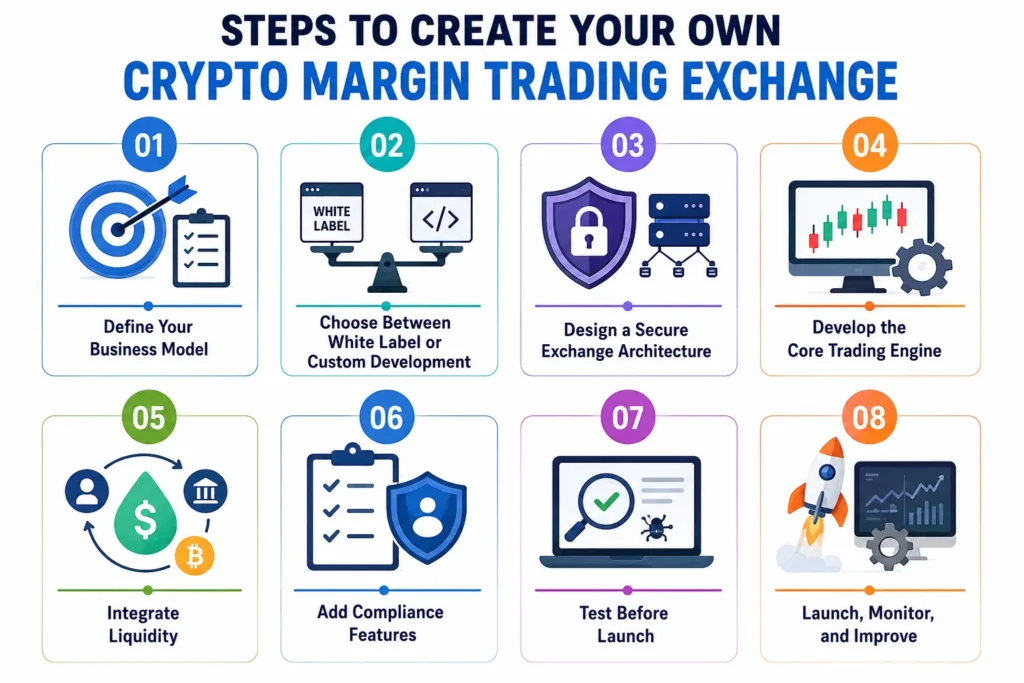
Building a successful exchange requires launching a platform traders can trust. Every stage of development affects security, scalability, and long-term profitability. Here are the steps included:
Step 1 Define Your Business Model
Before writing a single line of code, decide how your exchange will operate. This helps to define the product roadmap and technical architecture from the start.
Step 2 Choose Between White Label or Custom Development
This decision influences your launch timeline, budget, and flexibility.
- A white label margin trading exchange provides a ready-made infrastructure that significantly reduces development time. It’s an excellent option for businesses looking to enter the market quickly.
- Custom development offers complete control over platform architecture, trading features, user experience, and future scalability. Although it requires a larger investment, it creates a product tailored to your business objectives.
The right approach depends on your budget, growth plans, and competitive strategy.
Step 3 Design a Secure Exchange Architecture
Security is the foundation of every successful exchange. Building security into the platform from day one is far more effective than adding it after launch. Your platform should include:
- Multi-layer authentication
- Cold wallet integration
- Hot wallet management
- Encryption protocols
- Role-based access controls
- Anti-DDoS protection
- Secure API architecture
- Real-time monitoring
Step 4 Develop the Core Trading Engine
The matching engine powers every transaction on your exchange. It should process thousands of orders with minimal latency while maintaining accurate pricing and execution. A robust trading engine typically includes:
- Market orders
- Limit orders
- Stop-loss orders
- Take-profit functionality
- Cross margin
- Isolated margin
- Liquidation engine
- Position management
- Funding calculations
Performance at this stage directly affects user satisfaction and platform credibility.
Step 5 Integrate Liquidity
Most startups integrate liquidity through external providers or market makers during the early stages. This ensures tighter spreads, better order execution, and a smoother trading experience until the platform builds its own trading volume.
Step 6 Add Compliance Features
Regulatory expectations continue to evolve across global crypto markets. Building compliance capabilities early makes expansion into regulated markets much easier. Your exchange should include:
- KYC verification
- AML monitoring
- Transaction screening
- User verification
- Audit logs
- Compliance reporting
Step 7 Test Before Launch
Never launch without extensive testing. Your QA process should cover:
- Security testing
- Load testing
- Performance testing
- Smart contract audits (where applicable)
- API validation
- Penetration testing
- Mobile responsiveness
- Disaster recovery
Step 8 Launch, Monitor, and Improve
Successful platforms continuously improve by monitoring user behavior, releasing new features, optimizing trading performance, and responding quickly to security updates and market changes.
The most successful cryptocurrency exchange software development companies treat product development as an ongoing process rather than a one-time project.
7 Features Supported By Crypto Margin Trading Exchange
Unlike a traditional spot exchange, a crypto exchange with leverage includes additional components such as:
1. Margin Accounts
Margin accounts in a crypto margin trading exchange enable traders to borrow funds, increasing buying power and supporting leveraged cryptocurrency exchange platform development strategies.
2. Borrowing and Lending Mechanisms
Borrowing and lending mechanisms power liquidity flow in crypto exchanges with leverage, allowing users to trade assets beyond their initial capital efficiently.
3. Liquidation Engine
A liquidation engine in cryptocurrency exchange development automatically closes undercollateralized positions, protecting platform stability and reducing risk exposure during volatile trading conditions.
4. Risk Management System
A risk management system ensures secure crypto margin trading exchange operations by monitoring leverage, exposure limits, and maintaining overall trading platform financial stability.
5. Real-Time Collateral Monitoring
Real-time collateral monitoring tracks user assets continuously in a white label margin trading exchange, ensuring margin requirements are always accurately maintained and enforced.
6. Automated Margin Calls
Automated margin calls notify traders in a crypto exchange with leverage when collateral falls below thresholds, prompting deposits or position adjustments to avoid liquidation.
7. Position Management Dashboard
Position management dashboard in cryptocurrency exchange software development gives traders full visibility of leveraged trades, profits, losses, and exposure across all active positions.
These features create a more sophisticated trading environment designed for experienced traders looking to amplify market opportunities.
5 Reasons Why Build a Margin Trading Exchange in 2026?
Reason 1 Market demand is evolving fast
The crypto industry is shifting toward advanced trading experiences where users expect leverage, automation, and professional tools. Investing in crypto margin trading exchange development helps businesses meet this demand and stay competitive in a rapidly maturing digital asset ecosystem.
Reason 2 Higher trading volume and revenue potential
Margin trading significantly increases order frequency and market participation. This leads to higher transaction fees, stronger liquidity, and consistent platform revenue growth through cryptocurrency exchange platform development designed for active traders.
Reason 3 Stronger product differentiation
In a saturated exchange market, margin trading, advanced order types, and risk controls help platforms stand out. Offering leverage-based trading improves positioning against basic spot exchanges and enhances overall user value.
Reason 4 Multiple monetization opportunities
A crypto exchange with leverage enables diverse revenue streams, including borrowing interest, liquidation fees, API services, premium subscriptions, and institutional trading solutions.
Reason 5 Long-term scalability advantage
Launching a feature-rich exchange ensures your platform evolves with market maturity, prioritizing performance, security, and user experience over basic trading functionality.
Spot Exchange vs Margin Exchange: What's the Difference?
Although both platforms allow users to buy and sell cryptocurrencies, they cater to different types of traders. A spot exchange is ideal for users who want to purchase digital assets using their available funds. A crypto margin trading exchange, on the other hand, enables traders to borrow funds and open larger positions using leverage.
If you’re planning cryptocurrency exchange platform development, understanding these differences will help you choose the right business model for your target audience.
Feature | Spot Exchange | Crypto Margin Trading Exchange |
Trading Method | Buy and sell owned assets | Trade using borrowed funds with leverage |
Risk Level | Lower | Higher due to leveraged positions |
Profit Potential | Limited to available capital | Higher through leveraged exposure |
Target Users | Beginners and casual investors | Professional and active traders |
Core Features | Wallet, order book, trading engine | Margin accounts, liquidation engine, risk management |
Revenue Sources | Trading fees | Trading fees, borrowing interest, liquidation fees |
Development Complexity | Moderate | High |
If your goal is to build a platform for experienced traders, a crypto exchange with leverage offers greater revenue opportunities and stronger user engagement than a standard spot exchange.
How to Choose the Right Crypto Exchange Development Company?
Here is what to look for while choosing a Crypto Exchange Development Company:
1. Look for Proven Blockchain Experience- Choose a blockchain development company with hands-on experience in building exchanges, wallet infrastructure, trading engines, and Web3 applications. A proven portfolio often says more than a sales presentation.
2. Evaluate Their Security Standards- Ask how the company protects user funds, secures APIs, manages wallets, and prevents attacks. Features such as multi-factor authentication, cold wallet integration, encryption, DDoS protection, and regular security audits should already be part of their development process.
3. Understand Their Development Approach- Every business has different goals. Some need a white label margin trading exchange for a faster launch, while others require a fully customised platform. A reliable development company should recommend a solution based on your business model instead of offering the same package to every client.
4. Ask About Scalability- The platform should support future upgrades, additional cryptocurrencies, new trading products, staking, APIs, and higher transaction volumes without requiring a complete rebuild.
5. Consider Post-Launch Support- Choose a development partner that offers ongoing assistance rather than disappearing after deployment.
Power Your Crypto Margin Trading Business
Tech Stack Needed to Build Leverage Trading Software
Here’s what a modern cryptocurrency exchange software development stack typically includes.
Component | Recommended Technologies |
Backend Development | Go, Rust, Node.js, Java |
Frontend Development | React.js, Next.js, Vue.js |
Mobile Applications | Flutter, React Native |
Database | PostgreSQL, MongoDB, Redis |
Blockchain Integration | Ethereum, BNB Chain, Solana, Polygon |
Smart Contracts | Solidity, Rust |
Wallet Integration | MPC Wallets, Cold Wallets, Multi-Signature Wallets |
Cloud Infrastructure | AWS, Google Cloud, Microsoft Azure |
DevOps | Docker, Kubernetes, Jenkins |
Security | SSL Encryption, Web Application Firewall (WAF), DDoS Protection, Multi-Factor Authentication |
Core Features Your Platform Should Include
The Crypto margin Trading platform should also deliver the features traders expect. A scalable architecture ensures your crypto margin trading exchange can handle growing transaction volumes while maintaining speed, stability, and security. Core features include:
High-speed matching engine
A high-speed matching engine is the core of any crypto margin trading exchange development, ensuring instant order execution, low-latency trading, and accurate price discovery even during high volatility market conditions.
Spot and margin trading
Supporting both spot and leverage trading enables a flexible cryptocurrency exchange platform development model, allowing users to trade owned assets or amplify positions using borrowed funds for higher market exposure.
Real-time market data
Real-time market data ensures traders receive accurate price feeds, depth charts, and updates, which is essential for building a reliable crypto exchange with leverage that supports informed decision-making and active trading strategies.
Automated liquidation engine
An automated liquidation engine protects platform stability by closing undercollateralized positions instantly, a critical component in secure cryptocurrency exchange software development to manage risk during extreme market volatility.
Risk management system
A robust risk management system monitors leverage, exposure, and collateral in real time, making crypto margin trading exchange development safer, scalable, and compliant with modern trading ecosystem requirements.
Best Security Practices for a Crypto Derivatives Exchange
If you’re planning crypto margin trading exchange development, these are the security measures you shouldn’t compromise on.
Multi-Layer Authentication
The first line of defence is strong user authentication. Implement multi-factor authentication (MFA), biometric login, passkeys, and device verification to reduce the risk of unauthorized access. Adding these security layers protects user accounts even if login credentials are compromised.
Cold Wallet Storage
Keeping all digital assets in hot wallets increases exposure to cyberattacks. A secure cryptocurrency exchange platform development strategy stores most funds in cold wallets while maintaining only a small operational balance online. This significantly reduces the impact of potential breaches.
Real-Time Risk Monitoring
Margin trading requires continuous monitoring of user positions. Your platform should track collateral ratios, unrealized losses, leverage limits, and liquidation thresholds in real time. Automated risk controls help prevent cascading liquidations during periods of extreme market volatility.
Smart Contract & Security Audits
If your platform integrates blockchain-based features or smart contracts, regular third-party security audits are essential. Routine penetration testing, vulnerability assessments, and code reviews help identify weaknesses before they become security incidents.
KYC & AML Compliance
Security goes beyond protecting funds. Robust Know Your Customer (KYC) and Anti-Money Laundering (AML) procedures help prevent fraudulent activity while supporting compliance across different jurisdictions. Building these systems early makes future expansion much easier.
White Label Margin Trading Exchange vs Custom Development: Which One To Choose
Both options have advantages, but the right choice depends on your budget, launch timeline, and long-term business goals.
White Label Margin Trading Exchange | Custom Exchange Development |
Faster deployment | Built entirely around your business model |
Lower upfront investment | Greater development cost |
Proven infrastructure | Complete control over features and architecture |
Limited design flexibility | Fully customised user experience |
Easier maintenance | Highly scalable for future expansion |
Suitable for startups and MVPs | Ideal for established businesses with long-term growth plans |
Which Option Should You Choose?
- If your priority is to validate your idea and launch quickly, a white label margin trading exchange offers the fastest route to market.
- However, if you’re building a long-term trading ecosystem with unique features, institutional tools, or proprietary trading functionality, custom cryptocurrency exchange development provides far greater flexibility and scalability.
The best development companies help you choose a solution based on your business objectives.
Which Are the Best Margin Trading Crypto Websites?
While every business has different goals, these exchanges have set industry benchmarks for performance, liquidity, and user experience.
Exchange | Known For |
Binance | Deep liquidity, advanced trading tools, global user base |
Bybit | Professional derivatives trading and intuitive interface |
OKX | Margin trading, Web3 ecosystem, DeFi integrations |
Kraken | Strong security, regulatory compliance, institutional services |
Bitget | Copy trading, futures markets, growing global presence |
Turn Your Exchange Idea into Reality
Common Challenges in Building Leverage Trading Software (and How to Solve Them)
Building a crypto exchange with leverage involves far more than developing a trading interface. Here are some of the most common challenges businesses face, and how experienced development teams solve them.
Challenge | Solution |
Low liquidity during launch | Integrate trusted liquidity providers and market makers. |
Slow order execution | Build a high-performance matching engine with low latency. |
Security threats | Implement multi-layer security, cold wallets, and continuous monitoring. |
Regulatory uncertainty | Design the platform with flexible KYC, AML, and compliance modules. |
Scalability issues | Use cloud-native infrastructure and microservices architecture. |
Poor user retention | Focus on intuitive UI, responsive support, and continuous feature updates. |
Crypto Margin Trading Exchange Cost Breakdown
The cost of crypto margin trading exchange development depends on architecture, feature depth, security layers, and whether you choose a white label or custom build approach. Estimated Development Cost Range is”
Type of Exchange | Features Included | Estimated Cost |
White Label Margin Trading Exchange | Pre-built engine, basic UI, standard leverage trading | $20,000 – $60,000 |
Mid-Level Exchange | Custom UI, margin trading, liquidity integration | $60,000 – $150,000 |
Full Custom Exchange | Advanced matching engine, derivatives, AI risk system | $150,000 – $500,000+ |
Additional ongoing costs may include:
- Liquidity provider fees
- Security audits
- Cloud infrastructure scaling
- Compliance and legal modules
- Maintenance & upgrades
A reliable blockchain development company helps optimise cost efficiency without compromising scalability or security.
Takeaway
Launching a crypto margin trading exchange in 2026 is a strategic business decision shaped by user demand, liquidity competition, and institutional adoption. Whether you choose a white label margin trading exchange or invest in full-scale cryptocurrency exchange software development, the execution quality and post-launch optimisation matter.
If you’re planning to enter the market, the right cryptocurrency exchange development company will determine how fast you grow and how stable your platform remains under pressure.
Launch Crypto Margin Trading Platform With ShamlaTech
Shamlatech is a leading blockchain development company specialising in cryptocurrency exchange platform development, DeFi solutions, Web3 applications, and high-performance trading systems.
We help startups, fintech firms, and enterprises build scalable crypto exchanges with platforms designed for real-world trading demand. From architecture design to deployment and post-launch scaling, our engineering team focuses on security, liquidity integration, and long-term platform growth.
Whether you’re planning a white label margin trading exchange or a fully custom centralized crypto exchange development, Shamlatech delivers end-to-end solutions built for performance, compliance readiness, and user trust.
FAQs
1. What is crypto margin trading exchange development?
It is the process of building a trading platform where users can trade cryptocurrencies using borrowed funds with leverage.
2. How long does it take to build a crypto exchange with leverage?
A white label solution may take 2–6 weeks, while custom cryptocurrency exchange platform development can take 3–9 months.
3. Is a white label margin trading exchange better than custom development?
White labels are faster and cost-effective. Custom development offers full control, scalability, and advanced trading features.
4. What technologies are used in exchange development?
Common stack includes Node.js, Go, Rust, React, PostgreSQL, Redis, Kubernetes, and blockchain integrations like Ethereum or BNB Chain.
5. How do crypto margin exchanges make money?
Revenue comes from trading fees, liquidation charges, interest on borrowed funds, listing fees, and premium features.