
AI Summary
- MPC wallets improve crypto security by splitting signing authority into multiple key shares. No single person, device, or server holds the complete private key.
- Creating an MPC wallet involves several steps, including planning the wallet architecture, integrating MPC technology and blockchains, adding security controls, testing the wallet, and deploying it.
- An MPC wallet can cost between $15,000 and $300,000+, depending on whether it is a white label, custom, or enterprise solution and its required features.
- MPC wallets are useful for crypto exchanges, fintech platforms, DeFi apps, tokenization platforms, and institutions that need secure access, transaction approvals, and multi-chain support.
Crypto theft reached a billion in just the first quarter of 2026. CertiK reported over $1.31 billion in Web3 losses across 344 incidents in the first half of 2026. Thus, businesses are looking forward to new ways to eliminate single points of failure and protect their assets. Here, MPC wallets come into the picture. With MPC technology, businesses can build secure enterprise-grade MPC wallet solutions for their crypto exchanges, fintech startups, Web3 platforms, DeFi products, and gaming ecosystems.
MPC crypto wallets reduce private key risk, improve transaction approvals, support multi-chain growth, increase customer trust, and create a wallet experience that is safer and easier to use than seed phrase-based wallets.
This guide provides detailed insights into how businesses can create an MPC wallet through custom crypto wallet development or a white label MPC wallet solution.
What Is an MPC Wallet?
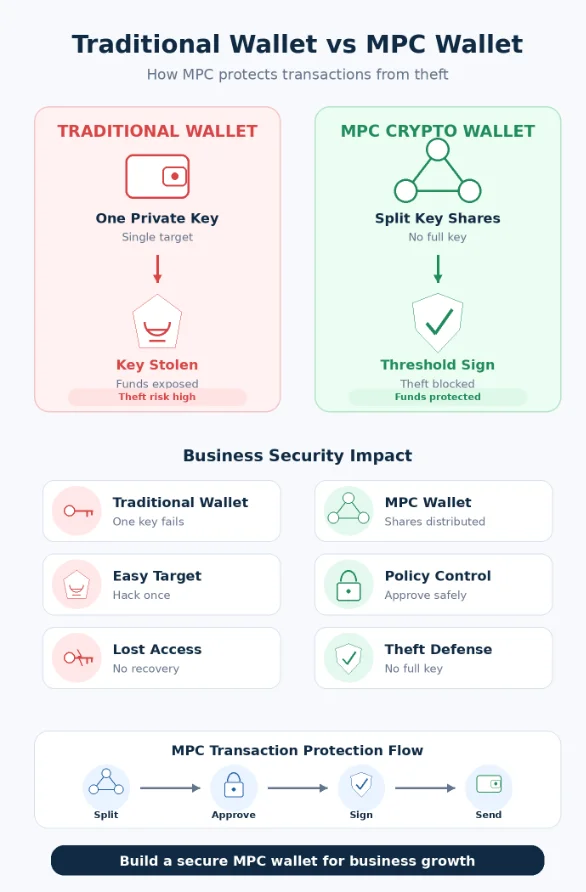
An MPC wallet uses Multi-Party Computation (MPC) to distribute signing authority across multiple participants or devices. Instead of storing a complete private key in one location, the wallet generates separate cryptographic shares.
When a transaction is initiated, these shares collectively authorize the signature without reconstructing the complete private key. This approach removes the risks associated with storing a single private key while enabling secure transaction authorization across multiple parties or devices.
This makes MPC useful for businesses that need:
- Safer digital asset custody
- Faster transaction approvals
- Multi-user access control
- Keyless crypto wallet development
- Better recovery options
- Multi-chain wallet support
- Lower risk from lost or stolen private keys
- Enterprise-grade policy controls
A threshold signature scheme wallet can also support approval rules such as 2-of-3, 3-of-5, or custom business policies. This allows a company to design wallet access around real business workflows instead of depending on one person, one private key, or one device.
Launch a safer MPC wallet before competitors turn custody trust into their strongest conversion advantage this quarter with ShamlaTech today.
Why Are Businesses Moving Toward MPC Wallets?
Reduce Single-Point Key Risk
Single private key wallets can create major operational risk. If the private key gets exposed, stolen, or lost, the business may lose access to funds or suffer a security breach.
MPC removes this single point of failure by splitting signing responsibility across multiple encrypted shares. This keyless crypto wallet development has no single device, employee, or server that holds the full key.
Improves Operational Efficiency
A business that manages thousands of transactions cannot depend on slow manual approvals. MPC wallets can support automated policies, role-based controls, transaction limits, risk checks, and API-based signing flows.
This helps exchanges, payment platforms, OTC desks, DeFi apps, and treasury teams reduce approval delays.
Supports Multi-Chain Growth
Multisig wallets often depend on chain-specific smart contracts or native multisig support. MPC wallets usually create a standard blockchain signature, which makes them easier to apply across many chains. Fireblocks notes that MPC can offer consistent multi-chain compatibility, while multisig can become fragmented across different chains.
For businesses, this matters because each new chain should not require a separate wallet architecture.
Creates a Better User Experience
Seed phrases create friction. Many users forget them, lose them, store them poorly, or avoid crypto products because of them.
Keyless crypto wallet development allows businesses to create wallets with biometric login, device-based shares, social recovery, email-based recovery, passkeys, or enterprise approval flows. This improves onboarding and reduces support tickets.
Builds Trust With Enterprise Clients
Institutions, fintech partners, and high-value clients look closely at custody infrastructure. A business that offers MPC-based controls can present stronger security, better governance, and clearer approval workflows.
That can improve deal confidence, retention, and conversion rates.
MPC vs Multisig Wallet: Which Is Better for Businesses?
Factor | MPC Wallet | Multisig Wallet |
Key structure | Splits one signing authority into multiple encrypted shares | Uses multiple complete private keys |
On-chain visibility | Usually appears as a standard signature | Approval structure may be visible on-chain |
Chain support | Easier to apply across many blockchains | Often depends on chain-specific support |
Gas efficiency | Can reduce on-chain signing complexity | May require higher fees on some chains |
Policy changes | Can update shares or approval policies without changing wallet address in many setups | May require contract updates or new wallet setup |
Best for | Exchanges, fintech apps, Web3 platforms, institutions, payment products | DAOs, public treasuries, transparent governance |
A multisig wallet can work well when a project needs public, on-chain approval visibility. But an MPC wallet often suits businesses that need privacy, speed, multi-chain scale, and flexible internal controls.
For commercial wallet products, MPC is usually the stronger fit when the company wants to serve users at scale without exposing complex signing logic to the blockchain.
Business Use Cases of MPC Wallets
Crypto Exchanges
Fintech and Payment Apps
DeFi Platforms
Web3 Gaming Platforms
Tokenization and RWA Platforms
Institutional Treasury Teams
Core Features of a Business-Ready MPC Wallet
Threshold Signature Security
Keyless User Onboarding
Multi-Chain Wallet Support
Role-Based Transaction Approval
Secure Wallet Recovery
How Much Does It Cost to Build an MPC Wallet?
The cost of building an MPC wallet depends on factors such as wallet type, security architecture, supported blockchain networks, compliance requirements, interface complexity, and third-party integrations.
A simple white label MPC wallet solution can cost less than a fully custom enterprise wallet. A custom wallet with institutional controls, compliance modules, advanced recovery, and multi-chain infrastructure requires more planning, development, testing, and audits.
Estimated Cost Range
Wallet Type | Estimated Cost Range | Best For |
White label MPC wallet solution | $15,000 – $40,000 | Startups that need faster launch |
Custom MPC wallet MVP | $40,000 – $80,000 | Businesses testing a wallet product |
Full custom crypto wallet development | $80,000 – $180,000+ | Exchanges, fintechs, DeFi apps, Web3 platforms |
Enterprise MPC wallet platform | $180,000 – $300,000+ | Institutions, custodians, high-volume businesses |
Key Factors That Affect the Cost of Building an MPC Wallet
Custom vs White Label Approach
A white label MPC wallet solution reduces development time and cost because the base wallet framework already exists. A custom wallet gives more control over features, design, architecture, integrations, and long-term scalability.
A business should choose white label when speed matters most. It should choose custom development when the wallet is part of a long-term product strategy.
Number of Supported Blockchains
MPC Architecture
Compliance Requirements
Recovery Model
Recovery is one of the most important parts of keyless crypto wallet development. Options may include device recovery, cloud backup, social recovery, institutional recovery, or admin-assisted recovery.
The right model depends on the business, user type, and custody responsibility.
Security Audits
Integrations
Reduce wallet risk, approval delays, and support costs with an MPC architecture built for serious crypto businesses that scale globally.
How to Create an MPC Wallet: Step-by-Step Process
Step 1: Business Requirement Analysis
The development company first studies the business model. It identifies the target users, custody model, supported assets, compliance needs, transaction volume, and revenue goals.
This step answers key questions:
- Is the wallet custodial, non-custodial, or semi-custodial?
- Will the wallet serve retail users, institutions, or internal teams?
- Which chains and assets should it support?
- Does the business need KYC or AML?
- Should the wallet include swaps, staking, NFTs, or DeFi access?
- What approval rules should apply to transactions?
Step 2: Wallet Architecture Design
The team designs the technical architecture. This includes MPC key share generation, storage, recovery, signing flows, backend services, mobile apps, web dashboards, APIs, and admin controls.
A good architecture supports security and scale from the beginning.
Step 3: UI and UX Design
The design team creates wallet screens for onboarding, login, asset view, transaction signing, recovery, history, notifications, and settings.
For businesses, UX directly affects conversion. A wallet with a confusing recovery process or complex signing flow can lose users before they make the first transaction.
Step 4: MPC Protocol Integration
Developers integrate the MPC signing logic and threshold signature scheme. They also configure how key shares communicate, approve transactions, and generate valid blockchain signatures.
This is the core of MPC wallet development.
Step 5: Blockchain and Token Integration
Step 6: Security Layer Development
The team adds authentication, encryption, access control, device binding, risk rules, session protection, and monitoring systems.
For enterprise wallets, this may also include approval workflows, withdrawal limits, and audit logs.
Step 7: Admin Panel and API Development
A business-ready wallet needs an admin layer. The admin panel helps teams manage users, view transactions, configure policies, track activity, and handle support requests.
APIs allow the wallet to connect with exchanges, fintech apps, DeFi platforms, payment systems, and internal business tools.
Step 8: Testing and Security Audit
The wallet must pass functional testing, performance testing, API testing, device testing, vulnerability testing, and transaction testing.
Security testing should review the MPC flow, recovery model, backend infrastructure, authentication, and third-party integrations.
Step 9: Deployment
After testing, the wallet goes live on app stores, web platforms, enterprise systems, or internal infrastructure.
The launch should include monitoring, analytics, support processes, and incident response planning.
Step 10: Maintenance and Scaling
How MPC Wallets Help Different Business Teams?
Founders
Product Teams
Compliance Teams
Operations Teams
Sales Teams
Turn wallet security into a revenue engine with custom MPC development designed for growth, compliance, and retention at scale today.
Custom vs White Label MPC Wallets: Which Approach Should You Choose?
White Label MPC Wallet Solution
A white label wallet gives the business a ready-made base wallet that can be branded and customized.
It works best when the company wants:
- Faster launch
- Lower upfront cost
- Proven core features
- Basic customization
- Quick market testing
However, white label solutions may limit deep customization, unique workflows, or advanced enterprise features.
Custom MPC Wallets
Custom crypto wallet development gives full control over the product. The business can design unique features, advanced security rules, custom integrations, and long-term scaling architecture.
It works best when the company wants:
- A unique wallet product
- Enterprise-grade security
- Complex compliance workflows
- Multi-chain expansion
- DeFi, NFT, staking, or payment features
- Long-term product ownership
A serious crypto business should choose the model based on strategy, not only budget.
Benefits of MPC Wallet Development
Lower Security Risk
Faster User Onboarding
Lower Support Cost
Better Enterprise Sales
Higher Transaction Efficiency
Stronger Multi-Chain Expansion
How Long Does It Take to Build an MPC Wallet?
The development timeline depends on project scope.
Project Type | Estimated Timeline |
White label MPC wallet | 3 – 6 weeks |
MVP MPC wallet | 8 – 12 weeks |
Custom MPC wallet | 3 – 6 months |
Enterprise MPC wallet platform | 6+ months |
A business can launch faster with a white label solution. But a custom wallet may create stronger long-term value if the wallet is central to the company’s product strategy.
Common Risks to Address in an MPC Wallet Project
Weak Recovery Design
Poor Key Share Storage
Overcomplicated UX
No Audit Trail
Limited Scalability
How to Choose an MPC Wallet Development Company?
What to Check Before Hiring
- Experience in custom crypto wallet development
- Understanding of MPC and threshold signature schemes
- Multi-chain development expertise
- Strong backend and API development skills
- Knowledge of wallet security and recovery models
- Ability to build admin dashboards
- Compliance integration experience
- Clear development process
- Post-launch support
- Transparent cost estimation
The best development partner should help the business make technical decisions that support revenue, security, and long-term growth.
Final Thoughts
A well-built MPC wallet can help a company reduce private key risk, improve user onboarding, support multi-chain operations, lower support costs, and create stronger trust with customers and partners.
A company can start with a white label MPC wallet solution for faster launch or choose custom MPC wallets for deeper control and long-term differentiation. The right choice depends on budget, timeline, product goals, compliance needs, and growth strategy.
Create an MPC Wallet With ShamlaTech
Build your secure, scalable, and business-ready MPC wallet with a leading MPC wallet development company – Shamla Tech Solutions. Our experts can help you plan, design, develop, test, and launch a custom crypto wallet development or white label MPC wallet solution based on your business goals.
Whether you need keyless onboarding, threshold signature security, multi-chain support, compliance integrations, admin controls, or enterprise-grade transaction workflows, we can help you turn wallet security into a stronger business advantage.