
Centralized exchanges have spent the last few years fighting withdrawal freezes, surprise delistings, and regulatory whiplash, and traders have noticed. More of them now want to hold their own keys, pick their own payment method, and settle a trade directly with another person instead of routing it through a company’s order book. That shift is exactly why peer-to-peer (P2P) trading keeps climbing as a share of retail crypto volume, especially across Asia, Africa, and Latin America, where local payment rails and currency volatility make direct trading genuinely useful rather than just ideological.
If you’re an entrepreneur, fintech founder, or an existing exchange operator thinking about adding a P2P layer, this guide walks through what P2P crypto exchange software actually is, how it works, what it costs, and the exact steps to build one.
What Is a P2P Crypto Exchange? (How Does It Work)
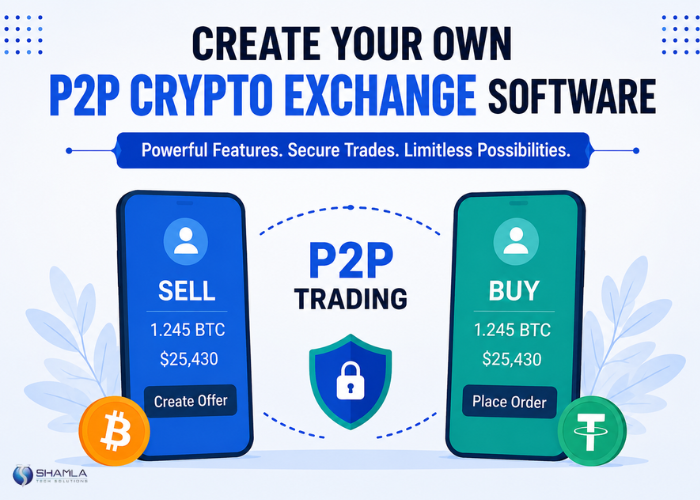
A P2P crypto exchange is a marketplace, not an order-matching engine. Instead of an algorithm pairing anonymous buy and sell orders the way a centralized exchange (CEX) does, users post their own offers,”Selling 0.05 BTC for bank transfer, INR”, and other users browse and accept them directly. The platform’s job is to make that interaction safe.
A typical trade flows in three steps:
- Offer creation and matching: A seller lists an offer with price, payment method, and limits. A buyer finds it and initiates a trade.
- Escrow lock: The platform automatically locks the seller’s crypto in escrow the moment a trade starts, so the seller can’t back out or double-spend once the buyer has committed.
- Payment and release: The buyer sends fiat (or another agreed asset) through the chosen payment method and marks the trade as paid. The seller confirms receipt, and the platform releases the escrowed crypto to the buyer. If something goes wrong, either side can raise a dispute for the platform’s moderators to resolve.
The platform in this model acts as a facilitator and referee, not a custodian holding your funds long-term the way a centralized exchange does.
P2P vs Centralized Crypto Exchange: Key Differences
Both models solve the same core problem, getting a buyer and seller to a trade, but they make very different trade-offs.
Factor | P2P Exchange | Centralized Exchange (CEX) |
Custody | Non-custodial or short-term escrow only | Platform holds user funds |
Fees | Typically lower, sometimes zero maker fees | Trading, withdrawal, and deposit fees |
KYC | Often flexible or tiered by trade size | Mandatory, full KYC upfront |
Liquidity | Depends on active traders/offers | Deep order-book liquidity |
Payment methods | Bank transfer, mobile wallets, cash, gift cards, local rails | Usually limited to bank/card/crypto deposit |
Control | Users set their own price and terms | Price set by market order book |
Regional reach | Strong in underbanked/high-inflation regions | Strong where banking infra is mature |
Heading into 2026, entrepreneurs are leaning into the P2P model because it sidesteps a lot of the heavy custodial infrastructure and compliance overhead a full CEX needs, while still giving users a familiar, structured trading experience. It’s also a natural fit for markets where local payment methods (UPI, M-Pesa, Pix, cash deposits) matter more than deep order-book liquidity.
Why Create Your Own P2P Crypto Exchange Software?
The business case has gotten stronger, not weaker. Analyst estimates for the broader crypto exchange market put 2026 figures well into nine and ten figures with double-digit annual growth projected through the early 2030s, and P2P specifically is grabbing an outsized share of that growth in emerging markets, some analytics firms peg P2P’s share of retail crypto trades above a third of total volume in parts of Asia and Africa. Brazil is a good example: P2P volume there has risen sharply as people use crypto to hedge against inflation and currency devaluation, a pattern repeating across several high-inflation economies.
This model fits three groups particularly well:
- Startups and fintech founders who want to enter crypto without building a full custodial exchange stack from day one.
- Freelancer- and remittance-focused platforms serving unbanked or underbanked users who need a bridge between local currency and crypto.
- Existing centralized exchanges looking to add a P2P module to capture users who want lower fees, more payment flexibility, or a workaround for regions with limited banking rails.
Must-Have Features of P2P Crypto Exchange Software
A serious P2P platform needs more than a listings page. At minimum, plan for:
- Escrow system (covered in detail below), the non-negotiable trust layer.
- Multi-currency wallet support, BTC, ETH, major stablecoins (USDT/USDC), and ideally multi-chain support so traders aren’t locked into one network.
- Dispute resolution/arbitration module, a structured workflow for moderators to review chat logs, payment proof, and evidence before releasing or reversing an escrowed trade.
- Rating and reputation system, trade history, completion rate, and average release time so users can vet counterparties before trading.
- Multiple payment method integration, bank transfer, UPI, mobile wallets, cash deposit, gift cards, and other local rails depending on your target region.
- Admin dashboard and controls, fee configuration, user management, KYC tier settings, dispute oversight, and transaction monitoring.
- Mobile app support, a large share of P2P trading, especially in emerging markets, happens on mobile-first connections.
Escrow System in P2P Exchanges, Why It's the Core Security Layer
Escrow is what actually makes P2P trading trustworthy between two strangers. The moment a trade starts, the seller’s crypto is locked, either through a smart contract on-chain or a managed escrow wallet controlled by the platform, so neither side can walk away mid-trade or attempt a double-spend.
If the buyer pays and the seller doesn’t release, or the seller claims non-payment, the trade moves into a dispute queue where moderators review payment proof, chat logs, and timestamps before manually releasing funds to the rightful party. Some newer platforms are moving toward state-channel and smart-contract-based escrow that settles in seconds without a manual custodian step at all, but for most new builds, a hybrid of smart-contract locking plus a human dispute layer is still the safer, more practical starting point.
Tech Stack Needed to Build a P2P Crypto Exchange
Your stack choice shapes cost, security posture, and how fast you can iterate later. A typical modern build looks like:
- Blockchain layer, Multi-chain support (Bitcoin, Ethereum, and one or more EVM-compatible chains for stablecoins) is now close to table stakes; a single-chain MVP is fine for a soft launch but limits your addressable market.
- Backend, Node.js, Go, or Java for the matching engine and escrow logic, paired with PostgreSQL or MongoDB for transactional data, and Redis for session/offer caching.
- Frontend, React or Next.js for web, React Native or Flutter for a shared mobile codebase.
- API and third-party integrations, Crypto Payment Gateway Development for fiat rails, KYC/AML providers for identity verification, and node infrastructure providers (or self-hosted nodes) for blockchain connectivity.
For teams handling wallet infrastructure directly rather than outsourcing it, this is also where crypto wallet development decisions matter most, multi-sig setup, hot/cold wallet split, and key management policy all get decided at this layer, not bolted on later
Build vs Buy, Custom Development vs P2P Crypto Exchange Script
Once the feature list is clear, the real decision is how you get there.
Ready-made scripts, including popular options modeled on established platforms like a Paxful clone script or a Local Bitcoin clone script, get you to market faster and cost less upfront, since the escrow logic, wallet structure, and admin panel are already built and battle-tested. The trade-off is flexibility: customizing deep architectural choices (custodial model, chain support, compliance workflow) can be harder and costlier than building it right the first time, and you inherit whatever technical debt the base script carries.
Custom development costs more and takes longer, but gives you full control over architecture, security design, and how the platform scales as you add markets or regulatory requirements. It’s generally the better call when you’re targeting multiple jurisdictions with different compliance needs, plan to differentiate heavily on features, or expect serious transaction volume within the first year or two.
There’s a middle path too, a white label cryptocurrency exchange solution, which gives you a proven, rebrandable base with more customization headroom than a pure clone script. Which route fits depends on your budget, timeline, and how differentiated you need the product to be, worth a proper conversation before committing either way.
7 Steps Create Your P2P Crypto Exchange Software
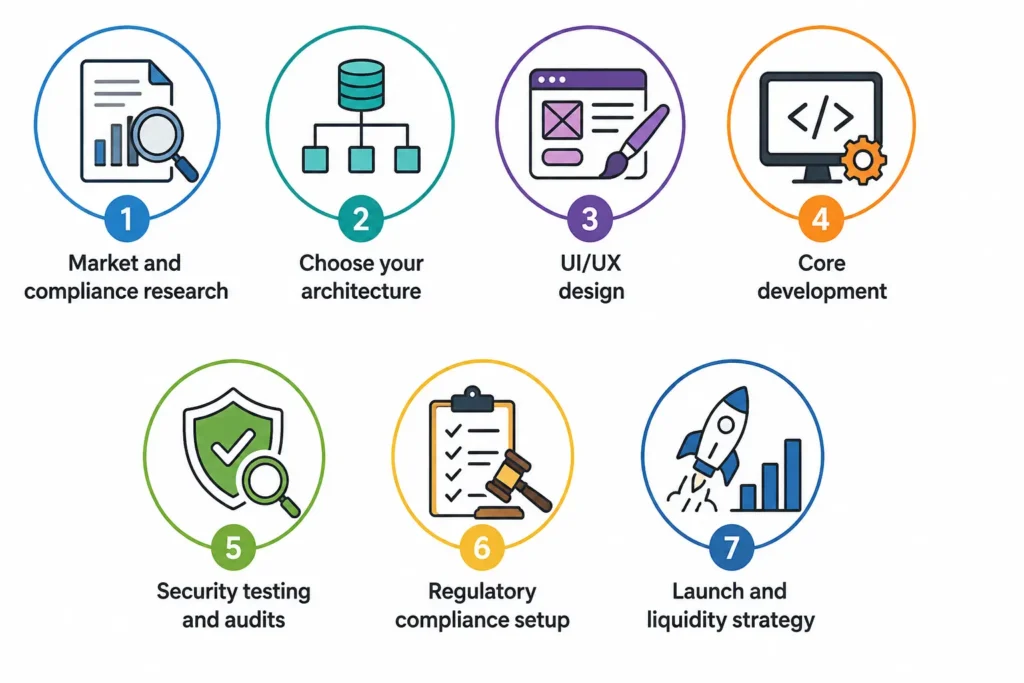
Step 1 Market and compliance research,
Identify your target regions, payment methods, and the regulatory posture in each. This shapes almost every decision after it.
Step 2 Choose your architecture
Custodial (platform manages escrow wallets) vs. non-custodial (smart-contract escrow, users retain more control). Non-custodial reduces your regulatory and security burden but is harder to build well.
Step 3 UI/UX design,
Trade flow, offer creation, chat interface, and dispute submission need to be simple enough for non-technical users, since P2P trading skews toward first-time crypto buyers in many regions.
Step 4 Core development
Build the escrow engine, wallet infrastructure, and offer-matching logic first; everything else (ratings, admin tools, notifications) layers on top.
Step 5 Security testing and audits
Smart contract audits if you’re using on-chain escrow, plus penetration testing on the backend and wallet infrastructure before any real funds touch the platform.
Step 6 Regulatory compliance setup
KYC/AML tooling, transaction monitoring, and licensing appropriate to your launch markets.
Step 7 Launch and liquidity strategy
A P2P platform is only as good as its active offers. Plan a maker-incentive or seed-liquidity strategy for your first few months, since an empty offer board kills adoption fast.
Legal and Regulatory Compliance for P2P Crypto Platforms
Compliance is where most P2P projects underestimate the work. Even though the platform doesn’t fully custody funds the way a Centralized Cryptocurrency Exchange Development does, most jurisdictions still expect KYC/AML controls proportional to transaction size, transaction monitoring for suspicious activity, and, in many cases, a money transmitter or virtual asset service provider (VASP) license.
At minimum, plan for:
- Tiered KYC, light verification for small trades, full identity verification above certain thresholds.
- AML monitoring, automated flagging for structuring, high-risk countries, or sanctioned wallet addresses.
- Region-specific licensing, requirements vary widely by country, and this changes often enough that you shouldn’t treat any single source (including this one) as final legal advice. Get a compliance review specific to each launch market before going live, services like KYC & AML services and cryptocurrency exchange license services exist specifically to handle this groundwork.
Cost to Create a P2P Crypto Exchange Software
Cost depends heavily on feature depth, tech stack choices, your development team’s location, and whether you’re customizing a script or building from scratch. Rather than quote a single number that goes stale fast, here’s a rough tier breakdown:
Tier | What’s Included | Typical Fit |
Basic | Core escrow, single-chain wallet support, basic admin panel, limited payment methods | MVP / market-testing launch |
Mid | Multi-chain wallets, dispute resolution module, ratings system, multiple payment gateways, mobile app | Regional launch with real volume expectations |
Enterprise | Full custom architecture, multi-jurisdiction compliance, AI-assisted fraud detection, high-availability infrastructure, dedicated security audits | Multi-country launch or existing exchange adding a P2P module at scale |
Custom Cryptocurrency Exchange Development builds naturally land above script-based or white-label builds at every tier, but they also give you ownership of the entire codebase and architecture, which matters a lot if you plan to raise funding or scale past your first market.
Revenue Model, How P2P Crypto Exchanges Make Money
Most P2P platforms and cryptocurrency exchange marketing combine a few revenue streams rather than relying on one:
- Transaction fees, a small percentage charged to the maker, taker, or both on completed trades.
- Listing fees, charged for premium offer placement or higher visibility in search results.
- Premium trader features, advanced analytics, higher trade limits, or priority dispute handling for a subscription fee.
- Advertisement and promoted listings, sellers pay to have their offers surfaced first, similar to promoted listings in e-commerce marketplaces.
Common Challenges When Building a P2P Exchange (And How to Solve Them)
- Liquidity bootstrapping, An empty offer board is the fastest way to lose new users. Seed the platform with your own market-making offers or partner with early power-traders before public launch.
- Fraud and dispute management, Fake payment proofs and chargeback fraud are the most common attack vectors. Strong evidence requirements (timestamped screenshots, bank reference numbers) and a clear escalation path reduce this significantly.
- Regulatory shifts, Build compliance as a configurable layer, not a hardcoded one, so you can adjust KYC tiers or reporting rules per region without a full redeploy.
- Scalability, Design the matching engine and escrow ledger to handle spikes in trade volume without downtime, especially around news events that drive sudden trading interest.
Read More About – How to Get a Crypto Exchange License in the USA ·
Future of P2P Crypto Exchanges in 2026 and Beyond
A few trends are already reshaping how P2P platforms operate:
- AI-based fraud detection, pattern recognition on payment proofs, trade timing, and account behavior is replacing purely manual dispute review at the larger platforms. Explore how this fits your roadmap in our piece on AI-powered crypto exchange development.
- Cross-chain P2P trading, newer protocols are settling trades across more than a dozen chains in seconds using state-channel and broker-network models, moving beyond the traditional single-chain escrow approach.
- Regulatory clarity, as more jurisdictions formalize VASP and money-transmitter frameworks for P2P specifically, expect compliance to get more structured (and more necessary) rather than looser.
Final Thoughts
Building P2P crypto exchange software isn’t just about wiring up a wallet and a chat box, the escrow logic, dispute handling, and compliance layer are what actually determine whether traders trust your platform enough to use it twice. Whether you go with a proven script, a white-label base, or a fully custom build depends on your timeline, budget, and how differentiated you need to be in your target market.
If you’re weighing those options for your own launch, our team at Shamla Tech, a P2P crypto exchange development company, can walk you through the architecture, cost, and compliance trade-offs specific to your target region, and get in touch to scope it out.
Related reading: How Can an Exchange Platform Integrate with Existing Crypto Wallets · · ·
Frequently Asked Questions
1. Is a P2P crypto exchange legal?
In most jurisdictions, yes, but it usually requires registration as a money transmitter or virtual asset service provider, along with KYC/AML controls. Requirements vary significantly by country, so get region-specific legal guidance before launch.
2. How is a P2P exchange different from a crypto wallet app?
A wallet app stores and sends crypto for a single user. A P2P exchange is a marketplace connecting multiple buyers and sellers, with built-in escrow and dispute resolution to make trading between strangers safe.
3.Can I add a P2P module to an existing centralized exchange?
Yes, many exchanges add P2P as a secondary trading module to capture users who want lower fees or local payment methods, without replacing their core order-book system.
4. Do I need my own blockchain node infrastructure?
Not necessarily at launch, you can use third-party node providers to reduce upfront infrastructure cost, then move to self-hosted nodes as volume and cost considerations justify it.
5. How long does it take to build a P2P crypto exchange?
A script-based or white-label MVP can launch in a matter of weeks. A fully custom build with multi-chain support, custom compliance workflows, and security audits typically takes several months from planning to launch.