

Enterprises and investors are identifying new pathways to access U.S. real estate through digital ownership infrastructure. Tokenization enables fractional participation, structured liquidity, and broader capital access, creating commercially viable investment models for asset managers, property owners, and institutional stakeholders.
The global real-world asset tokenization market is projected to reach $16 trillion by 2030, with real estate positioned as a major asset class for tokenization initiatives. This is increasing demand for real estate tokenization platforms in the USA that support compliant issuance, investor onboarding, and lifecycle administration.
This article explains what tokenized real estate investment in the USA involves, why it is attracting global investors, the strategic benefits it offers compared to conventional ownership structures, and how market adoption is strengthening the business case for dedicated tokenization platform infrastructure.
Build SEC-Compliant U.S. Real Estate Investment Platforms
What Is Tokenized Real Estate Investment in the USA and How Does It Work?
How Tokenized Real Estate Investment Functions in Practice:
- The U.S. real estate tokenization opportunity is expected to reach $4 trillion by 2035, reflecting growing institutional interest in digitized property ownership models and reinforcing the commercial need for scalable tokenization infrastructure across investment and asset management ecosystems.
- Property ownership is typically structured through legal entities such as SPVs, where economic rights are represented as digital securities, allowing issuers to define transfer permissions, investor eligibility criteria, governance rights, income distribution rules, and jurisdiction-specific compliance controls.
- Capital raising workflows become significantly more operationally efficient through tokenization, with integrated systems supporting automated investor onboarding, accreditation validation, ownership allocation, distribution management, cap table administration, and transaction-level audit visibility across the investment lifecycle.
- Tokenized real estate creates a more accessible framework for international capital participation in U.S. property markets, enabling digitally managed investor access, standardized governance controls, and streamlined participation models for distributed institutional and accredited investor networks.
- Execution quality depends heavily on platform capability, since enterprise-grade tokenized real estate offerings require integrated compliance infrastructure, smart contract orchestration, investor servicing systems, custody coordination, reporting architecture, and end-to-end lifecycle administration beyond basic token issuance functionality.
Why Global Investors Are Turning to Tokenized Real Estate Investment in the USA
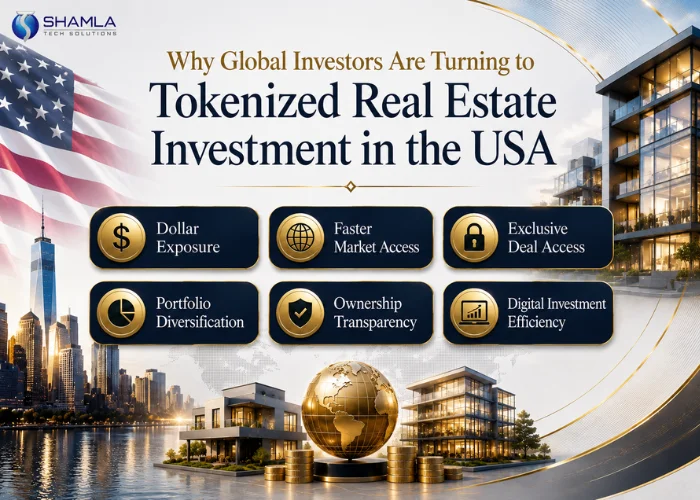
1. Exposure To Dollar-Denominated Income-Producing Assets
2. Reduced Friction In Cross-Border Investment Execution
3. Access To Previously Restricted Deal Flow
4. Better Capital Allocation Flexibility Across Multiple Assets
5. Improved Visibility Into Ownership And Asset Administration
6. Participation In A Scalable Digital Investment Infrastructure Model
Enable Global Investment Access Through Secure Tokenization
Key Benefits of Tokenized Real Estate Investment in the USA Compared to Traditional Real Estate
Tokenized real estate investment in the USA introduces measurable structural advantages for capital allocators seeking more efficient access, administration, and portfolio flexibility. Compared with conventional property investing, the model addresses longstanding operational and financial inefficiencies.
Benefit | Tokenized Real Estate Investment in the USA | Traditional U.S. Real Estate Investment |
Capital Accessibility | Fractional participation from significantly lower investment thresholds | High upfront capital, often $50,000 to $500,000+ for private placements |
Transaction Efficiency | Digitized onboarding, ownership allocation, and distribution workflows | Manual paperwork, legal coordination, banking delays, intermediary dependency |
Liquidity Potential | Structured secondary transfer opportunities through compliant marketplaces | Capital typically locked for 5–10+ years in private real estate holdings |
Cross-Border Participation | Digitally managed access for qualified international investors | Complex jurisdictional compliance, banking friction, and onboarding bottlenecks |
Lower Capital Entry Requirements
Faster Transaction Execution
Improved Liquidity Prospects
More Efficient International Investor Access
How the Growth of Tokenized Real Estate Investment in the USA Is Driving Demand for Tokenization Platforms
SEC Compliance and Securities Structuring Requirements
Institutional Investor Reporting and Governance Expectations
Cross-Border Investor Access Infrastructure
Lifecycle Asset Operations Beyond Token Issuance
Why Specialized Platform Development Capability Matters
Final Thoughts
Tokenized real estate investment in the USA represents a structural shift in how property-backed capital can be issued, accessed, and administered. The organizations positioned to benefit will be those treating tokenization as regulated investment infrastructure rather than a standalone blockchain initiative.
As institutional participation increases and cross-border capital seeks more efficient access to U.S. real estate, execution capability becomes a competitive differentiator. Platform architecture, compliance readiness, and operational design will increasingly determine which market participants translate tokenization opportunities into commercially viable investment products.
Build SEC-Compliant Real Estate Tokenization Platforms with Shamla Tech Solutions
At Shamla Tech Solutions, we develop SEC-compliant real estate tokenization platforms designed for issuers, asset managers, and investment firms entering the U.S. digital securities market. Our solutions support compliant investor onboarding, smart contract execution, governance controls, and institutional-grade asset administration.
We help organizations build tokenization infrastructure aligned with U.S. securities requirements, including Regulation D, Regulation S, and platform-level compliance workflows. From architecture design to deployment, our team delivers scalable real estate tokenization platforms built for cross-border capital participation and long-term operational execution.