

Home » Real Estate Tokenization » Blockchain Real Estate Investment in the USA and the Rise of Tokenized Property Ownership

Blockchain Real Estate Investment in the USA and the Rise of Tokenized Property Ownership

Share this article:
blockchain real estate investment in the USA
Table of Contents
About the Author
Balaji
CEO of Shamla Tech, specializes in crypto exchange development, RWA tokenization, blockchain infrastructure, AI solutions, and compliance-ready platforms. He helps enterprises address regulatory, security, and scalability challenges while driving real-world adoption of emerging technologies across industries.
Connect On:

Institutional real estate investment is entering a new phase where enterprises can structure digital ownership models, expand investor participation, and unlock new capital formation strategies. Blockchain real estate investment in the USA is creating commercially viable pathways for sponsors, developers, and investment platforms.

The global real estate tokenization market is projected to surpass $19 billion by 2033, reflecting sustained institutional interest in digitized property ownership models. This momentum is increasing demand for secure, compliant real estate tokenization platforms in the USA built for issuance, investor onboarding, and lifecycle management.

In this article, we offer insights on why blockchain real estate investment in the USA is gaining commercial traction in 2026, the regulatory framework shaping adoption, infrastructure requirements for tokenized ownership, and how enterprises can launch market-ready real estate tokenization platforms for U.S. investment markets.

Build SEC-Compliant Real Estate Tokenization Platform

Why Blockchain Real Estate Investment In the USA Is Accelerating In 2026

Blockchain real estate investment in the USA is becoming a strategic infrastructure priority for enterprises focused on capital access, digital ownership frameworks, and institutional investment delivery. In 2026, tokenization represents a commercially credible platform category for real estate operators, fintech firms, and asset-focused technology providers.

Key Strategic Drivers Behind Market Acceleration:

  • Industry estimates indicate $4 billion to $20 billion in real-world assets have already been tokenized globally, demonstrating that digital ownership infrastructure has moved beyond early experimentation and into commercially active deployment.

  • U.S. real estate enterprises are expanding capital formation strategies through fractional ownership structures, creating direct demand for platforms capable of compliant issuance, investor administration, and ownership lifecycle management.

  • Executive leadership teams are prioritizing operational efficiency across investor onboarding, compliance verification, ownership records, reporting, and distributions, positioning tokenization platforms as infrastructure investments with measurable operational value.

  • Cross-border capital participation is becoming a defined revenue opportunity for U.S. issuers, increasing demand for digital investment platforms built to support jurisdiction-aware onboarding and institution-ready investor access.

  • Technology enterprises have a strong opportunity to develop enterprise-grade real estate tokenization platforms integrating smart contract issuance, compliance controls, custody interoperability, payment infrastructure, and transaction governance.

How Tokenized Property Ownership Is Reshaping U.S. Real Estate Investment Infrastructure
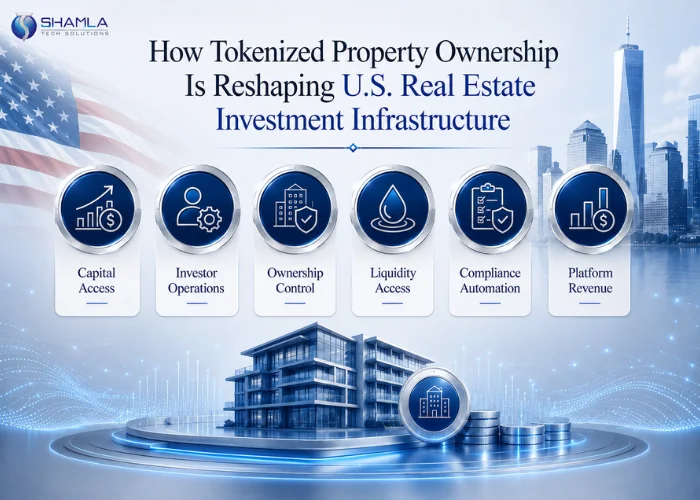
U.S. real estate investment infrastructure has long relied on operationally heavy fundraising, ownership administration, and investor servicing models that limit scale and flexibility. Tokenized property ownership is redefining how U.S. enterprises structure capital access, manage compliant digital ownership, and build institution-ready investment platforms.
How Tokenized Property Ownership Is Reshaping U.S. Real Estate Investment Infrastructure

1. Fragmented Capital Access Is Being Replaced

Commercial real estate fundraising in the United States remains concentrated within established private placement networks, institutional relationships, and operationally intensive subscription models. Tokenized property ownership enables enterprises to structure digitally accessible investment offerings that expand accredited investor participation, improve fundraising execution, and create stronger capital formation strategies.

2. Investor Administration Is Becoming Operationally Efficient

Managing accreditation verification, KYC workflows, subscription documentation, ownership allocation, and investor servicing creates significant administrative overhead for real estate investment operators. Tokenized ownership infrastructure centralizes these workflows within integrated digital platforms, enabling stronger execution control, lower servicing costs, improved audit readiness, and a more scalable enterprise operating model.

3. Ownership Record Management Gains Institutional Precision

Private real estate ownership administration often depends on fragmented records, disconnected documentation, and manual reconciliation processes that create governance exposure. Tokenized ownership introduces structured digital ownership records with transaction traceability and controlled transfer logic, improving reporting integrity, ownership visibility, and institutional oversight across investment operations.

4. Liquidity Infrastructure Becomes Strategically Relevant

Illiquidity remains a structural constraint across private real estate markets in the United States, limiting investor flexibility and narrowing product appeal. Tokenized ownership creates infrastructure for regulated secondary transaction models, enabling enterprises to design more flexible ownership transfer mechanisms that improve investor retention and strengthen commercial positioning.

5. Compliance Execution Moves Closer To Platform Infrastructure

Securities compliance, investor eligibility verification, documentation governance, and jurisdiction-based access controls require disciplined operational execution in U.S. real estate investment markets. Tokenized platforms embed these controls directly into workflow infrastructure, enabling enterprises to improve compliance consistency, reduce execution risk, and strengthen institutional governance.

6. Real Estate Platforms Become Revenue-Generating Digital Assets

Tokenized property ownership presents a substantial platform opportunity for technology providers, real estate enterprises, and financial infrastructure firms serving the U.S. market. Enterprises can commercialize digital issuance, investor lifecycle management, ownership servicing, compliance orchestration, and transaction infrastructure through recurring enterprise platform revenue models.

Develop Enterprise Blockchain Platforms For Real Estate

Regulatory And Compliance Considerations For Blockchain Real Estate Investment In the USA

Blockchain real estate investment in the United States requires rigorous regulatory planning alongside technical execution. Enterprises entering this market must structure tokenized ownership models around securities compliance, investor access governance, transaction controls, and operational accountability to build platforms that meet institutional expectations and support long-term commercial deployment.

Key Regulatory And Compliance Considerations

Consideration

Enterprise Relevance

Securities Structuring

Shapes how tokenized offerings are issued, marketed, and governed in the U.S.

Investor Eligibility Management

Controls compliant participation across accredited investors and permitted jurisdictions

KYC / AML Governance

Establishes identity verification and transaction monitoring requirements

Smart Contract Oversight

Protects transaction execution, ownership controls, and operational integrity

Secondary Market Controls

Defines how tokenized ownership interests may be transferred within regulatory boundaries

1. Securities Structuring Defines Commercial Viability

Tokenized real estate offerings in the United States require securities-aligned structuring from the outset. Offering format, investor access parameters, disclosure requirements, and issuance governance shape the platform’s legal and commercial foundation. Enterprises that establish strong regulatory architecture early create greater execution confidence, stronger institutional credibility, and a more dependable path toward scalable investment platform deployment.

2. Investor Eligibility Management Protects Platform Integrity

Accreditation verification, jurisdictional participation controls, subscription validation, and investor documentation governance require disciplined operational enforcement. Tokenized real estate platforms serving the U.S. market need embedded eligibility controls that govern investor access before transaction participation occurs. Strong access governance protects issuance integrity, supports compliant fundraising execution, and strengthens trust among enterprise stakeholders and institutional participants.

3. KYC And AML Governance Strengthens Institutional Readiness

Enterprise-grade tokenization platforms require comprehensive identity verification, sanctions screening, transaction monitoring, and source-of-funds validation capabilities. These controls support regulatory accountability and institutional trust across investment operations. Strong KYC and AML governance strengthens platform credibility, improves partnership readiness, protects transaction environments, and reinforces the operational discipline expected in regulated U.S. investment infrastructure.

4. Smart Contract Oversight Protects Transaction Governance

Smart contracts govern ownership allocation, transfer permissions, distribution execution, and transactional enforcement within tokenized real estate platforms. Enterprises require structured governance over contract logic, permission frameworks, audit review, and deployment controls to protect commercial commitments. Strong oversight reduces execution risk and ensures digital infrastructure performs in alignment with business objectives and governance requirements.

5. Secondary Market Controls Shape Liquidity Strategy

Transferability within tokenized real estate offerings requires carefully governed transaction controls aligned with U.S. regulatory requirements. Holding periods, investor eligibility rules, transfer permissions, and marketplace governance directly influence platform design decisions. Enterprises building tokenized investment infrastructure need clearly defined liquidity frameworks that support commercial product attractiveness while maintaining disciplined regulatory compliance.

Building Blockchain Real Estate Investment Platforms For The U.S. Market

Building a blockchain real estate investment platform for the U.S. market requires disciplined execution across regulatory architecture, investor infrastructure, transaction governance, and digital asset management. Enterprises entering this category need institution-ready platforms engineered for compliant capital formation, operational scale, and long-term commercial deployment.

1. Define The Investment Structure

Platform architecture begins with product definition. U.S. enterprises must determine whether the offering supports fractional ownership, tokenized private placements, real estate debt participation, syndication models, or secondary ownership frameworks. Investment structure influences securities design, investor eligibility rules, ownership mechanics, reporting requirements, and long-term platform monetization strategy.

2. Build Compliance Into Platform Architecture

Compliance architecture should be embedded at the platform design stage. U.S. market deployment requires investor accreditation workflows, KYC and AML governance, jurisdiction-aware access controls, transaction permissions, document management, and audit visibility. Strong compliance infrastructure supports institutional participation, protects fundraising execution, and strengthens long-term platform credibility with enterprise stakeholders.

3. Develop Enterprise Investor Infrastructure

Investor-facing infrastructure shapes platform usability and operational efficiency. Core capabilities include digital onboarding, subscription workflows, document execution, ownership dashboards, reporting interfaces, distribution management, and investor communications. Enterprises require infrastructure capable of managing institutional participation, high transaction volumes, and structured ownership administration across multiple real estate investment offerings.

4. Engineer Smart Contract Transaction Logic

Smart contracts govern ownership issuance, transfer permissions, distribution automation, transaction validation, and rule-based execution across tokenized real estate platforms. Enterprises require contract architecture aligned with commercial governance requirements and platform controls. Structured smart contract engineering strengthens operational consistency, ownership integrity, and scalable digital transaction execution across institutional investment environments.

5. Design Secondary Transaction Infrastructure

Liquidity architecture materially influences product attractiveness in tokenized real estate markets. U.S.-focused platforms require transaction approval workflows, ownership transfer governance, investor eligibility enforcement, settlement coordination, and secondary marketplace readiness. Enterprises designing commercial tokenization platforms benefit from clearly structured transaction infrastructure supporting regulated ownership movement and stronger long-term investor engagement.

6. Partner With An Enterprise Blockchain Development Company

Launching a U.S.-ready blockchain real estate investment platform requires coordinated execution across blockchain engineering, compliance-aware architecture, smart contract development, investor platform design, and enterprise deployment. Partnering with an experienced enterprise blockchain development company helps accelerate execution, reduce infrastructure risk, and deliver institution-ready tokenization platforms aligned with commercial objectives.

Bottom Line

Blockchain real estate investment in the USA represents a meaningful infrastructure opportunity for enterprises positioned to modernize capital formation, ownership administration, and digital investment delivery. Market leadership will belong to organizations building commercially credible platforms aligned with SEC expectations, institutional governance standards, and scalable execution architecture.

As capital markets continue embracing digital ownership infrastructure, tokenized real estate platforms present a compelling enterprise growth opportunity. Strategic execution across compliance, technology, and platform design will determine which businesses establish long-term leadership in the SEC-regulated U.S. digital real estate investment market.

Build Blockchain Real Estate Investment Platforms For The U.S. Market With Shamla Tech Solutions

Shamla Tech Solutions helps enterprises build institution-ready blockchain real estate investment platforms for the U.S. market with secure tokenization architecture, smart contract engineering, investor management infrastructure, and compliance-conscious system design tailored for regulated digital real estate ownership and investment models.

Our team has delivered enterprise blockchain solutions supporting digital asset infrastructure and tokenization initiatives with complex operational requirements. For businesses targeting the U.S. market, we engineer scalable platforms aligned with SEC-conscious deployment expectations, institutional governance standards, and the commercial demands of modern real estate investment infrastructure.
Launch Your U.S. Real Estate Tokenization Platform

FAQs

1. What is blockchain real estate investment in the USA?
Blockchain real estate investment in the USA refers to property investment models where ownership interests are digitally represented through blockchain infrastructure, enabling structured investor participation, transparent ownership administration, and more efficient investment operations within regulated market environments.
2. Is tokenized real estate legal in the United States?
Yes, tokenized real estate can operate legally in the United States when the investment structure aligns with securities regulations, investor eligibility requirements, KYC and AML obligations, disclosure expectations, and transaction governance standards applicable to digital investment offerings.
3. Who can build a blockchain real estate investment platform in the USA?
Real estate enterprises, fintech firms, investment operators, asset managers, and technology companies can develop blockchain real estate investment platforms for the U.S. market, provided the platform architecture supports regulatory compliance, operational governance, and institutional-grade investment infrastructure requirements.
4. What features should a U.S. real estate tokenization platform include?
A U.S.-focused real estate tokenization platform should include investor onboarding, accreditation verification, KYC and AML compliance, smart contract issuance, ownership record management, reporting dashboards, payment integrations, document governance, and transaction controls for compliant investment administration.
5. Why are enterprises investing in real estate tokenization platforms?
Enterprises are investing in tokenized real estate platforms to expand capital access, improve operational efficiency, strengthen ownership governance, modernize investor servicing, and establish scalable digital investment infrastructure aligned with long-term commercial opportunities in regulated U.S. asset markets.

Talk to Our Experts

Recent Posts