

Institutional capital is expanding into ownership models that deliver greater control, structured liquidity, and programmable asset participation. Real estate tokenization presents enterprises with a framework to digitize high-value assets while supporting governance, investor access, and capital formation objectives.
Tokenized real estate is projected to surpass $3 trillion by 2030, reflecting stronger institutional participation in blockchain-based property investment frameworks. This reinforces the need for enterprise-grade real estate tokenization platform development in USA financial markets with compliance-ready operational architecture.
This article elaborates why institutional real estate tokenization is drawing private equity interest, the structural advantages driving enterprise adoption, the infrastructure required for large-scale implementation, and the regulatory considerations shaping tokenized real estate investment strategies.
Launch Institutional Real Estate Investment Infrastructure
Why Traditional Private Equity Real Estate Models Are Facing Structural Limitations
Core Structural Constraints in Traditional Private Equity Real Estate:
- Private real estate holding periods reached approximately 5.4 years in recent institutional market analysis, highlighting how capital remains locked for extended durations before realization opportunities emerge. For enterprises, this directly limits portfolio agility, tactical asset rotation, and responsive capital redeployment strategies.
- Traditional private equity real estate ownership is structured around pooled fund exposure rather than asset-specific participation, limiting institutional precision when allocating capital toward individual commercial properties, logistics portfolios, hospitality assets, or sector-targeted real estate opportunities.
- Secondary transfers in private real estate often require complex legal restructuring, consent approvals, due diligence reviews, and manual administrative coordination. This creates execution friction when institutional investors seek partial exits, recapitalization transactions, or structured liquidity at the property ownership level.
- Real estate investment reporting frequently remains fragmented across fund administrators, property operators, legal stakeholders, and compliance functions. This weakens enterprise visibility into ownership records, property-level performance attribution, lease economics, and governance oversight required for institutional-grade asset management.
- Capital formation for traditional private real estate remains constrained by large minimum commitments and fund-centric participation models, reducing flexibility for enterprises seeking efficient fundraising around specific high-value properties rather than broad pooled investment vehicles.
How Institutional Real Estate Tokenization Is Reshaping Capital Formation and Asset Liquidity
Asset-Level Capital Formation Precision
Engineered Liquidity Pathways for Private Real Estate
Institutional-Grade Investor Access Expansion
Operational Consolidation Across Ownership Administration
Accelerated Capital Recycling and Portfolio Agility
Key Drivers Accelerating Institutional Adoption of Real Estate Tokenization
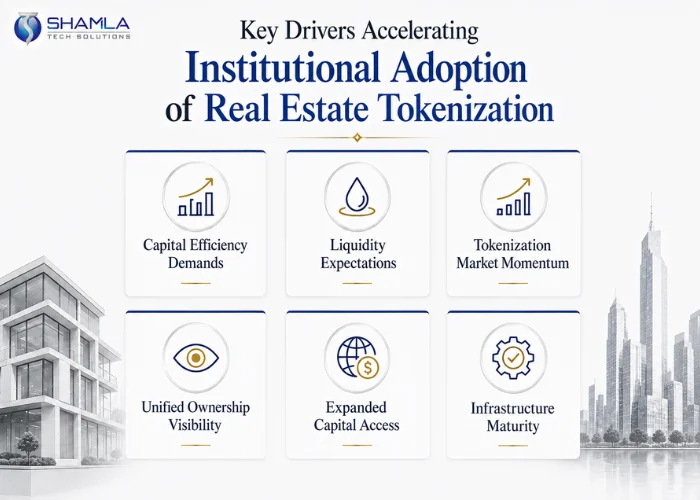
Pressure to Improve Capital Productivity
Market Demand for Greater Liquidity Optionality
Institutional Momentum Behind Tokenized Real Assets
Demand for Unified Ownership Intelligence
Expansion of Qualified Capital Access
Maturation of Digital Asset Infrastructure
Transform Real Estate Ownership Into Digital Capital Infrastructure
Challenges, Compliance Considerations, and Risk Management in Institutional Real Estate Tokenization
Consideration | Core Risk |
Regulatory Classification | Misclassification of tokenized real estate instruments can trigger securities enforcement exposure, licensing obligations, and offering restrictions |
Investor Compliance Controls | Weak KYC, AML, and investor accreditation workflows create legal exposure and onboarding risk |
Custody and Asset Security | Inadequate custody architecture increases vulnerability to asset compromise, unauthorized transfers, and control failures |
Secondary Transfer Governance | Unrestricted token movement can violate jurisdictional securities rules and investor eligibility requirements |
Smart Contract and Platform Integrity | Faulty contract logic or weak infrastructure can disrupt distributions, ownership records, and transaction execution |
Regulatory Structuring Discipline
Institutional-Grade Investor Compliance Controls
Secure Digital Custody Architecture
Controlled Secondary Transfer Governance
Technology Reliability and Operational Governance
Bottom Line
Real estate ownership infrastructure is entering a structural redesign phase where capital efficiency, liquidity engineering, and administrative precision carry direct commercial value. Enterprises that modernize ownership architecture early will be better positioned to define investor access, operational control, and long-term market relevance.
Institutional real estate tokenization represents a strategic infrastructure opportunity for enterprises seeking more efficient capital formation and ownership administration. Organizations implementing compliant, scalable, and governance-driven digital asset frameworks will be better equipped to support institutional participation, operational resilience, and long-term investment execution objectives.
Launch Institutional Real Estate Tokenization Platforms with Shamla Tech Solutions
If your enterprise is preparing to launch an institutional real estate tokenization platform, we deliver the technical infrastructure, compliance-aligned architecture, and ownership management capabilities required for secure digital asset issuance, investor administration, and scalable real estate investment operations.
If institutional-grade execution is your priority, our team at Shamla Tech Solutions builds customized real estate tokenization platforms with smart contract integration, investor onboarding systems, transfer governance controls, reporting infrastructure, and enterprise-ready digital asset frameworks tailored to your commercial objectives.