

Home » Real Estate Tokenization » How Tokenized Real Estate Investments Are Reshaping Cross-Border Wealth Building

How Tokenized Real Estate Investments Are Reshaping Cross-Border Wealth Building

Share this article:
tokenized-real-estate-investments-global-wealth-building
Table of Contents
About the Author
Balaji
CEO of Shamla Tech, specializes in crypto exchange development, RWA tokenization, blockchain infrastructure, AI solutions, and compliance-ready platforms. He helps enterprises address regulatory, security, and scalability challenges while driving real-world adoption of emerging technologies across industries.
Connect On:

New channels for cross-border capital formation are changing how property ownership is structured, enabling fractional participation in high-value assets across jurisdictions. Tokenization gives institutions and asset issuers a more precise mechanism to package, distribute, and govern real estate investment access.

Across 40+ jurisdictions, regulators and financial ecosystems are actively shaping frameworks for tokenized assets, reflecting serious institutional commitment toward digital asset infrastructure. This momentum strengthens the case for a secure real estate tokenization platform capable of managing compliance, investor onboarding, and cross-border asset administration.

This article explains how tokenized real estate investments are reshaping cross-border wealth building, the strategic benefits they offer international investors, the operational infrastructure required for issuance and management, and the regulatory considerations influencing global real estate tokenization initiatives.

Build Compliant Infrastructure For Cross-Border Property Investment

How Tokenized Real Estate Investments Remove Traditional Cross-Border Investment Barriers

Cross-border real estate investing has historically favored institutions with established banking access, legal infrastructure, and jurisdictional expertise. Tokenized real estate investments restructure this equation by reducing operational friction, improving capital mobility, and enabling scalable participation across international investment ecosystems.

How Tokenized Infrastructure Eliminates Legacy Cross-Border Friction:

  • Traditional international transfers still carry significant transaction inefficiencies, with the World Bank reporting an average global remittance cost above 6%, highlighting how legacy cross-border financial rails continue to create friction in capital movement. Tokenized settlement frameworks introduce greater transaction efficiency for globally distributed investors.

  • Cross-border property participation has historically required fragmented coordination across brokers, custodians, legal advisors, payment intermediaries, and regional compliance teams. Tokenized real estate investments consolidate issuance, ownership management, compliance workflows, and investor access within a unified digital asset infrastructure.

  • Illiquidity has traditionally limited international investor participation in premium real estate markets, particularly where capital commitments remain high. Fractional tokenization restructures asset accessibility, enabling diversified allocation strategies across multiple jurisdictions without requiring concentrated exposure to single property acquisitions.

  • Jurisdiction-specific onboarding requirements often delay investor participation through repetitive KYC, accreditation verification, and documentation workflows. A purpose-built real estate tokenization platform standardizes onboarding architecture, enabling compliant participation frameworks that scale across international investor networks.

  • Secondary market optionality has historically remained constrained in cross-border real estate structures due to transfer complexity and administrative overhead. Tokenized ownership models introduce programmable transfer mechanisms that support more structured liquidity pathways, improving portfolio flexibility for globally distributed investment participants.

Key Benefits of Tokenized Real Estate Investments for International Investors
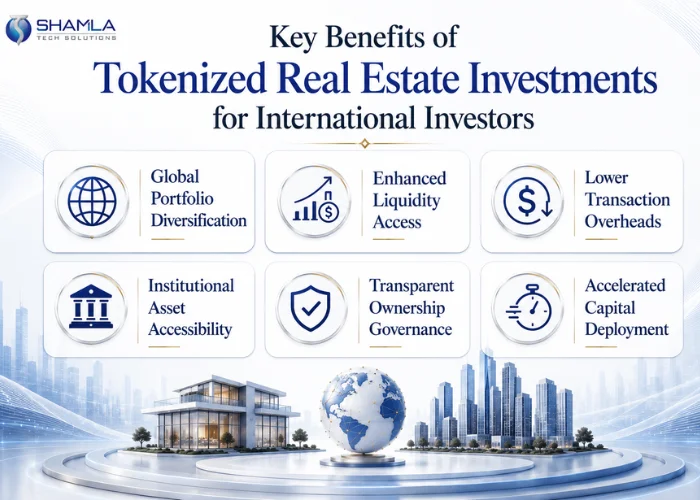
Key Benefits of Tokenized Real Estate Investments for International Investors

1. Portfolio Diversification Across High-Growth Global Markets

International investors have historically concentrated capital within familiar jurisdictions due to regulatory complexity, access limitations, and operational friction. Tokenized real estate investments make geographic diversification significantly more practical by enabling fractional exposure across multiple markets, property classes, and risk profiles. For investors seeking balanced global allocation, this creates a more disciplined pathway toward diversification without large single-asset capital concentration.

2. Improved Liquidity for Traditionally Locked Real Estate Capital

Conventional real estate exits can take 3 to 12 months or longer, depending on jurisdiction, asset type, and transaction complexity. For international investors, this creates major capital rigidity. Tokenized ownership structures introduce more efficient transfer frameworks and secondary transaction mechanisms, allowing investors to manage liquidity positioning with greater precision instead of waiting through extended traditional disposition cycles.

3. Reduced Transaction and Intermediary Cost Exposure

Cross-border property transactions often involve cumulative legal, brokerage, banking, escrow, and administrative costs reaching 5% to 10% of transaction value in certain markets. Tokenized infrastructure reduces dependency on fragmented intermediaries by consolidating ownership administration, compliance workflows, and settlement coordination. For capital allocators, preserving transaction efficiency directly improves net investment performance and deployment economics.

4. Access to Institutional-Grade Assets with Lower Entry Thresholds

Prime commercial real estate frequently demands entry capital in the six-figure to multi-million-dollar range, effectively excluding many international investors from premium opportunities. Tokenized structures break ownership into fractional units, lowering participation thresholds while preserving exposure to professionally managed income-generating assets, including logistics hubs, commercial developments, hospitality properties, and strategically positioned global real estate holdings.

5. Greater Transparency in Ownership Governance and Asset Reporting

International investors often face information asymmetry in conventional cross-border real estate structures, particularly around ownership records, fee leakage, transfer history, and governance accountability. Tokenized frameworks establish auditable digital ownership infrastructure with stronger visibility into asset administration. This becomes particularly valuable for investors deploying capital remotely, where reporting clarity and governance confidence directly influence long-term participation decisions.

6. Faster Capital Deployment Across International Investment Opportunities

Traditional international real estate onboarding can extend across 2 to 8 weeks, driven by documentation reviews, legal verification, banking approvals, and jurisdiction-specific compliance procedures. Tokenized investment platforms streamline onboarding through digital verification and standardized workflows. Faster deployment means investors can secure time-sensitive opportunities without losing momentum to administrative inefficiency.

Compliance, Security, and Regulatory Considerations in Cross-Border Real Estate Tokenization

Cross-border real estate tokenization requires regulatory precision, not generic digital asset infrastructure. Institutional participation depends on compliant issuance structuring, jurisdiction-aware investor governance, and enterprise-grade security controls. For enterprises, execution credibility is defined by legal defensibility, operational resilience, and investor protection architecture.

Consideration

Why It Matters

Regulatory Licensing Alignment

Supports compliant structuring under SEC, VARA, MAS, FINMA, FCA, and EU digital asset frameworks

Investor Verification Controls

Enforces KYC, AML, accreditation screening, sanctions checks, and jurisdiction-based investor eligibility

Smart Contract Audit Governance

Protects token issuance logic, ownership rules, distributions, and transfer execution from exploitable vulnerabilities

Qualified Custody Architecture

Secures tokenized ownership through institutional wallet governance, access controls, and recovery protocols

Data Protection Compliance

Aligns investor data handling with GDPR, PDPA, regional privacy mandates, and documentation governance

Transfer Restriction Enforcement

Prevents unauthorized secondary transfers through programmable jurisdiction and investor eligibility controls

Regulatory Alignment Across Global Jurisdictions

Cross-border real estate tokenization must align with the regulatory expectations of each target market, particularly when tokenized assets may be classified as securities. This includes SEC frameworks in the United States, VARA licensing in Dubai, MAS regulatory oversight in Singapore, FINMA digital asset guidance in Switzerland, FCA compliance in the United Kingdom, and MiCA-linked European obligations. Jurisdictional misalignment can delay issuance, restrict investor access, or expose enterprises to enforcement action.

Institutional Investor Verification and AML Enforcement

International investor onboarding requires a rigorous compliance framework capable of satisfying financial crime prevention standards across multiple jurisdictions. Enterprises must implement KYC verification, AML transaction monitoring, sanctions screening, politically exposed person checks, source-of-funds validation, and accredited investor qualification where required. Institutional investors and banking partners expect disciplined onboarding controls, particularly where cross-border capital movement and regulated real estate participation intersect.

Independent Smart Contract Audit and Governance Controls

Smart contracts govern critical operational functions including token issuance, ownership allocation, distribution logic, transfer restrictions, redemption conditions, and compliance triggers. A single technical vulnerability can compromise capital integrity and investor confidence. Enterprises should deploy independently audited smart contracts, governance approval mechanisms, controlled upgrade permissions, emergency intervention protocols, and formal security testing frameworks to meet institutional expectations for reliability and operational trust.

Qualified Digital Custody and Access Security

Tokenized ownership demands custody architecture that meets institutional asset protection standards, particularly when managing cross-border investor participation. Enterprises should implement multi-signature wallet controls, hardware security module integration, role-based access governance, secure private key custody, administrative approval workflows, and structured disaster recovery protocols. Weak custody infrastructure introduces operational fragility, investor hesitation, and significant reputational risk for high-value real estate tokenization platforms.

Cross-Border Data Privacy and Compliance Record Governance

Investor onboarding generates extensive sensitive documentation, including identity records, tax disclosures, proof of address, accreditation evidence, transaction histories, and compliance monitoring logs. Enterprises must align with GDPR in Europe, Singapore’s PDPA, DIFC data protection standards, and relevant regional privacy obligations. Strong compliance record governance protects against legal exposure while reinforcing institutional confidence in the platform’s administrative and operational matur

Programmable Secondary Market Transfer Restrictions

Secondary liquidity must be structured within legal boundaries, particularly where tokenized real estate interests fall under securities regulation. Enterprises should enforce wallet whitelisting, lock-up period controls, accredited investor restrictions, sanctions-based transfer screening, jurisdictional ownership permissions, and programmable compliance validation rules. Transfer functionality without governance discipline creates direct legal exposure and undermines the regulatory defensibility of the entire tokenized investment structure.

Transform Real Estate Assets Into Scalable Digital Investments

Real-World Use Cases of Tokenized Real Estate Investments in Global Markets

U.S. Commercial Real Estate Fractional Ownership

The United States remains one of the strongest markets for tokenized real estate participation, particularly across multifamily housing, office portfolios, industrial assets, and income-generating rental properties. Structured tokenization allows qualified international investors to access institutional-grade U.S. real estate opportunities while reducing the administrative complexity typically associated with direct cross-border property acquisition.

Dubai Luxury Real Estate Global Capital Access

Dubai’s premium real estate sector is highly aligned with tokenized ownership models due to its international investor base and digital asset regulatory readiness. Developers can fractionalize branded residences, waterfront developments, hospitality-linked assets, and prime commercial towers, creating more efficient cross-border capital access for investors seeking exposure to globally recognized Middle Eastern property markets.

Singapore-Based Commercial Real Estate Structuring

Singapore serves as a strategic jurisdiction for structuring tokenized commercial real estate offerings due to its institutional financial ecosystem and regulatory credibility. Asset managers can package logistics assets, Grade A office properties, and income-generating commercial portfolios into compliant digital investment structures, attracting sophisticated international investors seeking professionally governed exposure to Asia-Pacific real estate opportunities.

Hospitality Asset Tokenization in Tourism-Driven Markets

Tourism-driven markets such as Thailand, Bali, Spain, Greece, and the UAE present compelling opportunities for hospitality real estate tokenization. Hotels, serviced residences, branded resorts, and revenue-generating hospitality developments can be structured into digital investment offerings, allowing operators to raise capital efficiently while opening international participation in professionally managed hospitality-focused real estate portfolios.

European Yield-Focused Property Investment Access

Established real estate markets such as Germany, Switzerland, and the United Kingdom continue to attract global investors seeking stable rental-backed returns and mature legal frameworks. Tokenized ownership structures improve access to these traditionally capital-intensive markets by lowering entry thresholds, simplifying ownership administration, and enabling structured participation in professionally managed residential and commercial property assets.

Emerging Market Developer Capital Formation

Developers across India, Vietnam, Indonesia, and selected African growth corridors often face capital access constraints despite strong long-term demand fundamentals. Tokenized fundraising creates a structured mechanism for attracting qualified international investors, reducing dependence on narrow institutional capital channels while enabling more scalable funding for residential, commercial, infrastructure-linked, and mixed-use development projects.

Wrapping Up

Cross-border real estate access is becoming a strategic infrastructure question rather than a capital exclusivity issue. Enterprises that establish compliant tokenization capabilities today position themselves to capture international investor demand, unlock new fundraising models, and structure globally accessible property investment ecosystems.

The long-term advantage will belong to platforms that combine regulatory credibility, institutional security, and operational execution at scale. Tokenized real estate investments are establishing a new framework for global capital participation, where access, governance, and investment efficiency become measurable competitive differentiators.

Build a Scalable RWA Platform for Tokenized Real Estate Investments with Shamla Tech Solutions

Shamla Tech Solutions builds scalable RWA platforms for enterprises launching tokenized real estate investments across global markets. We develop infrastructure for asset tokenization, investor onboarding, compliance automation, ownership management, and secure transaction workflows designed to support institutional-grade digital real estate ecosystems.

Our team delivers end-to-end real estate tokenization platform development aligned with global regulatory expectations, including jurisdiction-aware compliance frameworks, smart contract architecture, custody-ready infrastructure, and secondary transfer controls. We help enterprises create secure, scalable platforms built for cross-border investor participation and capital growth.
Launch Your Global Real Estate Tokenization Platform Today

FAQs

What are tokenized real estate investments?
Tokenized real estate investments represent property ownership through digital tokens, allowing fractional participation in real estate assets. This structure improves accessibility, ownership administration, and investment participation for qualified investors seeking structured exposure to real estate opportunities.
How do tokenized real estate investments support cross-border investing?
Tokenized ownership structures simplify international participation by reducing transaction friction, streamlining investor onboarding, enabling fractional access, and creating more efficient frameworks for managing compliant cross-border real estate investment participation across multiple jurisdictions.
Are tokenized real estate investments regulated?
Yes, tokenized real estate investments are subject to applicable securities regulations, digital asset compliance requirements, investor verification obligations, and jurisdiction-specific ownership rules depending on the issuance structure, asset classification, and investor geography involved.
What types of real estate assets can be tokenized?
Commercial office buildings, multifamily housing, luxury residences, hospitality properties, logistics facilities, rental-backed portfolios, mixed-use developments, and institutional income-generating real estate assets can all be structured through compliant tokenization frameworks.
Why should enterprises build a real estate tokenization platform?
A dedicated platform helps enterprises structure compliant digital ownership offerings, attract international investors, improve capital formation efficiency, automate operational workflows, strengthen governance controls, and create scalable infrastructure for long-term tokenized real estate investment participation.

Talk to Our Experts

Recent Posts