


Private credit markets are expanding fast, but the infrastructure supporting them still looks outdated in many areas. Loan servicing remains fragmented. Investor onboarding takes too long. Liquidity is limited. Reporting systems often depend on disconnected manual workflows. That operational friction is exactly why enterprises are moving toward private credit tokenization platforms.
A private credit tokenization platform is a blockchain-powered system that converts private debt assets into digital tokens. These platforms help businesses manage issuance, investor participation, compliance workflows, settlement automation, reporting, and secondary trading through programmable infrastructure. But here is where things become more complicated.
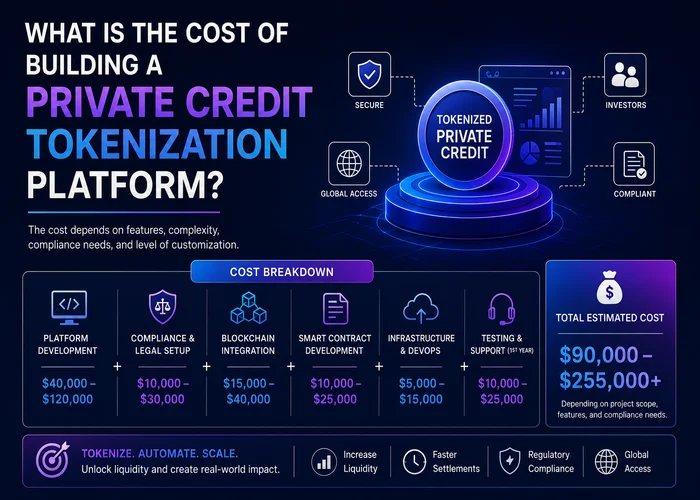
The cost of building a private credit tokenization platform is not defined by one fixed number. A lightweight MVP built for a niche lending ecosystem looks completely different from an institutional-grade platform supporting multi-chain interoperability, compliance automation, custody integration, and cross-border investors. This guide breaks down the major development considerations businesses need to evaluate before building a scalable private credit blockchain platform.
Key Highlights
- Private credit tokenization platforms help businesses digitize debt assets into blockchain-based tokens, improving liquidity, transparency, operational efficiency, and investor accessibility within modern financial ecosystems.
- The cost of building a private credit tokenization platform depends on blockchain infrastructure, compliance integrations, smart contract complexity, investor onboarding systems, and long-term scalability planning.
- Institutional demand for RWA tokenization platforms is increasing as enterprises look for secure and regulation-ready infrastructure to modernize private lending operations.
- Advanced smart contract development services automate interest distribution, compliance workflows, governance mechanisms, and digital asset management across tokenized private credit ecosystems.
- Regulatory infrastructure significantly impacts private credit blockchain platform development, especially when businesses operate across multiple jurisdictions with different compliance requirements.
- Secondary market functionality within private debt tokenization platforms improves liquidity opportunities but increases technical complexity and compliance obligations.
- Enterprise-grade security architecture in digital asset tokenization platforms requires smart contract audits, encryption systems, wallet security, and infrastructure monitoring capabilities.
- AI-powered analytics within blockchain-based private credit platforms improve operational efficiency through fraud detection, portfolio forecasting, and automated risk analysis systems.
Why Businesses Are Investing in Private Credit Tokenization Platforms
Traditional private credit systems were never designed for global digital finance. Most infrastructure still depends heavily on intermediaries, manual documentation, delayed settlements, and disconnected reporting systems. That becomes a scalability problem when enterprises start managing larger investor networks or cross-border lending operations. Private credit tokenization platforms create operational advantages.
1.Improved Liquidity
Private debt tokenization platforms enable fractional ownership models, helping businesses improve investor participation and unlock liquidity opportunities that traditional private credit markets often restrict. In traditional private lending environments, assets remain highly illiquid. Investors may need to wait years before exiting positions. Tokenization changes that dynamic by creating programmable ownership structures and secondary trading possibilities.
2. Faster Settlement Infrastructure
3. Better Transparency
5. Reduced Operational Friction
The Biggest Factors Affecting the Cost of Building a Private Credit Tokenization Platform
1. Platform Architecture Complexity
The architecture scope directly affects development estimation. A smaller MVP may include:
- Token issuance
- Investor dashboards
- Wallet integration
- Basic reporting
An institutional-grade private credit tokenization platform may require:
- Multi-chain interoperability
- AI-powered analytics
- Compliance orchestration
- Custody integrations
- Secondary trading systems
- Governance automation
- Institutional reporting
- Liquidity infrastructure
The difference between these two systems is massive from both an engineering and operational perspective.
2. Blockchain Selection
Blockchain selection influences:
- Scalability,
- Transaction efficiency,
- Compliance flexibility,
- Interoperability,
- Infrastructure maintenance.
Blockchain | Best Use Case | Operational Impact |
Ethereum | Institutional-grade ecosystems | Higher gas and audit complexity |
Polygon | Cost-efficient scaling | Faster transaction throughput |
Avalanche | High-performance financial systems | Moderate infrastructure requirements |
Hyperledger | Permissioned enterprise environments | Extensive customization needs |
Stellar | Asset issuance and settlement | Lower operational overhead |
Businesses developing private credit blockchain solutions usually balance security, compliance, and scalability before choosing infrastructure. What works for a startup often fails at institutional scale.
Smart Contract Development
Smart contracts are the operational engine behind every private credit tokenization platform. They automate:
- Interest payments.
- Token issuance.
- Investor permissions.
- Governance logic.
- Yield distribution.
- Compliance restrictions.
But complexity grows quickly once businesses introduce institutional workflows.
Build Scalable Tokenization Infrastructure for Institutional Growth. Create secure architecture, compliance readiness, and scalable infrastructure for long-term adoption.
Core Smart Contract Requirements
Automated Yield Distribution
Compliance Restrictions
Governance Mechanisms
Multi-Tranche Structures
Institutional private debt tokenization platforms often require complex tranche logic with varying risk profiles and investor participation rules.
This is where many businesses realize that tokenization infrastructure is far more complex than standard Web3 application development.
Compliance Infrastructure Is a Major Cost Driver
Many enterprises initially think blockchain development represents the largest expense. Compliance infrastructure often becomes more demanding. Businesses building private credit tokenization solutions usually need:
- KYC verification in private credit tokenization platforms helps businesses verify investor identities, reduce fraud risks, and comply with financial regulations during onboarding and transaction management processes.
- AML monitoring within private credit blockchain platforms tracks suspicious financial activities, prevents money laundering risks, and strengthens regulatory compliance across tokenized lending ecosystems and investor transactions.
- Investor accreditation systems in RWA tokenization platforms validate whether investors meet financial eligibility requirements before accessing regulated private credit investment opportunities and tokenized assets.
- Transfer restrictions in digital asset tokenization platforms prevent unauthorized token transfers by enforcing investor eligibility rules, jurisdiction limitations, and compliance-based ownership permissions automatically through smart contracts.
- Audit reporting capabilities within enterprise tokenization platforms provide transparent transaction records, compliance documentation, and operational tracking to support regulatory reviews and institutional investor confidence.
- Jurisdiction-based permissions in private credit tokenization solutions control investor access according to regional financial regulations, helping businesses manage cross-border compliance and legal participation requirements effectively.
- Data privacy compliance in blockchain-powered private credit platforms helps businesses protect sensitive investor information while meeting legal standards related to data storage, security, and digital identity management.
Why Compliance Complexity Increases Costs
1.Cross-Border Regulations
Multi-jurisdiction operations within RWA tokenization platforms require businesses to adapt onboarding, reporting, and investor participation workflows based on regional regulations.
2. Ongoing Regulatory Updates
Compliance systems in private credit blockchain solutions require continuous updates as securities laws and digital asset regulations evolve globally.
3. Investor Verification Systems
Institutional-grade digital asset tokenization platforms require secure onboarding infrastructure capable of validating accredited investor eligibility and risk profiles.
Most businesses underestimate how expensive post-launch compliance maintenance becomes over time.
Security Infrastructure Cannot Be Treated as Optional
Security failures in financial infrastructure create reputational damage that is difficult to recover from. That is why institutional investors prioritize audited and security-tested ecosystems. Major security components include:
1. Smart Contract Audits
Security audits within private credit tokenization platforms help identify vulnerabilities, strengthen investor trust, and improve infrastructure resilience before deployment.
2. Wallet Security
Secure custody systems in blockchain-powered private credit platforms protect institutional assets and transaction workflows from unauthorized access risks.
3. Infrastructure Monitoring
Enterprise-grade RWA tokenization platforms require continuous monitoring systems to detect suspicious activity and operational anomalies in real time.
4. Encryption and Data Protection
Advanced encryption frameworks within digital asset tokenization platforms help businesses secure sensitive investor information and transaction records.
Security becomes even more important when secondary trading functionality enters the ecosystem.
Secondary Trading Adds Another Layer of Complexity
Liquidity is one of the biggest reasons businesses pursue private debt tokenization platforms in the first place. But enabling secondary trading infrastructure is not simple. It may require:
- Trading engines,
- Compliance validation systems,
- Liquidity pools,
- Settlement automation,
- Market-making tools,
- Institutional APIs.
Many startups build tokenization systems without planning liquidity infrastructure early enough. Later, expansion becomes expensive and operationally difficult.
Step-by-Step Process to Build a Private Credit Tokenization Platform
Step 1: Define Asset Structures
Step 2: Choose Blockchain Infrastructure
Step 3: Develop Smart Contracts
Step 4: Integrate Compliance Systems
Step 5: Build Investor Interfaces
Step 6: Conduct Security Audits
Step 7: Launch and Scale Infrastructure
Common Mistakes That Increase Development Costs
Overengineering the MVP
Many businesses attempt to build institutional-scale infrastructure immediately. That usually creates:
- Longer timelines,
- Larger engineering overhead,
- Delayed market entry.
How to Fix It
Launch with a scalable MVP focused on:
- Token issuance,
- Compliance onboarding,
- Investor management first.
Then expand gradually.
Ignoring Compliance Early
Some startups focus heavily on blockchain architecture while delaying legal planning. That becomes expensive later.
How to Fix It
Engage compliance specialists during the discovery phase before infrastructure decisions are finalized.
Choosing the Wrong Blockchain
Some blockchains work well for smaller ecosystems but struggle under institutional transaction volume.
How to Fix It
Evaluate long-term scalability and compliance requirements instead of choosing infrastructure based only on popularity.
Comparison Table: Basic vs Enterprise Tokenization Platforms
Feature | Basic Platform | Enterprise Platform |
Smart Contracts | Simple issuance logic | Governance and compliance automation |
Security | Limited testing | Institutional-grade audits |
Investor Management | Basic onboarding | Full compliance orchestration |
Blockchain Support | Single-chain | Multi-chain interoperability |
Reporting | Standard dashboards | Real-time analytics infrastructure |
Liquidity Features | Limited transfers | Secondary trading ecosystems |
Scalability | Startup-focused | Institutional-grade architecture |
Takeaway
Build Enterprise-Ready Private Credit Infrastructure With ShamlaTech
Businesses entering tokenized finance need more than basic blockchain development. They need a scalable infrastructure that can support institutional investors, evolving compliance requirements, and long-term ecosystem growth. At Shamla Tech, we build secure and scalable private credit tokenization platforms tailored for enterprise financial ecosystems. We specialize in RWA tokenization platforms, smart contract architecture, DeFi integration, AI-powered automation, compliance-ready blockchain systems, and institutional Web3 infrastructure. Our team focuses on creating blockchain infrastructure that helps businesses streamline operations, improve liquidity access, automate investor workflows, and scale efficiently across global digital finance markets.
Partner with our expert to launch a Custom and Complaint Tokenization Platform.