



Home » Stable Coin » How Enterprise Stablecoin Settlement Could Cut Cross-Border Payment Delays by Days

How Enterprise Stablecoin Settlement Could Cut Cross-Border Payment Delays by Days

Share this article:
enterprise stablecoin settlement
Table of Contents
About the Author
Balaji
CEO of Shamla Tech, specializes in crypto exchange development, RWA tokenization, blockchain infrastructure, AI solutions, and compliance-ready platforms. He helps enterprises address regulatory, security, and scalability challenges while driving real-world adoption of emerging technologies across industries.
Connect On:

Cross-border payments continue to influence global trade, yet settlement timelines remain a significant challenge for enterprises managing international suppliers, treasury operations, and multi-market transactions. Delayed settlements can restrict working capital availability, increase reconciliation complexity, and affect the movement of funds across jurisdictions.

In 2026, stablecoin settlement has become a strategic priority for financial institutions, payment providers, and multinational enterprises seeking continuous transaction processing. Industry reports indicate that stablecoin transaction volumes exceeded $33 trillion, reflecting growing enterprise adoption for cross-border payments, treasury transfers, and global liquidity management.

This article offers insights on how enterprise stablecoin settlement reduces cross-border payment delays, the infrastructure supporting real-time settlement across global markets, and the operational benefits it provides for transaction visibility, treasury efficiency, liquidity access, and international payment execution.

Accelerate Global Payments With Stablecoin Settlement

Why Enterprise Stablecoin Settlement Matters for Cross-Border Payments in 2026

Cross-border payment infrastructure has become a board-level priority in 2026 as enterprises expand supplier networks, treasury operations, and settlement activities across multiple jurisdictions. Enterprise stablecoin settlement is increasingly being evaluated as a financial infrastructure layer that supports operational efficiency and capital movement.

Why Enterprises Are Prioritizing Stablecoin Settlement Infrastructure:

  • Enterprise finance teams are adopting stablecoin settlement to reduce capital lockup periods associated with international transactions, enabling faster access to working capital and improving liquidity allocation across global business units and payment corridors.

  • Stablecoin-based settlement networks support continuous transaction execution beyond banking hours, allowing enterprises to process supplier payments, treasury transfers, and partner settlements without dependency on regional banking schedules or intermediary settlement windows.

  • Multiple research forecasts stablecoin cross-border B2B transaction value will surpass $5 trillion globally, highlighting growing enterprise demand for settlement infrastructure that supports high-volume international transactions with greater speed, transparency, and operational control.

  • Enterprises are integrating stablecoin settlement into invoicing and accounts payable workflows to improve transaction traceability, automate reconciliation processes, and maintain a more consistent audit trail across cross-border financial operations.

  • Global organizations are evaluating stablecoin settlement frameworks as part of broader treasury modernization initiatives, particularly for managing multi-currency exposure, improving fund mobility between markets, and strengthening visibility across international payment ecosystems.

The Hidden Causes of Delays in Traditional Cross-Border Payment Systems

1. Multi-Layered Intermediary Networks

Cross-border payments frequently pass through multiple correspondent banks before reaching the beneficiary institution. Each intermediary introduces additional verification, compliance reviews, and processing cycles that extend settlement timelines. For enterprises handling large transaction volumes, these fragmented payment routes reduce predictability, create operational dependencies across institutions, and make it difficult to accurately forecast fund availability for business-critical obligations.

2. Fragmented Compliance And Regulatory Checks

International payments are subject to varying regulatory requirements across jurisdictions, including sanctions screening, anti-money laundering reviews, and transaction monitoring protocols. Since these checks are often conducted independently by participating financial institutions, payment processing can be delayed at multiple stages. Enterprises are left managing uncertain settlement windows while maintaining compliance across diverse regulatory environments.

3. Limited Visibility Across Payment Lifecycles

Traditional payment infrastructure provides limited real-time insight into transaction status once funds enter the correspondent banking network. Treasury teams often rely on fragmented updates from banking partners to determine payment progress. This lack of visibility complicates cash flow planning, delays issue resolution, and increases the administrative burden associated with tracking high-value international transactions.

4. Liquidity Trapped Within Settlement Cycles

Funds involved in cross-border transactions often remain unavailable until all intermediary processing and settlement requirements are completed. For enterprises operating across multiple markets, these delays can impact working capital utilization and treasury efficiency. Capital that could otherwise support procurement, supplier payments, or strategic initiatives remains tied up within lengthy settlement processes and banking workflows.

5. Banking Hour And Time Zone Dependencies

Cross-border payments remain heavily influenced by banking operating hours, regional holidays, and market-specific processing schedules. A transaction initiated in one jurisdiction may wait several hours or even days before processing resumes in another. For multinational enterprises managing global supply chains and financial operations, these timing constraints introduce unnecessary delays into otherwise time-sensitive payment activities.

How Enterprise Stablecoin Settlement Reduces Payment Delays from Days to Minutes

Enterprise stablecoin settlement transforms cross-border payment execution by removing many of the operational layers that contribute to settlement delays. Through blockchain-based infrastructure, businesses can move value directly between parties, enabling faster settlement cycles, greater liquidity access, and improved transaction visibility.

Factor

Traditional Cross-Border Payments

Enterprise Stablecoin Settlement

Settlement Speed

2-5 business days due to intermediary processing and banking schedules

Settlement completed within seconds or minutes on blockchain networks

Transaction Routing

Multiple correspondent banks participate in payment processing

Direct transfer between participants on a shared blockchain network

Operating Hours

Restricted by banking hours, weekends, and holidays

Available 24/7/365 without institutional downtime

Payment Visibility

Limited tracking across intermediary institutions

Real-time transaction monitoring on a transparent ledger

Reconciliation

Manual verification across multiple systems

Automated reconciliation through programmable transaction records

Near-Instant Settlement Finality

Enterprise stablecoin settlement enables transactions to be validated and recorded directly on blockchain networks rather than passing through multiple banking institutions. Once consensus is reached, settlement is considered final, eliminating waiting periods associated with correspondent banking workflows. As a result, enterprises can receive and deploy funds within minutes instead of waiting two to five business days for traditional settlement completion.

Elimination Of Intermediary Processing Layers

Traditional cross-border payments often move through several correspondent banks before reaching the recipient. Each intermediary performs verification, compliance screening, and processing activities that increase settlement timelines. Enterprise stablecoin settlement removes many of these routing dependencies by enabling direct value transfer between participating entities. Fewer processing layers translate into faster transaction execution and greater operational efficiency.

Continuous 24/7 Settlement Infrastructure

Stablecoin networks operate continuously without dependence on banking schedules, regional holidays, or market-specific operating windows. Transactions can be initiated, processed, and settled at any time regardless of geography. This infrastructure allows multinational enterprises to execute treasury transfers, supplier payments, and cross-border settlements immediately, improving responsiveness across global operations and reducing delays caused by institutional downtime.

Real-Time Transaction Visibility And Verification

Enterprise stablecoin settlement records transaction data on a shared blockchain ledger, creating immediate visibility into payment status. Treasury and finance teams can track transactions from initiation through settlement without relying on fragmented updates from intermediary institutions. This transparency reduces investigation times, improves operational oversight, and enables faster resolution of payment-related exceptions across international transaction environments.

Improved Liquidity Utilization Across Global Operations

Enterprise stablecoin settlement reduces the time funds remain tied up within payment processing and settlement workflows. By enabling near-instant value transfer between counterparties, enterprises gain faster access to capital across markets. This improved fund mobility supports more efficient working capital management, stronger treasury control, and better allocation of liquidity across suppliers, subsidiaries, and business operations.

Develop Scalable Stablecoin Payment Infrastructure

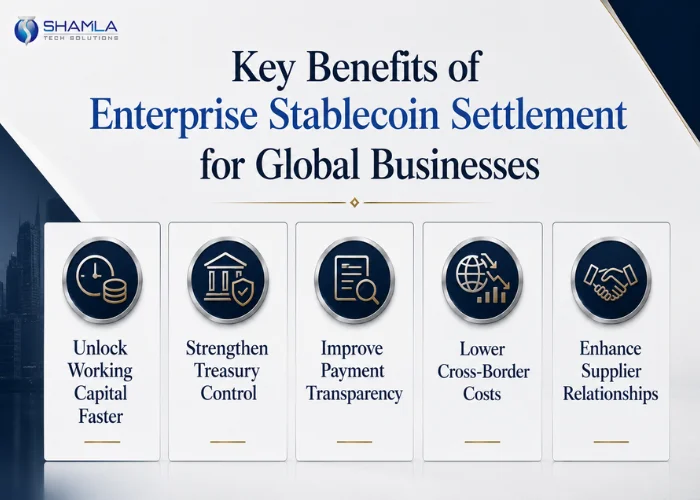
Key Benefits of Enterprise Stablecoin Settlement for Global Businesses
Key Benefits of Enterprise Stablecoin Settlement for Global Businesses

1. Stronger Working Capital Efficiency

Enterprise stablecoin settlement improves working capital utilization by reducing the time funds remain locked within payment processing cycles. Faster settlement allows finance teams to deploy capital where it generates the greatest business value, whether for supplier obligations, inventory procurement, strategic investments, or treasury activities. Improved fund availability creates greater financial flexibility across international operations and payment ecosystems.

2. Greater Treasury Control Across Jurisdictions

Managing liquidity across multiple countries often requires treasury teams to navigate fragmented banking systems and varying settlement schedules. Enterprise stablecoin settlement provides a unified mechanism for transferring value between business entities, enabling more efficient liquidity positioning. This increased control helps organizations optimize cash management strategies while maintaining visibility across geographically distributed financial operations.

3. Enhanced Payment Transparency And Auditability

Every stablecoin transaction is recorded on an immutable blockchain ledger, creating a verifiable record of payment activity. Finance and compliance teams gain direct access to transaction histories, timestamps, and settlement records without relying on fragmented reporting processes. This transparency strengthens audit readiness, improves internal controls, and supports governance requirements across complex international payment environments.

4. Reduced Operational Costs In Payment Processing

Traditional cross-border transactions often involve intermediary fees, foreign exchange processing charges, investigation costs, and manual reconciliation efforts. Enterprise stablecoin settlement streamlines payment execution by reducing reliance on multiple processing layers. This operational efficiency can lower transaction-related overhead while minimizing the administrative resources required to manage large-scale international payment activities.

5. Improved Supplier And Partner Payment Experiences

Timely settlement plays a critical role in maintaining strong commercial relationships across global supply chains. Enterprise stablecoin settlement enables businesses to deliver payments with greater speed, predictability, and transparency. Faster fund availability improves confidence among suppliers, distributors, and international partners, supporting smoother commercial operations and strengthening long-term business relationships across markets.

Wrapping Up

Cross-border payment infrastructure is increasingly being evaluated through the lens of settlement efficiency, liquidity accessibility, and operational control. As international transaction volumes grow, organizations are prioritizing payment systems that support continuous value transfer, greater transparency, and more effective movement of capital across jurisdictions.

Stablecoin-based settlement frameworks are becoming a strategic consideration for businesses seeking greater flexibility in global financial operations. Organizations that establish the right settlement capabilities today will be better positioned to support scalable treasury functions, improve capital efficiency, and navigate increasingly connected international markets.

Build Enterprise Stablecoin Settlement Solutions with Shamla Tech Solutions

Shamla Tech Solutions is a stablecoin settlement solution provider specializing in enterprise-grade payment infrastructure for global businesses. We design and develop secure settlement platforms that support cross-border transactions, treasury operations, multi-currency workflows, and compliance requirements across diverse regulatory jurisdictions.

Our team helps enterprises build scalable stablecoin settlement ecosystems with capabilities for payment automation, transaction monitoring, liquidity management, and blockchain integration. We deliver solutions tailored for global deployment, enabling businesses to operate confidently across multiple jurisdictions while maintaining security, transparency, and operational efficiency.


Build Cross-Border Settlement Solutions For Enterprise Growth

FAQs

1. What Is Enterprise Stablecoin Settlement?
Enterprise stablecoin settlement refers to the use of blockchain-based stablecoins to complete business transactions. It enables organizations to transfer value across borders with greater speed, transparency, and operational efficiency than many traditional settlement methods.
2. How Fast Is Enterprise Stablecoin Settlement?
Settlement speed depends on the blockchain network and implementation model. In many cases, transactions can be completed within minutes, allowing businesses to access funds significantly faster than conventional cross-border payment processes.
3. Can Enterprise Stablecoin Settlement Support Global Payments?
Yes. Enterprise stablecoin settlement solutions are designed to facilitate international transactions across multiple jurisdictions, helping businesses move funds globally while improving payment visibility, liquidity management, and transaction traceability.
4. How Does Stablecoin Settlement Improve Treasury Operations?
Faster settlement reduces the time capital remains tied up in payment workflows. This allows treasury teams to improve liquidity utilization, strengthen cash flow management, and gain greater control over cross-border fund movements.
5. What Features Should Businesses Look for in a Stablecoin Settlement Platform?
Businesses should prioritize security, compliance capabilities, transaction monitoring, payment automation, multi-currency support, liquidity management tools, and integration flexibility to ensure the platform aligns with their operational and regulatory requirements.

Talk to Our Experts

Recent Posts