

Stablecoins have become the most important part of the cryptocurrency ecosystem, providing the infrastructure needed for trading, payments, and decentralized financing (DeFi). Stablecoins are better for transactions, savings, and cross-border payments because they are linked to traditional assets like the US dollar and don’t change value like volatile cryptocurrencies like Bitcoin or Ethereum.
The overall market value has gone over $300 billion as of March 2026, and the amount of money that changes hands each year is in the tens of trillions of dollars. This in-depth guide looks at the top stablecoins 2026, their characteristics, where they stand in the market, and their potential for investment.
Develop Your Own StableCoin 2026
Stablecoin Market Overview 2026
Key Market Statistics
Here is the key market statistic of stablecoins trend 2026
- Total Market Cap: $280-310 billion
- Annual Transfer Volume: $33+ trillion
- Dominant Peg: USD-backed top stablecoins 2026 represent over 95% of market
- Key Trends: Increasing institutional adoption, clearer regulations, expansion of yield-bearing products
What are Stablecoins?
Stablecoins are cryptocurrencies designed to minimize price volatility by pegging their value to stable assets (commonly fiat currencies like USD). Unlike Bitcoin or Ethereum, a fiat‑backed stablecoin typically holds reserves (cash, short-term bonds) equal to its circulating supply, aiming to stay at ~$1.00. This stability makes them ideal for payments, settlements, and DeFi. In effect, top stablecoins 2026 combine the speed and programmability of crypto with the predictability of fiat currency.
As CoinGecko notes, secure stablecoins are “pegged to the United States dollar” or other assets to maintain a stable value. The stablecoin market has grown into hundreds of billions in 2026, underpinning trillions in daily transactions.
How to Stay Compliant with Legal Frameworks of Stablecoin Development?
Regulators have moved swiftly to treat the future of stablecoins as financial infrastructure rather than unregulated tokens. In the US, the GENIUS Act (2025) establishes a federal framework: only banks or specially‑chartered issuers may issue “payment stablecoins,” which must be fully backed 1:1 by fiat or high-quality liquid assets.
The Act classifies these tokens as neither securities nor commodities, removing SEC/CFTC oversight and putting them under banking regulations. In Europe, the MiCA regime (effective 2024) requires any fiat-backed e-money token to be issued by authorized EU credit or e-money institutions, fully reserved, with a regulator‑approved whitepaper and guaranteed redemption at par.
The UK is following suit: its Financial Services & Markets Act (2023) formally brought payment stablecoins into the regulated space, and new FCA rules (from 2026) will require authorisation, full reserves, and stringent operational controls for any stablecoin used in UK payment systems.
In short, compliance means building risk controls into the top stablecoins 2026 itself. Enterprises should enforce full 1:1 backing, maintain audited reserve accounts, implement KYC/AML and real-time monitoring, and design governance with transparent audit trails. For example, the BVNK report notes regulators worldwide now insist on “full reserve backing, clear redemption rights, and direct supervision of issuers” for stablecoins.
Companies must treat stablecoin projects like bank-grade systems: segregate customer funds, freeze or recall tokens if needed, and document every transaction for auditors. By aligning with frameworks like GENIUS (US), MiCA (EU) and forthcoming UK rules, projects can ensure regulatory approval while building trust in their stablecoin products.
Also Read – Top 10 Crypto Coin Development Companies in USA
Recent USDC Stablecoin Surge in 2026
Be the Part of Next Wave in Stablecoin 2026
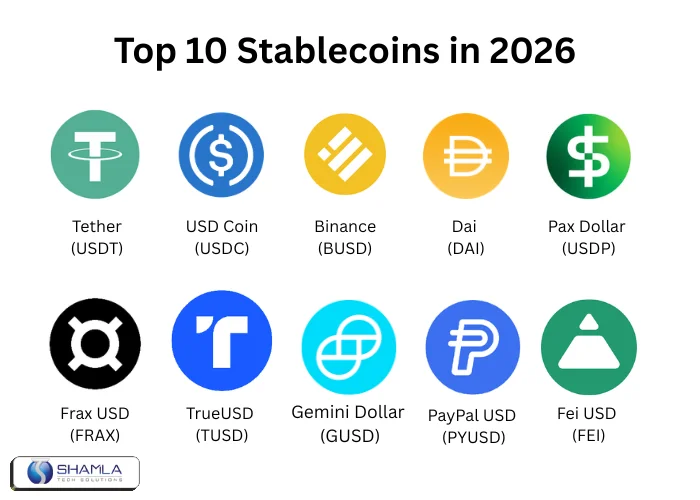
Top 10 Stablecoins in 2026
1. Tether (USDT):
The original and top stablecoins 2026 (market cap ≈ $189 billion). It’s purportedly backed by cash, equivalents and short-term loans (reserves held by Tether Ltd). USDT operates on multiple chains (Ethereum ERC-20, Tron TRC-20, Omni, BNB, Solana, etc.), making it widely available.
- Issuers: Tether Ltd (Hong Kong/Texas) – not a regulated bank.
- Use-cases: Dominates crypto exchange liquidity, cross-border remittances, and institutional cash management.
- Key point: USDT’s trustworthiness relies on Tether’s reserves transparency and ongoing audits.
2. USD Coin (USDC):

A highly regulated fiat-backed coin (MC ≈ $77 billion). Each USDC is 1:1 backed by USD deposits and cash equivalents held by regulated banks. USDC spans many chains (Ethereum, Algorand, Solana, Tron, BSC, etc.) and is managed by Centre Consortium (Circle and Coinbase).
- Issuers: Circle Internet Group (OCC-chartered), Coinbase (licensed).
- Use-cases: Tokenised payments, DeFi collateral, cross-border transfers. Because of its strict backing and audit policy, USDC has become the stablecoin of choice for payment-focused applications.
- Key Points: In 2026, its strong growth continues as regulators welcome its transparency.
3. Binance USD (BUSD):

Originally a fiat-backed top stablecoins 2026 by Paxos (New York–licensed trust) for Binance. At its peak BUSD was multi-billion, but after Paxos lost its NYDFS license in early 2023, new BUSD issuance was halted. Today (2026) BUSD’s market cap is very small (~$0.28 billion) as Binance works to retire remaining tokens. Collateral: US dollars in escrow. Chains: Ethereum, BNB (BEP-20).
- Issued by Paxos (now no new minting).
- Use-cases: Previously heavy on Binance trading and payments, BUSD now survives in limited capacity.
- Note: Regulatory changes have largely phased BUSD out, but some legacy supply remains in circulation.
4. Pax Dollar (USDP):

A full-reserve USD-backed stablecoins in 2026 issued by Paxos Trust Company (NYDFS-regulated). Collateral: 1:1 USD reserves.
- Chains: Ethereum (and Binance Chain).
- Market cap: small (~$0.04 B).
- Use-cases: Spot trading, institutional settlements and a compliance-focused alternative to other coins. Pax Dollar’s backing by Paxos (a trust chartered in NY) makes it one of the safest fiat-backed coins from a regulatory standpoint.
5. Dai (DAI):

A decentralized crypto-collateral stablecoin (MC ≈ $5.36 billion). It is not backed by USD but by a diversified pool of crypto assets (Ether, wrapped Bitcoin, USDC, etc.) held in MakerDAO’s vaults.
- Chains: Ethereum (with bridges to Arbitrum, Polygon, etc.).
- Use-cases: DeFi lending/borrowing (as collateral or loan), trading on decentralized exchanges, and any Ethereum-based payments.
6. Frax USD (FRAX):

A fractional-algorithmic top stablecoins 2026 (MC ≈ $0.27 billion). FRAX, one of the stablecoin investments 2026 is partially backed by collateral and partially by its own governance token (FRAX Shares).
- Chains: Ethereum, BNB, Avalanche, Arbitrum, etc. Governance: Frax Finance DAO (token holders).
- Use-cases: Offers a hybrid of stability (from collateral) and capital efficiency (because not 100% reserved).
- It’s used in DeFi protocols and liquidity pools as an alternative to fully-collateralized coins.
7. TrueUSD (TUSD):

A fiat-collateralized top stablecoins 2026 (MC ≈ $0.49 billion) by TrustToken.
- Chains: Ethereum, Tron, BNB, Polygon, Avalanche, others.
- Use-cases: Transparent top 10 stablecoins in 2026 for trading and payments; integrates with exchanges and payment apps. TUSD has strong reserve attestations, and its issuer has a regulatory license (money transmitter) in multiple US states, adding trust.
8. Gemini Dollar (GUSD):

- A 1:1 USD backed top stablecoins 2026 (MC ≈ $0.15 billion) issued by Gemini Trust (Winklevoss). Chains: Ethereum.
- Use-cases: Crypto trading on Gemini and other venues as a stable collateral in DeFi.
- GUSD’s on-chain transparency and full backing under NY regulation make it one of the most fully-compliant USD coins, though its adoption is smaller than USDT/USDC.
9. PayPal USD (PYUSD):

PayPal’s new and one of the top stablecoins 2026 (launched 2023) with Mc ≈ $3.9 billion. Collateral: 100% USD (cash and Treasuries) held by Paxos Trust (OCC-chartered). Chains: Ethereum and Solana.
- Use-cases: Consumer and merchant payments inside PayPal’s ecosystem, cross-border remittances, and earn/rewards programs.
- Its global rollout (to 70 countries as of early 2026) leverages PayPal’s network, making PYUSD one of the fastest‑growing fiat-backed coins.
- Because PYUSD is fully regulated and integrated into a major payments platform, it’s a high-credibility top stablecoins 2026.
10. Fei USD (FEI):

An algorithmic best stablecoins 2026 by Fei Protocol (MC ≈ $0.003 billion).
- Collateral: Over-collateralized by cryptocurrency (TRIBE token, ETH, and other assets). Chains: Ethereum.
- Use-cases: Primarily experimental DeFi use (auto-liquidity and yield). FEI maintains its peg via mint-and-burn incentives and bonding curves.
- Although small in market size, it represents an innovative algorithmic model (and was one of the first “no-fee AMM” experiments).
Click Here to Read – Top 10 Crypto Token Launch Companies in 2026
Comparative Overview of the Best Stablecoins
Stablecoin | Collateral Model | Chains | Market Cap (2026) |
USDT (Tether) | Fiat (USD & short-term loans) | ETH, Tron, Omni, BSC, Solana… | ~$189B |
USDC (Circle) | Fiat (USD deposits + Treasuries) | ETH, Algorand, Solana, BSC, etc. | ~$77B |
BUSD (Binance) | Fiat (USD, Paxos reserves) | ETH, BNB | ~$0.28B |
USDP (Pax) | Fiat (USD reserves) | ETH, BNB | ~$0.04B (small) |
DAI (Maker) | Crypto-collateral (multi-asset) | ETH & EVM chains | ~$5.36B |
FRAX | Fractional-algo (USDC+token) | ETH, BNB, Avalanche, etc. | ~$0.27B |
TUSD | Fiat (USD reserves) | ETH, Tron, BNB, etc. | ~$0.49B |
GUSD | Fiat (USD reserves) | ETH | ~$0.15B |
PYUSD (PayPal) | Fiat (USD + Treasuries) | ETH, Solana | ~$3.9B |
FEI | Crypto-collateral (TRIBE, etc.) | ETH | ~$0.003B |