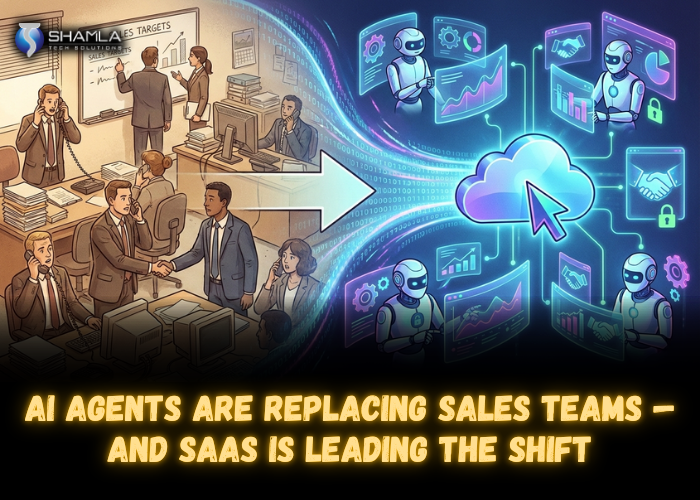

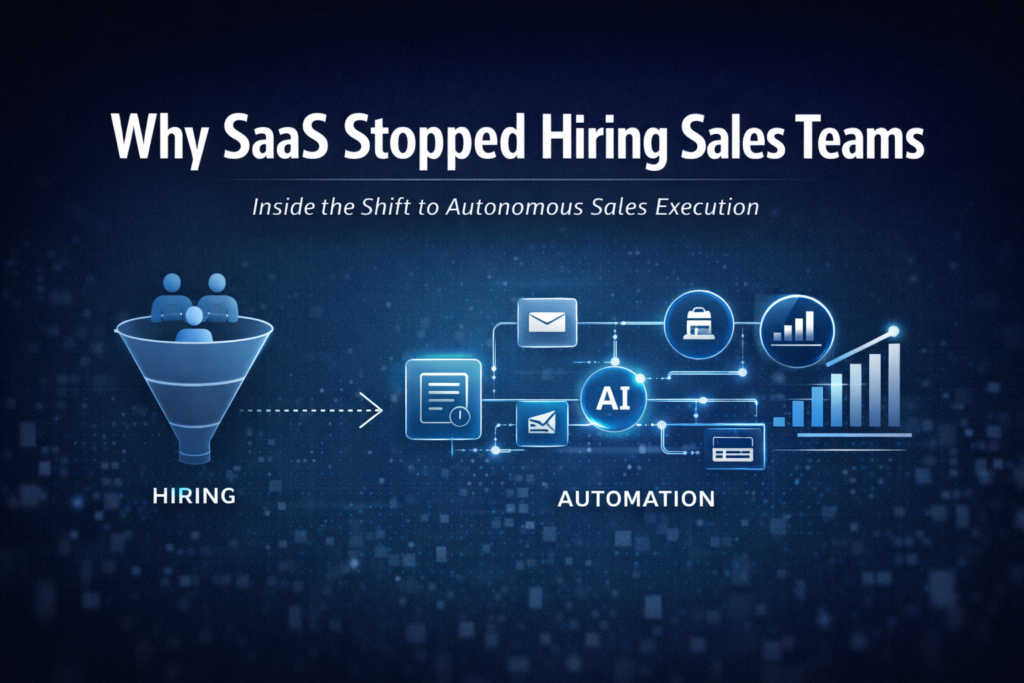
In 2026, a striking shift in enterprise go-to-market strategy made headlines: Jason Lemkin, founder of SaaStr and widely known as the “Godfather of SaaS,” announced that his business replaced most of its traditional sales team with autonomous AI agents and intends to stop hiring humans for these roles altogether. During this transition, SaaStr expanded from one AI agent to 20+ agents handling tasks previously done by 10 sales development personnel, sharply highlighting how AI is transforming revenue functions.
This move is unfolding alongside explosive market momentum. The global AI agents market is forecasted to expand from about USD 7.92 billion in 2025 to approximately USD 236.03 billion by 2034 at a CAGR of ~45.82% according to Precedence Research.
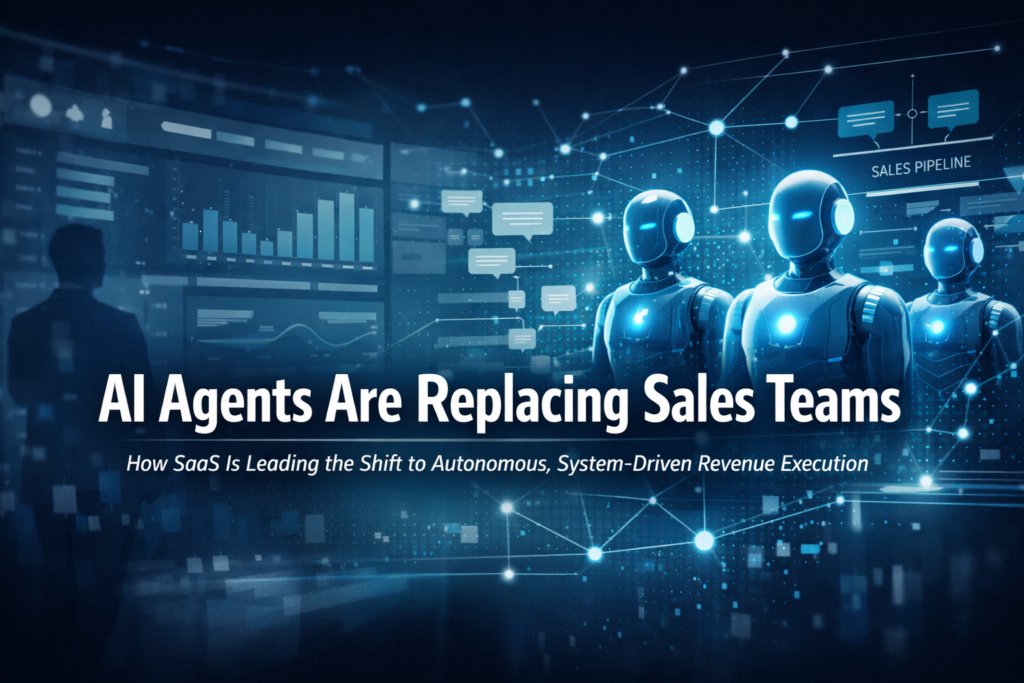
This blog explores why SaaS is leading this transition, how AI Agent Development is replacing traditional sales execution, and what this shift means for enterprise growth, efficiency, and competitive advantage.
Redesign Sales Execution with AI Agents
Why Has Sales Execution Become Structurally Unsustainable?
3.Execution Variability Introduces Revenue Risk
Highly paid sales professionals spend most of their time on non-differentiated work:
- Follow-ups
- Lead enrichment
- CRM updates
- Scheduling
- Status reporting
How AI Agent Development Solves the Sales Execution Problem
AI agents do not replace sales teams by “selling better.” They replace them by executing better.
AI Agent Development addresses the structural failures in sales by redesigning who performs the work, not by adding more tools to human workflows. Instead of relying on people to execute repetitive, time-sensitive tasks, enterprises deploy autonomous agents that own execution end-to-end, with humans retained for oversight and high-judgment decisions.
Here is how AI agents resolve the core problems.
AI agents scale digitally, not linearly. Once developed and trained, additional execution capacity does not require hiring, onboarding, or compensation cycles.
- No ramp time
- No attrition cost
- No commission overhead
- No performance variance tied to tenure
This decouples revenue growth from headcount expansion, allowing sales capacity to scale without proportional cost increases.
AI agents operate continuously. They respond instantly, follow up consistently, and engage buyers the moment intent is detected—regardless of time zone or workload.
- Immediate first-touch responses
- Automated follow-ups without drop-off
- Continuous engagement across the funnel
Speed becomes a system capability, not a staffing challenge.
AI agents execute predefined playbooks with zero deviation. Every lead receives the same quality of follow-up, qualification, and routing—based on data, not discretion.
- No “bad days”
- No skill variance
- No drift from best practices
This stabilizes pipeline execution and improves forecast reliability by removing human inconsistency from repeatable work.
AI agents assume ownership of non-differentiated execution tasks:
- Follow-ups
- Lead enrichment
- CRM updates
- Scheduling
- Status reporting
- Complex negotiations
- Strategic account planning
- Relationship management
- Enterprise deal structuring
This restores the economic logic of human involvement.
AI Agent Development is not automation. It is organizational re-architecture. AI agents are not inventing new sales logic. They are executing existing logic more efficiently and consistently.
(CTA – Modernize Sales Execution with AI Agents
Architect an enterprise-grade AI agent framework that eliminates execution latency, reduces CAC, and delivers consistent, system-driven pipeline performance.
Schedule a Strategy Call)
What the SaaStr Case Actually Reveals About AI Agent–Led Sales
What Enterprises Should Learn
Why This Matters Now for Enterprise Leaders
- Competitive advantage will favor organizations that engineer execution systems, not those that attempt to optimize human headcount within legacy models.
- AI Agent Development must be treated as revenue infrastructure, with defined ownership, performance metrics, governance controls, and accountability—no different from billing, payments, or data platforms.
- Growth capacity is shifting from hiring velocity to system scalability, fundamentally changing how revenue organizations plan, budget, and forecast.
Most critically, the risk of inaction is being misdiagnosed.
The real risk is not falling behind on AI sophistication or model selection. It is remaining anchored to a human-centric execution model whose economics no longer support scalable, predictable growth.
Enterprises that recognize this shift early will compound advantages in efficiency, margin, and execution reliability. Those that delay will not lose to better sellers—but to better-designed systems.
How Enterprises Should Build AI Agents That Actually Scale
AI agents must have clear responsibility boundaries.
Before development begins, decide:
- Which tasks are repetitive and rules-driven
- Which tasks require human judgment
- Where escalation is mandatory
For sales, agents typically own:
- Lead outreach and follow-ups
- Qualification and routing
- Scheduling
- CRM updates
Humans retain:
- Pricing authority
- Negotiation
- Relationship management
- Strategic exceptions
If ownership is unclear, the agent will fail.
AI agents execute existing business logic. They do not invent it.
This requires:
- Extracting workflows from top performers
- Standardizing qualification rules and SLAs
- Encoding routing and compliance logic
The quality of an AI agent depends entirely on the quality of the playbooks it runs.
Every enterprise-grade AI agent needs four layers:
- Reasoning Layer
- Determines next actions
- Must be constrained by rules
- Orchestration Layer
- Controls task flow
- Handles retries and edge cases
- Integration Layer
- Connects to CRM, email, calendars
- Executes actions via APIs
- Control Layer
- Permissions and access control
- Escalation and human override
- Full audit logs
Without this structure, agents remain unsafe and unreliable
Prompting alone is not enough.
Enterprise agents must learn from:
- Historical interactions
- Conversion outcomes
- Funnel performance data
This enables continuous improvement and prevents behavioral drift.
AI agents must be owned, measured, and audited.
This includes:
- Named business owners
- Clear KPIs (conversion, velocity, SLA adherence)
- Monitoring and alerting
- Compliance readiness
If no one owns the outcome, the agent does not scale.
- Compare agent performance to human benchmarks
- Expand scope only after consistency is proven
- Scale capacity digitally, not through hiring
AI agents should not assist humans.
They should own execution.
When built correctly, agents replace:
- Manual follow-ups
- Pipeline hygiene work
- Routine engagement
Humans move up the value chain—to strategy, judgment, and relationships.
Enterprises that design agents as reliable operators will scale faster, operate leaner, and compete on systems—not headcount.
Conclusion
This moment signals where enterprise go-to-market models are headed. Sales execution is shifting from a headcount-driven function to a system-driven capability. AI Agent Development allows organizations to decouple growth from hiring, eliminate execution variability, and refocus humans on judgment, strategy, and relationships. As agents mature into core revenue infrastructure, competitive advantage will favor enterprises that deliberately design execution systems, not those optimizing legacy sales models.
Enterprise-Grade AI Agent Development with Shamla Tech
Book Your Free Consultation.
Lorem ipsum dolor sit amet, consectetur adipiscing elit. Ut elit tellus, luctus nec ullamcorper mattis, pulvinar dapibus leo.
Lorem ipsum dolor sit amet, consectetur adipiscing elit. Ut elit tellus, luctus nec ullamcorper mattis, pulvinar dapibus leo.