
Enterprises around the globe are now reevaluating capital markets as RWA tokenization has started to influence how ownership and securities are being represented, traded, and settled. This serious shift is also challenging incumbents to rethink equity issuance and get new liquidity models while managing enterprise risk.
Market analysts project the global asset tokenization sector will exceed USD 3 trillion by 2026, growing rapidly as institutional adoption accelerates and regulatory clarity improves, reflecting heightened enterprise interest in programmable, compliant financial instruments.
This article explains key drivers behind equity and security tokenization, why traditional models are evolving, the essential technology stack enterprises need, and the legal and compliance considerations that decision-makers must understand.
Why Enterprises Are Turning to Equity and Security Tokenization in 2026
Enterprises are increasingly moving beyond pilot projects to full-scale tokenization initiatives as digital representation of equity and securities shifts from theoretical to commercially viable. Tokenization is now seen as a strategic lever for competitive differentiation and capital market modernization.
Here’s what’s driving the shift:
- Unlocking Institutional Liquidity and Efficiency: Tokenization enables faster settlement and around-the-clock trading, reducing friction in cross-border capital flows and improving operational efficiency compared with legacy systems.
- Strategic Asset Fractionalization: Enterprises can fractionalize traditionally illiquid assets, allowing diversified investor participation and creating new pools of capital beyond traditional institutional investors.
- Meet Evolving Regulatory Frameworks: As frameworks mature globally, tokenized securities are gaining legitimacy, transforming regulatory uncertainty into actionable compliance pathways for enterprise issuance.
- Competitive Pressure from Market Infrastructure Innovation: Major exchanges and financial institutions are developing tokenized trading platforms, signaling mainstream adoption and forcing enterprise reevaluation of legacy equity models.
- Market Adoption & Institutional Participation: 63% of financial custodians already offer tokenized asset services, indicating that tokenization has moved beyond experimentation and is becoming embedded within core financial market infrastructure.
Why Traditional Equity Models Are Being Replaced by Tokenized Securities
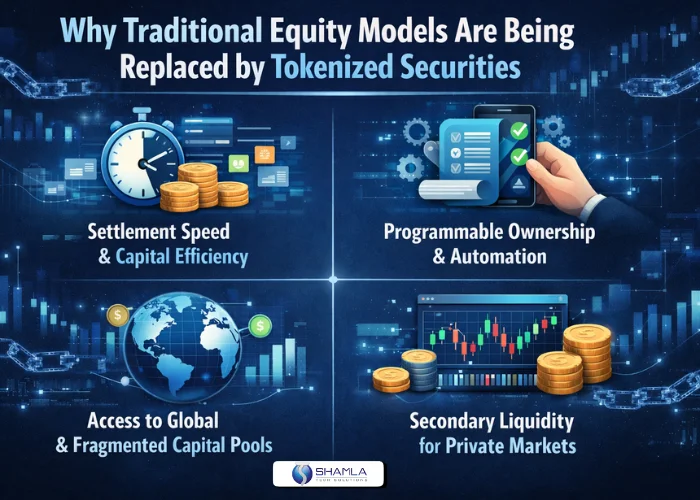
1. Settlement Speed and Capital Efficiency
2. Programmable Ownership and Automation
3. Access to Global and Fragmented Capital Pools
4. Secondary Liquidity for Private Markets
Architecture & Tech Stack Required for Enterprise-Grade Tokenization Platforms
Layer | Core Requirement | Why It Matters |
Blockchain Infrastructure | Scalable, secure, cost-predictable network | Supports high-volume issuance without performance or fee volatility risk |
Issuance & Lifecycle Engine | Structuring, dividends, voting, redemptions | Ensures tokens function as real securities, not simple digital assets |
Compliance & Identity Layer | KYC/AML, accreditation, transfer controls | Prevents non-compliant transactions at execution level |
Custody & Wallet Security | Institutional custody, multi-approval controls | Meets audit, governance, and fiduciary standards |
Integration & Liquidity Framework | ERP sync, reporting, secondary trading support | Aligns tokenization with enterprise systems and enables controlled liquidity |
1. Multi-Layer Blockchain and Infrastructure Strategy
2. End-to-End Issuance and Lifecycle Management Engine
3. Embedded Compliance, Identity, and Transfer Controls
4. Institutional Custody, Wallet Management, and Security Controls
5. Enterprise Integration, Reporting, and Liquidity Enablement
Legal and Compliance Framework Required for Security Tokenization
Securities Law Classification and Regulatory Positioning
Cross-Border Offering and Investor Eligibility Controls
Ongoing Disclosure, Reporting, and Governance Obligations
Custody, AML, and Market Integrity Safeguards
Final Thoughts
Equity and security tokenization introduces a new operating model for capital formation, where issuance, transfer restrictions, governance, and reporting are embedded directly into digital infrastructure. It demands clarity on regulatory positioning, technology architecture, custody standards, and cross-border considerations before any instrument reaches investors.
Understanding these fundamentals allows enterprises to evaluate tokenization aligned with existing legal structures and financial systems, which can enhance capital flexibility, improve transparency, and support broader investor participation without compromising regulatory integrity.
Partner with Shamla Tech to Launch Compliant Security Tokenization Platforms
Shamla Tech is an RWA tokenization platform development company specializing in enterprise-grade equity and security tokenization solutions. We design structured issuance frameworks, embed compliance directly into platform architecture, and integrate institutional custody and scalable blockchain infrastructure for regulated environments.
Our approach aligns legal structuring, technology deployment, and governance workflows from day one. We support enterprises across jurisdictions, ensuring platforms meet regulatory expectations while remaining flexible, secure, and capable of supporting long-term institutional participation.