
Home » Real world Asset » How Asset Managers Can Launch a MiCA-Ready Tokenized Fund Platform in 2026

How Asset Managers Can Launch a MiCA-Ready Tokenized Fund Platform in 2026

Share this article:
MiCA-Ready Tokenized Fund Platform
Table of Contents
About the Author
Balaji
CEO of Shamla Tech, specializes in crypto exchange development, RWA tokenization, blockchain infrastructure, AI solutions, and compliance-ready platforms. He helps enterprises address regulatory, security, and scalability challenges while driving real-world adoption of emerging technologies across industries.
Connect On:

Across Europe, asset managers are exploring new ways to structure and distribute investment funds. With MiCA establishing a unified regulatory framework, tokenized funds are moving closer to becoming a regulated and scalable financial infrastructure.

Industry projections highlight the scale of this shift. A report estimates tokenized assets could grow from roughly $22 billion today to more than $11 trillion by 2030, signaling rapid institutional adoption of blockchain-based financial markets.

This article explains how asset managers can launch a MiCA-ready tokenized fund platform in 2026, covering regulatory context, required infrastructure, compliance considerations, and the strategic steps needed to operate within Europe’s digital asset compliance framework.

Build Secure & Compliant Tokenized Fund Platforms for European Markets

Why the Tokenized Fund Market Will Shift Under MiCA in 2026

As Europe moves toward a unified regulatory environment for digital assets, asset managers are beginning to treat tokenized funds as regulated financial products. MiCA offers clearer operational standards for issuers, custodians, and service providers.

This shift is driven by several structural changes that MiCA brings to the digital asset ecosystem:

EU-Wide Regulatory Clarity: MiCA creates a single rulebook for crypto-asset issuers and service providers across all EU member states, allowing tokenized fund platforms to operate under harmonized regulatory standards throughout the European market.

Global Institutional Momentum Influencing Europe: Institutional tokenized funds are gaining traction globally, shaping how European asset managers approach MiCA-ready products. BlackRock’s USD Institutional Digital Liquidity Fund (BUIDL) surpassed $1 billion in assets under management, signaling strong institutional demand for blockchain-based fund structures.

Programmable Fund Infrastructure: Tokenized funds enable programmable settlement, automated compliance logic, and blockchain-based recordkeeping, creating new operational efficiencies for asset managers and fund administrators.

Institutional Market Participation: Global asset managers, banks, and financial infrastructure providers are actively developing tokenized products, including money-market funds, treasury instruments, and private credit strategies.

Stronger Investor Confidence: Clear disclosure requirements, custody rules, and operational standards under MiCA strengthen regulatory oversight and increase institutional confidence in tokenized investment platforms.

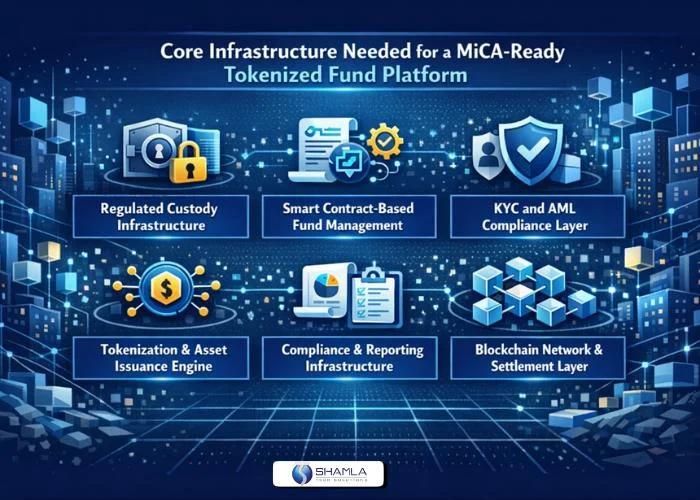
Core Infrastructure Needed for a MiCA-Ready Tokenized Fund Platform
1. Regulated Custody Infrastructure

A MiCA-ready platform must include regulated digital asset custody. Asset managers need licensed custodians that securely store private keys, manage wallets, and safeguard investor assets. This setup supports segregation of funds, strong security standards, and clear accountability, which are essential when managing tokenized fund units within Europe’s regulated financial environment.

2. Smart Contract-Based Fund Management

Tokenized funds rely on smart contracts to automate key fund operations. These contracts manage token issuance, redemptions, investor allocations, and transfer restrictions. For MiCA-ready platforms, contracts must be audited and aligned with the fund’s legal structure so that digital transactions follow the same rules applied to traditional investment funds.

3. KYC and AML Compliance Layer

A strong compliance layer is necessary for investor onboarding. Platforms must integrate KYC and AML systems that verify identities, screen sanctions lists, and monitor transactions. This ensures only approved investors can access the fund and helps asset managers maintain regulatory compliance while protecting the integrity of the investment platform.

4. Tokenization and Asset Issuance Engine

A strong compliance layer is necessary for investor onboarding. Platforms must integrate KYC and AML systems that verify identities, screen sanctions lists, and monitor transactions. This ensures only approved investors can access the fund and helps asset managers maintain regulatory compliance while protecting the integrity of the investment platform.

5. Compliance and Reporting Infrastructure

MiCA places strong emphasis on transparency and reporting. Tokenized fund platforms must maintain detailed records of investor holdings, fund transactions, and operational activity. Integrated reporting tools help asset managers generate regulatory disclosures, maintain audit trails, and provide regulators with clear oversight of the fund’s activities.

6. Blockchain Network and Settlement Layer

The blockchain network acts as the settlement and record-keeping layer for the tokenized fund. It records ownership, processes transactions, and maintains a transparent ledger of activity. Asset managers typically select networks that offer strong security, reliable performance, and infrastructure that supports institutional financial applications.
Build Your MiCA-Ready Tokenized Fund Platform With the Right Technology

Compliance and Regulatory Requirements Asset Managers Must Meet Under MiCA

Requirement

What It Involves

Why It Matters

RWA Token Classification

Classify tokenized fund units under MiCA or existing frameworks like UCITS/AIFMD.

Ensures the correct regulatory framework for issuance and distribution.

CASP Authorization

Obtain Crypto-Asset Service Provider licensing if offering custody or trading services.

Provides legal approval to operate across EU markets.

Legal Token–Asset Link

Establish legal ownership rights between tokens and underlying fund shares.

Protects investor rights and ensures enforceable ownership.

MiCA Whitepaper

Publish a compliant disclosure document detailing token structure and risks.

Provides transparency and required investor information.

Investor Controls

Implement KYC, AML screening, and transfer restrictions.

Ensures only eligible investors hold or trade tokens.

Custody Structure

Separate custody for underlying assets and blockchain tokens.

Protects investor assets and maintains accountability.

Smart Contract Governance

Audit and monitor smart contracts managing tokenized fund operations.

Reduces technical risks and strengthens platform security.

1. Regulatory Classification of Tokenized RWAs

Tokenized funds fall within the broader category of real-world asset (RWA) tokenization, where traditional financial instruments such as fund units or securities are represented as blockchain tokens. Under MiCA, asset managers must determine whether the token qualifies as a crypto-asset under MiCA or remains regulated primarily under existing financial frameworks like UCITS or AIFMD, since MiCA does not replace traditional fund regulation.

2. CASP Authorization and Platform Licensing

If the platform provides services such as custody, transfer, or trading of tokenized assets, the operator may need authorization as a Crypto-Asset Service Provider (CASP). This requires regulatory approval from an EU national authority, governance controls, risk management procedures, and operational policies. Once authorized, the firm can operate across the EU through passporting rights under the MiCA framework.

3. Legal Link Between Tokens and Underlying Assets

A critical requirement for tokenized funds is establishing a clear legal connection between the blockchain token and the underlying real-world asset. Investors must have legally enforceable rights to the fund shares represented by tokens. This usually requires structured legal documentation, fund registers, and custody arrangements ensuring that on-chain tokens correspond directly to off-chain asset ownership.

4. Disclosure Through Crypto-Asset Whitepapers

MiCA requires issuers to publish a crypto-asset whitepaper before offering tokens to investors. For tokenized funds, this document must explain the underlying assets, investor rights, redemption mechanisms, technology infrastructure, and operational risks. The whitepaper becomes a formal disclosure document and must be submitted to regulators and made publicly available to investors.

5. Investor Eligibility, Transfer Controls, and Compliance Monitoring

Tokenized funds must incorporate compliance restrictions at both the legal and technical levels. This includes KYC and AML verification, investor eligibility checks, and transfer controls embedded within smart contracts. These mechanisms ensure that tokens can only be held or transferred by approved investors, allowing asset managers to maintain regulatory compliance while operating a blockchain-based fund structure.

6. Custody of Underlying Assets vs Token Custody

In tokenized funds, two custody layers must be clearly defined: custody of the underlying real-world assets and custody of the digital tokens representing those assets. Asset managers must ensure regulated custodians hold the underlying assets while digital asset custodians manage token wallets. Clear separation of responsibilities helps maintain investor protection and ensures regulatory compliance within the MiCA framework.

7. Secondary Market Trading Restrictions

MiCA allows trading of crypto-assets on regulated platforms, but tokenized fund units may still be subject to securities law and fund regulations. Asset managers must design transfer rules that restrict trading to compliant venues or approved investors. Smart contract controls and platform-level compliance systems are often used to enforce these restrictions while maintaining regulatory oversight.

8. Operational Risk and Smart Contract Governance

Tokenized funds introduce technological risks that regulators increasingly examine. Asset managers must implement smart contract audits, upgrade governance processes and incident response procedures. Regulators expect platforms to document how smart contracts are deployed, monitored, and updated, ensuring that automated fund operations remain secure, transparent, and aligned with the fund’s legal framework.

Steps Asset Managers Should Take to Launch a MiCA-Ready Tokenized Fund Platform

1. Define the Regulatory and Fund Structure

The first step is determining how the tokenized fund will be structured legally. Asset managers must evaluate whether the fund operates under frameworks such as UCITS or AIFMD, while ensuring the tokenized representation aligns with MiCA requirements. This stage also defines investor rights, redemption rules, and how blockchain-based tokens correspond to the official fund register.

2. Choose the Right EU Jurisdiction for Authorization

MiCA provides a unified regulatory framework across the EU, but authorization is granted by national regulators. Asset managers must choose the member state where they apply for approval. Jurisdictions such as Luxembourg, France, and Germany have established financial infrastructures and regulatory experience in digital assets, making them common choices for launching regulated tokenized fund platforms.

3. Design the Tokenization and Blockchain Architecture

Asset managers must determine how fund units will be represented on blockchain infrastructure. This includes selecting a blockchain network, defining token standards, and implementing mechanisms that control transfers and investor eligibility. The architecture must also maintain accurate synchronization between on-chain token ownership and the official off-chain fund records.

4. Partner With Specialized RWA Tokenization and Compliance Providers

Launching a tokenized fund platform requires collaboration with experienced infrastructure providers. These partners typically provide tokenization technology, smart contract frameworks, compliance integrations, and digital asset custody solutions. Working with specialized RWA tokenization providers like Shamla Tech allows asset managers to accelerate development while ensuring the platform aligns with regulatory expectations and institutional operational standards.

5. Prepare Regulatory Disclosures and Operational Infrastructure

Before launching the platform, asset managers must complete required documentation such as the MiCA crypto-asset whitepaper, investor disclosures, and operational policies. Internal systems for compliance monitoring, reporting, and investor onboarding must also be established to ensure the platform can operate smoothly within the European regulatory environment.

Final Thoughts

Europe’s regulatory clarity is opening new opportunities for asset managers to rethink how funds are issued, managed, and distributed. With MiCA establishing clear rules, tokenized fund platforms can move from experimental initiatives to credible financial infrastructure.

For asset managers willing to prepare early, the opportunity extends beyond compliance. Building the right infrastructure, partnerships, and regulatory alignment today can position firms to lead the next phase of institutional tokenization across Europe’s digital asset ecosystem.

Build and Launch MiCA-Ready Tokenized Fund Platforms with Shamla Tech

As a leading RWA tokenization platform development company, Shamla Tech helps asset managers build secure tokenized fund platforms designed for the European market. We combine blockchain expertise, compliance-focused architecture, and scalable infrastructure to support the launch of MiCA-ready investment platforms.

We work closely with asset managers to design tokenization systems, implement smart contract frameworks, and integrate compliance layers aligned with EU regulatory requirements. Our RWA tokenization solutions help firms launch regulated tokenized fund platforms and distribute digital investment products across European markets with confidence.
Launch a Compliant Tokenized Fund Platform for European Union

FAQs

1. What is a MiCA-ready tokenized fund platform?

A MiCA-ready tokenized fund platform enables asset managers to issue and manage fund units as blockchain tokens while complying with the European Union’s Markets in Crypto-Assets regulation and related financial frameworks governing digital assets and investor protection.

2. Does MiCA apply to tokenized real-world assets (RWAs)?

MiCA regulates many crypto-asset activities in the EU, but tokenized real-world assets such as fund shares may also fall under existing financial regulations like UCITS or AIFMD, depending on the structure of the underlying investment product.

3. Why are asset managers exploring tokenized funds in Europe?

Tokenized funds can improve operational efficiency, enable fractional ownership, and streamline settlement processes. With MiCA providing regulatory clarity across EU member states, asset managers are exploring blockchain infrastructure for fund issuance and distribution. \

4. What infrastructure is required to launch a tokenized fund platform?

Launching a tokenized fund platform typically requires blockchain infrastructure, smart contract systems, digital asset custody, investor onboarding with KYC and AML compliance, and integration with traditional fund administration and reporting systems. \

5. How can asset managers ensure compliance when launching tokenized funds?

Asset managers must establish the correct regulatory structure, prepare MiCA-compliant disclosures, implement investor verification systems, maintain secure custody arrangements, and ensure the tokenized representation of fund units aligns with the legal fund framework.

Talk to Our Experts

Recent Posts