
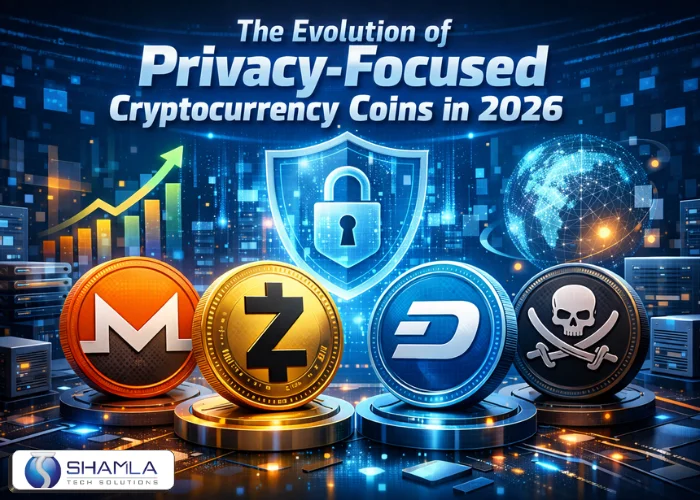

On-chain privacy had a huge year in 2025. One of the biggest success stories of the year was Zcash, one of the first privacy-focused cryptocurrency coin. The prices were also increased. Ethereum and Solana both said they were going to do big things to make their networks more private. And startups that make privacy-protecting software using zero-knowledge (ZK) proofs and fully homomorphic encryption (FHE) keep becoming more popular.
Mert Mumtaz, CEO of the Solana infrastructure company Helius, said it was “Privacy Szn.” And a lot of other people argued that anonymity was important for institutional adoption because firms don’t usually want to do business on public blockchains with ledgers that are completely open.
So, what’s ahead for 2026? We asked five leading folks from the privacy space to make predictions.
From Absolute Anonymity to Practical Privacy
The first generation of privacy coins, led by projects like Monero (XMR) and Zcash (ZEC), focused almost exclusively on strong anonymity guarantees. Techniques such as ring signatures, stealth addresses, zk-SNARKs, and confidential transactions were designed to make transactions fully opaque by default.
While these innovations were groundbreaking, they came with trade-offs:
- Limited exchange support
- Regulatory resistance
- Performance and scalability challenges
- Difficulty integrating with institutional workflows
By 2026, the privacy coin sector has largely moved past the “all-or-nothing” model. The focus is no longer on extreme anonymity at any cost, but on contextual and selective privacy—where users control what is private, when, and for whom.
This shift reflects a deeper understanding: privacy does not need to oppose identity or compliance to be effective.
Why privacy is becoming central to crypto’s future
People are starting to see privacy as a strategic advantage for blockchain networks themselves, not just for individual users. A16z crypto, the venture financing arm of Andreessen Horowitz, recently tweeted on X that “privacy will be the most important moat in crypto” as we approach into 2026.
Ali Yahya, a general partner at Andreessen Horowitz, has said that privacy impacts the way blockchains compete in a big way. Users can easily move assets and interact between chains on public blockchains with no trouble. Blockchains that emphasize on privacy, on the other hand, make network lock-in greater.
Yahya stated, “When users are on private blockchains, the chain they choose matters a lot more because they are less likely to move and risk being exposed once they join one.” “And since privacy is important for most real-world uses, a few privacy chains could own most of crypto.”
This dynamic indicates that privacy may lead to a “winner-take-most” scenario, wherein a limited number of predominant privacy-centric networks acquire an excessive fraction of users and engagement.
Top 5 Privacy Coins That Surged in 2025
Token | Privacy Type | Default Privacy | Tech Used | Smart Contracts | Regulatory Risk | Best For |
Monero (XMR) | Transaction-level | ✅ Yes | RingCT, Stealth Addresses | ❌ No | 🔴 High | Maximum anonymity |
Zcash (ZEC) | Transaction-level | ❌ Optional | zk-SNARKs | ❌ No | 🟠 Medium | Flexible privacy |
Secret (SCRT) | Data & contracts | ✅ Yes | Encrypted SGX contracts | ✅ Yes | 🟠 Medium | Private DeFi & apps |
Oasis (ROSE) | Data privacy | ❌ Optional | Confidential computing | ✅ Yes | 🟡 Low–Medium | AI & data privacy |
Horizen (ZEN) | Transaction + infra | ❌ Optional | zk-SNARKs | ⚠️ Limited | 🟡 Medium | Modular privacy |
Inside the Privacy Coin Boom: What You Need to Know in 2026
Bitcoin and Ethereum are examples of public blockchains that have changed the way money works around the world by being transparent and honest. However, that same openness is now a big problem. No financial privacy is possible because every wallet and transaction may be tracked. This kind of visibility is good for regulators, but it’s a deal-breaker for businesses that deal with sensitive transfers or proprietary transactions that need to be kept private.
Recent information backs up this change in privacy.
- In early 2025, 11.4% of all cryptocurrency transactions will contain privacy coins. This is up from 9.7% in 2024.
- There are currently more than $250 billion worth of global privacy-based transactions, which shows that this development is based on real user need, not speculation.
- Monero handles more than half of all private crypto transactions, even though it has been removed from Binance, Coinbase, and Kraken. This shows that privacy adoption pushed by users is unstoppable.
- In a world where knowledge is power, being open without privacy means being exposed. Studies now demonstrate that blockchain’s inability to change goes against the GDPR’s right to erase and correct, which could lead to fines of up to €20 million or 4% of global sales. This is not simply a legal problem for businesses; it’s also a security hole that needs to be fixed with technology.
This is where crypto work that focuses on privacy architecture is changing the game. Privacy coins let you verify without showing who you are by using Zero-Knowledge Proofs, Ring Signatures, and Stealth Addresses. “Monero has the biggest market share at 58%, and Zcash is second with 21%. Both show that private transactions can grow in a compliant way.” Asia-Pacific now accounts for 29% of all privacy coin use, while Africa’s use is expanding by 37% per year because more people want to send money without revealing their identity.
Even while rules are getting stricter, privacy technology is growing quickly. In 2024, regulatory crackdowns went up 34%, but adoption went up even more. FINMA’s “Privacy Coin Sandbox in Switzerland” and the fact that 24% of new privacy wallets currently belong to businesses illustrate that privacy is becoming more of a compliance feature than a fault. The data is clear: global markets want privacy, and current crypto development tools are making it easy to get it safely and lawfully.
Privacy is not optional, it’s foundation. Build the Privacy based cryptocurrency coin today with Shamlatech.
Who Needs Privacy Coin Development the Most?
Fintech Startups and Digital Payment Platforms
Large Enterprises and Corporations
Central Banks and Governments
Institutional Investors and Family Offices
DeFi Platforms and Web3 Protocols
Cross-Border Remittance Providers
Why Hiring a Privacy Coin Development Company Is a Strategic Move in 2026
- Expertise: You can talk to experts in blockchain security, privacy protocols, and cryptography.
- Compliance: Make sure your systems follow the rules set by GDPR, FATF, and AML.
- Speed: Use tried-and-true privacy coin frameworks to get started faster.
- Customization: Make solutions that work for fintech, DeFi, or businesses.
- Security: Make sure the infrastructure is scalable, safe, and fast.
- Integration: Work well with current systems and wallets.
- Efficiency: Cut down on downtime and long-term maintenance expenditures.
- Advantage: Build trust, get investors, and stay ahead in digital finance.
When you choose a competent team, you can be confident that your blockchain journey will be accurate, safe, and full of new ideas. When you work with coin development professionals, you can make privacy solutions that can grow and fulfill worldwide requirements.
Ready to Build Your Privacy Coin?
Businesses all across the world are starting to see that privacy is not only a feature, but a competitive edge. Making your own privacy currency can help you build trust with users, make sure you follow the rules, and make safe financial systems. With privacy coin integration, your company can handle private transactions with openness, responsibility, and control.
Working with experts in privacy crypto development gives you access to frameworks that make privacy infrastructure appropriate for compliance. Shamlatech is a top cryptocurrency development company that helps businesses build and use blockchain systems that protect privacy and change how people trust each other online. Your privacy coin idea can become a business-level success story with Shamlatech.