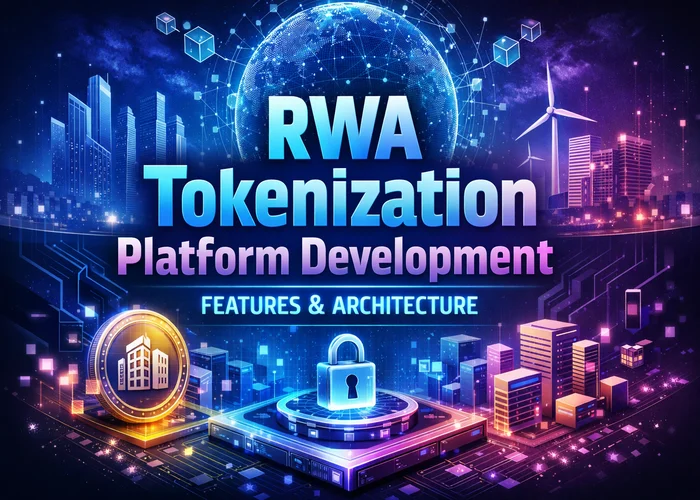

The financial industry is going through a structural change that is changing how ownership, liquidity, and access to actual assets work. As the blockchain infrastructure gets better and the rules get clearer in big economies, real-world assets are no longer limited to old markets and systems. Tokenization involves making them programmable, divisible, and available all around the world.
People will no longer see the development of RWA tokenization platform development as an experimental new idea by 2026. Instead, they will see it as a basic part of modern financial infrastructure. startups, institutions, asset managers, and fintech startups are transitioning from proof-of-concept systems to systems that can be used in production. This change needs a clear plan that takes into account technology, compliance, security, and business logic.
This blog gives you a step-by-step plan on how to build a real-world asset tokenization platform in a way that is practical and focused on execution. It talks about the design, development processes, operational issues, and strategic choices that need to be made to create platforms that are strong, compliant, and suitable for use by institutions.
RWA Tokenization Platform Development Steps
Define Requirements
The most important thing to do first while making a RWA tokenization platform development is to gather needs. Companies need to think about what they need and what their users demand, as well as look into their competitors in the tokenization industry. It also means setting rules for the platform that it must follow. Because rules are different in each country, you need to make a RWA platform that meets the safety regulations of the country you want to reach.
Think about your target audience very carefully. Will your platform be useful for retail investors, businesses, or people in specialty markets? Knowing your users is important since it will affect how the platform looks, what it can do, and how it works. This information lets you customize the technical parts and user experience to better meet the needs of your target clients. In the end, this makes the platform more attractive and useful in the market.
Create a Project Plan
The next stage is to make a project plan, which is a list of the goals and objectives you set for your RWA tokenization platform development project. Clearly state the project’s goals, objectives, and success metrics as a first step. Find important people from different departments, such business development, tech, and RWA Legal Consulting Services. List the precise things that need to be done, such as building the platform’s architecture, writing smart contracts, and designing the user interface. Make a list of chores that can be done, give each person a job, and set reasonable due dates. Set milestones to keep track of your progress and celebrate your successes.
A good project plan is like a map that helps everyone on the team work together and use resources wisely. It makes sure that all parts of the RWA platform development are taken care of. This makes it clear what everyone’s tasks are, when things need to be done, and what is expected of them. This helps lower risks and keep the project on pace.
Select a Technology Stack
The next important stage in making a RWA tokenization platform is to choose the correct technological stack, which builds on the project concept. This level is all about the blockchain infrastructure. Your team needs to carefully look at a number of things, such as scalability, consensus process, and high transaction throughput, to choose the right blockchain architecture.
Also, check to see if the blockchain platform works with common smart contract languages. This is important for making sophisticated Real World Asset Blockchain Platform logic work. The chosen infrastructure should also be able to integrate with regulatory RWA Platform Security & Compliance frameworks to make sure that legal requirements are met in different places.
Smart Contract Development
The next important step in building your RWA tokenization platform development is to make smart contracts. These self-executing digital contracts are the heart of the platform. They automate important tasks like issuing, transferring, and managing assets. By cutting out middlemen, smart contracts make things run more smoothly and cost less.
To make smart contracts that work, you should concentrate on writing code that is well-documented and follows recognized token standards. Use strong Security Token Development for RWA procedures, such as comprehensive audits and formal verification. Include access control measures and make sure you follow all the rules set by the government. Make sure the contracts can accommodate fractional ownership, which is a big benefit of tokenization for assets that aren’t usually liquid.
Testing and Deployment
Before you launch your RWA Tokenization Architecture platform, you need to test it properly. This means looking at everything, such as smart contracts, APIs, and user interfaces. You may write, explore, and test your platform in IDEs, which are integrated development environments. Use automated testing methods to check how well the platform works, how fast it is, and how safe it is in diverse situations.
After testing, roll out the platform in stages on the mainnet. Get feedback and find any problems before the launch by starting with a small sample of people. Once the platform is up and running, keep a careful eye on it and act promptly. At the same time, fix any issues to make sure everything works well for users.
Business Models Enabled by RWA Tokenization Platforms
Tokenization platforms enable multiple revenue models beyond asset issuance.
Common monetization methods include:
- Platform usage and onboarding fees
- Asset management and administration fees
- Transaction and settlement fees
- Compliance and reporting services
A forward looking RWA tokenization platform development company designs its platform to support diverse revenue streams without compromising user experience.
Cost Breakdown: How Much Does It Cost to Build a Tokenized RWA Platform?
One of the most popular questions that founders and businesses ask is, “What does it really cost to build a tokenized RWA platform?” The truth is that it depends on how big the project is, how strict the rules are, and how institutional the platform is designed to be. A simple MVP may seem cheap, but building a production-ready RWA platform features requires a lot of money to be spent on security, governance, interoperability, and following the rules. Here is a realistic analysis of the costs and timeframes for the main parts needed to develop a scalable tokenized RWA platform in 2026.
Feature | Description | Development Duration | Estimated Cost (USD) |
RWA Token Standards & Smart Contracts | Design and development of asset-backed tokens, minting, burning, transfer rules, and compliance logic | 4–8 weeks | $25,000 – $60,000 |
Asset Onboarding & Tokenization Engine | Workflow for asset verification, valuation inputs, metadata management, and token issuance | 6–10 weeks | $40,000 – $90,000 |
Compliance & KYC/AML Layer | Identity verification, investor eligibility checks, jurisdiction rules, and audit trails | 5–9 weeks | $35,000 – $80,000 |
Legal & Ownership Mapping Logic | Smart contract alignment with legal agreements, ownership rights, and enforceability models | 4–7 weeks | $30,000 – $70,000 |
Wallet Integration & Custody Support | User wallets, institutional custody integrations, signing flows, and access control | 4–6 weeks | $20,000 – $50,000 |
Cross-Chain Interoperability | Asset mobility, cross-chain messaging, and state synchronization across Blockchain-based Asset Tokenization | 6–12 weeks | $50,000 – $120,000 |
DeFi & Liquidity Integrations | Integration with lending, trading, staking, or yield protocols | 4–8 weeks | $25,000 – $65,000 |
Admin Dashboard & Platform Controls | Issuer dashboards, asset management tools, monitoring, and reporting systems | 5–8 weeks | $30,000 – $70,000 |
Governance & Permission Framework | Role-based access, voting mechanisms, upgrade approvals, and issuer controls | 4–6 weeks | $20,000 – $45,000 |
Security Audits & Testing | Smart contract audits, penetration testing, and performance validation | 3–6 weeks | $25,000 – $75,000 |
Infrastructure & Deployment Setup | Cloud infrastructure, node setup, monitoring, backups, and DevOps pipelines | 3–5 weeks | $15,000 – $40,000 |
Why Choose Shamlatech For Your RWA Platform Development?
- End-to-End Expertise: Complete RWA tokenization platform development solutions, from ideation and architecture to deployment and post-launch support.
- Regulatory-Aware Development: Platforms designed with compliance, KYC/AML integration, and jurisdictional adaptability in mind.
- Secure Smart Contracts: Robust, audited RWA smart contract development ensuring asset integrity and investor protection.
- Multi-Chain Support: Ethereum, Polygon, BNB Chain, and other scalable blockchain integrations.
- Asset Tokenization Framework: Real Estate Tokenization Development, commodities, equity, and alternative Asset Tokenization Development Company capabilities.
- Scalable Infrastructure: High-performance architecture built for institutional-grade adoption.
- Customizable UI/UX: Intuitive dashboards for issuers, investors, and administrators.
- Ongoing Technical Support: Dedicated maintenance, upgrades, and security monitoring.
Conclusion
The goal of developing the RWA tokenization platform in 2026 is to create long-lasting solutions that connect traditional finance with decentralized infrastructure. Thoughtful architecture, following the rules, strict security, and user trust are all important for success.
It’s no longer an issue of if Real World Asset Tokenization is possible, but how well it can be done. Companies who have a clear plan on how to build platforms will shape the future generation of financial markets.
If you want to be able to compete in a tokenized global market, you need to work with the proper RWA Tokenization Company and put your money into strong real world asset tokenization platform services. This is true whether you are a business, a fintech innovation, or an asset manager.
The future belongs to platforms that treat actual assets with the same care, openness, and trustworthiness as traditional financial systems, but that also find ways to be more efficient than older systems could ever be.