
There are thousands of different projects in the bitcoin industry, and each one has its own set of features and technologies. Most cryptocurrency protocols have their own digital currencies. For example, there are metaverse tokens for digital experiences and meme coins that help online communities grow.
The crypto business is always coming up with new ways to generate money, but it can be hard to figure out how to use blockchain technology in different ways. Many cryptocurrencies and types of crypto coins do more than just act like regular money; they also offer a wide range of decentralized services.
Knowing about the kinds of digital currencies will help you make smarter choices when you use Web3. As you look through these groups, think about how they fit with your interests and ambitions.
Let’s have a look at the types of crypto coins that are accessible in this booming market.
Explore the Right Crypto Category for Your Goals
Popular Types of Cryptocurrency Coins in the Market
1. Payment Cryptocurrencies
Payment cryptocurrencies let people store and move value on a decentralized network without having to go via banks or governments. These types of crypto coins want to make transactions faster, cheaper, and safer than regular ways.
These crypto coins vs tokens make it possible for people all around the world to send, record, and protect financial transactions.
Litecoin (LTC) is a type of crypto coin that may be used to make payments. Charlie Lee, the founder, designed the protocol to be a cheaper and speedier alternative to Bitcoin’s BTC unit.
Store of Value
Store of value (SoV) cryptocurrencies are digital currencies that are meant to keep their value over time, unlike fiat currencies.
They have a number of benefits over traditional assets like land or gold and silver:
- Easy to get to and move: Crypto coin development companies are easy to move, which is great for people who own them.
- Less expensive to store: Storing cryptocurrency usually costs less than keeping tangible goods.
- Limited supply: Because types of crypto coins like Bitcoin have a finite supply, they are more appealing as stores of value. It’s easy to check Bitcoin’s supply because there can only be 21 million coins.
- Bitcoin (BTC) is a well-known example of an SoV coin. It is a peer-to-peer electronic cash system that lets people make direct internet payments without going through banks.
A lot of people like this cryptocurrency because there aren’t many coins available and the schedule for issuing new coins is easy to understand.
Memecoins
Memecoins are digital payment tokens that are mostly based on popular culture and viral internet trends. Dogecoin (DOGE) and Pepe (PEPE) are two well-known examples that have millions of fans, including famous people.
People often make memecoins as lighthearted social experiments. They don’t have as many uses as other cryptocurrencies, and people like them because they are a fun change from the serious nature of standard crypto.
Memecoins are mostly used for speculation, but they are also used to give tips to online creators and build cryptocurrency coin communities on social media.
Stablecoins
Stablecoins are meant to be worth the same as real money and other things, like gold.
They are popular for cross-border transfers and traders who want to park their money in digital assets that don’t change too much in value. This is because they combine the efficiency and portability of blockchain-based cryptocurrencies with price stability measures.
There are three main types of stablecoins:
Stablecoins backed by fiat: These coins try to keep their value equal to that of the currency they are based on, which means that issuers must keep the same amount of cash or cash equivalents in reserve. Some examples are:
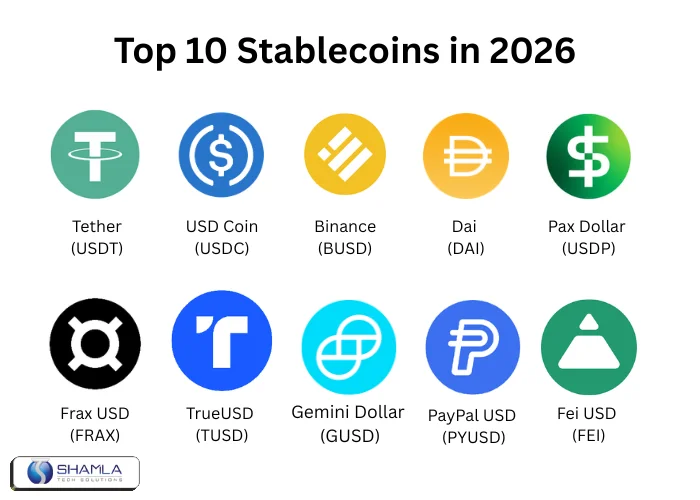
- Tether (USDT) is the biggest stablecoin and is linked to the US dollar.
- Another stablecoin, USD Coin (USDC), aims to have a 1:1 peg with the U.S. dollar.
- Tether Euro (EURT) is a stablecoin that follows the price of the Euro.
- Stablecoins backed by other different types of crypto coins held in smart contracts are called
Crypto-collateralized stablecoins: They usually need more collateral than they have. Users put in more cryptocurrency types than the stablecoins they get are worth. Some examples are:
- DAI from MakerDAO is backed by types of crypto coins and is worth three times as much as the DAI that is currently in circulation.
- LUSD from Liquity: Only ETH backs it.
Algorithmic stablecoins: Use smart contracts to change the supply according to market demand to keep the value peg without collateral. Price stability hasn’t always been dependable.
It’s crucial to know that stablecoins are risky, and that includes risks related to the issuer and how they work. Institutions that might go bankrupt could hold the collateral for these tokens, and algorithmic stablecoins could fail because of bugs or other problems.
Privacy coins
Privacy coins make transactions more private by hiding information about the sender, receiver, and amount spent. They utilize unique tools to protect transactions, which makes it difficult to monitor them and allows anonymous transactions on privacy-focused cryptocurrency coins.
All privacy coins have their own ways of doing things, but they all want to give you more privacy than regular types of crypto coins.
Some well-known instances are:
- Monero (XMR): Uses a type of encryption called ring signatures to keep users anonymous.
- Zcash (ZEC) is a Bitcoin fork that focuses on privacy. It uses the Zerocash protocol and a “shielded” ledger to keep users completely anonymous.
2. Cryptocurrencies for infrastructure
Infrastructure cryptocurrencies are tokens that make the technology that supports other cryptocurrencies better. They are mostly connected to blockchain networks that support smart contracts, which let developers make agreements that carry out themselves for various uses.
Most of these projects focus on creating a foundational layer for application development or improving blockchain performance through the implementation of Layer 2 scaling solutions.
Application development
Smart contracts on the Ethereum blockchain made it possible for the first time for anyone to make decentralized apps (dApps).
Smart contracts now run almost all Web3 apps on a number of major blockchains, and they can be customized and work with each other.
This trend is shown by the growth of decentralized finance (DeFi) and use cases like decentralized physical infrastructure networks (DePIN).
Some well-known types of crypto coins that are used for app development:
- Ether (ETH) is a decentralized platform for apps, games, and financial services.
- Solana (SOL) is a blockchain that is made to be scalable, which means it can handle more transactions at once.
- Avalanche (AVAX) is a fast Layer 1 blockchain for dApps and bespoke networks.
Scaling
At first, apps on Ethereum and other blockchains used the main network to perform transactions and store data. This method is safe, but it doesn’t let many transactions through at once, which means expensive gas fees and slowdowns during busy times.
As more people use blockchain, scaling is necessary to improve transaction throughput and minimize costs.
There are many different solutions that have been made, such as
- Optimistic Rollup: Groups transactions together and processes them off-chain to let Layer 1 platforms like Ethereum work better, presuming that all transactions are genuine unless someone questions them.
- Zk-Rollup: Uses zero-knowledge proofs to swiftly check transactions, which adds an extra layer of security and trust.
- Data Availability Service: Reduces stress on blockchains to keep things from slowing down.
Communication
As Web3 grows, it becomes more vital to have strong communication systems. This means connecting blockchains to real-world data and making it easier for Layer 1 and Layer 2 networks to talk to each other.
Oracles link data from the real world to the blockchain, which makes decentralized apps (dApps) better and Web3 bigger.
They give you important information, such social media feeds and financial statistics, and they show you the current values of cryptocurrencies on both centralized exchanges like Kraken and decentralized exchanges like dYdX and Uniswap.
Some examples of blockchain oracles are:
- Chainlink (LINK) connects blockchains to data sources outside of them.
- Pyth (PYTH) gives financial dApps on several networks real-time market data.
- As Web3 grows quickly, the number of blockchains grows as well. Developers are now making their own blockchains, termed “appchains,” to improve performance.
This complexity makes it necessary for networks to communicate well with each other. Cross-chain messaging and bridges let assets and data move easily from one blockchain to another.
Here are some examples of cross-chain infrastructure tokens:
- Axelar (AXL): Links dApps on different blockchains.
- Celer (CELR) works on making DeFi, GameFi, NFTs, and other things work across chains.
- LayerZero (ZRO) helps developers make dApps that work on all chains.
Let’s Build The Next Wave Cryptocurrency Coin
3. Financial cryptocurrencies
Financial cryptocurrencies give you instruments to handle and trade assets in the crypto world. They are often linked to DeFi protocols and offer similar services to traditional banking, but in a way that is easier to see and use.
Cryptocurrencies that are linked to controlled or decentralized exchanges are called financial types of crypto coins. They usually have cheaper trading fees and may act as governance tokens, giving holders the right to vote on how the platform works.
Financial markets
Crypto financial markets combine smart contracts and blockchain technology with traditional financial services. This makes decentralized exchanges, lending platforms, and cross-chain transfers possible.
With decentralized exchanges (DEXs), anybody can trade cryptocurrencies directly without using standard order books. Instead, they use liquidity pools to make asset swaps go more smoothly. Uniswap (UNI) and Curve (CRV) are two well-known platforms that compensate users for supplying liquidity. This makes for a decentralized trading environment powered by the community.
Users can lend their crypto for rewards or borrow against their holdings without any middlemen in decentralized money exchanges. Anyone with internet access can use these services as long as they match the collateral requirements. Aave (AAVE) and Compound (COMP) are two examples of this type of system. They decide how much to compensate users based on supply and demand.
Bridges are significant because they connect multiple blockchains and let assets and data move across them without any problems. For instance, a bridge can burn USDC on Ethereum and make a new USDC on Arbitrum, making it easier to travel across networks. Some important bridges are Stargate Finance (STG) and Synapse (SYN).
Asset management
Traditional asset managers put money into investments for institutions or people with a lot of money. DeFi makes investment methods available to everyone by letting them use smart contracts to improve their holdings.
DeFi systems make it easier to use different services, which helps traders make better selections when they use more than one platform.
Some common categories:
- DEX aggregators: Look at a lot of DEXs to find the best transaction execution.
- Yield aggregators: Move assets across lending protocols automatically to get the most money.
4. Service cryptocurrencies
Service cryptocurrencies are technologies that let you use and share data on blockchain networks. They use the security tokens and openness of distributed ledgers to improve conventional fields like healthcare and energy.
Some service cryptocurrencies let people build digital identities and connect real-world records to the blockchain. Others let people track and exchange their energy production using peer-to-peer networks.
Decentralized physical infrastructure (DePIN)
DePIN is changing the way that infrastructure services like Wi-Fi and cell phone data are provided. DePIN networks employ blockchain technology to encourage people to create cryptocurrency coin governance models and take care of their own infrastructure instead of depending on big companies.
People can buy special gadgets that gather and store data, give them coverage, and give them bitcoin rewards. Smart contracts make things run more smoothly, thus there is no need for centralized control.
File storage
We keep a lot of our information online as data, and decentralized file storage solutions use blockchain technology to keep it safe and protect it from problems with centralized servers.
Filecoin (FIL) and Storj (STORJ) are two platforms that let people store files on decentralized networks. This makes the files safer and more open. Users can also give up unneeded storage space and get native tokens (FIL, STORJ, etc.) to help the network grow.
Digital resource markets
Computing Power
Decentralized networks let people all around the world use CPUs and GPUs to construct Web3 apps, make AI crypto coins models, or host decentralized services.
Notable examples include:
- Akash (AKT) is an open-source cloud computing marketplace that speeds up the deployment of apps in fields like blockchain and machine learning.
- Render (RENDER) is a network that connects those who require GPU power with operators that have extra GPU capacity to rent.
- Energy Web (EWT) is a company that works to make renewable energy distribution more efficient by connecting businesses and keeping an eye on how resources are distributed. This makes the market more efficient.
Data
There are a number of projects that focus on aggregating and sharing data from both on-chain and off-chain sources.
- The Graph (GRT) makes it easy to find and see data from different blockchains by indexing it.
- Ocean Protocol (OCEAN): Lets users list and make money from different sets of data while keeping ownership and privacy.
5. Media and entertainment cryptocurrencies
Cryptocurrencies for media and entertainment want to compensate people for making and using content, games, gambling, and social media. One example is Basic Attention Token (BAT), which helps make sure that inventors and consumers get a fair share of the value.
These cryptocurrencies also support the “metaverse,” which is a digital environment that can be accessed using virtual and augmented reality technologies.
Also, non-fungible tokens (NFTs) are in this group. They let people show that they own unique digital goods, including in-game characters and digital art.
NFTs, or non-fungible tokens
Digital art was the main reason NFTs became popular, with collections like Bored Ape Yacht Club (BAYC) and Cryptopunks hitting the news. But they go beyond art; they also prove ownership on the blockchain for things like concert tickets, Rolex certifications, memberships, and virtual property.
NFTs show that you own a piece of media, not the media itself. Some collections, like BAYC, come with their own crypto tokens. For example, Apecoin (APE) lets holders have a say in the project’s destiny, which is another way that cryptocurrencies can be used besides for payments and storing value.
The Metaverse
The metaverse is a digital arena that everyone may use to interact and have virtual experiences that are similar to those in the real world. The MANA token from Decentraland and the SAND token from The Sandbox are both utility tokens. People who own them can buy land, interact with user-generated content, and help run the platform.
Some new trends are investing in virtual real estate, digital fashion, and social experiences that mix gaming, art, and business. The metaverse also looks at new ways to make content and decentralized social networks.