
Cryptocurrency wallet development is emerging as a gateway to Web3 services, decentralized applications, tokenized assets, NFT platforms, exchanges, and crypto payment systems. To safely buy, purchase, and manage digital assets, you need a crypto wallet. However, to create a crypto wallet, several steps need to be taken care of before you start trading. This includes creating an account, safely storing private keys, implementing security features, and many more. Here, the right Cryptocurrency Wallet development service provider comes into the picture.
Whether you want to create your own crypto wallet for your customers or launch a complete Web3 product, the right development strategy matters. This guide provides detailed instructions to create a crypto wallet with steps and features.
Create a custom crypto wallet
What is Crypto Wallet Development?
Crypto wallet development is the process of designing and building a secure software application that allows users to manage digital assets such as Bitcoin, Ethereum, stablecoins, utility tokens, governance tokens, and NFTs.
A crypto wallet does not physically store cryptocurrency. Instead, it stores or manages private keys, public keys, seed phrases, and transaction signing functions. These keys allow users to access assets recorded on a blockchain. In simple terms, the blockchain holds the transaction record, while the wallet gives users control over their assets.
For Cryptocurrency wallet development, the focus should be on security, usability, scalability, compliance, and blockchain integration. It must connect with multiple networks, display balances, create addresses, sign transactions, scan QR codes, integrate fiat gateways, and interact with decentralized applications.
9 Steps to Create Your Own Crypto Wallet Development
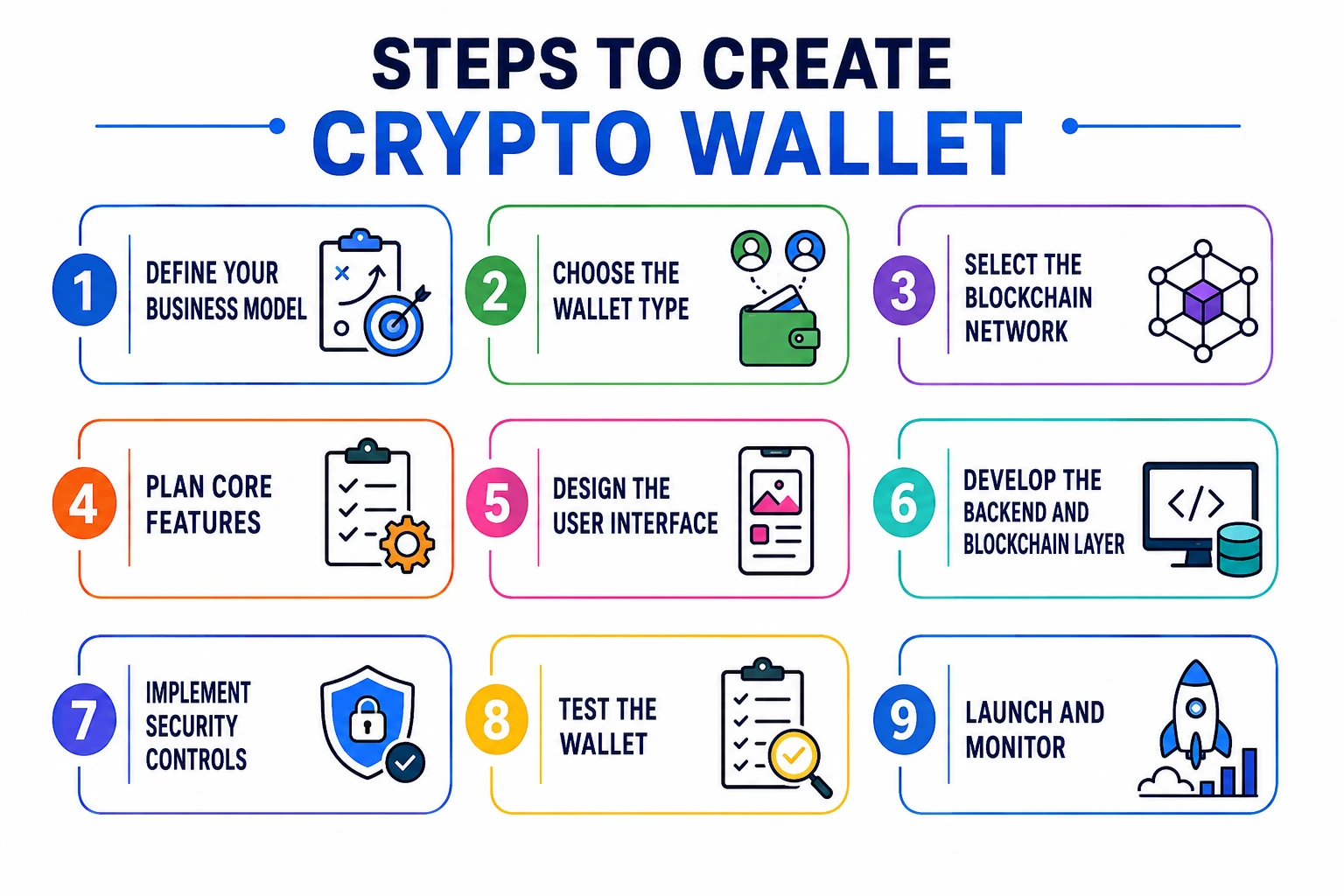
A successful wallet project requires structured planning, secure engineering, and continuous testing. Here are the main steps.
Step 1: Define Your Business Model
Start with a clear goal. Decide whether the wallet will serve retail users, traders, merchants, DeFi users, enterprises, or token communities. Your business model may include transaction fees, premium features, exchange integration, payment gateway services, staking, or white-label licensing.
Step 2: Choose the Wallet Type
Select custodial, non-custodial, mobile, web, desktop, multi-chain, or smart contract wallet architecture based on your target users. A trading platform may need a custodial wallet, while a DeFi application may need a non-custodial wallet.
Step 3: Select the Blockchain Network
Choose the blockchain according to transaction speed, gas fees, security, ecosystem, token standards, and scalability. Ethereum, Polygon, BNB Chain, Solana, Avalanche, Tron, and Bitcoin are common options for wallet development.
Step 4: Plan Core Features
Create a feature list that includes account creation, key management, transaction history, balance display, token support, QR code payments, push alerts, swap integration, and security settings.
Step 5: Design the User Interface
A crypto wallet must be simple. Users should understand how to create accounts, back up seed phrases, send funds, receive assets, and confirm transactions without confusion. Good UX reduces transaction errors and improves trust.
Step 6: Develop the Backend and Blockchain Layer
The backend manages APIs, user sessions, notifications, analytics, admin controls, and third-party integrations. The blockchain layer handles node connection, address generation, token standards, transaction creation, gas estimation, and network monitoring.
Step 7: Implement Security Controls
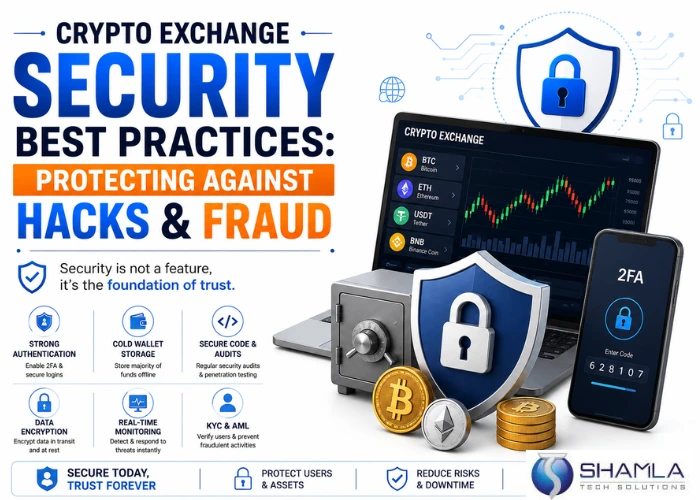
Security is the foundation of Cryptocurrency Wallet development. Use encryption, secure key storage, biometric authentication, two-factor authentication, anti-phishing tools, withdrawal limits, device management, and audit logs.
Step 8: Test the Wallet
Testing should cover functionality, security, performance, usability, compatibility, smart contracts, API behavior, transaction flow, and recovery process. Security audits and penetration testing are essential before launch.
Step 9: Launch and Monitor
After deployment, monitor transactions, server health, user behavior, network fees, failed transfers, and suspicious activity. Regular updates help maintain performance and protect users from emerging threats.
What Is the Difference Between Custodial and Non-Custodial Wallets?
| Custodial Wallet | Non-Custodial Wallet |
| In a custodial wallet, a third party controls or manages the private keys on behalf of users. Crypto exchanges often use this model because it offers easier recovery, faster onboarding, and platform-level transaction control. | In a non-custodial wallet, users control their private keys and seed phrases. The wallet provider cannot access or move user funds. This model supports decentralization, privacy, and user ownership. |
| A custodial wallet is suitable for exchanges, fintech platforms, payment providers, and businesses that need compliance workflows. However, it also creates responsibility for security, asset protection, user trust, and legal obligations. | A non-custodial wallet is ideal for DeFi platforms, Web3 applications, NFT ecosystems, and users who want full asset control. However, users must protect their recovery phrase because losing it may result in permanent asset loss. |
Which One Should You Choose?
For managed platforms, regulated services, and exchange-based products, choose custodial wallets. And, for decentralized services, user-owned assets, and Web3 ecosystems, go for non-custodial wallets. If you want to balance convenience and control, go for the hybrid models.
Set up your crypto wallet
What Is the Best Blockchain for Wallet Development?
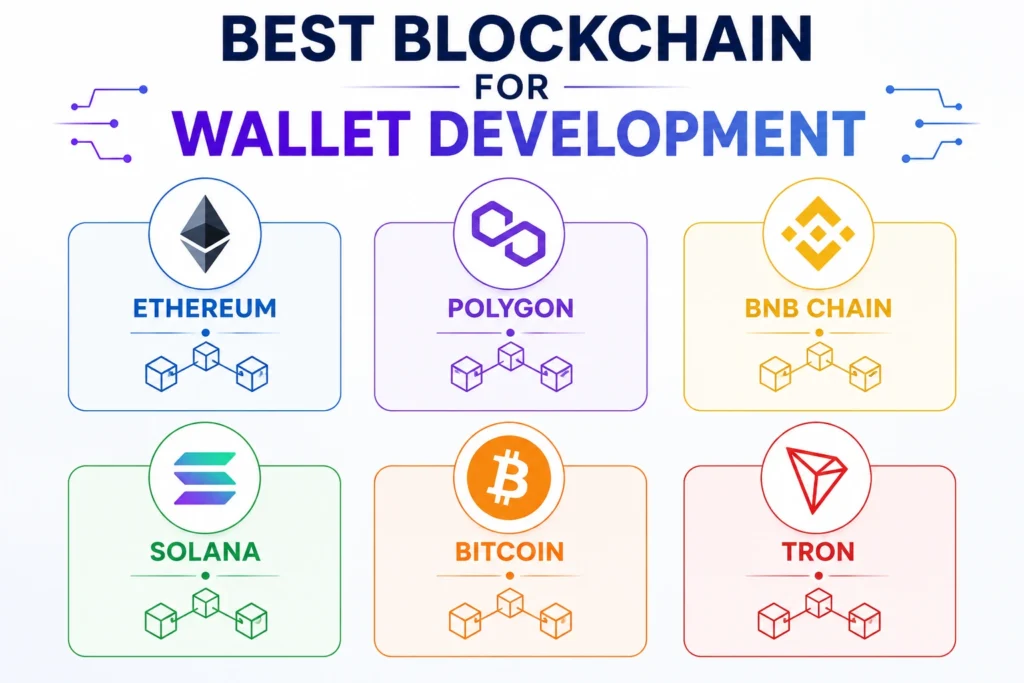
There is no single best blockchain for every wallet. The right option depends on your project goal, target market, asset type, and transaction volume.
Ethereum
Ethereum is a strong option for DeFi, NFTs, token launches, and smart contract wallets. It has a large developer ecosystem and supports ERC-20, ERC-721, ERC-1155, and ERC-4337-based wallet models.
Polygon
Polygon is useful for businesses that want Ethereum compatibility with lower transaction costs. It is suitable for payments, games, NFT platforms, and consumer applications.
BNB Chain
BNB Chain supports fast transactions and a large token ecosystem. It is often used for trading apps, DeFi products, and multi-currency wallets.
Solana
Solana offers high throughput and low transaction fees. It is suitable for applications that require fast settlement, gaming, and large-scale payment activity.
Bitcoin
Bitcoin is best for wallets focused on BTC storage, transfers, and long-term digital asset holding. It is not ideal for complex smart contract use cases compared with Ethereum-based networks.
Tron
Tron is widely used for stablecoin transfers, especially USDT transactions. It can be suitable for payment wallets and remittance-focused platforms.
For most businesses, a multi-chain wallet is the best long-term strategy. It allows users to manage assets across several networks in one application.
Essential Features Required to Build Your Own Crypto Wallet
A competitive wallet must include both user-facing and admin-level features.
| User Features | Security Features | Admin Features |
|---|---|---|
| Easy registration and wallet creation | End-to-end encryption | User management |
| Secure login with PIN, password, biometrics, or two-factor authentication | Secure private key storage | Transaction monitoring |
| Public and private key management | Multi-signature approval | Asset listing controls |
| Seed phrase backup and recovery | Anti-phishing protection | Fee management |
| Multi-currency and multi-chain asset support | Device authorization | KYC and AML integration (if required) |
| Send, receive, and request crypto | Session timeout | Analytics dashboard |
| QR code scanner and address book | Withdrawal limits | Support ticket management |
| Real-time balance updates | Suspicious activity alerts | Risk alerts |
| Transaction history with status tracking | Smart contract audit | Compliance reports |
| Token swap integration | Regular security updates | — |
| NFT display and management | — | — |
| Push notifications | — | — |
| Gas fee estimation | — | — |
| Fiat on-ramp and off-ramp support | — | — |
| dApp browser or WalletConnect integration | — | — |
| Multi-language and multi-currency display | — | — |
These features improve trust, retention, and conversion. They also help your wallet compete in a market where users expect speed, safety, and simple navigation.
Don't Miss the Complete Blueprint
What Are the Technology Stacks Used in Creating Crypto Wallets?
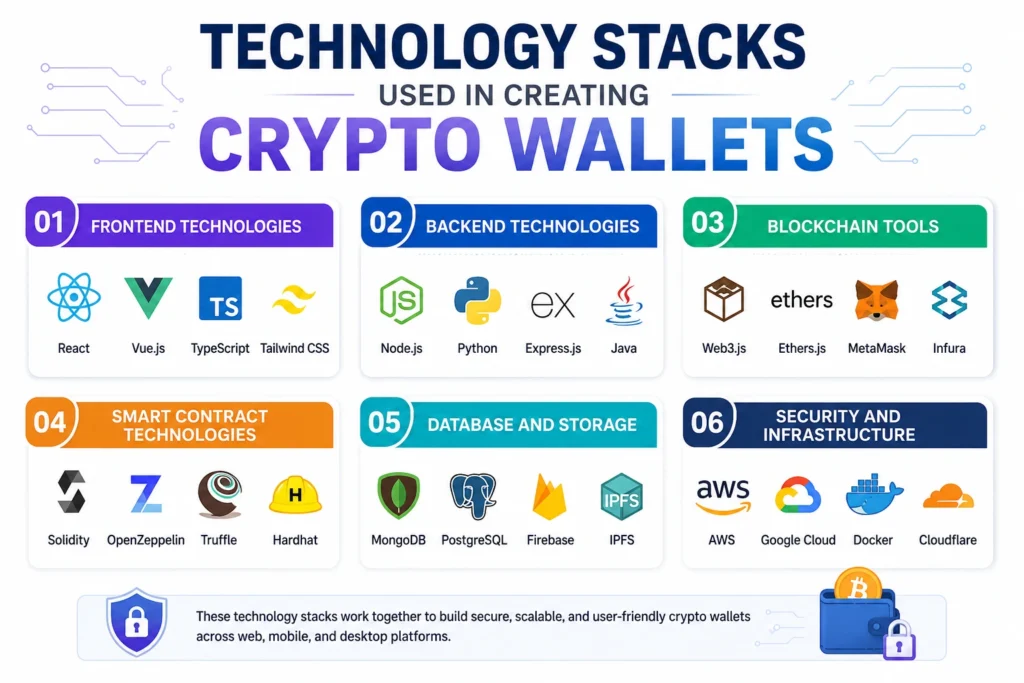
The technology stack depends on wallet type, supported chains, security model, and scalability needs. A professional Cryptocurrency Wallet development team usually combines frontend, backend, blockchain, database, cloud, and security technologies.
Frontend Technologies
For mobile wallets, developers commonly use Swift for iOS, Kotlin for Android, React Native, or Flutter. For web wallets, React.js, Next.js, Angular, and Vue.js are common choices.
Backend Technologies
Node.js, Python, Java, Go, and Rust are used for backend development. The backend handles API services, authentication, transaction indexing, notifications, admin panels, and integrations.
Blockchain Tools
Wallet development may use Web3.js, Ethers.js, Bitcoin Core, Solana Web3.js, TronWeb, BNB Chain SDKs, Polygon APIs, and blockchain node providers.
Smart Contract Technologies
Solidity, Vyper, Rust, Move, Hardhat, Foundry, Remix, and Truffle are used for smart contract development and testing. These tools support DeFi wallets, smart contract wallets, token logic, and advanced transaction controls.
Database and Storage
PostgreSQL, MongoDB, Redis, Firebase, and cloud storage services can support user data, transaction metadata, analytics, and app performance.
Security and Infrastructure
AWS, Google Cloud, Microsoft Azure, Docker, Kubernetes, HSM, MPC, SSL, encryption libraries, monitoring tools, and CI/CD pipelines support secure deployment.
A strong technology stack helps businesses create a scalable wallet that can handle more users, more networks, and more transaction volume.
What is the Cost to Set Up Crypto Wallet Development?
The cost to create a crypto wallet depends on features, platforms, security model, design complexity, blockchain networks, integrations, and compliance requirements.
A basic wallet with simple send, receive, balance, and transaction history features may cost less than a multi-chain enterprise wallet. A wallet with token swaps, fiat gateway, KYC, admin dashboard, dApp browser, NFT support, smart contract wallet functions, and high-level security will require a larger budget.
Typical cost factors include:
- UI and UX design
- Mobile or web platform selection
- Number of supported blockchains
- Custodial or non-custodial architecture
- Key management method
- Smart contract development
- Third-party API integration
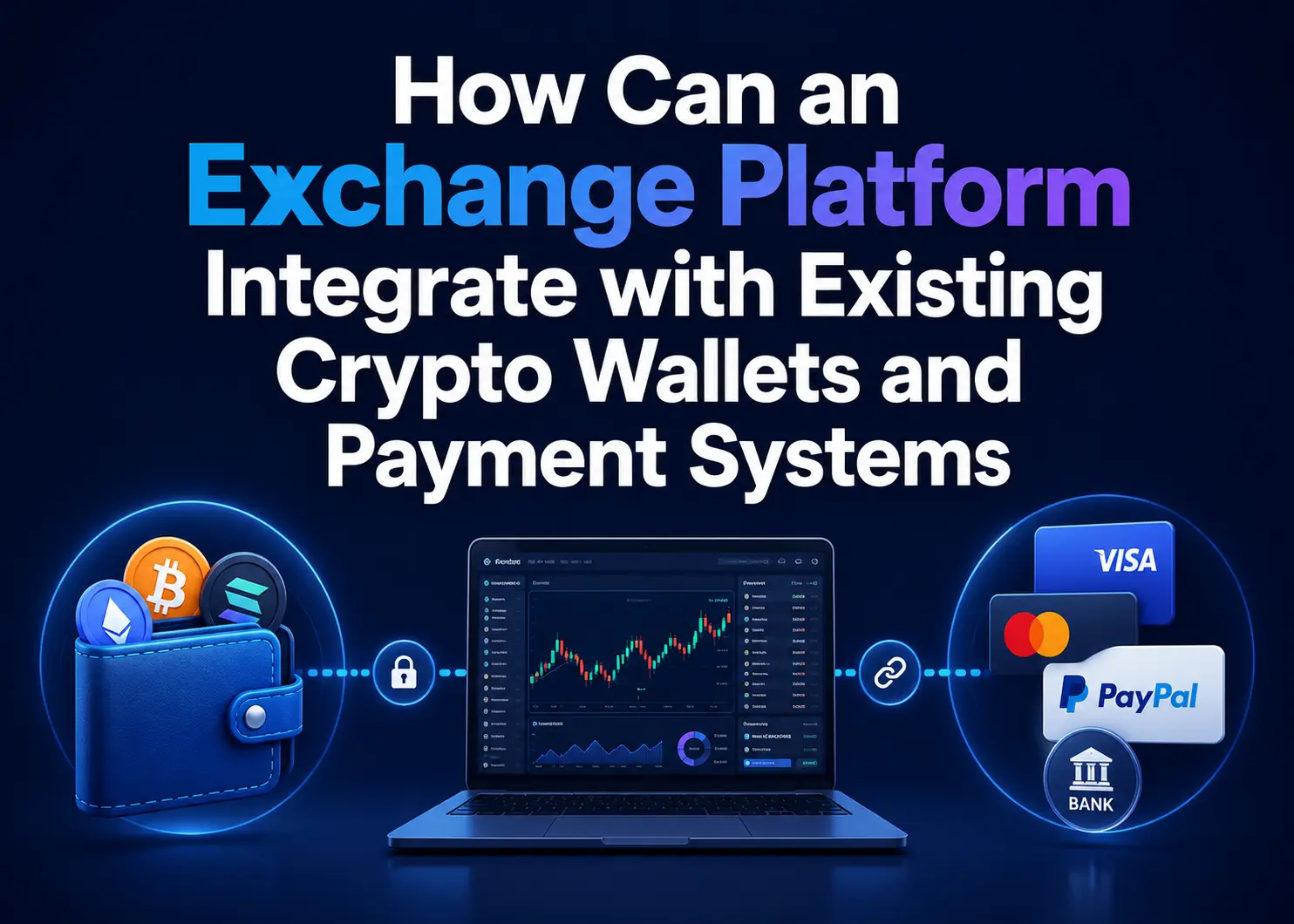
- Exchange and payment gateway integration
- Security audit and penetration testing
- Admin panel development
- Maintenance and upgrades
As a broad estimate, a simple wallet MVP may start from a moderate development budget, while an advanced enterprise-grade wallet may require a much higher investment. The best approach is to define your feature scope first and then request a custom cost estimate from an experienced blockchain development company.
A low-cost wallet without proper security can create serious business risks. For this reason, businesses should focus on secure architecture, tested code, and long-term scalability instead of only choosing the lowest quote.
Takeaway
Crypto wallet development is a powerful opportunity for businesses entering the digital asset economy. A well-planned wallet can support payments, trading, DeFi, NFTs, token ecosystems, and enterprise blockchain use cases. To succeed, you need the right wallet type, blockchain network, feature set, technology stack, security model, and development partner.
If your goal is to create a crypto wallet that is secure, scalable, and ready for real users, Shamlatech can help you move from concept to launch with confidence.
Start your crypto wallet development journey with Shamlatech and build a future-ready blockchain product for the growing digital economy.
Why Choose Shamlatech for Creating Your Own Crypto Wallet Development?
Shamlatech helps startups, enterprises, and digital businesses build secure, scalable, and user-friendly crypto wallet solutions. With practical experience in Cryptocurrency development, our experts deliver end-to-end blockchain solutions based on business goals.
We provide you with complete support at every stage of development. From idea validation, development, testing, deployment, and maintenance, our crypto wallet development team is there to answer all your queries. We provide technical knowledge, blockchain expertise, and product-focused execution to help you launch a wallet that users can trust.
Whether you want to Create your own crypto wallet for a payment platform or an enterprise asset system, Shamlatech can build a solution that fits your market.