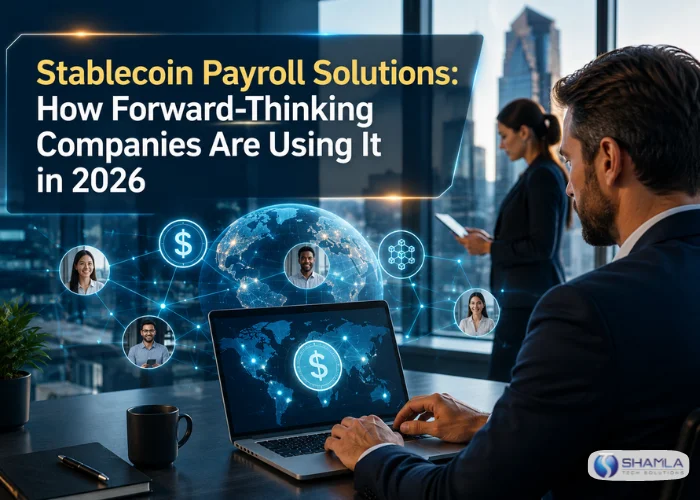

Crypto payroll has moved from niche experiment to mainstream business infrastructure. Stablecoins completed $9 trillion in on-chain transfers in 2025, almost 50% of Visa’s yearly throughput. Deel had $22 billion in global payroll. According to EY’s latest CFO survey, 87% of finance leaders now regard stablecoins as a competitive advantage, up from 61% just a year ago.
Benefits of stablecoin and crypto payroll for remote teams are that the stablecoin payroll provides advantages including fast international payments, decreased transaction costs, currency stability for global employees, and simpler compliance for multi-country teams.
Looking for a faster, more efficient way to pay your global workforce? Discover how a secure stablecoin payroll solution can reduce costs, automate international salary payments, and simplify cross-border payroll operations.
What Is Stablecoin Payroll?
Stablecoin payroll is when you pay employees or contractors with a digital asset that is anchored to the value of a fiat currency, most often the US dollar. Stablecoin payroll is run using blockchain infrastructure, rather than typical global payroll with stablecoin systems that run on correspondent banking networks and clearinghouses. Meaning monies can be sent directly from an employer wallet to an employee wallet without going via several financial middlemen.
The mechanism starts with employer funding. A corporation sends fiat currency to a treasury or exchange partner to mint or buy the corresponding quantity of stablecoins. Once the corporate digital wallet is funded, the payroll software or smart contract calculates the distribution amounts based on the employee contracts. At the end of the pay month a transaction is sent to the blockchain network. The network confirms the transaction and the stablecoins are placed straight in the individual employee’s wallets.
“Beyond that, employees can decide how to spend their digital compensation. They can either keep the digital assets in a self-custodial wallet or transfer them to a centralized exchange to convert the assets back to the local fiat currency. They can also use the digital assets directly for payments in the decentralized payroll infrastructure ecosystem. Organizations can also use smart contracts to automate the entire distribution process. Programmable payouts also mean that salaries can be paid out at specified intervals, rather than in a manual procedure that is common to standard human resources and accounting workflows.
Why Traditional Payroll Is Broken for Global Teams?
Organizations have often tried to address these visibility and compliance gaps as discrete geographical challenges. They recruited a local provider in Japan, engaged a regional bureau for Latin America, and constructed custom software bridges to connect those elements back to a central Human Resources Information System (HRIS).
Each of these decisions, taken separately, appeared sensible. But this patchwork imposes a heavy long-term debt burden—financial and architectural.
A central HRIS combined with ten different local payroll solutions means ten different software integrations. When the local government changes a tax rule or the central HRIS changes its platform, those delicate pipelines burst. And with most local providers still using asynchronous, antiquated file transfers, global data is forever behind. Calculation delays and retroactive errors arise when a centrally made mid-month wage modification takes weeks to be reflected in a local provider’s system. The procedures that have been put in place to manage expansion are a strain on the architecture.
Why Stablecoin Payroll Adoption Is Accelerating in 2026?
If demand pulled, regulation removed friction. The July 18, 2025 GENIUS Act—the Guiding and Establishing National Innovation for U.S. Stablecoins Act—has been the biggest catalyst. The law defines who can issue payment stablecoins and under what conditions. Framed around establishing national innovation and strengthening American leadership in digital financial technology, the stablecoins act gives financial institutions the legal certainty they had been waiting for before committing capital and balance sheets to the space.
Institutions value accurate regulation. Allowable payment stablecoins are not securities. Issuers must back their digital currency one-to-one with high-quality liquid assets like cash and short-term U.S. Treasuries and publish transparency reports on them. The OCC, FDIC, NCUA, Treasury, FinCEN, and OFAC spent 2026 developing implementing rules, with the statutory deadline in July 2026 and the whole framework entering effect in early 2027. National oversight innovation turns stablecoins from a legal gray zone into a designated asset class with clear regulatory obligations for financial services executives.
Regulation clarity goes beyond legal risk reduction. Institutional risk appetite grows. Capital flows when regulations are defined, and 90% of financial institutions report market action, whether planning, piloting, or live deployment.
Why Institutions Are Adopting Stablecoins Now
In areas where financial systems work poorly, stablecoins make the most sense. Traditional payment rails were designed for domestic, business-hours payments and can manage high-volume domestic payments but suffer with cross-border transfers across time zones, territories, and currencies. This causes exorbitant costs, multi-day delays, and stranded working cash. Stablecoins offer quick settlement, real-time payments that never close, and lower costs that accumulate over thousands of transactions.
Consider a treasury team handling 8,000 monthly cross-border invoices from 12 countries. The average wire cost is 5%, thus annual transaction fees are approximately $500,000. Routing the same flows across stablecoin rails at under 1% can lower that figure by an order of magnitude, improving operational efficiency and competitiveness. Internal transfers between subsidiaries, worldwide liquidity management, and paying international contractors without stable currency bank accounts follow the same reasoning.
Traditional payment processors and networks noticed. Visa has implemented stablecoin settlement, SWIFT has connected to blockchain networks, and Mastercard acquired BVNK. Early adoption is becoming a differentiator rather than an experiment as the payments ecosystem adapts.
Key Benefits of Stablecoin Payroll
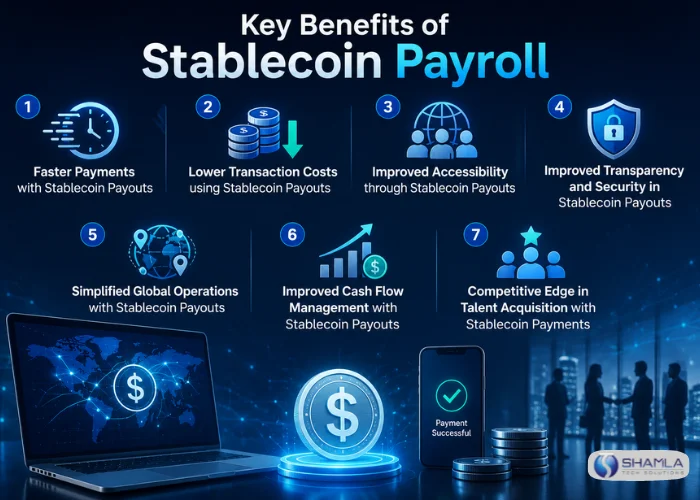
1. Faster Payments with Stablecoin Payouts
Stablecoin payouts provide near-instant cross-border payments regardless of time zone or bank holidays. Multiple intermediaries and clearing processes can delay traditional bank transfers for days.
Stablecoins enable real-time payments 24/7, benefiting organizations with global staff or suppliers. Blockchain technology reduces intermediaries, expediting transaction verification and recordkeeping. AI helps monitor and optimize settlement speed, although it is not the main cause.
Faster payments enhance cash flow forecasts, minimize the need for significant cash reserves in transit, and speed up reinvestment. As businesses develop globally, stablecoin payouts’ speed and cost advantages offer operational advantages over traditional payment options.
2. Lower Transaction Costs using Stablecoin Payouts
Payments with stablecoins are cheaper, especially internationally. By eliminating intermediaries and leveraging blockchain technology, they cut worldwide money transfer costs, allowing businesses control payments.
Savings can be big. Some e-commerce companies achieved 65% payment cost savings after integrating stablecoins. Traditional overseas transfers add conversion fees and middleman expenses, so these savings are greatest. Direct transfers are cheaper with stablecoins.
Stablecoins can transmit $200 from the US to Colombia for less than $0.01 and settle promptly, compared to $12 and several days via traditional methods. Settlement on blockchain networks is rapid, however fiat currency conversions can take time depending on liquidity and laws.
Benefits include:
- Direct transfers: Bank-free peer-to-peer transfers.
- No currency conversion expenses: One stablecoin eliminates currency exchange fees.
- Compliance: Blockchain’s transparency can simplify reporting, but regulations differ by jurisdiction.
Blockchain network congestion might raise transaction fees. Converting stablecoins to fiat may be risky and expensive.
Consider implementation costs like wallet setup and system integration. Long-term savings often outweigh initial investments for organizations with high transaction volumes or frequent cross-border payments.
As the stablecoin ecosystem evolves, costs are likely to fall, making them more attractive for optimizing payment processes and decreasing costs.
3. Improved Accessibility through Stablecoin Payouts
Globally, stablecoin payouts promote financial access. Stablecoins are more inclusive than banks with rigid standards and geographic boundaries. Stablecoins are used worldwide as a cheap, accessible means to save and spend money, although adoption and stability depend on the coin and local legislation.
So for businesses:
Pay freelancers and contractors worldwide without complicated financial arrangements.
- Low entry barriers: Anyone with the internet and a digital wallet can get stablecoins without banks.
- Impact in underserved areas: Stablecoins enable payments in areas with poor financial infrastructure, making operations easier.
- Global teams benefit from digital payouts, which streamline payroll and vendor payments.
However, issues persist:
- Local constraints and regulatory uncertainty may limit stablecoin use in some countries.
- Digital literacy, internet reliability, and wallet security affect adoption.
- Tax and anti-money laundering laws must be followed.
- Stablecoins help firms develop globally and simplify cross-border salary payments.
4. Improved Transparency and Security in Stablecoin Payouts
Traditional stablecoin rewards are less secure and transparent than blockchain payouts. Blockchain’s immutability makes every transaction permanent and traceable, enhancing tracking over traditional banking.
Benefits include:
- Improved security: Cryptographic protocols decrease fraud and unauthorized access, reducing financial loss.
- Real-time on-chain tracking: Improves reconciliation and accounting.
- In regulated businesses, public ledgers provide transparent transaction records for compliance and risk management.
- Instant auditability: Blockchain payroll settlement surfaces immediately, enabling ongoing monitoring and speedier irregularity discovery.
- Complete transparency: Stablecoin rewards eliminate transaction opacity across borders, unlike bank transactions.
- Privacy balance: Many stablecoins use public blockchains, but privacy features protect vital corporate data.
- Blockchain security depends on platform consensus processes, while GDPR requires cautious data handling.
5. Simplified Global Operations with Stablecoin Payouts
Stablecoin payouts reduce cross-border payment complexity by employing a single digital currency and conversions. Instead of managing various banking relationships, organizations can use one payment rail, improving payment processes.
Stablecoins open up markets without traditional banking to low-cost savings and spending. Some governments struggle with regulatory uncertainty and regional adoption and acceptance.
In addition to payments, stablecoins simplify treasury management by avoiding currency conversion and foreign exchange vulnerability. Stablecoin payouts may require investment and skill to integrate into treasury and accounting systems.
Stablecoin payouts will help simplify global business operations as regulations change.
6. Improved Cash Flow Management with Stablecoin Payouts
Stablecoins settle instant international payroll, enhancing liquidity and enabling just-in-time payments that decrease the need for huge cash reserves. Better capital allocation and strategic decisions come from faster access to finances.
Stablecoins eliminate money in transit and release operating capital caught up in typical cross-border transfers that take days to settle. They are available 24/7, making them ideal for multinational organizations and remote teams that need to process payments regardless of banking hours or holidays.
By tracking on-chain, you can enhance reconciliation and eliminate accounting errors, which in turn leads to more accurate cash flow forecasting and financial planning.
Programmable stablecoins and smart contracts automate conditional payments, recurring transactions and escrow arrangements, simplifying cash flow management. However, deploying smart contracts needs technical know-how.
If you change your stablecoins to fiat currencies, there may be some delays owing to liquidity or regulatory reasons. Network congestion and transaction fees can also impact speed and prices.
7. Competitive Edge in Talent Acquisition with Stablecoin Payments
With stablecoin payouts you can;
- Attract multinational talent without the hassle of cross-border banking
- Make it easier for employees to access their pay and improve their financial wellbeing
- Reduce payroll costs, allowing you to provide more competitive compensation packages
With digital assets becoming more mainstream, professionals across all industries are seeing the benefits of stablecoin payments – protection from local currency instability, greater access to global investments and involvement in the burgeoning decentralised finance ecosystem.
Offering stablecoin payments indicates you’re on top of changing trends in financial technology. This is especially appealing to millennials and Gen Z workers, who tend to seek out firms that are tech-savvy and adaptable.
Providing this payment option communicates to your company:
- At the leading edge of financial innovation
- Committed to flexible and effective payment solutions
- The digital era and the globalisation of work awareness
Stablecoin incentives can draw talent, but they should complement, not substitute, traditional payment mechanisms. This allows employees to choose what best suits their own needs.
The Future of Payments in Business
Stablecoin payouts reduce settlement time and fees, making them a perfect solution for international payments and worldwide payroll. They also enhance cash flow and operational flexibility.
Set-up takes planning and regulatory attention, but the benefits are worth the pain. And as technology and legislation change, stablecoins will be a must for competitive enterprises.
Stablecoin Payroll vs Traditional Payroll
Feature | Stablecoin Payroll | Traditional Payroll |
Payment Speed | Near-instant, available 24/7 | Typically 1–5 business days |
Cross-Border Payments | Fast and low-cost | Slower with higher banking fees |
Transaction Costs | Lower, especially for international transfers | Higher due to bank and intermediary charges |
Currency Stability | Pegged to fiat currencies, reducing volatility | Paid directly in local fiat currency |
Accessibility | Requires a crypto wallet and internet access | Requires a bank account |
Settlement Time | Minutes or seconds | Hours to several business days |
Payroll Availability | Can process payments anytime, including weekends | Limited to banking hours and holidays |
Transparency | Blockchain provides an immutable transaction record | Records maintained by payroll providers and banks |
Financial Inclusion | Enables payments to unbanked or underbanked workers | Limited for employees without banking access |
Compliance | Must comply with crypto regulations and tax laws | Well-established payroll and labor compliance frameworks |
Currency Conversion | Employees can convert to local currency if needed | No conversion required for domestic payroll |
Best Suited For | Global teams, freelancers, remote workers, Web3 companies | Domestic businesses with traditional banking systems |
From remote teams and international contractors to enterprise payroll operations, stablecoin payroll helps businesses streamline payments with greater speed, transparency, and compliance.
How Real Companies Are Using It in 2026
1. Protocol Labs: Paying Distributed Teams Worldwide
Protocol Labs uses stablecoin payroll to compensate its globally distributed workforce without establishing local payroll infrastructure in every country. Stablecoin payments simplify treasury management while enabling near-instant international settlements.
Key benefits:
- Faster international salary payments
- Lower banking and FX costs
- Simplified payroll operations across multiple countries
2. Web3 Companies and DAOs
Many blockchain startups, DAOs, and remote-first organizations now pay contributors and employees in USDC or USDT. This allows global teams to receive salaries quickly without relying on traditional banking systems.
Key benefits:
- Borderless payroll
- Instant on-chain settlements
- Flexible payment options for remote workers
3. Enterprises Using Hybrid Payroll Models
Large enterprises are increasingly adopting hybrid payroll, where employees can choose between traditional bank transfers and stablecoin payouts. This approach supports workforce flexibility while maintaining compliance with local tax and labor regulations.
Key benefits:
- Employee choice between fiat and stablecoins
- Easier global workforce management
- Seamless integration with existing payroll systems
4. Companies Operating in High-Inflation Markets
payroll to help workers receive USD-backed compensation, protecting purchasing power from rapid currency depreciation.
Key benefits:
- Preserves employee earnings
- Reduces foreign exchange losses
- Improves employee satisfaction and retention
Stablecoin Payroll Use Cases Across Industries
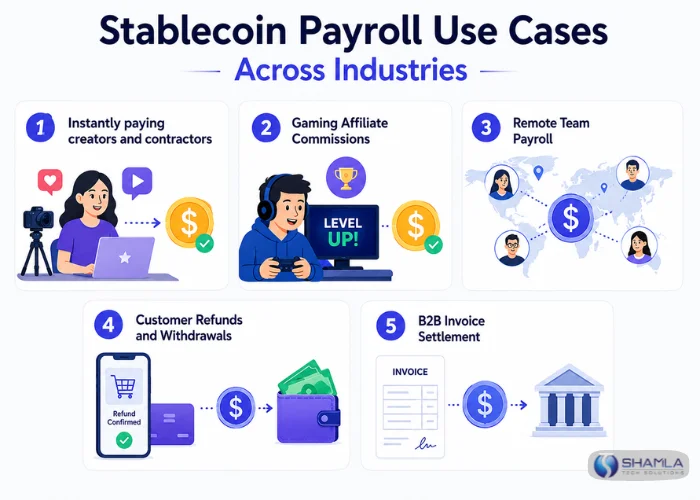
Instantly paying creators and contractors
Global businesses collaborate with creators and freelancers. Traditional payments weren’t designed for this. 3-7 business days for bank transfers. Payment systems may require $50-$100. International wire transfers cost $25–45.
These restrictions annoy everyone. Creators earning $30 per project wait weeks for payouts. Late payments cost 74% of freelancers 10-20% of their profits. Your best workers join platforms with better pay.
Stablecoins promptly fix this. Pay $10/$10,000. No minimums, waiting, or regional restrictions—creators get funds in minutes.
Gaming Affiliate Commissions
Gaming operators drive traffic and conversions with thousands of affiliates. These payments are overly complicated by traditional banking. Small weekly commissions below wire transfer minimums are typical for affiliates. When you submit payments, fees often exceed commission.
Thousands of monthly payments equal thousands of fees. In nations with high underbanked populations, affiliates may have trouble receiving international payments using regular payment rails.
Stablecoins simplify payouts with global reach, rapid transactions, and predictable value.
Remote Team Payroll
Building remote teams presents predictable payment challenges. Traditional payroll requires local or costly employer-of-record services. Clearing international bank transfers takes many business days. Currency exchange increases expense and complexity.
The administrative burden grows with team growth. Different nations demand different paperwork. Not all contractors can receive cables. People lose money to conversion expenses. More time is spent on payments than individuals.
Stablecoins simplify remote payroll. Fund your payment wallet monthly. Pay team members on time, anywhere. Team members get stable USD quickly.
Customer Refunds and Withdrawals
Your trading platform handles hundreds of withdrawals everyday. Customers demand fast refunds—45% want them in three days. However, bank transfers take longer. Unavailable card reimbursements can last a week. Everyone is frustrated by the disconnect.
Stablecoins eliminate waiting. Wallet addresses are entered upon registration. Get money in minutes by withdrawing. Smart contracts automate everything.
B2B Invoice Settlement
Standard invoices are Net 30, however 46% of Asian B2B credit sales are late. An invoice for $10,000 due in 30 days may arrive in 50. Meanwhile, suppliers want timely payment.
International trade increases currency risk and timing issues. A USD invoice is paid in euros weeks later. Exchange rates alter during delay. Settlement reduces $10,000.
Multiply by dozens of weekly transactions and losses mount.
Stablecoins solve both issues. Both sides settle in the USDC. Same-day invoice payment. No currency risk or fund wait. The invoiced and received amounts always match.
How Stablecoin Payroll Actually Works
Employee and contractor compensation is issued in stablecoins tied to a fiat currency, usually the U.S. dollar. Stablecoin payroll employs blockchain infrastructure instead of correspondent banking networks and clearinghouses. Funds can travel straight from an employer wallet to an employee wallet without intermediate financial intermediaries.
It starts with employer funding. A corporation gives its treasury or exchange partner fiat currency to create or buy stablecoins. After funding the company digital wallet, payroll software or smart contracts decide distribution amounts depending on employee contracts. A transaction is broadcast to the blockchain network after the pay period. The network approves the transaction and deposits stablecoins into employee wallets.
Digital compensation management is therefore up to employees.
They may store the digital assets in a self-custodial wallet, convert them to local fiat currency on a centralized exchange, or utilize them for DeFi payments. Organizations can automate distribution via smart contracts. Programmable payouts eliminate manual processing delays in HR and accounting operations by disbursing salaries at precise intervals.
Compliance & Regulation
Build vs Buy
What to Look for in a Stablecoin Payroll Solution
Challenges & Risks
How to Get Started
Here’s the simple explanation of how payroll solution operates with Shamlatech, one of the leading stablecoin payroll development solutions.
Implementing stablecoin payroll solutions in Shamlatech begins with evaluating your organization’s payroll requirements and identifying countries where employees can legally receive stablecoin payments. Next, choose a trusted payroll provider that offers regulatory compliance, secure wallet management, and seamless system integration. Define payroll policies, educate employees about wallet usage, and conduct pilot testing before full deployment. Integrate the platform with existing HR and accounting software to automate payroll operations. Regularly monitor regulatory updates and security practices to maintain compliance while optimizing global payroll efficiency through blockchain-powered payment infrastructure.