


Home » Real world Asset » Equity and Security Tokenization: What Enterprises Need to Know

Equity and Security Tokenization: What Enterprises Need to Know

Share this article:
Equity and Security Tokenization
Table of Contents
About the Author
Balaji
CEO of Shamla Tech, specializes in crypto exchange development, RWA tokenization, blockchain infrastructure, AI solutions, and compliance-ready platforms. He helps enterprises address regulatory, security, and scalability challenges while driving real-world adoption of emerging technologies across industries.
Connect On:

Enterprises around the globe are now reevaluating capital markets as RWA tokenization has started to influence how ownership and securities are being represented, traded, and settled. This serious shift is also challenging incumbents to rethink equity issuance and get new liquidity models while managing enterprise risk.

Market analysts project the global asset tokenization sector will exceed USD 3 trillion by 2026, growing rapidly as institutional adoption accelerates and regulatory clarity improves, reflecting heightened enterprise interest in programmable, compliant financial instruments.

This article explains key drivers behind equity and security tokenization, why traditional models are evolving, the essential technology stack enterprises need, and the legal and compliance considerations that decision-makers must understand.

Build Secure And Compliant Tokenization Platforms

Why Enterprises Are Turning to Equity and Security Tokenization in 2026


Enterprises are increasingly moving beyond pilot projects to full-scale tokenization initiatives as digital representation of equity and securities shifts from theoretical to commercially viable. Tokenization is now seen as a strategic lever for competitive differentiation and capital market modernization.

Here’s what’s driving the shift:

  • Unlocking Institutional Liquidity and Efficiency: Tokenization enables faster settlement and around-the-clock trading, reducing friction in cross-border capital flows and improving operational efficiency compared with legacy systems.

  • Strategic Asset Fractionalization: Enterprises can fractionalize traditionally illiquid assets, allowing diversified investor participation and creating new pools of capital beyond traditional institutional investors.

  • Meet Evolving Regulatory Frameworks: As frameworks mature globally, tokenized securities are gaining legitimacy, transforming regulatory uncertainty into actionable compliance pathways for enterprise issuance.

  • Competitive Pressure from Market Infrastructure Innovation: Major exchanges and financial institutions are developing tokenized trading platforms, signaling mainstream adoption and forcing enterprise reevaluation of legacy equity models.

  • Market Adoption & Institutional Participation: 63% of financial custodians already offer tokenized asset services, indicating that tokenization has moved beyond experimentation and is becoming embedded within core financial market infrastructure.

Why Traditional Equity Models Are Being Replaced by Tokenized Securities
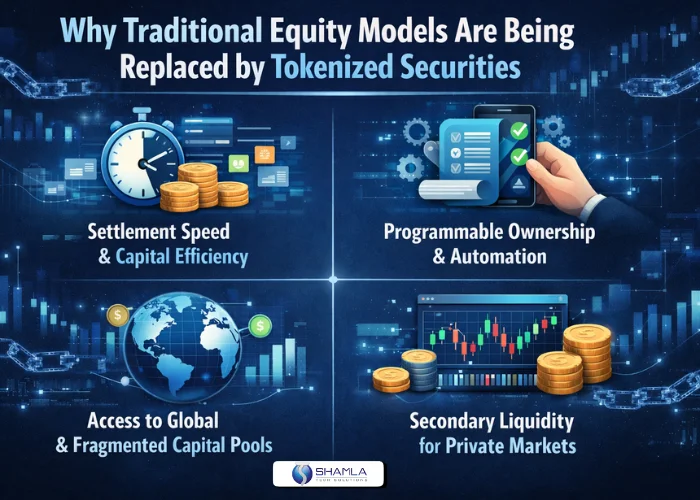
1. Settlement Speed and Capital Efficiency

Traditional equity issuance still depends on multiple intermediaries, clearing cycles, and manual reconciliation. This slows down capital deployment and increases operational costs. Tokenized securities reduce these layers by enabling near-instant settlement and automated recordkeeping. For enterprises, this directly improves cash flow visibility and frees capital that would otherwise remain locked in settlement cycles.

2. Programmable Ownership and Automation

Equity in traditional systems is static and administratively heavy. Corporate actions such as dividends, voting, and transfers require multiple service providers. Tokenized securities embed these rights directly into smart contracts, allowing automated compliance, dividend distribution, and governance execution. This reduces administrative burden while giving enterprises greater control and transparency over shareholder management.

3. Access to Global and Fragmented Capital Pools

Raising capital through conventional models often restricts participation due to jurisdictional and structural limitations. Tokenization enables fractional ownership and digital distribution, opening access to a broader, globally connected investor base. Enterprises can attract strategic capital from new regions without building complex cross-border financial infrastructure from scratch.

4. Secondary Liquidity for Private Markets

Private equity traditionally suffers from long lock-in periods and limited exit pathways. Tokenized securities introduce structured secondary trading mechanisms that enhance liquidity while maintaining compliance controls. For enterprises, this means improved investor confidence, stronger valuation discovery, and the ability to structure funding rounds with more flexibility than legacy private market frameworks allow.

Architecture & Tech Stack Required for Enterprise-Grade Tokenization Platforms

Layer

Core Requirement

Why It Matters

Blockchain Infrastructure

Scalable, secure, cost-predictable network

Supports high-volume issuance without performance or fee volatility risk

Issuance & Lifecycle Engine

Structuring, dividends, voting, redemptions

Ensures tokens function as real securities, not simple digital assets

Compliance & Identity Layer

KYC/AML, accreditation, transfer controls

Prevents non-compliant transactions at execution level

Custody & Wallet Security

Institutional custody, multi-approval controls

Meets audit, governance, and fiduciary standards

Integration & Liquidity Framework

ERP sync, reporting, secondary trading support

Aligns tokenization with enterprise systems and enables controlled liquidity

1. Multi-Layer Blockchain and Infrastructure Strategy
An enterprise tokenization platform must be built on infrastructure that supports scalability, privacy, and long-term interoperability. This includes choosing the right blockchain environment, ensuring cross-chain compatibility where needed, and designing for predictable transaction costs. The platform should support high-volume issuance and transfers without performance bottlenecks. Infrastructure decisions must align with institutional reliability standards, not short-term experimentation.
2. End-to-End Issuance and Lifecycle Management Engine
The platform must handle the full lifecycle of a security, from structuring and issuance to dividend distribution, voting, conversions, and redemptions. Enterprises need configurable deal templates that allow legal and finance teams to define rights and obligations without rewriting code. A strong lifecycle engine ensures tokenized securities behave like regulated financial instruments, not simple digital assets.
3. Embedded Compliance, Identity, and Transfer Controls
Enterprise-grade platforms must integrate identity verification, accreditation checks, jurisdiction screening, sanctions monitoring, and transfer restrictions directly into the transaction flow. Every token movement should automatically validate compliance requirements before execution. This reduces legal exposure and manual oversight. Compliance cannot sit outside the system; it must be architected into the platform logic itself.
4. Institutional Custody, Wallet Management, and Security Controls
Security architecture is critical. The platform should support regulated custodians, enterprise wallet infrastructure, multi-party approvals, and strict access controls. Treasury management features, key recovery processes, and role-based permissions are essential. Enterprises must demonstrate to auditors and investors that digital asset controls meet or exceed traditional financial security standards.
5. Enterprise Integration, Reporting, and Liquidity Enablement
A serious tokenization platform connects with ERP systems, cap table tools, accounting software, and regulatory reporting workflows. It should provide real-time ownership visibility, automated corporate actions, and audit-ready records. In addition, it must support compliant secondary trading integrations or structured liquidity mechanisms. Tokenization only creates value when it strengthens governance, transparency, and investor confidence.
Build Enterprise-Grade Equity Tokenization Infrastructure

Legal and Compliance Framework Required for Security Tokenization

Securities Law Classification and Regulatory Positioning
The first step in security tokenization is determining how the instrument is classified under securities laws. Whether in the United States, the European Union, Singapore, or the UAE, regulators focus on economic substance over technology. Enterprises must structure offerings to comply with private placement exemptions, prospectus requirements, or regulated market frameworks before any token is issued.
Cross-Border Offering and Investor Eligibility Controls
Tokenized securities are inherently global, but securities laws are not. Enterprises must define where the offering is legally permitted and restrict access accordingly. This includes accredited investor rules in the US, MiFID-based classifications in Europe, and regional suitability standards in Asia and the Middle East. Transfer restrictions must reflect jurisdictional boundaries to prevent regulatory breaches.
Ongoing Disclosure, Reporting, and Governance Obligations
Compliance does not end at issuance. Enterprises must meet continuous disclosure requirements, financial reporting standards, beneficial ownership monitoring, and corporate governance obligations. Tokenization does not replace statutory reporting; it must align with it. Platforms should support audit trails, voting transparency, and regulator-ready documentation to ensure digital issuance strengthens accountability rather than complicates oversight.
Custody, AML, and Market Integrity Safeguards
Security tokens remain subject to anti-money laundering, sanctions screening, and market abuse regulations. Enterprises must integrate KYC verification, transaction monitoring, and custody standards comparable to traditional financial instruments. Whether operating under SEC oversight, ESMA guidance, or regional financial authorities, maintaining investor protection and market integrity is essential for institutional credibility.

Final Thoughts

Equity and security tokenization introduces a new operating model for capital formation, where issuance, transfer restrictions, governance, and reporting are embedded directly into digital infrastructure. It demands clarity on regulatory positioning, technology architecture, custody standards, and cross-border considerations before any instrument reaches investors.

Understanding these fundamentals allows enterprises to evaluate tokenization aligned with existing legal structures and financial systems, which can enhance capital flexibility, improve transparency, and support broader investor participation without compromising regulatory integrity.

Partner with Shamla Tech to Launch Compliant Security Tokenization Platforms

Shamla Tech is an RWA tokenization platform development company specializing in enterprise-grade equity and security tokenization solutions. We design structured issuance frameworks, embed compliance directly into platform architecture, and integrate institutional custody and scalable blockchain infrastructure for regulated environments.

Our approach aligns legal structuring, technology deployment, and governance workflows from day one. We support enterprises across jurisdictions, ensuring platforms meet regulatory expectations while remaining flexible, secure, and capable of supporting long-term institutional participation.
Ready To Launch A Compliant Security Tokenization Platform?

FAQs

1. What is the difference between equity tokenization and security tokenization?

Equity tokenization refers specifically to digitizing company ownership, while security tokenization covers a broader range of regulated financial instruments, including equity, debt, funds, and hybrid structures, all issued and managed using blockchain-based infrastructure.

2. Are tokenized securities legally recognized across jurisdictions?

Yes, but recognition depends on compliance with local securities laws. Jurisdictions such as the United States, the European Union, Singapore, and the UAE permit tokenized securities when structured within existing regulatory frameworks and offering exemptions.

3. How does tokenization improve capital efficiency for enterprises?

Tokenization enables automated settlement, programmable ownership controls, streamlined corporate actions, and enhanced transparency. This reduces administrative overhead, improves investor management, and allows more efficient structuring of private placements and secondary liquidity mechanisms.

4. What compliance requirements apply to security token offerings?

Security token offerings must follow securities classification rules, investor accreditation standards, AML and KYC obligations, disclosure requirements, and transfer restrictions. Compliance must be embedded into both the legal structuring and platform architecture.

5. Can tokenized securities support secondary market trading?

Yes, when integrated with regulated trading venues or approved liquidity frameworks. Secondary transfers must enforce jurisdictional eligibility checks and regulatory controls to ensure that trading remains compliant with securities laws.

Talk to Our Experts

Recent Posts