
Home » Real world Asset » Building a Real Estate Tokenization Platform in 2026: Business Model & Tech Architecture

Building a Real Estate Tokenization Platform in 2026: Business Model & Tech Architecture

Share this article:
Building a Real Estate Tokenization Platform in 2026: Business Model & Tech Architecture
Table of Contents
About the Author
Balaji
CEO of Shamla Tech, specializes in crypto exchange development, RWA tokenization, blockchain infrastructure, AI solutions, and compliance-ready platforms. He helps enterprises address regulatory, security, and scalability challenges while driving real-world adoption of emerging technologies across industries.
Connect On:

Enterprise real estate portfolios are capital-heavy, jurisdiction-bound, and structurally illiquid, limiting balance sheet agility. Real estate tokenization platforms challenge this model by introducing divisible, programmable ownership that can unlock liquidity, streamline settlement, and expand global participation.

Industry research estimates the real estate tokenization market at approximately USD 3.7 billion in 2025, projected to reach USD 23.9 billion by 2035 with a 21% CAGR, reflecting accelerating institutional interest and infrastructure maturity.

This article explains the state of real estate tokenization in 2026, analyzes enterprise-grade business models, details the core technology stack required for deployment, and examines regulatory and risk frameworks shaping scalable platform strategies.

Ready to launch your Real Estate Tokenization Platform?

Why Real Estate Tokenization Is Gaining Institutional Momentum in 2026

Institutional investors are under pressure to improve liquidity, reduce operational drag, and modernize asset distribution without compromising compliance. Real estate tokenization addresses these priorities by restructuring how ownership, settlement, and investor access are engineered at the infrastructure level.

The momentum is being driven by tangible structural advantages:

  • Liquidity Engineering Without Asset Disposal

    Tokenization enables partial liquidity events without forcing full asset sales, allowing institutions to rebalance exposure while maintaining control over core holdings.

  • Balance Sheet Optimization Through Structured Vehicles

    By issuing tokens via SPVs or regulated entities, institutions can ring-fence risk, improve capital structuring flexibility, and optimize reporting transparency.

  • Growing Institutional Capital in Tokenized RWAs

    Reliable industry reports predict that tokenized assets could reach $16 trillion by 2030, representing a significant share of global financial assets.

  • Automated Compliance at the Protocol Layer

    Transfer restrictions, accreditation checks, and jurisdictional controls can be embedded directly into smart contracts, reducing manual oversight and post-issuance compliance complexity.

  • Faster Cross-Border Capital Formation

    Tokenized structures reduce reliance on traditional intermediaries, enabling more efficient international capital participation within regulated frameworks.

Business Models Behind Real Estate Tokenization Platforms

Business Model

Core Focus

Revenue Streams

Best Suited For

Asset-Backed Issuance

Tokenizing property via SPV

Issuance fees, structuring fees, servicing fees

Institutions digitizing high-value assets

Platform-as-a-Service

Tokenization infrastructure for third parties

Setup fees, licensing, transaction fees

Tech-first firms scaling without owning assets

Marketplace & Trading

Regulated trading of tokenized assets

Listing fees, trading commissions, spreads

Platforms focused on liquidity and recurring revenue

Integrated Asset Management

Tokenization plus property operations

Management fees, performance fees, admin charges

Enterprises seeking end-to-end control

Asset-Backed Issuance Model

In this model, the platform tokenizes a specific property through a legal structure like an SPV. Investors buy tokens representing economic rights to rental income or appreciation. The platform earns through issuance fees, structuring charges, and ongoing management fees. This model works well for institutions looking to digitize and distribute single high-value assets efficiently.

Platform-as-a-Service (White-Label Model)

Instead of holding property, the company provides the full tokenization stack to developers, real estate funds, and asset managers. Revenue comes from technology licensing, onboarding fees, compliance integrations, and transaction processing. The advantage is scalability—growth depends on client acquisition rather than deploying large amounts of capital into physical assets.

Marketplace and Secondary Trading Model

Some real estate tokenization platforms focus on building regulated marketplaces where tokenized real estate assets can be traded. They earn through listing fees, trading commissions, and spread margins. The real value here is liquidity. By enabling secondary transactions within compliance boundaries, the platform becomes a recurring revenue engine instead of a one-time issuance service.

Integrated Asset Management Model

In this structure, the platform combines token issuance with ongoing property management and reporting. It earns from management fees, performance incentives, and distribution servicing. Investors benefit from transparent reporting, automated payouts, and governance tools. This model suits enterprises that want end-to-end control across issuance, operations, and investor relations.

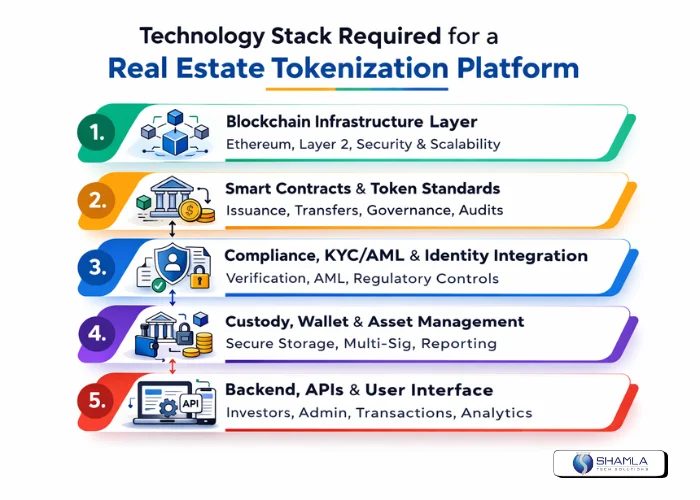
Technology Stack Required for a Real Estate Tokenization Platform
Building a Real Estate Tokenization Platform in 2026: Business Model & Tech Architecture

1. Blockchain Infrastructure Layer

The foundation starts with selecting the right blockchain, typically Ethereum or an EVM-compatible Layer 2 for scalability and lower transaction costs. The choice affects security, interoperability, and long-term sustainability. Institutions usually prefer networks with strong developer ecosystems and regulatory clarity. The blockchain layer ensures transparent ownership records, immutable transactions, and the base infrastructure required to issue and manage real estate tokens securely.

2. Smart Contracts & Token Standards

Smart contracts handle token issuance, ownership transfers, dividend distribution, and compliance restrictions. Security-focused token standards such as ERC-20 or more advanced permissioned standards are commonly used. Contracts must embed investor eligibility rules, transfer limitations, and governance logic. Independent audits are critical before deployment. This layer essentially replaces manual legal enforcement with programmable rules, reducing operational friction while maintaining control over asset movement

3. Compliance, KYC/AML & Identity Integration

Real estate tokens are often classified as securities, so identity verification is non-negotiable. The platform must integrate KYC, AML, accreditation checks, and jurisdiction-based restrictions directly into onboarding flows. APIs from identity providers connect investor data with smart contract permissions. This ensures only verified participants can transact. Automated compliance reduces administrative burden and strengthens trust with regulators and institutional investors.

4. Custody, Wallet & Asset Management Infrastructure

Secure storage of digital tokens is critical for institutional adoption. Platforms must integrate custodial wallets, multi-signature controls, and sometimes third-party regulated custodians. Key management policies, recovery mechanisms, and access controls must be enterprise-grade. On the asset side, systems should support automated income distribution, reporting dashboards, and cap table management to maintain transparency across the investor base.

5. Backend Architecture, APIs & User Interface

Beyond blockchain, a robust backend manages investor records, transaction history, reporting, and integrations with banking rails. RESTful APIs enable communication between frontend dashboards, compliance systems, and blockchain nodes. The user interface must be simple, secure, and intuitive for both administrators and investors. Performance, uptime, encryption standards, and data protection frameworks are essential to ensure reliability at an institutional scale

Build a Secure & Scalable Tokenization Infrastructure

Regulatory, Compliance, and Risk Management Framework

1. Jurisdiction Selection Based on Regulatory Clarity

Jurisdiction determines how your real estate token is classified and distributed. The United States treats most tokenized real estate as securities under SEC oversight, often using exemptions like Regulation D. The European Union operates under MiCA alongside local securities laws. Singapore and the UAE have clearer digital asset frameworks, making them popular for cross-border token issuance structures.

2. Securities Compliance and Offering Design

Tokenized real estate is usually classified as a security, which means the offering structure matters. Platforms must choose between private placements, accredited investor models, or regulated public offerings. Capital limits, resale restrictions, disclosure requirements, and marketing permissions must be defined upfront to avoid enforcement action after issuance.

3. Programmable Compliance and Transfer Controls

Compliance should be embedded directly into the token logic. Whitelisting verified wallets, enforcing holding periods, restricting cross-border transfers, and automating accreditation checks reduce manual oversight. Integrating KYC and AML systems with smart contracts ensures ongoing eligibility verification, not just a one-time onboarding check.

4. Risk Controls Across Custody and Operations

Beyond legal compliance, platforms must manage custody, governance, and operational risks. Multi-signature treasury management, regulated custodians, audited smart contracts, and clearly defined upgrade authority are critical. Regular financial reporting, reconciled cap tables, and transparent income distribution processes build long-term institutional trust.

Bottom Line

Real estate markets are entering a phase where infrastructure matters as much as assets. A well-structured real estate tokenization platform allows enterprises to design liquidity, automate compliance, and access global capital with greater precision and operational clarity.

Institutions that approach tokenization with clear legal structuring, disciplined technology architecture, and strong governance will shape the next phase of digital asset markets. The advantage will belong to those who build these real estate tokenization platforms early and execute with long-term strategic intent.

Build Scalable Real Estate Tokenization Platforms with Shamla Tech

Build scalable real estate tokenization platforms with Shamla Tech, engineered for enterprise performance, regulatory alignment, and long-term growth. From legal structuring support to blockchain architecture and compliance integration, our solutions are designed to meet institutional expectations without compromising security or scalability.

We deliver end-to-end development solutions that include smart contract engineering, KYC integration, custody infrastructure, and investor dashboards. Whether launching a new platform or upgrading existing systems, we help enterprises deploy secure, compliant, and future-ready real estate tokenization ecosystems.
Partner with Us to Build a Compliant Tokenization Platform

FAQs

1. What is a real estate tokenization platform?

A real estate tokenization platform is a digital infrastructure that converts property ownership or debt into blockchain-based security tokens. It manages issuance, compliance, investor onboarding, transaction processing, reporting, and secondary transfers within a regulated framework.

2. Is real estate tokenization legally compliant?

Yes, when structured correctly. Tokenized real estate is typically treated as a security, so platforms must comply with securities laws, investor accreditation rules, jurisdictional restrictions, and ongoing disclosure requirements in the regions where tokens are offered.

3. How does tokenization improve liquidity in real estate?

Tokenization enables fractional ownership and regulated secondary trading, allowing investors to transfer portions of their holdings without waiting for a full property sale. This improves capital flexibility while maintaining structured legal and compliance controls.

4. What technology is required to build a tokenization platform?

A real estate tokenization platform requires blockchain infrastructure, audited smart contracts, permissioned token standards, KYC and AML integrations, secure custody systems, backend APIs, investor dashboards, and strong cybersecurity architecture to support institutional-grade operations.

5. Who can invest in tokenized real estate assets?

Eligibility depends on jurisdiction and offering structure. Many platforms restrict participation to accredited or qualified investors, while some regulated environments allow broader access. Investor verification and compliance checks determine who can legally participate.

Talk to Our Experts

Recent Posts