
For decades, financial markets have operated within rigid boundaries: limited time trading windows, a multiple-day settlement cycle, and a network of intermediaries. While this infrastructure has supported global finance for generations, it was never designed for a digital-first economy. Asset tokenization Platform Development services are reshaping that infrastructure.
Recent data indicates that the total value of tokenized real-world assets on public blockchains has climbed to $23.6 billion, representing a 66% increase since the beginning of 2026. Much of this growth is driven by tokenized funds backed by treasury instruments, commodities such as gold, and tokenized equities.
More importantly, the momentum behind tokenization reflects a deeper shift toward always-on capital markets, where assets can be traded, settled, and transferred continuously on blockchain networks rather than within traditional market hours.
This guide evaluates the forces driving the rapid growth of real-world asset tokenization and the platforms enabling this new generation of digital financial markets.
Every stock, every bond, every fund- every asset can be tokenized. If they are, it will revolutionize investing.”
- Larry Fink, CEO of BlackRock
The Real Drivers Behind the $23.6B Tokenized Asset Market
The rise of tokenized real-world assets is often described as a blockchain trend. In reality, it reflects a broader structural change within global capital markets. According to data from DeFiLlama, the total value of tokenized assets has increased significantly in early 2026, reflecting growing institutional participation and broader investor interest.
Traditional financial infrastructure is increasingly misaligned with modern digital expectations. Institutional investors, fintech innovators, and asset managers are exploring tokenization because it addresses several long-standing inefficiencies:
- Delayed settlement cycles
- Limited trading hours
- Fragmented global market access
- Operational complexity caused by intermediaries
- Limited liquidity for alternative assets
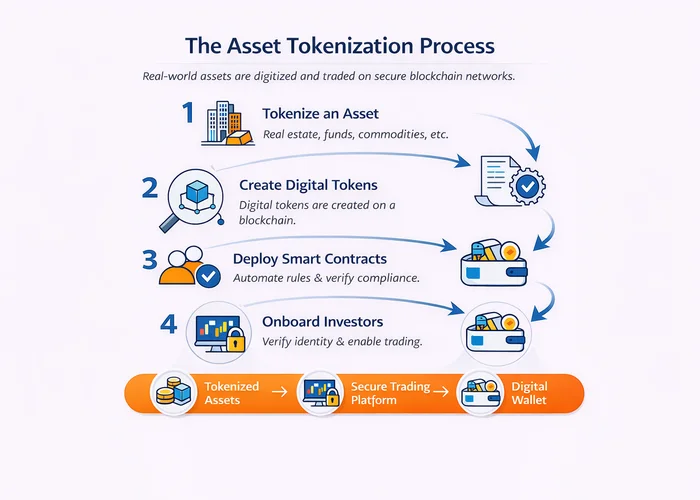
Tokenization replaces these constraints with programmable financial instruments issued on blockchain networks. The asset tokenization platform development enables organizations to convert ownership rights of real-world assets into blockchain-based tokens. These tokens represent fractional or full ownership of underlying assets while enabling programmable governance, compliance, and settlement. This is why the tokenized asset ecosystem is expanding across multiple sectors simultaneously.
Real World Tokenized Asset Market Breakdown
Asset Category | Market Value | Key Tokenization Drivers |
Tokenized Treasury Funds | $10.5B | On-chain yield products and institutional liquidity |
Tokenized Commodities | $6.5B | Digital ownership of physical assets like gold |
Tokenized Equities | ~$4B | Global investor accessibility |
Private Credit & Structured Products | Emerging | Alternative financing and yield generation |
Why 24/7 Markets Are Becoming the New Financial Standard
One of the most powerful advantages of blockchain-based financial infrastructure is continuous market access. Traditional exchanges operate within strict time zones. Once markets close, assets cannot be traded, transferred, or settled until the next trading session begins. Even then, settlement can take several days. Tokenized asset ecosystems operate differently.
On blockchain networks, financial instruments exist as digital tokens governed by smart contracts. These assets can move instantly between participants without waiting for clearinghouses or banking intermediaries. This capability introduces a new financial model often described as always-on capital markets.
Key characteristics of these markets include:
Continuous trading
Assets remain accessible to investors regardless of geographic location or trading hours.
Instant settlement
Transactions settle directly on blockchain networks rather than through multi-day clearing processes.
Fractional ownership
High-value assets can be divided into smaller digital units, expanding investor participation.
Programmable compliance
Regulatory rules can be encoded directly into smart contracts to automate investor verification and asset transfers.
These capabilities are driving increasing interest in tokenized asset platform development, particularly among organizations managing high-value real-world assets.
Asset Classes Leading the Tokenization Movement
Tokenized Government Bonds and Treasury Products
Tokenized Commodities
Tokenized Equities
Tokenized Private Credit
The Infrastructure Layer Powering Tokenized Finance
Blockchain Asset Issuance
Smart Contract-Based Ownership Management
Investor Onboarding and Compliance Verification
Token Lifecycle Management
Secondary Trading Mechanisms
Real-Time Asset Reporting
Modern asset tokenization platforms provide real-time reporting dashboards that track ownership structures, transactions, and asset performance on-chain, offering transparency and data visibility that traditional financial reporting systems often lack.
Organizations entering this market are increasingly prioritizing custom asset tokenization platform development rather than relying solely on third-party infrastructure.
Strategic Advantages of Proprietary Tokenization Platforms
Ownership of Digital Asset Infrastructure
New Capital Formation Models
Improved Liquidity
Automated Financial Operations
Smart contracts streamline dividend distribution, compliance checks, and ownership transfers.
For organizations managing real estate portfolios, commodity reserves, private funds, or financial instruments, these advantages are reshaping how capital formation occurs.
Takeaway
Beyond technological innovation, asset tokenization introduces new models for capital formation and asset management.
By digitizing ownership structures, tokenization platforms enable fractional investment opportunities that can significantly expand the pool of potential participants. High-value assets that were historically accessible only to institutional investors can be distributed more broadly through tokenized marketplaces. This approach can improve liquidity for traditionally illiquid assets such as private funds, infrastructure projects, or large commodity reserves.
Over time, these efficiencies could reshape how assets are issued, traded, and managed across global markets.
Partner with Shamla Tech to Build a Custom Tokenization Platform
As tokenized finance continues to gain momentum, organizations require reliable technology partners capable of building secure and scalable tokenization infrastructure. Shamla Tech provides end-to-end asset tokenization platform development services, enabling businesses to digitize real-world assets through blockchain-based systems designed for transparency, compliance, and scalability.
Our development solutions support:
- Real-world asset tokenization platforms
- Blockchain-based asset issuance frameworks
- Tokenized investment marketplaces
- Smart contract automation and compliance integration
- Investor onboarding and digital asset lifecycle management
With deep expertise in blockchain engineering and financial technology infrastructure, Shamla Tech helps organizations launch custom tokenization platforms
Call our expert today to schedule a free tech consultation and get a tokenization roadmap.