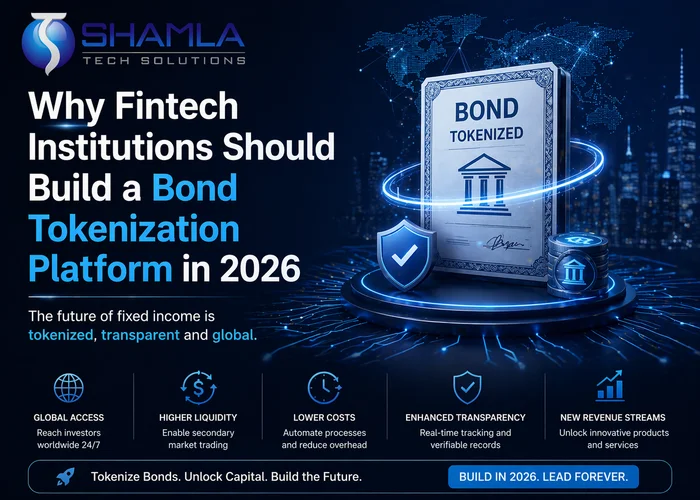

Bond tokenization is reshaping fixed income infrastructure by transforming traditional debt instruments into programmable digital assets that enable faster settlement, fractional ownership, and improved transparency across global capital markets and institutional investment ecosystems.
The global bond market is valued at approximately USD 127.36 trillion in 2026 and is projected to reach USD 167.52 trillion by 2031, driven by institutional demand and evolving digital settlement infrastructure.
In this article we will examine why fintech institutions should build a bond tokenization platform in 2026, explore market structure evolution, assess liquidity and access improvements, and outline how to partner with the right RWA platform development company.
Bond Tokenization Market in 2026
The bond tokenization market in 2026 represents an emerging institutional shift where fixed income instruments are increasingly digitized on blockchain rails, enabling programmable settlement, fractional ownership, and improved capital market efficiency at scale.
Key Market Indicators and Institutional Trends
- Global bond tokenization is gaining traction through pilot programs by major financial institutions such as JPMorgan, BlackRock, and European market infrastructure providers, focusing on issuance, settlement, and custody modernization.
- Regulatory clarity across major jurisdictions is improving, enabling financial institutions to experiment with tokenized debt instruments within compliant frameworks.
- Traditional bond market infrastructure is increasingly integrating distributed ledger systems to reduce post-trade settlement delays and operational inefficiencies.
- Industry projections suggest tokenized financial assets, including bonds, could scale into the multi-trillion-dollar range by 2030, depending on regulatory clarity and infrastructure maturity.
- Institutional demand for real-world asset (RWA) exposure is driving experimentation in tokenized fixed income products as part of broader portfolio diversification strategies.
How RWA Tokenization is Rapidly Disrupting Traditional Bond Markets
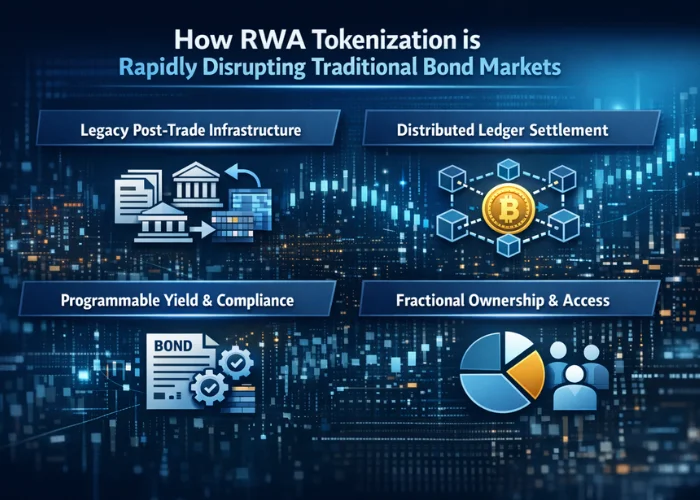
Legacy Post-Trade Infrastructure Is Increasing Capital Drag in Bond Markets
Distributed Ledger Settlement Is Reducing Counterparty and Liquidity Risk
Tokenized Fixed Income Is Enabling Programmable Yield and Compliance Layers
Fractionalization of Bonds Is Restructuring Global Investor Participation
High minimum investment thresholds and regional restrictions have historically limited bond market participation to institutions. Tokenization breaks these constraints by enabling fractional ownership and real-time transferability across jurisdictions. This expands the investor base to include smaller institutions and qualified retail segments. In this environment, the ability to build a bond tokenization platform becomes essential for enabling scalable issuance and continuous secondary market liquidity.
How Bond Tokenization Offers New Market Access and Liquidity
Global Bond Market Distribution Across Key Regions (2026)
Region | Estimated Market Size (USD Trillion) | Market Characteristics |
North America | 50–55T | Deep Treasury market, institutional dominance |
Europe | 35–40T | Sovereign issuance, ESG-linked bonds |
Asia-Pacific | 25–30T | High growth, mixed regulatory maturity |
Japan | 12–14T | Government bond heavy, low yield environment |
China | 20–25T | Controlled capital flows, large domestic issuance |
Rest of World | 5–10T | Emerging sovereign and corporate debt |
Fragmented Liquidity Across Global Bond Markets
Despite the scale of the market, liquidity remains segmented due to structural barriers that limit efficient capital movement across jurisdictions.
- Settlement systems vary significantly across regions (T+1, T+2, T+3 cycles)
- Custody and clearing infrastructure is not globally interoperable
- Regulatory frameworks restrict cross-border participation
- Currency conversion friction limits real-time capital movement
- Institutional access remains concentrated within domestic ecosystems
These constraints result in localized liquidity pools rather than a unified global fixed income market.
Expansion of Investor Access Through Tokenized Fixed Income
Tokenization introduces fractional ownership and programmable settlement infrastructure that significantly expands participation beyond traditional institutional investors.
- Enables fractional bond ownership for smaller institutions and qualified investors
- Reduces minimum ticket sizes for high-value sovereign and corporate bonds
- Improves cross-border accessibility through digital issuance rails
- Allows 24/7 transferability of fixed income instruments
- Supports integration with global investor networks without traditional intermediaries
This creates broader capital distribution across previously restricted bond markets.
Liquidity Transformation Through Unified Digital Settlement Rails
The introduction of tokenized infrastructure fundamentally alters how liquidity is formed and distributed across fixed income markets.
- Settlement cycles shift toward near real-time execution models
- Secondary trading becomes continuous rather than session-based
- Capital efficiency improves through instant settlement finality
- Market makers can access unified liquidity pools across geographies
- Collateral mobility increases across financial ecosystems
This results in deeper, more responsive liquidity structures across global bond markets.
Transform Your Fixed Income Infrastructure With Scalable Bond Tokenization Solutions
A Checklist for Choosing the Right RWA Platform Development Company to Build Your Bond Tokenization Platform
Checklist for Evaluating the Right RWA Development Partner for Bond Tokenization
- Institutional-Grade Blockchain Infrastructure Expertise
The partner must demonstrate strong capability in designing high-performance blockchain systems capable of supporting regulated financial instruments. This includes handling large transaction volumes, low-latency settlement, and fault-tolerant architecture suitable for institutional bond issuance and trading environments.
- Regulatory and Compliance Architecture Capability
A credible provider should be able to embed jurisdiction-specific compliance frameworks directly into the platform. This includes KYC, AML, investor accreditation, and securities law alignment across multiple geographies, ensuring the infrastructure remains compliant as issuance scales globally.
- Proven Experience in Real-World Asset Tokenization
It is essential to evaluate whether the company has actual production experience in tokenizing real-world assets such as debt instruments, funds, or structured products. The ability to design compliant financial token standards is critical for building a bond tokenization platform effectively.
- Secure Custody and Digital Asset Ownership Frameworks
The solution must include robust custody architecture that ensures secure storage, transfer, and verification of tokenized bonds. Institutional-grade key management, auditability, and clear legal ownership mapping are necessary to maintain trust in regulated financial environments.
- Interoperability With Banking and Capital Market Systems
A strong RWA platform should integrate seamlessly with existing financial infrastructure including banking APIs, payment networks, custodians, and clearing systems. This interoperability ensures smooth issuance, settlement, and secondary trading without disrupting established market workflows.
- Scalability for Institutional-Scale Bond Issuance and Trading
The architecture must be capable of scaling to handle large issuance programs and continuous secondary market activity. Performance consistency under high transaction loads is essential, particularly when dealing with sovereign bonds or large corporate debt programs.
- Long-Term Product Roadmap and Regulatory Adaptability
Beyond initial deployment, the partner should demonstrate a clear roadmap for continuous upgrades aligned with evolving regulatory frameworks and market standards. This ensures the platform remains relevant as tokenized fixed income markets mature globally.
Final Thoughts on Bond Tokenization for Fintech Institutions
Bond tokenization is positioning itself as a structural layer for modern fixed income markets, reshaping how issuance, ownership, and settlement operate across global capital systems. The shift reflects deeper changes in financial infrastructure design and institutional market architecture.
For fintech institutions, the opportunity lies in building foundational platforms that define next-generation bond markets rather than participating in incremental upgrades. The evolution of tokenized fixed income creates space for new infrastructure leaders in global debt ecosystems.
Partner with Shamla Tech to Build Your Bond Tokenization Platform
Shamla Tech is a bond tokenization platform development company, and we have worked with fintech businesses across global markets. We have built bond tokenization platforms designed to support issuance, settlement, and lifecycle management of tokenized fixed income assets at institutional scale.
At Shamla Tech, we combine blockchain engineering with financial infrastructure expertise to deliver compliant and scalable solutions. We have developed platforms that integrate custody, compliance, and settlement layers, helping fintech institutions modernize fixed income operations and accelerate adoption of tokenized bond markets globally.