

Key Takeaways
- There has been a rapid growth in the crypto prediction market, with trading volumes that crossed $44 billion back in 2025, and these platforms are gathering much interest from a number of Web3 startups and major financial institutions.
- To get started on how to build a crypto prediction market platform, first and foremost one needs to understand the right architecture in place. The smart contracts, Oracle integrations, liquidity mechanisms, and a scalable blockchain network form the heart of the platform.
- One reason platforms perform better comes down to which blockchain they pick. Ethereum or Polygon are generally chosen by many businesses; specifically, they have the fastest transaction speed with lower transaction costs, allowing them to process smart contracts smoothly.
- Many startups launch an MVP first to validate demand before scaling with advanced trading and governance features.
- The cost to build a crypto prediction market platform varies widely, from about $25,000 to $40,000 for an MVP to over $150,000 for a fully customized platform.
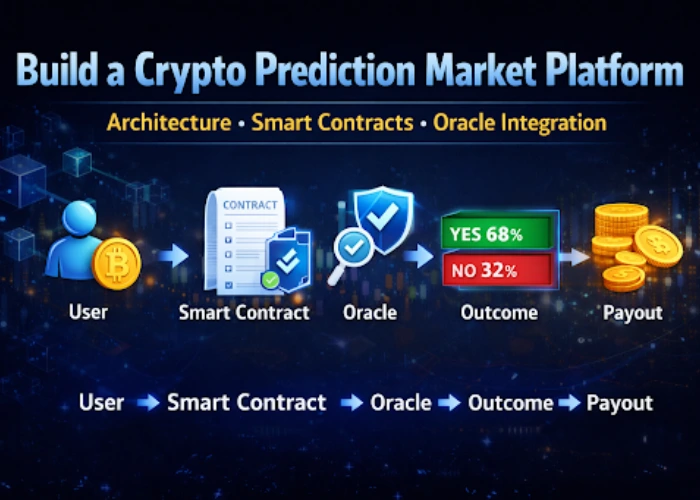
How to build a crypto prediction market platform solutions has become a major focus for Web3 entrepreneurs as decentralized forecasting platforms gain traction across finance and technology sectors. Utilizing blockchain technology, crypto prediction markets are changing the way people make predictions in real world events.
Platforms such as Polymarket and Kalshi help users to trade on outcomes through decentralized probability markets from elections and sports to financial indicators. Most entrepreneurs and Web3 startups are increasingly exploring how to build a crypto prediction market platform infrastructure.
The scale of growth in this sector has been remarkable. In 2025 alone, prediction market activity exceeded $44 billion, and 2026 began with a record single day trading volume of nearly $701.7 million, while weekly volumes crossed $5 billion, highlighting the rapidly expanding demand for event driven trading platforms.
Major exchanges are beginning to move into the space, with Cboe planning prediction market contracts that offer partial payouts, Nasdaq seeking SEC approval for prediction style options tied to stock indexes, and Intercontinental Exchange committing up to $2 billion in investment to the Polymarket. These developments suggest prediction markets are becoming mainstream finance. In this guide, you will learn how to build a crypto prediction market platform.
Build Your Prediction Market Platform
Looking for how to build a crypto prediction market platform? Our blockchain experts can help you design and develop a secure, scalable system tailored for Web3 trading ecosystems.
What Is a Crypto Prediction Market Platform?
A crypto prediction market platform allows users to trade on the probability of future events using blockchain technology. Participants buy or sell outcome shares based on their prediction, whether they believe an event will happen.
Understanding how to build a crypto prediction market platform systems begins with understanding the structure of decentralized probability markets.
Core characteristics of prediction markets
- Users trade event outcomes using tokens
- Market prices reflect crowd probability estimates
- Blockchain ensures transparency and trustless execution
- Smart contracts automate settlement
When learning how to build a crypto prediction market platform, developers must design a system where market pricing dynamically reflects collective intelligence rather than centralized odds.
How to Build a Crypto Prediction Market Platform
Building a crypto prediction market platform demands a systematic approach combining several topics, including blockchain engineering, smart contract design, liquidity architecture, and reliable data feeds. In order to actually and fully understand how to build a crypto prediction market platform infrastructure, the founders must develop an environment for users to create markets, trade markets with outcome shares, and receive automated payouts of hedge escrow money.
Step 1: Define the market scope and use cases
Before development begins, the first step in how to build a crypto prediction market platform architecture is defining what types of events your platform will support.
Key considerations include:
- Political events and elections
- Sports outcomes
- financial market predictions
- technology and product launches
- macroeconomic indicators
Defining the market scope early helps shape the event contracts, trading logic, and oracle requirements.
Important questions to answer:
- What types of events will users predict?
- Will markets be binary or multi outcome?
- Will users be able to create their own markets?
Decentralized prediction market development depends much on pre-planning.
Step 2: Choose the right blockchain infrastructure
The next critical step in how to build a crypto prediction market platform development is selecting the blockchain network that will host your smart contracts.
Prediction markets require networks that offer:
- low transaction fees
- high throughput for trading activity
- strong smart contract security
- reliable oracle compatibility
Popular choices include:
Blockchain | Key Advantage |
Ethereum | Mature ecosystem and strong security |
Polygon blockchain | Low gas fees and fast transaction speed |
Arbitrum | Layer 2 scalability for DeFi applications |
Many platforms use Polygon blockchain because prediction markets involve frequent trades and on-chain settlement, making low fees essential.
Choosing the best blockchain for prediction market development directly impacts platform scalability.
Step 3: Design the smart contract architecture
Smart contracts form the core infrastructure of a smart contract prediction market. They automate market creation, trading, liquidity management, and settlement.
Developers must design smart contracts that manage:
- market creation
- outcome token issuance
- trading logic
- liquidity pools
- payout distribution
In most DeFi prediction market platform systems, smart contracts also implement automated market maker models to allow continuous trading without centralized order books.
This step is where smart contracts for prediction markets explained concepts become critical for developers.
Security considerations include:
- contract auditing
- protection against manipulation
- oracle verification mechanisms
Step 4: Build the market creation engine
Prediction markets operate through structured market creation processes.
The platform must allow administrators or users to launch new prediction markets through predefined templates.
Typical market creation parameters include:
- event title and description
- possible outcomes
- market expiration time
- liquidity pool size
These parameters are stored within event contracts, which define the rules for each market.
This module is essential when designing how to build a crypto prediction market platform ecosystem that supports large numbers of markets.
Step 5: Implement the trading mechanism
Trading is the core activity within prediction markets.
Users buy outcome tokens that represent their prediction of an event result. Prices fluctuate depending on demand and market sentiment.
Modern blockchain prediction market platforms typically use:
- automated market maker models
- liquidity pool trading
- tokenized outcome shares
These systems are in place to ensure that at any time, traders can purchase and sell.
Platforms depend on liquidity providers, who deposit funds into pools, and receive a share of the trading fees to maintain liquidity.
Key trading components are:
- market price discovery
- liquidity pool balancing
- token minting and burning
These mechanisms allow markets to function as decentralized probability markets.
Step 6: Integrate oracle infrastructure
Prediction markets depend on real world event data to determine final outcomes.
This is where oracle systems become essential.
Developers must understand how to integrate oracle in prediction market architecture so that smart contracts receive verified external data.
One widely used provider is Chainlink oracle, which delivers reliable off chain data to blockchain applications.
Oracle workflow typically includes:
- Event occurs in the real world
- Oracle collects verified data from trusted sources
- Smart contracts receive the data
- Market enters the outcome resolution phase
Without reliable oracle infrastructure, prediction markets cannot settle correctly.
Step 7: Build the user interface and trading experience
Building the UI becomes imperative for even the most advanced blockchain platforms.
The UI should enable users for the following:
- browse available prediction markets
- analyze probabilities and price movements
- buy and sell outcome tokens
- track portfolio performance
Many modern platforms integrate wallet abstraction to simplify onboarding and allow users to interact with the platform without complex wallet management.
Key UI features include:
- real time probability charts
- market analytics
- trading history
- liquidity indicators
A strong interface significantly improves adoption when launching a DeFi prediction market platform.
Step 8: Implement governance and token incentives
Many prediction market platforms introduce token-based governance systems to decentralize control.
A governance token allows the community to participate in decisions such as:
- market approval policies
- platform fee adjustments
- treasury allocation
- protocol upgrades
Governance tokens also help incentivize early users and liquidity providers.
This token economy becomes an important part of long-term decentralized prediction market development.
Step 9: Security testing and smart contract audits
Security is one of the most critical stages in how to build a crypto prediction market platform infrastructure.
Prediction markets handle significant financial activity, so vulnerabilities can lead to major losses.
Security measures include:
- professional smart contract audits
- oracle data validation
- liquidity pool security testing
- stress testing trading infrastructure
Platforms that ignore these steps risk manipulation or exploit attacks.
Step 10: Launch and scale the platform
The platform launch and ecosystem expansion are the final phase after development and testing.
Successful platforms focus on:
- attracting liquidity providers
- launching high interest prediction markets
- building strong community participation
- expanding market categories
Growth strategies may include:
- incentive programs
- token rewards
- DAO governance participation
By thoroughly following some of these steps you can understand how to build a crypto prediction market platform solution, that is transparent, scalable, and decentralized forecasting ecosystems.
Create a Scalable crypto Prediction Platform
From smart contracts to oracle integrations, we help businesses build high-performance prediction markets ready for real-world trading.

How Much Does It Cost to Build a Crypto Prediction Market Platform?
Building a simple prediction market significantly as an MVP may cost between $20,000 and $40,000, whereas, a well-built and completely customized product including advanced liquidity mechanisms, oracle expansions and security auditing provides a platform that costs about $80,000 up to $180,000 and above. The cost to build a crypto prediction market platform varies depending on if one uses a clone script, a white-label solution or a completely customized approach.
Development cost by platform type
Development Type | Estimated Cost |
Clone Script / White-Label | $20,000 – $50,000+ |
MVP Platform | $40,000 – $80,000+ |
Custom Platform | $80,000 – $150,000+ |
Enterprise Platform | $150,000 – $300,000+ |
Many startup companies that are exploring how to build a crypto prediction market platform may start developing the platform using some readymade clone scripts or white-label approaches just to get the platform released as fast as possible without busying themselves with custom development.
Key development cost components
The total cost of how to build a crypto prediction market platform infrastructure depends on several technical components.
Development Component | Estimated Cost |
Smart contract development | $15,000 – $60,000+ |
Frontend trading interface | $7,000 – $30,000+ |
Backend infrastructure | $8,000 – $35,000+ |
Oracle integration | $5,000 – $20,000+ |
Security audits | $20,000 – $80,000+ |
Smart contract audits are one of the most important investments when understanding how to build a crypto prediction market platform.
Factors that influence development cost
Several technical and operational factors can significantly impact the final cost of how to build a crypto prediction market platform.
- Blockchain network selection
- Smart contract complexity
- Oracle integrations
- Liquidity architecture
- Security and audits
Typical development timeline
The timeline to implement how to build a crypto prediction market platform depends on platform complexity.
Platform Type | Development Timeline |
Clone Script Platform | 2 – 4 weeks |
MVP Prediction Market | 4 – 8 weeks |
Custom Platform | 2 – 3 months |
Enterprise Platform | 3 – 4 months or more |
Many Web3 startups start with an MVP, aiming to gauge the market’s potential and consequently, they move towards integrating more complex trading models, governance systems, and multi-chain support.
Companies that are earnest in contemplating how to build a crypto prediction market platform have quite a substantial part of funds to be spent on hiring experienced blockchain professionals, instituting secure smart contracts with proper auditing mechanisms to safeguard the platform’s scalability.
Ready to Enter the Prediction Market Industry?
The demand for decentralized prediction markets is growing fast. Build a secure and scalable platform that can capture this emerging opportunity.
How Does a Crypto Prediction Market Work?
A crypto prediction market works by allowing users to trade shares representing possible outcomes of future events. The price of each share reflects the market’s estimated probability of that outcome occurring. Understanding how does a crypto prediction market works is essential when planning how to build a crypto prediction market platform infrastructure because the trading logic, liquidity model, and settlement system must all operate through blockchain based smart contracts.
Core workflow of a crypto prediction market
Most platforms follow a structured lifecycle that governs how to build a crypto prediction market platforms, trades, and settlements.
- Market creation
The process begins when a new prediction market is launched on the platform.
Key steps include:
- Defining the event and possible outcomes
- Creating blockchain based event contracts
- Setting market parameters such as duration and liquidity pool size
- Publishing the market on a decentralized interface
Example market:
Event | Possible Outcomes |
Will Bitcoin reach $100,000 in 2026? | Yes / No |
Who will win the US 2028 elections? | Candidate 1 / Candidate 2 / Candidate 3 |
Such markets are often termed probability markets as the market prices typically capture the prevalent crowd view on the likelihood of each particular outcome.
This stage is a foundational component when designing how to build a crypto prediction market platform architecture.
- User participation and wallet connection
Users participate in prediction markets through crypto wallets.
Most blockchain prediction market platforms allow traders to connect wallets such as:
- MetaMask
- WalletConnect supported wallets
- Mobile Web3 wallets
Some modern platforms also implement wallet abstraction to simplify onboarding and allow users to trade without complex wallet management.
Typical onboarding steps:
- Connect wallet
- Deposit platform supported tokens
- Choose a prediction market
- Buy shares representing a specific outcome
The goal when planning how to build a crypto prediction market platform infrastructure is to make this process extremely simple so new users can participate quickly.
- Trading outcome shares
Once the market is live, traders buy and sell outcome tokens that represent predictions.
Each token represents a possible event outcome.
For example:
Outcome | Token Price | Implied Probability |
Yes | $0.70 | 70% |
No | $0.30 | 30% |
The pricing model often uses an automated market maker to dynamically adjust prices based on trading demand.
This mechanism ensures:
- Continuous liquidity
- Dynamic probability pricing
- Fair market discovery
In many DeFi prediction market platform architectures, the AMM pool is funded by liquidity providers who earn a portion of trading fees.
Understanding liquidity mechanics is essential when evaluating how to build a crypto prediction market platform trading infrastructure.
- Market price discovery
Prediction markets are powerful because prices aggregate collective intelligence.
The market price changes based on:
- new information entering the market
- trader sentiment
- trading volume
- liquidity pool size
- Example scenario:
If traders believe a certain candidate is likely to win an election, demand for that outcome token increases.
This pushes the token price higher and increases the implied probability.
Because every transaction occurs on blockchain, the process remains transparent and tamper resistant.
This price discovery process is what makes blockchain prediction market platforms valuable forecasting tools.
- Oracle data verification
Once the predicted event occurs, the platform must verify the outcome using an oracle.
An oracle connects blockchain systems to real world data sources.
A commonly used oracle provider is Chainlink oracle, which delivers trusted external data to smart contracts.
Typical oracle workflow:
- Event occurs in the real world
- Oracle retrieves verified data from trusted sources
- Smart contracts receive the verified result
- Platform triggers the outcome resolution process
Knowing how to integrate oracle in prediction market infrastructure is a critical technical step when developing how to build a crypto prediction market platform system
- Outcome resolution and settlement
After the oracle confirms the final result, the platform settles the market.
Settlement occurs automatically through smart contracts.
Key settlement steps include:
- verifying the final outcome
- identifying winning outcome tokens
- distributing rewards to token holders
- closing the prediction market
Because everything occurs through blockchain logic, payouts happen instantly through on-chain settlement.
Example payout scenario:
Outcome Token | Final Result | Reward |
Yes | Correct | $1 per token |
No | Incorrect | $0 |
This automated payout process is one of the main advantages of a smart contract prediction market.
- Governance and ecosystem incentives
Many modern platforms include governance systems that allow users to influence platform decisions.
These systems often use a governance token that grants:
- voting rights on protocol upgrades
- market creation approvals
- fee structure decisions
Governance helps decentralize platform control and is often included when designing decentralized prediction market development frameworks.
Simplified architecture of a crypto prediction market
Layer | Function |
User Interface | Trading interface for prediction markets |
Wallet Layer | User authentication and transaction signing |
Smart Contracts | Market creation, trading, settlement |
Oracle Network | Real world data verification |
Blockchain Infrastructure | Transparent transaction recording |
Selecting the best blockchain for prediction market development is also important. Many platforms deploy on Polygon blockchain because of low fees and high scalability.
Anyone exploring how to build a decentralized prediction market must understand each operational stage. Mastering these components is the foundation of how to build a crypto prediction market platform ecosystem that is scalable, secure, and capable of supporting high trading volumes.
Turn Your Web3 Idea into a Prediction Market
Have an idea for a decentralized prediction platform? Let’s turn it into a powerful blockchain product with smart contracts, liquidity systems, and secure architecture.
What Are the Types of Crypto Prediction Markets?
Crypto prediction markets can be structured in different formats depending on how event outcomes are defined and traded. Choosing the right market structure is important when designing how to build a crypto prediction market platform solution because it directly affects smart contract logic, liquidity distribution, and outcome settlement within a blockchain prediction market ecosystem.
Common types of crypto prediction markets
Most DeFi prediction market platform architectures support several core market types used in decentralized prediction market development.
Binary prediction markets
Binary markets are the simplest format and are widely used across prediction platforms. These markets have only two possible outcomes, and traders buy shares based on which outcome they believe will occur.
Key characteristics include:
- Simple market structure with two outcomes
- Easy pricing through probability markets
- Faster outcome resolution through smart contracts
- Popular in election, finance, and event predictions
Binary markets are often the starting point when planning how to build a crypto prediction market platform infrastructure.
Multiple outcome prediction markets
Multiple outcome markets allow several possible results instead of just two. Traders can buy outcome shares for any listed result, and prices reflect the market’s probability estimates.
Key features include:
- Multiple tradable outcomes
- Higher market complexity
- Requires balanced liquidity distribution
- Managed through event contracts in a smart contract prediction market
These markets are common in platforms that support advanced decentralized prediction market development.
Scalar prediction markets
Scalar markets allow users to predict values within a numerical range instead of choosing fixed outcomes. Smart contracts calculate payouts based on how close the prediction is to the final result.
Important elements include:
- Range based predictions
- Algorithmic payout models
- Advanced smart contracts for prediction markets explained logic
- Used in economic and financial forecasting
Scalar markets require more sophisticated contract design when planning how to build a crypto prediction market platform system.
Conditional prediction markets
Conditional markets activate only when a related event occurs. These markets allow layered predictions and deeper forecasting models.
Key characteristics include:
- Markets triggered by another event
- More complex trading structure
- Requires strong oracle verification
- Often implemented in advanced DeFi prediction market platform ecosystems
Understanding these market structures helps developers and founders design scalable platforms when exploring how to build a crypto prediction market platform and selecting the best blockchain for prediction market development.
Conclusion
How to build a crypto prediction market platform is one of the topics that the founders as well as innovators in Web3 space cannot fail to master, considering the large adoption of embracing decentralized forecasting platforms. Also, it is noteworthy that as the volume of transactions rises as well as the interest among institutions, there are many entrepreneurs who have engaged themselves in looking for how to build a crypto prediction market platform solutions that incorporate transparency, operations through smart contracts and settlements in an automated manner.
If you are looking for how to build a crypto prediction market platform, the first step is to decide what blockchain to use, from smart contract architecture to usability design and system security there is a lot to consider. A well-built platform can bring in active participants who trade, provides liquidity, and encourages the community to stick around.
Firms looking to enter the market must be proficient in how to build a crypto prediction market platform infrastructure, to launch a secure prediction market ecosystem in the evolving Web3 economy.
Build Your crypto Prediction Market Platform with Shamla Tech
At Shamla Tech, we work closely with startups, Web3 entrepreneurs, and enterprises that want to understand how to build a crypto prediction market platform solutions that are secure, scalable, and ready for real world adoption. Our team focuses on building practical blockchain products that combine strong smart contract architecture, reliable oracle integrations, and seamless user experience.
When businesses approach us to learn how to build a crypto prediction market platform, we help them move from concept to launch with a structured development approach. This includes platform architecture design, smart contract development, liquidity mechanisms, and prediction market infrastructure that supports high trading activity.
Our blockchain engineers and Web3 specialists understand the technical and operational challenges involved in how to build a crypto prediction market platform ecosystem. From market creation systems to trading engines and secure on-chain settlement, we develop platforms that are built for long term growth.
If you are planning how to build a crypto prediction market platform for your Web3 startup or enterprise project, our team can help you design, develop, and launch a reliable prediction market platform tailored to your business goals.
Bring Prediction Markets to Your Business
Prediction markets are becoming a powerful financial tool. Build a platform that allows users to trade on real-world events using blockchain technology.
FAQs
1. What Blockchain Should You Use for a Prediction Market?
Selecting the right blockchain is a critical step in how to build a crypto prediction market platform solution because prediction markets require frequent trading, fast settlement, and reliable smart contract execution.
Blockchain | Why It Is Used |
Ethereum | Mature ecosystem and strong security |
Polygon blockchain | Low fees and high transaction speed |
Arbitrum | Layer 2 scalability for DeFi applications |
Solana | High throughput for large trading volumes |
Selecting the right network is therefore a foundational step when designing how to build a crypto prediction market platform
2. What Are the Core Components of a Prediction Market Platform?
If you wish to learn how to build a crypto prediction market platform, focus on these components:
- Smart contracts for trading and settlement
- Event creation system
- Trading interface
- Liquidity pools
- Oracle integration for verifying outcomes
All these are key components of a prediction market platform.
3. How Do Smart Contracts Power Prediction Markets?
When it comes to exploring how to build a crypto prediction market platform and establish all the relevant factors, smart contracts automate the entire process.
- Create prediction markets
- Execute trades
- Manage liquidity pools
- Distribute payouts automatically
With the implementation of the above process, the system ensures transparency, and removes the centralized intermediaries.
4. What Features Must a Crypto Prediction Market Have?
When designing how to build a crypto prediction market platform, essential features include:
- Market creation tools
- Simple trading interface
- Liquidity pools
- Wallet integration
- Automated payouts
These features ensure smooth trading and reliable market settlement.
5. How to Launch a Prediction Market MVP?
An MVP is the fastest way to start how to build a crypto prediction market platform.
Typical MVP includes:
- Basic market creation
- Outcome share trading
- Smart contract settlement
- Wallet connection
This also allows the new ventures to test and validate the user needs before developing and scaling the platform.
6. How Do Prediction Market Platforms Make Money?
Revenue models used in how to build a crypto prediction market platform include:
- Trading fees on transactions
- Market creation fees
- Liquidity pool commissions
- Governance token incentives
All these models in one way or the other enhance platform operations as well as boost trading activity.
7. What Are the Biggest Risks in Building a Prediction Market?
While working on how to build a crypto prediction market platform, founders must consider key risks:
- Smart contract vulnerabilities
- Regulatory uncertainty
- Low liquidity
- Market manipulation
Security audits and preparation for regulations are appropriate measures to mitigate those challenges.
These challenges can only be dealt with by conducting security audits and ensuring compliance with regulations.
8. How Is Polymarket Built and What Can You Learn from It?
Polymarket is a well-known example of how to build a crypto prediction market platform.
Key elements include:
- Smart contract trading system
- Oracle-based outcome verification
- Liquidity pools for market activity
Studying its architecture helps understand real-world prediction market design.
9. What Is an Oracle in a Prediction Market?
An oracle supplies real-world data to blockchain smart contracts. When learning how to build a crypto prediction market platform, integrating reliable oracle systems ensures event results are verified and markets can settle automatically.
10. How Are Prediction Market Outcomes Determined?
In how to build a crypto prediction market platform, outcomes are determined through verified data sources.
Process:
- Event occurs
- Oracle verifies the result
- Smart contract confirms outcome
- Rewards are distributed automatically
This ensures fair and transparent settlement.