
Home » Stable Coin » Stablecoin Settlement for Tokenized Assets: Fiat Rails vs Stablecoins vs CBDC-Compatible Models

Stablecoin Settlement for Tokenized Assets: Fiat Rails vs Stablecoins vs CBDC-Compatible Models

Share this article:
stablecoin settlement for tokenized assets
Table of Contents
About the Author
Balaji
CEO of Shamla Tech, specializes in crypto exchange development, RWA tokenization, blockchain infrastructure, AI solutions, and compliance-ready platforms. He helps enterprises address regulatory, security, and scalability challenges while driving real-world adoption of emerging technologies across industries.
Connect On:

Tokenized assets are entering production environments, yet settlement design remains a gating factor for scale. Execution risk, capital lockup, and fragmented payment rails continue to constrain institutional deployment strategies and limit the efficiency gains tokenization is expected to deliver.

Stablecoin transaction volumes surpassed $30 trillion in 2025, with increasing allocation toward settlement, liquidity provisioning, and cross-border payment flows. Institutions are prioritizing integrated payment layers that enable continuous settlement, controlled access, and predictable capital movement across tokenized markets.

This article explains stablecoin settlement for tokenized assets through a decision lens. It outlines when to use fiat rails, stablecoins, or CBDC-compatible models, and defines the infrastructure required to implement secure, institution-grade settlement systems aligned with enterprise requirements.

Build Stablecoin Settlement Solutions For Tokenized Assets

Why Stablecoin Settlement Matters in 2026 for Tokenized Assets

Stablecoin settlement has become a core component of tokenized asset infrastructure. Institutions are aligning payment rails with liquidity access, balance sheet efficiency, and transaction-level control, treating settlement as a strategic layer within digital asset operations.

Key Strategic Drivers

  • Settlement latency directly impacts capital utilization in tokenized instruments, where delayed clearing restricts reinvestment cycles and reduces balance sheet velocity
  • Stablecoin transaction volumes are reported to reach up to $35 trillion annually as of 2026, reflecting institutional-scale throughput across settlement, liquidity provisioning, and on-chain financial flows
  • Continuous settlement capability enables synchronized asset transfer and payment execution, reducing reconciliation overhead and removing dependency on batch-based clearing systems
  • Cross-border tokenized transactions require a neutral settlement layer that operates independently of correspondent banking constraints and jurisdictional clearing windows
  • Treasury and liquidity models are being restructured around programmable money, enabling embedded controls, automated fund flows, and transaction-level risk management

Which Settlement Rail Should You Choose for Tokenized Assets? (Fiat vs Stablecoins vs CBDC Models)

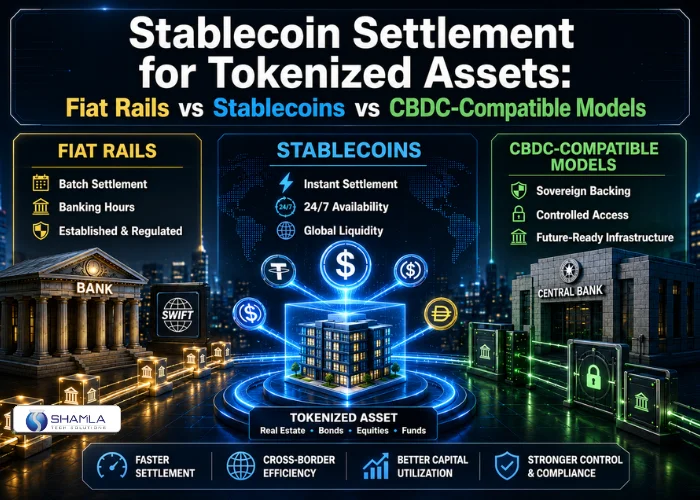
Selecting a settlement rail for tokenized assets is a structural decision that directly impacts execution, liquidity movement, and system design. Stablecoin settlement for tokenized assets is increasingly being evaluated alongside fiat and CBDC models based on operational efficiency and deployment readiness.

Criteria

Fiat Rails

Stablecoins

CBDC-Compatible Models

Speed

Batch-based

Instant

Conditional

Availability

Limited hours

24/7

Restricted access

Regulatory Position

Established

Maturing

Sovereign-backed

Liquidity

Deep (off-chain)

Growing (on-chain)

Limited

Integration

Complex

Native

Infrastructure-heavy

Fiat Rails for Tokenized Asset Payments

Fiat rails support payment for tokenized assets through established banking networks, providing regulatory certainty and deep liquidity. Payment execution follows clearing cycles and operating windows, creating timing gaps between asset transfer and settlement, which introduces friction in tokenized environments requiring continuous and synchronized payment flows.

Stablecoin Settlement for Tokenized Asset Payments

Stablecoin settlement for tokenized assets enables payment and asset transfer within a unified execution layer, delivering immediate finality and continuous liquidity movement. This structure aligns with how tokenized markets operate, allowing institutions to streamline payment flows, reduce reconciliation exposure, and execute transactions with greater precision and control.

CBDC-Compatible Models for Tokenized Asset Payments

CBDC-compatible models position payment for tokenized assets within sovereign-backed frameworks, supporting direct settlement in central bank money. Access remains limited and infrastructure is still being deployed across jurisdictions, placing current implementations within controlled environments rather than enabling broad, scalable payment execution across tokenized asset markets.

Choosing the Right Settlement Model for Tokenized Assets

Settlement model selection defines how efficiently tokenized assets move, settle, and scale within institutional systems. The decision is shaped by execution requirements, liquidity access, and regulatory alignment across operational environments.

How Institutions Are Structuring Settlement for Tokenized Assets

  • Stablecoins are being positioned as the primary execution layer for payment and settlement in tokenized asset environments, particularly where transactions require synchronized asset transfer and payment finality within a single infrastructure
  • Fiat rails continue to play a critical role in enabling fiat conversion, regulatory reporting, and integration with legacy financial systems, especially at onboarding and offboarding stages of tokenized asset transactions
  • CBDC-compatible models are being explored within controlled ecosystems, primarily for regulated settlement corridors where central bank-backed instruments are required for specific asset classes or institutional mandates
  • Hybrid settlement architectures are being actively implemented, allowing institutions to execute transactions via stablecoins while maintaining interoperability with fiat systems and preparing for future CBDC integration

Settlement Architecture in Practice

In production environments, settlement is increasingly structured around stablecoins to enable continuous execution and liquidity movement. Fiat rails are retained for system compatibility and regulatory alignment, while CBDC integration remains a forward-looking layer within evolving institutional settlement frameworks.

Launch Scalable Payment Rails For Tokenized Markets

Building Stablecoin Settlement for Tokenized Assets: What Actually Matters
Building Stablecoin Settlement for Tokenized Assets: What Actually Matters

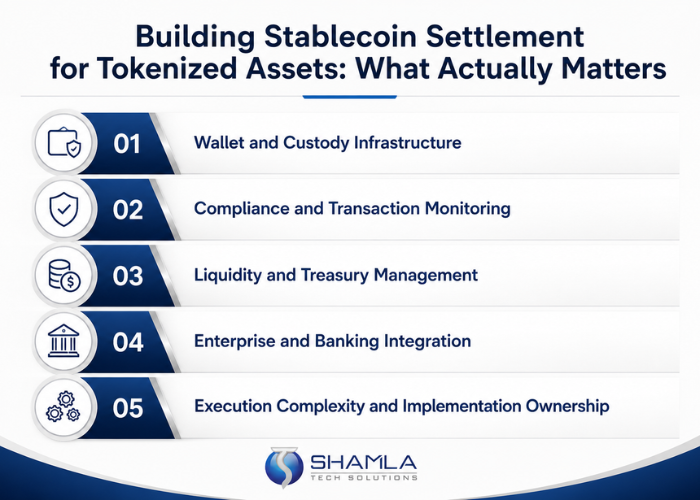
1. Wallet and Custody Infrastructure

Stablecoin settlement for tokenized assets requires a permissioned wallet architecture aligned with institutional control frameworks, not retail-grade access models. This includes role-based transaction authorization, policy-driven execution controls, and secure key orchestration across internal teams and external counterparties. Custody design must support asset segregation, programmable approvals, and audit-ready transaction trails that integrate directly into governance, risk, and compliance workflows.

2. Compliance and Transaction Monitoring

Payment infrastructure must embed compliance as an execution constraint rather than a post-transaction process. This involves real-time wallet screening, jurisdiction-aware rule enforcement, and continuous transaction monitoring across on-chain flows. Institutions require configurable compliance layers that adapt to regulatory requirements while maintaining settlement continuity, ensuring that payment execution does not introduce exposure to sanctioned entities, restricted jurisdictions, or reporting gaps.

3. Liquidity and Treasury Management

Stablecoin settlement introduces new treasury dynamics where liquidity must be actively positioned across wallets, chains, and counterparties. Institutions must manage funding cycles, conversion pathways between fiat and stablecoins, and exposure to issuers and liquidity providers. Effective treasury design ensures that payment obligations are met without delay while maintaining control over capital allocation, yield strategies, and counterparty risk across tokenized asset operations.

4. Enterprise and Banking Integration

Stablecoin settlement does not operate in isolation and must be embedded into existing financial infrastructure. This requires integration with banking systems for fiat access, ERP platforms for financial reporting, and custodians for asset servicing. Data synchronization, reconciliation logic, and reporting consistency are critical to ensure that on-chain settlement activity aligns with internal accounting systems and external financial disclosures.

5. Execution Complexity and Implementation Ownership

Deploying stablecoin settlement for tokenized assets involves coordinating multiple interdependent layers across infrastructure, compliance, treasury, and integration domains. Each layer must align with institutional policies, regulatory expectations, and operational workflows. Execution requires specialized capabilities spanning blockchain systems and financial infrastructure, leading most institutions to engage experienced partners for design, deployment, and ongoing system management.

Bottom Line

Settlement design is becoming a defining layer in tokenized asset infrastructure, shaping how capital moves, how risk is managed, and how institutions execute transactions. Stablecoin settlement for tokenized assets is emerging as the most practical and effective model, aligning payment execution with the speed and structure of tokenized markets.

Institutions advancing in this space are structuring settlement around stablecoins to enable continuous execution, efficient capital movement, and tighter operational control. This approach positions stablecoins as the core layer for scalable, institution-grade payment systems within tokenized asset ecosystems.

Build Stablecoin Settlement with Shamla Tech Solutions

Shamla Tech Solutions is a stablecoin development company delivering institutional-grade payment infrastructure for tokenized asset ecosystems. We have built stablecoin payment rails for RWA tokenization platforms across global jurisdictions, enabling compliant, scalable settlement aligned with enterprise requirements and cross-border operational demands.

Our capabilities cover wallet infrastructure, compliance integration, liquidity management, and enterprise system connectivity, ensuring seamless execution of stablecoin settlement for tokenized assets. We support end-to-end deployment, helping institutions design, implement, and scale payment systems that align with regulatory frameworks and operational objectives.


Enable Real Time Settlement For Digital Assets with Stablecoins

FAQs

What is stablecoin settlement for tokenized assets?
Stablecoin settlement for tokenized assets refers to using blockchain-based digital currencies to complete payment and asset transfer simultaneously. This enables synchronized execution, reduces reconciliation processes, and supports continuous settlement within tokenized financial systems across markets and jurisdictions.
Are stablecoins suitable for institutional tokenized asset settlement?
Stablecoins are increasingly used in institutional settlement due to their ability to support continuous transactions, programmable controls, and integration with blockchain infrastructure. Their suitability depends on regulatory alignment, issuer credibility, and the ability to integrate with compliance and treasury systems.
How do stablecoins compare to CBDCs for tokenized asset payments?
Stablecoins currently offer broader accessibility and integration flexibility compared to CBDCs, which remain limited to controlled environments. While CBDCs provide sovereign backing, stablecoins enable immediate deployment and scalability for tokenized asset payment use cases across jurisdictions and platforms.
What infrastructure is required for stablecoin settlement implementation?
Stablecoin settlement requires wallet and custody systems, compliance frameworks including KYC and AML controls, liquidity and treasury management, and integration with banking and enterprise systems. Each component must align to support secure, compliant, and scalable payment execution across tokenized asset workflows.
Can stablecoin settlement integrate with existing financial systems?
Stablecoin settlement can integrate with existing banking, ERP, and custodial systems through defined interfaces and reconciliation processes. This allows institutions to embed blockchain-based payment execution into current financial operations without disrupting reporting, compliance, or broader system-level financial management.

Talk to Our Experts

Recent Posts