


Real-world assets are entering digital markets with institutional intent. Tokenization defines how ownership, liquidity, and access are structured. The development partner shapes execution quality, regulatory alignment, and the credibility of the platform.
By 2026, tokenized real-world assets are expected to cross $2 trillion in on-chain value. Institutions require dedicated RWA platforms to meet compliance, control asset lifecycles, and integrate custody, trading, and reporting within a single operational framework.
In this article, we outline how to evaluate an RWA tokenization development company, the capabilities that matter, and a structured approach to selecting a partner aligned with your platform, regulatory obligations, and long-term operating model.
RWA Tokenization in 2026: What You Need to Know
Tokenization has shifted into institutional deployment. The focus is no longer on pilots but on asset origination, distribution, and lifecycle control. Platforms are being evaluated on execution, compliance alignment, and their ability to support real financial products at scale.
Key structural realities shaping RWA tokenization in 2026
- On-chain value of tokenized RWAs has crossed $25B–$27B in 2026, confirming institutional capital deployment across private credit, treasuries, and commodities
- Asset classes are consolidating around yield-bearing instruments such as private credit and government securities, where demand is driven by predictable returns and regulatory clarity
- Tokenization platforms are expected to manage the full asset lifecycle, including issuance, compliance enforcement, secondary trading, and reporting within a single system
- Liquidity is becoming a design problem, not a byproduct, requiring integrated trading venues, investor access controls, and structured market participation
- Interoperability and standardization are critical, with institutions prioritizing platforms that support cross-chain assets, compliant token standards, and seamless integration with existing financial infrastructure
Why Partner With an RWA Tokenization Development Company in 2026?
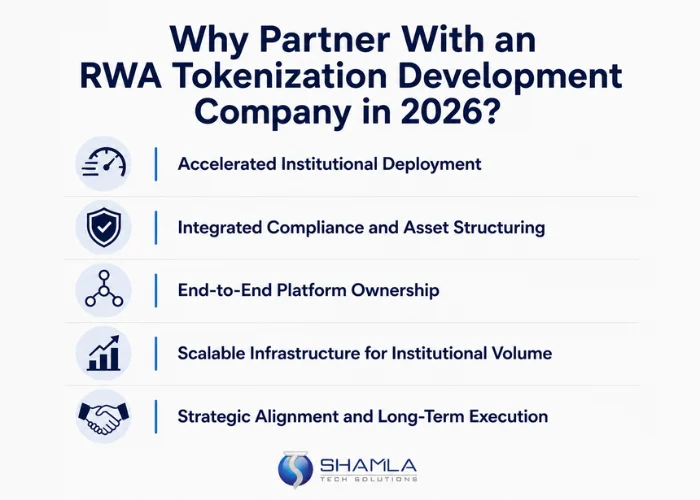
Accelerated Institutional Deployment
An experienced RWA tokenization development company enables faster transition from concept to live issuance by leveraging pre-built modules, tested architectures, and deployment frameworks. This reduces execution timelines, minimizes rework, and ensures your platform is structured to handle real asset flows rather than experimental or isolated blockchain implementations.
Integrated Compliance and Asset Structuring
RWA platforms operate within defined regulatory boundaries. A specialized partner embeds compliance logic directly into the system, including investor eligibility, jurisdictional restrictions, and asset structuring workflows. This approach ensures that legal, operational, and technical layers function as a unified system rather than disconnected compliance add-ons.
End-to-End Platform Ownership
Building an RWA platform requires coordination across token issuance, custody integration, trading mechanisms, and reporting systems. A dedicated development partner delivers a cohesive architecture where each component is designed to interoperate, eliminating dependency risks and ensuring operational control across the entire asset lifecycle.
Scalable Infrastructure for Institutional Volume
Institutional adoption requires platforms capable of handling large transaction volumes, complex asset classes, and multi-party interactions. Development partners design systems with scalability at the core, ensuring performance consistency, data integrity, and system resilience under real-world operational loads and expanding investor participation.
Strategic Alignment and Long-Term Execution
RWA tokenization is not a one-time deployment but an ongoing operational model. A strong partner aligns with your long-term roadmap, supporting upgrades, regulatory adaptations, and new asset integrations. This ensures your platform remains relevant, competitive, and capable of supporting adapting financial products and market requirements.
Must-Have Capabilities in an RWA Tokenization Development Partner
Core Capabilities of a RWA Tokenization Development Company
Capability | What It Means in Practice | Business Impact |
End-to-End Asset Lifecycle Management | Covers onboarding, token issuance, compliance, trading, and reporting in one system | Ensures full operational control and eliminates fragmentation |
Embedded Compliance Framework | KYC/AML, investor eligibility, and jurisdiction rules (SEC, VARA, MiCA, FINMA) enforced at system level | Reduces legal exposure and ensures transaction-level compliance |
Smart Contract Security and Auditing | Secure contract design, testing, and third-party audits | Protects asset integrity and prevents financial loss |
Scalable and Modular Architecture | Infrastructure designed for growth across assets and users | Supports long-term expansion without re-engineering |
Financial System Integrations | Connectivity with custodians, exchanges, and payment rails | Enables liquidity, settlement, and real-world usability |
End-to-End Asset Lifecycle Management
Embedded Compliance and Jurisdictional Framework
Smart Contract Security and Auditing
Scalable and Modular Architecture
Financial System Integrations
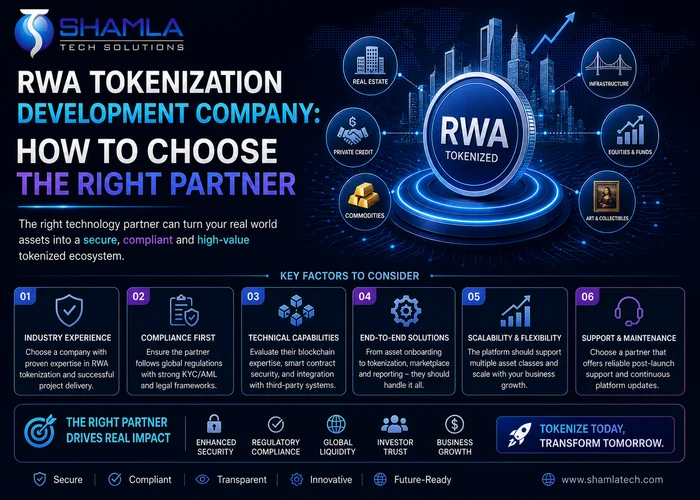
Checklist: How to Choose the Right Partner for Your RWA Tokenization Platform
- Validate proven experience in delivering RWA or regulated fintech platforms, with live deployments that demonstrate asset issuance, investor onboarding, and transaction flows operating reliably under real-world conditions and compliance requirements
- Assess the partner’s ability to design unified architecture covering issuance, compliance, trading, and reporting, ensuring no reliance on disconnected systems that introduce operational risk, inefficiencies, or data inconsistencies
- Evaluate how compliance is embedded within the platform, including automated enforcement of investor eligibility, jurisdictional restrictions, and transfer rules at the system level rather than external or manual processes
- Review smart contract development standards, including testing methodologies, audit history, and security practices to ensure contract logic is reliable, tamper-resistant, and capable of handling real financial assets without vulnerabilities
- Confirm scalability of infrastructure to support increasing asset volumes, investor participation, and transaction frequency without performance degradation or the need for architectural redesign as the platform grows
- Examine integration capabilities with custodians, payment rails, and trading venues to ensure seamless asset movement, settlement processes, and liquidity access within both blockchain ecosystems and traditional financial environments
- Analyze transparency in development processes, including documentation, communication structure, and delivery timelines, ensuring alignment between technical execution and business objectives throughout the engagement lifecycle
- Verify long-term support capabilities, including system upgrades, regulatory updates, and feature enhancements, ensuring the partner can sustain platform relevance and operational stability as market requirements and compliance standards evolve
Final Thoughts
Selecting an RWA tokenization development company defines how effectively your platform operates under regulatory scrutiny and institutional expectations. The right partner establishes control across asset lifecycles, embeds compliance into execution, and enables access to capital flows without operational fragmentation or dependency risks.
Execution quality determines platform credibility in tokenized markets. A capable partner aligns architecture, compliance, and integrations into a single operating model, allowing you to launch structured assets, scale participation, and sustain long-term market relevance with confidence and precision.
Partner With Shamla Tech Solutions to Build Your RWA Tokenization Platform
Shamla Tech Solutions is an RWA tokenization platform development company delivering institution-ready infrastructure for asset issuance, compliance enforcement, and lifecycle management. We design systems that align with regulatory frameworks, integrate financial infrastructure, and support scalable asset distribution across global markets.
Partner with us to build a platform that operates with precision, control, and long-term viability. From architecture to deployment and beyond, we ensure your RWA tokenization platform is structured for compliance, performance, and sustained market relevance.